Solar sector trends in India are reshaping how clean power develops. Solar is no longer limited to large ground-mounted power projects. Instead, storage, local manufacturing, and smarter procurement now influence industry growth.
India reached 162.15 GW of cumulative solar capacity by June 2026. Moreover, rooftop solar capacity crossed 30 GW during the same period. Therefore, businesses now have more flexible options for adopting renewable electricity.
This blog explores five trends driving India’s solar sector forward. These include solar-plus-storage, domestic manufacturing, and corporate open-access solar. In addition, high-efficiency modules and digital technologies are improving project performance.
What Are the Top Solar Trends in India?
India’s leading solar trends include solar-plus-storage, domestic manufacturing, and corporate open-access solar. Meanwhile, high-efficiency modules and digital technologies are improving project performance, energy reliability, and long-term business savings.
| Solar Trend | What Is Changing? | Main Business Impact |
| Solar-Plus-Storage | Solar projects increasingly integrate Battery Energy Storage Systems (BESS). | Better reliability, peak-load management, and renewable energy utilisation |
| Domestic Manufacturing | India is expanding domestic solar module and cell production. | Stronger supply chains, improved equipment availability, and easier policy compliance |
| Corporate Open Access | Businesses procure renewable electricity from off-site solar plants through the grid. | Lower energy costs without depending entirely on available rooftop space |
| High-Efficiency Modules | TOPCon, HJT, bifacial, and dual-glass technologies are gaining adoption. | Higher capacity and generation from limited project area |
| Digital Solar Operations | AI, drones, IoT sensors, and EMS platforms improve solar plant management. | Faster fault detection, predictive maintenance, and better performance control |
Together, these trends connect technology, manufacturing, energy procurement, and plant operations. However, their value differs for developers, investors, manufacturers, and electricity consumers. Therefore, businesses should evaluate each trend according to their energy demand, project location, budget, and operational requirements.
The International Energy Agency reported nearly 50 GW of solar capacity additions in India during 2025. This rapid expansion is increasing demand for battery storage, domestic manufacturing, advanced modules, and digital solar management across the country.
Trend 1: Solar-Plus-Storage Projects Are Expanding
Solar-plus-storage combines solar generation with a Battery Energy Storage System (BESS). The battery stores surplus electricity and supplies it when solar generation declines or electricity demand increases. This integration makes renewable energy more flexible and manageable.
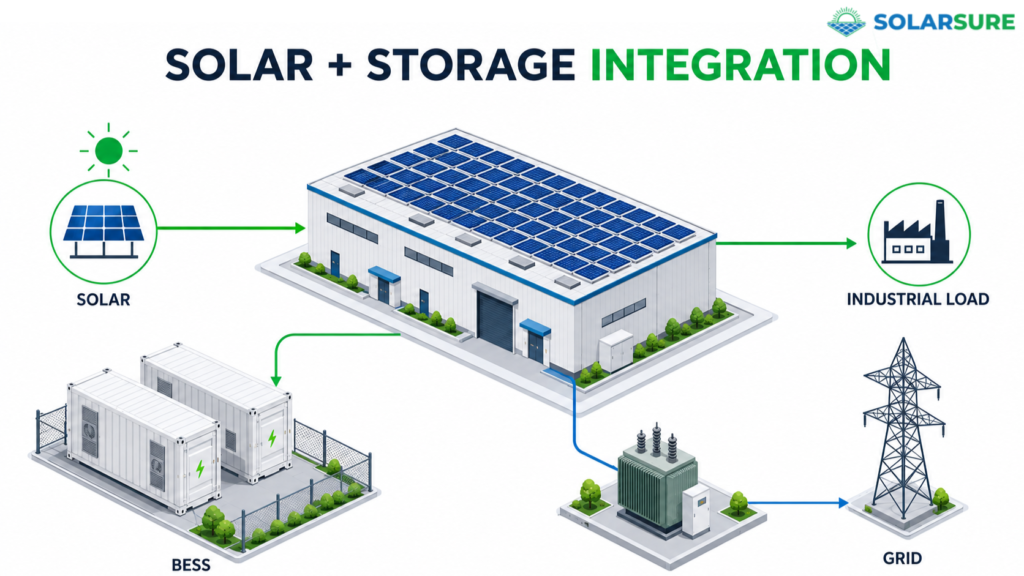
Solar generation varies according to sunlight, weather and time of day. However, commercial and industrial facilities require stable electricity throughout their operating hours. Battery storage can help manage the difference between solar generation and facility demand.
Why Is Solar-Plus-Storage Growing?
- Batteries store surplus solar electricity for use during later periods.
- Stored energy can reduce grid consumption during peak-demand hours.
- BESS can support critical loads during power interruptions when suitable backup controls and protection systems are included.
- Storage helps renewable projects provide scheduled and dispatchable electricity.
- Smart controllers coordinate solar, batteries, the grid and diesel generators.
However, battery capacity must match the facility’s actual load and intended use. An oversized BESS can increase project costs without delivering proportional financial benefits. Therefore, every storage project should begin with detailed load, tariff and operating-cycle analysis.
Real-World Solar-Plus-Storage Examples
Tata Power Solar commissioned a 100 MW solar project integrated with a 120 MWh BESS at Rajnandgaon in Chhattisgarh. The project uses bifacial monocrystalline modules and utility-scale battery storage, demonstrating large-scale solar and storage integration in India.
NTPC has also planned a 4 MW ground-mounted solar microgrid with battery storage at NETRA in Greater Noida. The battery is intended to support emergency night-time loads and smooth solar generation. A smart controller will prioritise solar, battery storage, the grid and other available power sources.
In March 2026, SECI issued a tender for 1,000 MW of firm and dispatchable round-the-clock renewable power. Such tenders create demand for renewable projects that can supply electricity according to scheduled requirements, increasing the importance of storage and hybrid configurations.
Key Challenge
Battery storage requires careful financial, safety and technical planning. Project costs depend on power capacity, discharge duration, battery chemistry, operating cycles and the intended application.
Cooling, fire protection, battery management, electrical protection and performance monitoring are also essential. Businesses should define whether the BESS will provide backup, peak-demand reduction or solar energy shifting before selecting its capacity.
🔋 Related Guide: Understand How Battery Energy Storage Improves Business Reliability
Trend 2: Domestic Solar Manufacturing Is Accelerating
India is rapidly expanding domestic solar module and cell manufacturing. Policies such as the PLI scheme, ALMM and Domestic Content Requirements are encouraging local production, integrated supply chains and greater equipment traceability.
India previously depended heavily on imported solar equipment and components. However, new manufacturing facilities are strengthening domestic module and cell production. This expansion also supports investment, employment and technology development within the country.
Policies Supporting Domestic Solar Manufacturing
- The PLI scheme supports high-efficiency and integrated solar manufacturing.
- ALMM identifies approved models and manufacturers of solar modules and cells.
- Domestic Content Requirements apply to selected government-supported solar projects.
- Quality-control standards encourage the use of tested and reliable equipment.
- Import duties and trade measures influence the cost of domestic and imported products.
The PLI scheme for high-efficiency solar PV modules has a total outlay of ₹24,000 crore across two tranches. Tranche II accounts for ₹19,500 crore and includes awards for 39.6 GW of fully or partially integrated manufacturing capacity.
Real-World Manufacturing Developments
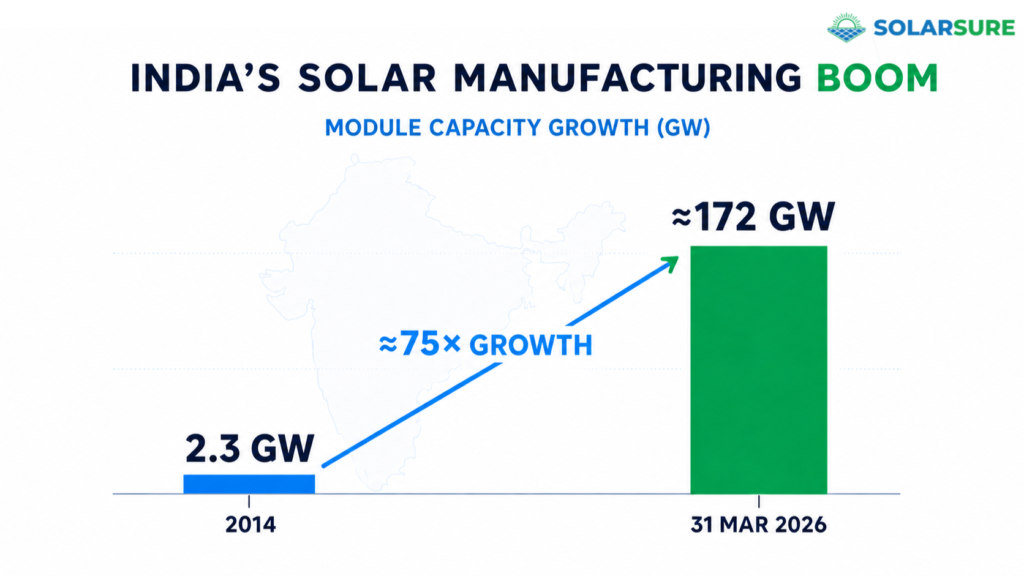
India’s solar module manufacturing capacity reached approximately 172 GW by 31 March 2026, compared with 2.3 GW in 2014. However, installed manufacturing capacity should not be confused with actual annual production or capacity utilisation.
During 2025, beneficiaries under the PLI scheme installed around 11 GW of solar module capacity and 5 GW of solar cell capacity. This development shows that domestic manufacturing is gradually moving beyond module assembly towards deeper supply-chain integration.
MNRE also continues to update its ALMM lists for approved solar modules and cells. List I covers solar PV modules, while List II covers solar PV cells. Developers must verify the latest lists, project eligibility, procurement dates and commissioning-related conditions before placing equipment orders.
How Do Businesses Benefit?
Domestic manufacturing can improve equipment availability and reduce exposure to long international supply chains. Local service networks may also simplify warranty coordination, technical support and component replacement.
Moreover, businesses gain access to a wider range of domestically manufactured products that may meet the compliance requirements of regulated solar projects. However, procurement teams must still compare technical quality, certifications, warranties and long-term performance.
Key Challenge
India’s module manufacturing capacity is expanding faster than several upstream stages. Domestic capacity for cells, wafers, ingots, polysilicon and specialised materials still needs further development.
Manufacturers must also maintain consistent quality while competing in a price-sensitive market. Therefore, higher domestic capacity alone does not guarantee reliable equipment or complete supply-chain independence.
🏭 Industry Update: Review MNRE’s Latest ALMM Lists and Clarifications
Trend 3: Corporate Open-Access Solar Is Growing
Open-access solar allows businesses to purchase renewable electricity from an off-site solar plant through the grid. It enables companies to adopt solar at a larger scale without depending entirely on available rooftop space.
Energy-intensive businesses may have limited rooftop area, high electricity demand or multiple operating locations. As a result, onsite solar may meet only a portion of their total energy requirements.
Open-access solar helps such businesses procure larger volumes of renewable electricity through long-term Power Purchase Agreements (PPAs). These agreements can reduce exposure to rising grid tariffs and provide greater visibility over long-term electricity costs.
How Do Corporate Solar Procurement Models Compare?
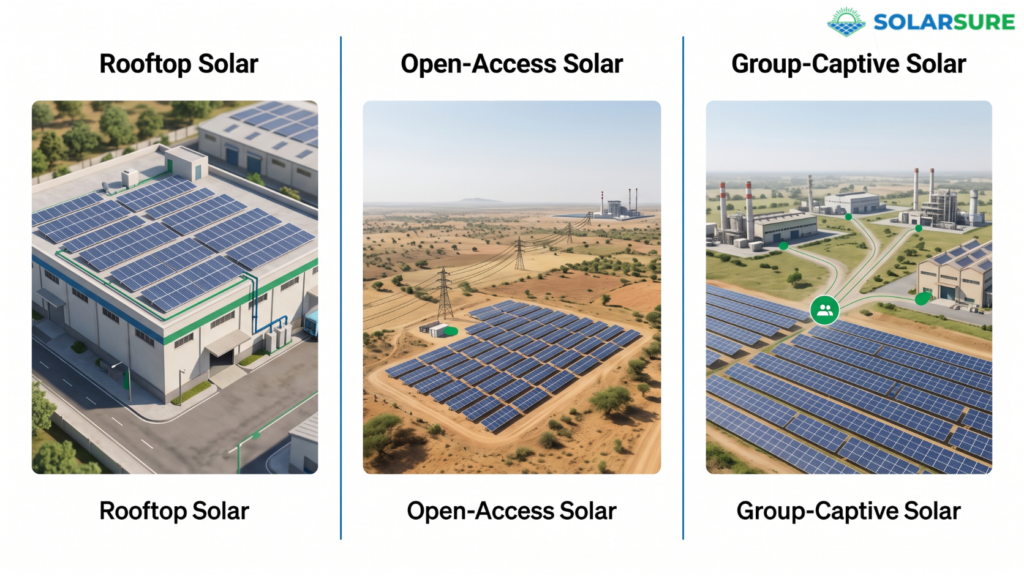
Businesses can adopt solar through onsite ownership, third-party power purchase agreements, or group-captive projects. The right option depends on available space, electricity demand, investment capacity, state regulations, and long-term energy goals.
| Procurement Model | Project Location | Business Investment | Best Suited For |
| Rooftop CAPEX | Consumer’s premises | Business funds and owns the solar plant | Businesses with suitable rooftop space seeking long-term asset ownership |
| Third-Party Open Access | Off-site solar plant | Usually no direct project equity; electricity is purchased through a PPA | Businesses seeking renewable electricity without significant upfront investment |
| Group Captive | Off-site captive renewable energy project | Consumer contributes the required project equity | Large electricity consumers seeking long-term savings and greater tariff visibility |
| Grid Electricity | Supplied through the utility network | No solar project investment | Consumers relying on conventional utility electricity |
Open-access feasibility depends on state regulations, electricity consumption, and applicable charges. Wheeling, transmission, banking, cross-subsidy, and additional surcharges can significantly affect the final savings.
Therefore, businesses should compare the complete landed cost of electricity instead of considering only the quoted PPA tariff. A detailed load and regulatory analysis is essential before finalising a third-party or group-captive arrangement.
Real-World Corporate Examples
Bangalore International Airport Limited began its partnership with CleanMax through a 0.5 MWp rooftop solar plant in 2016. It later signed a 13 MWp open-access solar agreement in 2018. In 2023, the partnership expanded under a group-captive model with 36 MWp of solar and 9.9 MW of wind capacity.
Equinix partnered with CleanMax to develop 33 MW of captive renewable capacity in Maharashtra, comprising 26.4 MWp of solar and 6.6 MW of wind. The group-captive solar component was commissioned in November 2025 to support the company’s data centres in Mumbai.
Serentica Renewables also signed a long-term captive PPA with MRF Limited. Under the agreement, Serentica is developing a 170 MW wind-solar hybrid project to supply renewable electricity to MRF’s manufacturing facilities through the inter-state transmission network.
These examples show how airports, data centres and manufacturing businesses are combining solar, wind and group-captive procurement to meet larger electricity requirements.
Why Does This Trend Matter?
CRISIL Ratings expects India’s commercial and industrial renewable energy capacity to reach 57 GW by fiscal 2028, compared with approximately 40 GW expected by the end of fiscal 2026.
Favourable long-term PPA tariffs, corporate net-zero targets and renewable energy obligations are supporting this growth. However, continued policy stability and timely transmission expansion will remain important.
Key Challenge
Open-access projects involve state-specific approvals, scheduling requirements, contracts and electricity charges. Wheeling, transmission, banking, cross-subsidy and additional surcharges can significantly influence actual project savings.
Therefore, businesses should compare the complete landed cost of renewable electricity instead of relying only on the quoted PPA tariff. They should also evaluate regulatory risks and possible tariff changes before signing a long-term agreement.
⚡ Practical Guide: Understand Open-Access Solar, Approvals, Charges and Benefits
Trend 4: High-Efficiency Solar Modules Are Advancing
Indian solar projects are increasingly adopting N-type TOPCon, HJT and bifacial modules. These technologies can install more capacity and generate more electricity within limited rooftop or land area. However, their performance still depends on product quality, engineering, climate and installation conditions.
Earlier, module comparisons focused mainly on wattage and purchase price. Businesses now evaluate efficiency, degradation, temperature coefficient, bifaciality, warranty terms and expected energy yield.
A higher specification does not automatically guarantee better project performance. Therefore, module selection should consider complete plant design and long-term generation rather than individual product claims.
How Do Emerging Solar Module Technologies Compare?
Modern solar modules differ in cell technology, construction, efficiency and installation requirements. Features such as bifacial design and dual-glass construction can also be combined with TOPCon or HJT cells, so these categories are not always mutually exclusive.
| Module Technology | Main Advantage | Important Consideration |
| N-Type TOPCon | High efficiency, lower degradation, and strong long-term energy yield | Performance, warranties, and manufacturing quality vary between brands |
| HJT | Strong temperature performance, high efficiency, and excellent bifacial potential | Higher manufacturing costs may result in a higher module price |
| Bifacial Modules | Generate electricity from both front and rear surfaces | Additional generation depends on mounting height, spacing, shading, and ground reflectivity |
| Larger-Format Modules | Higher wattage can reduce the number of modules required | Larger dimensions and weight affect transportation, handling, mounting structures, and rooftop access |
| Dual-Glass Modules | Improved protection against moisture, corrosion, and environmental stress | Additional weight requires careful structural and installation planning |
Higher module wattage does not necessarily mean higher efficiency. A physically larger panel may produce more electricity while occupying proportionally more space.
Therefore, businesses should compare module efficiency, dimensions, degradation, temperature performance, warranties, structural requirements, and expected energy yield. The final selection should depend on complete project engineering rather than wattage alone.
Real-World Technology Examples
Waaree secured a 132.5 MWp order for N-type TOPCon modules during 2025. The order demonstrates commercial demand for high-performance N-type technology. Moreover, similar modules now serve utility and commercial solar applications.
Meanwhile, Vikram Solar offers N-type bifacial modules with efficiencies exceeding 23% across selected product configurations. Such modules can increase capacity within space-constrained industrial projects. However, actual output still depends on complete plant engineering.
Adani Solar also expanded TOPCon cell and integrated manufacturing at Mundra. Its TOPCon production line became operational during March 2024. Consequently, advanced N-type technology is becoming increasingly available from Indian manufacturers.
Why Businesses Are Interested
Higher efficiency can increase installed capacity within limited rooftops or land. In addition, improved temperature performance may support generation during hot conditions. Lower degradation can also protect long-term energy production.
Key Challenge
Advanced technology cannot compensate for poor engineering or installation. Therefore, businesses should verify certifications, degradation warranties, and independent testing results. They must also assess structural loads, inverter compatibility, and replacement availability.
Trend 5: Digital Technologies Are Transforming Solar Operations
AI, sensors, drones, and digital platforms improve solar management. These tools detect faults, forecast generation, and organise maintenance activities. Therefore, solar plants can operate with greater visibility and faster responses.
Traditional maintenance often depends upon fixed schedules and manual inspections. However, large solar portfolios generate extensive performance and equipment data. Digital tools convert this information into practical operating decisions.
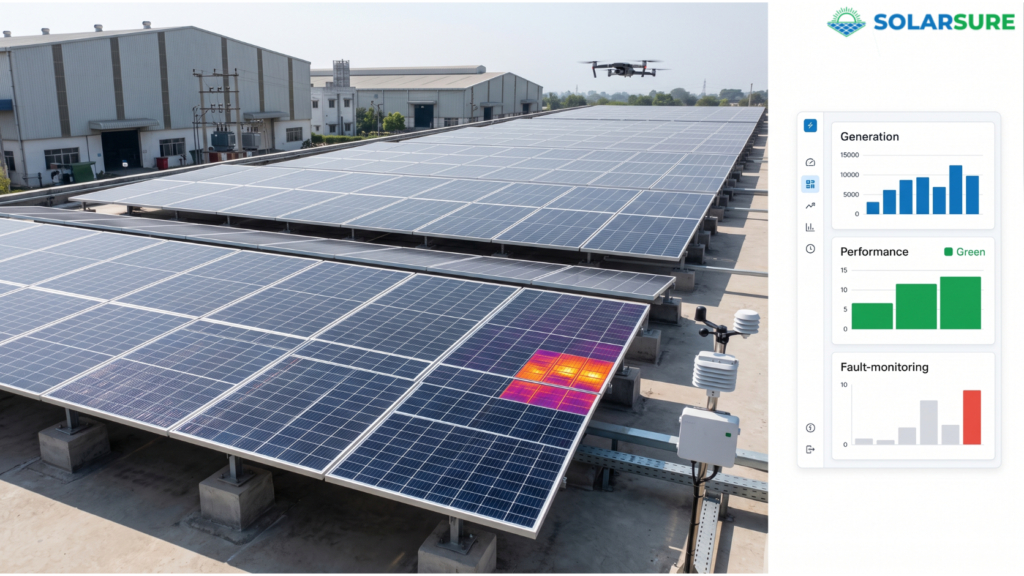
Important Digital Solar Technologies
- Artificial Intelligence: Identifies unusual patterns and predicts potential equipment faults.
- Energy Management Systems: Balance solar, storage, grids, and facility consumption.
- Drones: Inspect large project areas using visual and thermal cameras.
- Digital Twins: Create virtual equipment maps for tracking performance and defects.
- IoT Sensors: Measure temperature, irradiance, voltage, current, and environmental conditions.
- Automated Workflows: Convert alarms into assigned maintenance activities and reports.
Moreover, digital monitoring helps compare multiple plants using standard performance indicators. It also allows teams to prioritise faults according to generation impact. Consequently, businesses can reduce unnecessary site visits and delayed repairs.
Real-World Digital Solar Examples
ReNew introduced robotic cleaning across 44 solar sites during FY 2024–25. The company reported substantial water savings from these automated cleaning deployments. Moreover, its digital tools support predictive monitoring and performance optimisation.
Meanwhile, IIT Jodhpur is developing an AI-driven digital twin for solar plants. The research project runs from 2024 through 2026. It focuses on real-time monitoring, predictive maintenance, and inverter modelling.
In addition, Indian technology company Rayos offers a renewable energy lifecycle management platform. The platform connects SCADA data, monitoring, asset management, and predictive analytics. This example shows growing demand for integrated solar data platforms.
Benefits for Commercial and Industrial Businesses
Digital tools improve visibility across rooftop and off-site solar projects. Moreover, EMS platforms can connect solar, batteries, and facility electricity demand. Businesses can identify energy waste and adjust consumption more effectively.
Key Challenge
Digital platforms need accurate sensors, reliable communication, and clean operational data. Cybersecurity and system compatibility also require careful planning. Therefore, businesses should not treat every software alert as confirmed failure.
📊 Related Guide: Understand How an Energy Management System Improves Business Performance
How Do These Solar Trends Benefit Indian Businesses?
These solar trends offer more than additional renewable electricity capacity. They improve procurement flexibility, reliability, performance, and long-term energy planning. Therefore, businesses can choose solutions matching their specific operating requirements.
Lower and More Predictable Energy Costs
Rooftop and open-access solar can reduce dependence upon expensive grid electricity. Moreover, long-term PPAs may provide greater tariff visibility. Storage can also reduce peak-demand consumption when designed correctly.
Better Use of Available Space
High-efficiency modules generate more power within limited project areas. Therefore, factories, warehouses, and commercial buildings can install greater capacity. Bifacial modules may also increase generation under suitable design conditions.
Improved Power Reliability
Solar-plus-storage can support critical loads during grid interruptions. Meanwhile, intelligent controllers manage solar, batteries, grids, and backup sources. This integration helps businesses reduce disruption across essential operating processes.
Stronger Sustainability Performance
Renewable electricity can reduce operational emissions and support corporate targets. In addition, digital monitoring improves renewable energy measurement and reporting. Accurate data strengthens ESG disclosures and customer sustainability commitments.
Faster Fault Detection
AI and performance monitoring can identify unusual generation patterns quickly. Consequently, maintenance teams can address faults before losses become substantial. Digital records also improve warranty coordination and long-term asset management.
Real-World Business Examples
Infosys developed an onsite solar plant at its Hyderabad campus. The installation supported approximately two-thirds of that campus’s energy requirements. This example shows how corporate campuses can use onsite generation effectively.
Meanwhile, Maruti Suzuki announced plans to expand solar capacity to 319 MWp by fiscal 2031. The strategy supports renewable electricity across expanding automobile operations. Therefore, solar planning increasingly aligns with long-term manufacturing growth.
Google also supported a 150 MW solar project planned in Rajasthan. The company will procure environmental attributes from the project. Consequently, renewable procurement now supports broader corporate value-chain emission strategies.
What Challenges Could Slow India’s Solar Growth?
India’s solar expansion remains strong, but several challenges require attention. Grid infrastructure, policy variation, financing, and technical quality can delay projects. Therefore, faster capacity additions need stronger supporting infrastructure and execution.
Grid and Transmission Constraints
Large solar projects often develop far from major electricity demand centres. Consequently, transmission networks must expand alongside renewable generation capacity. Delayed connectivity can postpone commissioning and restrict available project locations.
The IEA reported inadequate transmission affecting 60 GW of Indian renewable capacity. Therefore, grid expansion remains essential for achieving future solar targets.
Solar Generation Variability
Solar generation changes throughout the day and across weather conditions. However, electricity demand may peak after solar output declines. Storage, flexible generation, and demand management can reduce this mismatch.
Battery Costs and Safety
Storage improves reliability but adds substantial upfront investment. Moreover, batteries require suitable cooling, fire protection, and control strategies. Poor sizing can weaken both financial returns and equipment performance.
Different State Regulations
Open-access charges, banking rules, and net-metering conditions vary between states. In addition, regulatory changes can affect project savings and contractual assumptions. Businesses should model multiple scenarios before finalising long-term investments.
Land and Approval Delays
Large projects need suitable land, evacuation capacity, and multiple approvals. Local concerns, access roads, and land ownership can create delays. Therefore, early due diligence remains important before committing project capital.
Equipment Quality Risks
Rapid market growth can encourage procurement based mainly on price. However, low-quality modules, structures, and connectors may reduce long-term reliability. Independent testing and strong EPC specifications can reduce these risks.
Digital Skills and Data Gaps
Smart solar platforms require reliable sensors and trained operating teams. In Maharashtra, MSEDCL surrendered two sanctioned smart-grid projects after receiving no competitive bids and facing higher prices. This example shows how costs and capability gaps can delay digital infrastructure.
Expanding Transmission Infrastructure
The government is developing an inter-state network for 13 GW of renewable projects in Ladakh. Such projects connect resource-rich regions with distant electricity consumers. Consequently, transmission investment will remain central to India’s solar growth.
How Should Businesses Respond to These Solar Trends?
Businesses should not adopt every new solar technology immediately. Instead, they should match each trend with clear operational requirements. The following steps can support better technical and financial decisions.
Step 1: Analyse Electricity Consumption
Review monthly bills, load curves, tariffs, and peak-demand patterns. Moreover, separate daytime consumption from evening and seasonal demand. This analysis identifies suitable rooftop, open-access, and storage combinations.
Step 2: Assess Available Project Options
Check rooftop area, structural strength, land, and grid connectivity. However, limited rooftop space does not prevent larger solar adoption. Open-access and group-captive projects can supply additional renewable electricity.
Step 3: Compare Technologies Through Energy Yield
Do not select modules using wattage or efficiency alone. Instead, compare degradation, temperature performance, warranties, and expected generation. Project design should also reflect local climate and operating conditions.
Step 4: Evaluate Storage Carefully
Identify whether storage supports backup, peak reduction, or solar shifting. Then, calculate the required power rating and discharge duration. A clearly defined use case prevents unnecessary battery oversizing.
Step 5: Verify Regulatory Compliance
Review ALMM requirements, open-access rules, and applicable approval conditions. Moreover, confirm project deadlines and state-level policy changes. Regulatory assumptions should remain documented within the financial model.
Step 6: Prioritise Digital Monitoring
Choose monitoring systems that provide useful and reliable operating information. Dashboards should track generation, alarms, availability, and expected performance. However, businesses also need trained teams for interpreting collected data.
Step 7: Select an Experienced EPC Partner
Evaluate engineering capability, safety systems, previous projects, and after-sales support. In addition, review component brands, exclusions, warranties, and performance assumptions. The lowest quotation may not deliver the best long-term value.
Step 8: Plan for Long-Term Operations
Include cleaning, inspections, spares, monitoring, and equipment replacements. Therefore, financial analysis should cover complete lifecycle costs. Annual performance reviews can also identify improvement opportunities.
Businesses can understand how the complete Solar EPC process works before finalising project responsibilities. Strong engineering and procurement decisions help new technologies deliver dependable results.
Common Mistakes Businesses Should Avoid
New solar trends can create better investment opportunities for businesses. However, rushed decisions may increase costs and reduce project performance. Companies should avoid these common mistakes during project evaluation.
Choosing Technology Only Because It Is New
Newer technology does not automatically suit every project location. Therefore, compare proven performance, warranties, availability, and service support. Site conditions should guide technology selection instead of market hype.
Comparing Only the Final Project Price
A cheaper quotation may exclude important equipment and technical services. Moreover, component quality can affect generation for several decades. Compare the complete engineering scope, warranties, exclusions, and expected energy yield.
Assuming Every Battery Project Saves Money
Battery storage delivers value only through a clearly defined use case. Backup power, peak reduction, and solar shifting require different configurations. Therefore, complete load analysis should happen before selecting battery capacity.
Ignoring State-Level Open-Access Rules
Headline PPA tariffs do not represent final delivered electricity costs. Wheeling, banking, transmission, and other charges affect actual savings. Consequently, businesses should calculate landed costs using current state regulations.
Selecting Modules Through Wattage Alone
A higher-wattage module may simply have larger physical dimensions. Therefore, buyers should compare efficiency, degradation, temperature coefficients, and product warranties. Structural loads and inverter compatibility also require technical review.
Treating Digital Dashboards as Complete Solutions
Monitoring software can identify unusual patterns and generate useful alerts. However, poor sensors and missing data can produce misleading conclusions. Trained professionals must verify important faults before starting corrective work.
Overlooking Grid and Evacuation Capacity
A suitable site does not guarantee immediate power evacuation. Therefore, developers should confirm substation capacity and connectivity timelines early. Delayed approvals can affect commissioning schedules and project finances.
Ignoring Long-Term Maintenance Planning
Advanced solar equipment still requires inspections, monitoring, and timely repairs. Moreover, batteries and inverters may need replacements during project life. Lifecycle budgets should include these future operating expenses.
Expert Tips for a Future-Ready Solar Strategy
A future-ready solar strategy should remain flexible, measurable, and commercially practical. Therefore, businesses should balance innovation with proven engineering and realistic savings.
Use a Phased Adoption Approach
Start with financially strong solar opportunities before adding complex technologies. For example, businesses may begin with rooftop or open-access solar. Later, storage can support specific reliability or demand-management requirements.
Design for Future Expansion
Reserve suitable electrical capacity, space, and communication infrastructure during project design. Moreover, consider future batteries, EV charging, and additional solar capacity. Early planning can reduce expensive modifications during later expansion.
Compare Lifecycle Value
Evaluate generation, downtime, degradation, replacements, and maintenance across project life. Therefore, avoid comparing investments through upfront costs alone. Long-term energy yield often matters more than module purchase price.
Keep Financial Assumptions Realistic
Use conservative generation, tariff escalation, and equipment degradation assumptions. In addition, test financial results against multiple operating scenarios. Sensitivity analysis reveals which variables affect project returns most.
Maintain Strong Technical Documentation
Preserve drawings, datasheets, warranties, settings, and commissioning test reports. Moreover, record every inspection, alarm, repair, and component replacement. Complete documentation supports future upgrades and warranty claims.
Review Policies Before Procurement
ALMM rules, open-access charges, and grid conditions may change periodically. Therefore, verify current requirements before ordering major equipment. Contract clauses should also address regulatory changes and project delays.
Integrate Energy Data
Connect solar generation with facility consumption and tariff information. Consequently, businesses can identify when electricity savings actually occur. An EMS can also coordinate solar, batteries, grids, and critical loads.
Select the Right Ownership Model
CAPEX suits businesses seeking ownership and long-term asset value. Meanwhile, OPEX can reduce upfront investment through contracted electricity purchases. Businesses can compare CAPEX and OPEX renewable energy models before choosing.
☀️ Business Guide: Explore the Benefits of Adopting Solar Power in India
Frequently Asked Questions (FAQs)
Q. What Are the Latest Solar Trends in India?
India’s leading solar trends include storage, domestic manufacturing, and corporate open access. Moreover, businesses increasingly prefer high-efficiency modules and digital monitoring technologies. These developments improve energy flexibility, supply security, project performance, and long-term solar asset management.
Q. Why Is Solar-Plus-Storage Growing in India?
Solar-plus-storage helps shift daytime generation into later consumption periods. It can also support critical loads and reduce peak-demand grid consumption. However, project value depends on tariffs, battery sizing, operating cycles, and specific business requirements.
Q. What Is ALMM in the Indian Solar Sector?
ALMM means the Approved List of Models and Manufacturers. MNRE maintains separate approved lists for eligible solar modules and cells. Therefore, developers must verify applicable ALMM requirements before procuring equipment for regulated or government-supported projects.
Q. Is Open-Access Solar Suitable for Small Businesses?
Open-access solar may suit businesses meeting applicable eligibility and demand requirements. However, feasibility depends on state regulations, charges, consumption patterns, and contract structure. Smaller businesses can also explore group-captive arrangements or suitable aggregated procurement options.
Q. Are TOPCon Panels Better Than Mono PERC Panels?
TOPCon panels generally offer higher efficiency and lower degradation potential. They may also deliver stronger temperature and low-light performance. However, businesses should compare product quality, warranties, pricing, certification, and expected project generation before choosing.
Q. What Is the Role of AI in Solar Plants?
AI analyses performance data and identifies unusual operating patterns. It can support forecasting, fault detection, cleaning decisions, and predictive maintenance. However, trained professionals must verify alerts because inaccurate sensors can create misleading recommendations.
Q. Will Battery Storage Replace Grid Electricity Completely?
Battery storage does not automatically remove grid dependence for every business. Complete independence requires sufficient solar capacity, storage duration, and load management. Therefore, most commercial projects use batteries alongside grids, solar plants, and backup sources.
Q. Why Is Domestic Solar Manufacturing Important for India?
Domestic manufacturing can improve supply security and reduce import dependence. Moreover, local production supports employment, investment, and technology development. Stronger cell, wafer, and material manufacturing can create a more integrated Indian solar supply chain.
Q. What Challenges Affect Solar Projects in India?
Solar projects can face land, transmission, approval, financing, and policy challenges. In addition, variable generation requires stronger grids, storage, and flexible demand. Careful due diligence and experienced project execution can reduce these risks significantly.
Q. How Should Businesses Choose a Solar EPC Company?
Businesses should review engineering skills, project experience, safety, and after-sales support. Moreover, they should compare component specifications, warranties, exclusions, and generation estimates. A transparent EPC partner provides clear responsibilities throughout design, construction, commissioning, and maintenance.
Bottom Line
India’s solar sector is moving beyond conventional power generation projects. Storage, domestic manufacturing, and corporate procurement now influence future growth. Moreover, advanced modules and digital tools are improving project performance.
However, every emerging technology requires careful technical and financial evaluation. Businesses should review site conditions, regulations, electricity demand, and lifecycle costs. Therefore, trend-driven decisions must remain practical rather than promotional.
Finally, strong engineering and reliable data will shape successful solar investments. Companies adopting suitable technologies can improve savings, reliability, and sustainability performance. These five trends will continue transforming India’s clean energy market.
🔎 Continue Reading: Compare Mono PERC, TOPCon, HJT, and Bifacial Solar Panel Technologies