CAPEX vs OPEX models are one of the most important decisions businesses make when investing in renewable energy solutions. While both financing models help organizations reduce electricity costs and achieve their sustainability goals, the right choice depends on factors such as available capital, long-term business objectives, operational priorities, and risk tolerance. Understanding the differences between CAPEX and OPEX models helps businesses select a financing strategy that aligns with their financial and operational needs.
As energy prices continue to rise and sustainability requirements become more important, commercial and industrial businesses are increasingly adopting solar and other renewable energy solutions to improve cost efficiency and strengthen energy resilience. However, selecting the right financing model can significantly impact cash flow, return on investment (ROI), and long-term financial performance. Therefore, evaluating CAPEX vs OPEX models is essential before making a renewable energy investment decision.
📄Source: International Energy Agency (IEA) Renewable Energy Report
In this guide, you’ll learn how the CAPEX and OPEX renewable energy models work, their key advantages and limitations, and the industries best suited to each approach. Moreover, we’ll compare both models across ownership, costs, maintenance responsibilities, tax considerations, and long-term savings to help you make a confident, well-informed decision for your business.
Businesses adopting renewable energy can also benefit from reduced electricity costs, improved energy independence, and stronger sustainability performance. Learn more about the Benefits of Solar Power for Businesses and how solar adoption can create long-term value for commercial and industrial organizations.
Why Choosing the Right Renewable Energy Financing Model Matters
As businesses increasingly adopt renewable energy, choosing the right CAPEX vs OPEX renewable energy model has become a strategic decision. The CAPEX model offers complete ownership and higher long-term savings. In contrast, the OPEX model requires little or no upfront investment. Therefore, the right choice can improve cash flow, return on investment (ROI), and operational flexibility. It also supports stronger long-term financial performance.
Moreover, every business has unique financial priorities and growth plans. Therefore, financing options should be evaluated carefully before investing. For example, Tata Steel has invested in renewable energy assets to improve energy security and lower electricity costs. This approach aligns well with the CAPEX model. Meanwhile, Amazon has expanded its clean energy portfolio through direct investments and long-term Power Purchase Agreements (PPAs). This strategy allows the company to scale renewable energy adoption while maintaining financial flexibility.
Ultimately, the right CAPEX vs OPEX model selection affects much more than the initial investment. It influences maintenance responsibilities, financial risk, future scalability, and overall project economics. Moreover, the right financing approach supports long-term ESG and sustainability objectives. Consequently, businesses should evaluate their financial capacity, operational goals, and energy requirements before making a decision. This approach helps organizations choose a financing model that delivers lasting business value.
What Is the CAPEX Model for Renewable Energy Projects?
The CAPEX (Capital Expenditure) model is a renewable energy financing approach in which a business purchases and owns its renewable energy system through an upfront investment. Unlike third-party financing models, CAPEX gives businesses complete ownership of the asset from day one.
As the system owner, the business is responsible for installation, operation, and maintenance, either through its internal team or a qualified service provider. In return, it benefits from lower electricity costs, greater operational control, and higher long-term financial returns throughout the system’s lifespan.
How Does the CAPEX Model Work?
Under the CAPEX model, a business invests in a renewable energy system, such as a rooftop or ground-mounted solar plant, and becomes its legal owner. Once commissioned, the system generates electricity for on-site consumption, reducing dependence on grid power.
Although the initial investment is higher than other renewable energy financing models, businesses gradually recover the cost through electricity bill savings. After the payback period, the system continues to generate low-cost clean energy for decades, delivering long-term financial value.
Benefits of the CAPEX Model
Businesses that choose the CAPEX model benefit from:
- Complete ownership of the renewable energy asset
- Higher long-term savings after the payback period
- Greater control over system performance and future upgrades
- Potential tax benefits and depreciation incentives, subject to applicable regulations
- Protection against rising electricity tariffs through stable energy costs
For example, Aditya Birla Group has invested in captive renewable energy projects across several manufacturing facilities to improve energy reliability and reduce long-term operating costs. Similarly, JSW Steel continues to expand its renewable energy portfolio to lower energy expenses while supporting its decarbonization strategy.
Challenges of the CAPEX Model
Despite its long-term advantages, the CAPEX model is not the right fit for every business.
The biggest challenge is the significant upfront investment, which can affect cash flow, particularly for small and medium-sized enterprises (SMEs). Businesses are also responsible for system maintenance, operational performance, and future technology upgrades. These responsibilities may require dedicated technical expertise or long-term maintenance contracts.
Industries Best Suited for the CAPEX Model
The CAPEX model is ideal for organizations with stable cash flow, high electricity consumption, and long-term operational plans. It is particularly well suited for industries such as:
- Manufacturing and industrial facilities
- Cement and building materials
- Steel and metal processing
- Chemicals and petrochemicals
- Automotive manufacturing
- Food and beverage processing
- Paper and pulp industries
These industries typically operate energy-intensive facilities where owning renewable energy assets can deliver substantial long-term savings. In addition to lowering electricity costs, the CAPEX model strengthens energy security and supports corporate sustainability goals.
What Is the OPEX Model in Renewable Energy?
The OPEX (Operational Expenditure) model is a renewable energy financing approach that allows businesses to adopt clean energy without making a significant upfront investment. Instead of purchasing the renewable energy system, a third-party developer finances, owns, installs, operates, and maintains it.
In return, the business pays only for the electricity it consumes or a pre-agreed service fee. This approach helps organizations lower electricity costs, preserve working capital, and transition to renewable energy with minimal financial risk.
Power Purchase Agreement (PPA)
A Power Purchase Agreement (PPA) is the most widely used financing structure under the OPEX model. In this arrangement, a renewable energy developer installs and owns the system at the customer’s site or supplies electricity from an off-site renewable energy project.
The customer purchases the generated electricity at a pre-agreed tariff, which is often lower than the local grid rate, for a fixed contract period. This enables businesses to reduce electricity costs without investing in renewable energy infrastructure.
For example, Microsoft has signed long-term renewable energy PPAs across multiple countries to power its data centres with clean electricity while avoiding large capital investments. Similarly, Meta has expanded its renewable energy portfolio through long-term PPAs to support its growing digital infrastructure and advance its net-zero commitments.
⚡ Related Guide: Understanding Power Purchase Agreements (PPAs) for Renewable Energy Projects
Renewable Energy Service Company (RESCO) Model
The Renewable Energy Service Company (RESCO) model is another widely adopted OPEX structure, particularly for rooftop solar projects.
Under this model, the RESCO developer bears the entire project cost and remains responsible for system installation, operation, monitoring, and maintenance throughout the contract period. The customer simply pays for the electricity generated, eliminating the need for significant upfront investment.
In India, several airports, educational institutions, and government buildings have adopted the RESCO model to deploy rooftop solar while minimizing financial risk and operational responsibilities.
How Do Payments Work Under the OPEX Model?
Businesses using the OPEX model do not purchase the renewable energy system. Instead, they pay the developer for the electricity generated, typically at a fixed tariff per kilowatt-hour (kWh), under a long-term agreement that usually spans 15 to 25 years.
Because the developer owns and maintains the system, businesses benefit from predictable electricity costs without worrying about equipment performance, maintenance, or technology upgrades. This allows them to focus on their core operations while reducing energy expenses.
Benefits of the OPEX Model
Businesses that choose the OPEX model benefit from:
- Little or no upfront capital investment
- Better cash flow for business expansion and core operations
- Operations and maintenance managed by the developer
- Reduced technology and performance risks
- Predictable electricity costs through long-term agreements
- Faster adoption of renewable energy
Challenges of the OPEX Model
While the OPEX model significantly reduces financial risk, businesses do not own the renewable energy asset. As a result, the long-term financial returns are generally lower than those offered by the CAPEX model.
In addition, OPEX agreements often include long-term contractual commitments, tariff escalation clauses, and other commercial terms that may limit flexibility. Businesses should carefully review these conditions and evaluate the overall agreement before choosing an OPEX financing model.
Industries Best Suited for the OPEX Model
The OPEX model is ideal for organizations that want to reduce electricity costs without making a significant upfront investment. It is particularly well suited for businesses that prioritize cash flow, operational flexibility, and business expansion.
Industries that commonly benefit from the OPEX model include:
- IT parks and technology campuses
- Hospitals and healthcare facilities
- Hotels and hospitality businesses
- Retail chains
- Commercial office buildings
- Educational institutions
- Warehouses
- Logistics centres
These sectors often have consistent electricity demand but prefer to preserve capital for core business activities rather than investing in energy infrastructure.
For example, DLF has integrated renewable energy solutions across several commercial properties to improve sustainability and operational efficiency. Similarly, IndiGo has expanded its renewable energy procurement initiatives to reduce carbon emissions while preserving capital for its core business operations.
CAPEX vs OPEX Models: Key Differences
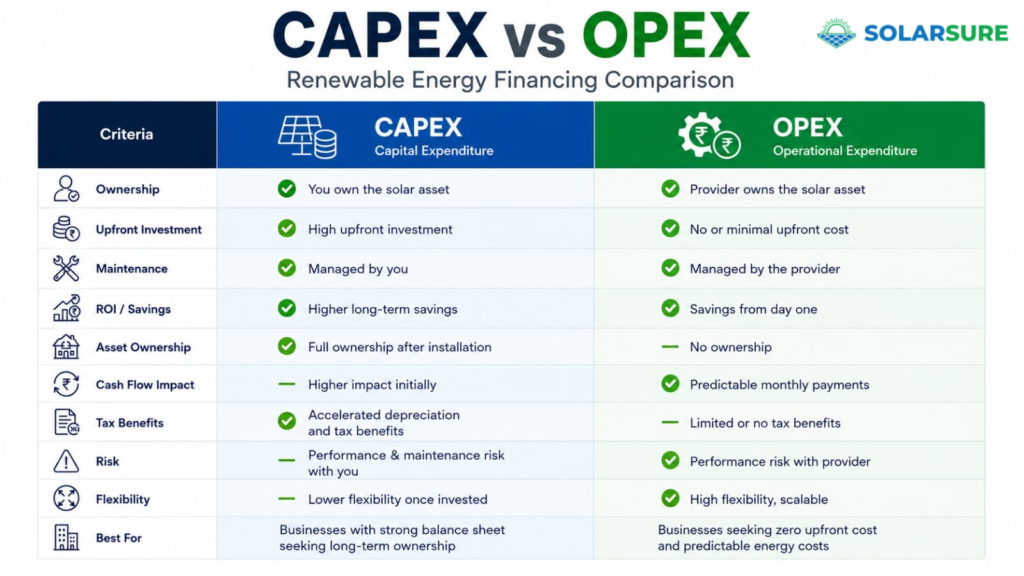
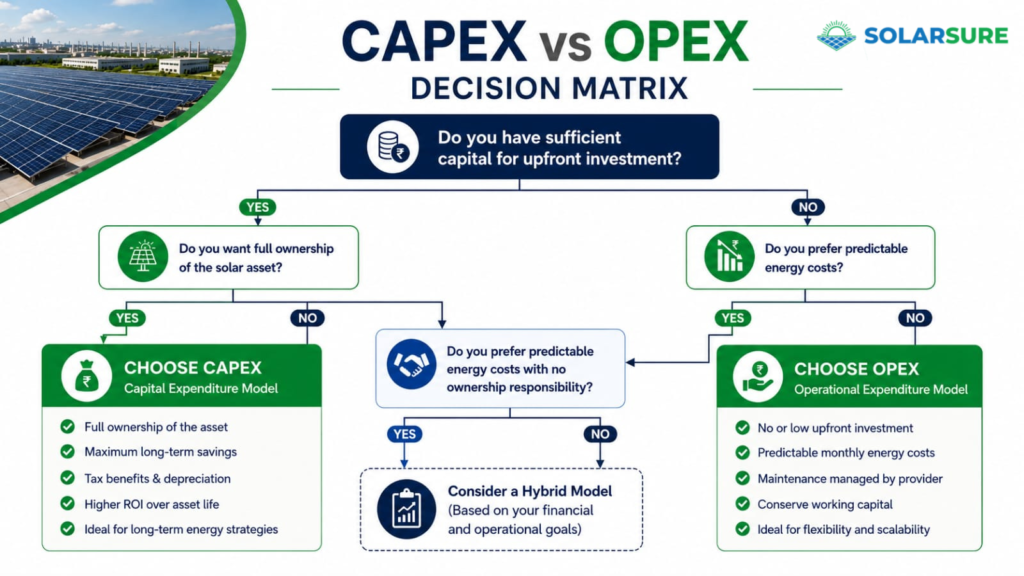
Choosing between the CAPEX and OPEX models depends on your business’s financial capacity, operational priorities, and long-term sustainability goals. While both models help organizations transition to renewable energy and reduce electricity costs, they differ significantly in terms of ownership, investment, financial returns, and risk allocation. Therefore, understanding these differences can help businesses select the financing model that best aligns with their growth strategy and energy requirements.
The following comparison highlights the key differences between the CAPEX and OPEX renewable energy models:
| Parameter | CAPEX Model | OPEX Model |
| Ownership | The business purchases and owns the renewable energy system. | A third-party developer owns the renewable energy system. |
| Upfront Investment | Requires a significant initial capital investment. | Requires little or no upfront investment. |
| Maintenance | Managed by the business or its appointed service provider. | Managed entirely by the developer throughout the contract period. |
| Return on Investment (ROI) | Higher long-term ROI due to complete ownership and lifetime energy savings. | Immediate operational savings but comparatively lower long-term financial returns. |
| Financial Risk | Higher initial financial and performance risk. | Lower financial risk as the developer assumes ownership and operational responsibilities. |
| Payback Period | Typically 3–7 years, depending on project size, location, and electricity tariffs. | No payback period for the customer since there is no capital investment. |
| Accounting Treatment | Recorded as a capital asset on the company’s balance sheet and depreciated over time. | Electricity payments are generally treated as operating expenses. |
| Tax Benefits | Businesses may be eligible for depreciation and other applicable tax incentives, subject to prevailing regulations. | Tax benefits related to asset ownership are generally claimed by the developer. |
| Flexibility | Offers greater control over system upgrades and operational decisions. | Limited flexibility due to long-term contractual obligations. |
| Asset Ownership | The business retains ownership throughout the system’s lifecycle. | The developer owns the asset unless otherwise specified in the agreement. |
| ESG Reporting | Supports long-term sustainability goals through direct ownership of renewable energy assets. | Helps organizations reduce carbon emissions and meet ESG targets without owning the asset. |
Both financing models can deliver significant economic and environmental benefits, but they are designed for different business needs. Businesses with strong capital reserves and long-term operational plans often benefit from the CAPEX model, whereas organizations seeking lower financial risk and greater cash flow flexibility may find the OPEX model more suitable. Evaluating factors such as investment capacity, energy consumption, growth plans, and sustainability objectives can help determine the most appropriate renewable energy financing strategy.
CAPEX vs OPEX Models Cost Comparison
Comparing the financial impact of the CAPEX and OPEX models is essential before investing in renewable energy. While the CAPEX model requires a higher upfront investment, it typically delivers greater long-term savings through complete asset ownership. In contrast, the OPEX model allows businesses to reduce electricity costs without significant capital expenditure, making it an attractive option for organizations that want to preserve cash flow.
The overall financial outcome depends on several factors, including electricity tariffs, system performance, financing structure, contract duration, and future energy consumption. Evaluating these variables helps businesses choose the financing model that offers the best long-term value.
The table below presents an illustrative comparison for a 500 kW rooftop solar system installed at a manufacturing facility. The figures are indicative and intended for comparison purposes only.
| Parameter | CAPEX Model | OPEX Model |
| System Capacity | 500 kW | 500 kW |
| Upfront Investment | ₹2–2.5 crore | ₹0 (or minimal upfront cost) |
| Annual Electricity Savings | ₹45–60 lakh* | ₹20–35 lakh* (through lower power tariffs) |
| Estimated Payback Period | 4–6 years | No payback period, as there is no capital investment |
| Estimated Savings Over 25 Years | ₹10–14 crore* | ₹5–8 crore* (depending on PPA tariff and contract terms) |
| Ownership | Business owns the solar asset | Third-party developer owns the solar asset |
Although the CAPEX model generally offers higher lifetime savings because the business owns the renewable energy asset, it also requires a substantial upfront investment. On the other hand, the OPEX model enables businesses to achieve immediate operational savings without tying up capital, making it an attractive option for organizations that prioritize cash flow and financial flexibility.
Industries Best Suited for the CAPEX Model
The CAPEX model is best suited for businesses with high and consistent electricity consumption, strong capital availability, and long-term operational plans. Because companies own the renewable energy asset, they benefit from greater energy independence, lower electricity costs, and higher returns after the payback period.
Industries that benefit most from the CAPEX model include:
Textile Industry
Textile manufacturers operate energy-intensive facilities, making electricity one of their largest operating expenses. Investing in a CAPEX-based renewable energy system helps reduce long-term energy costs while improving operational competitiveness.
For example, Arvind Limited has expanded its renewable energy portfolio across its manufacturing facilities to lower electricity costs and strengthen its sustainability initiatives.
Cement Industry
Cement manufacturing requires large amounts of electricity, making long-term cost stability a strategic priority. By investing in renewable energy assets, cement companies can reduce their dependence on conventional power and improve operational efficiency.
For instance, Shree Cement has invested in captive renewable energy projects, including solar power, to support its decarbonization goals and lower operating costs.
Automotive Industry
Automotive manufacturers operate large production facilities with continuous power demand. Owning renewable energy assets helps stabilize electricity costs while supporting long-term sustainability commitments.
For example, Mahindra & Mahindra has invested in renewable energy across its manufacturing operations as part of its journey toward carbon neutrality.
Pharmaceutical Industry
Pharmaceutical facilities require a reliable and uninterrupted power supply for precision manufacturing and quality control. The CAPEX model gives companies greater control over their energy infrastructure while improving long-term cost efficiency.
For instance, Dr. Reddy’s Laboratories has expanded renewable energy adoption across several facilities to improve energy efficiency and reduce carbon emissions.
Steel Industry
Steel manufacturing is one of the most energy-intensive industrial sectors. Investing in renewable energy through the CAPEX model helps reduce operating costs, improve energy security, and support long-term sustainability goals.
For example, Jindal Steel & Power (JSPL) continues to expand its renewable energy investments to support cleaner steel production and improve operational efficiency.
Industries Best Suited for the OPEX Model
The OPEX model is ideal for organizations that want to reduce electricity costs without making a significant upfront investment. Since the renewable energy developer owns and maintains the system, businesses can preserve capital for expansion while benefiting from predictable energy costs.
Industries that commonly benefit from the OPEX model include:
Warehouses and Logistics
Warehouses typically have large rooftop spaces and significant daytime electricity consumption, making them ideal for rooftop solar under the OPEX model. This approach allows logistics companies to reduce energy costs without investing their own capital.
For example, DP World has expanded rooftop solar installations across several logistics and port facilities to lower emissions and improve operational efficiency.
FMCG Industry
FMCG companies operate multiple manufacturing plants and distribution centres, requiring continuous electricity while preserving capital for business growth. The OPEX model helps reduce operating costs without affecting expansion plans.
For instance, Nestlé India has increased its use of renewable electricity across its operations to support its net-zero ambitions and improve energy efficiency.
IT Parks
IT parks require uninterrupted electricity to power offices, data infrastructure, and cooling systems. The OPEX model enables developers to secure renewable energy without investing in energy assets.
For example, RMZ Corp has integrated renewable energy solutions across several business parks to improve sustainability and lower operating costs.
Hospitals
Hospitals rely on uninterrupted electricity to support critical healthcare services and medical equipment. The OPEX model helps healthcare providers reduce energy expenses while preserving capital for patient care and infrastructure improvements.
For instance, Apollo Hospitals has adopted renewable energy initiatives across several facilities to improve energy efficiency and support its sustainability goals.
Retail Chains
Retail businesses operate multiple stores and distribution centres, making electricity a significant operational expense. The OPEX model enables retailers to adopt renewable energy across multiple locations while preserving capital for future expansion.
For example, Decathlon India has integrated renewable energy and sustainable building practices across several stores to improve operational efficiency and reduce its environmental footprint.
Factors to Consider Before Choosing Between CAPEX and OPEX Models
Selecting the right renewable energy financing model involves more than comparing upfront costs. Businesses should evaluate their financial position, operational requirements, and long-term sustainability goals before making a decision.
ESG and Sustainability Goals
Businesses with ambitious Environmental, Social, and Governance (ESG) targets should choose a financing model that supports their long-term sustainability strategy. Renewable energy adoption helps reduce carbon emissions, improve ESG performance, and strengthen stakeholder confidence.
For example, Accenture has committed to sourcing renewable electricity across its global operations to achieve its science-based climate targets, demonstrating how clean energy investments support long-term sustainability goals.
Tax Planning
Tax benefits can significantly influence the overall return on a renewable energy investment. Under the CAPEX model, businesses may qualify for depreciation and other applicable tax incentives, subject to prevailing regulations. In contrast, these benefits are generally claimed by the system owner under the OPEX model.
Before selecting a financing model, businesses should evaluate tax implications alongside overall project economics.
Business Growth Plans
Future expansion plans should play an important role in financing decisions. Companies planning rapid growth often prefer the OPEX model because it preserves capital for opening new facilities, expanding production, or entering new markets.
Businesses with stable, long-term operations may generate greater lifetime value by investing in renewable energy assets through the CAPEX model.
Risk Appetite
Every business has a different tolerance for financial and operational risk. Organizations willing to invest upfront and manage energy assets often benefit from the CAPEX model, while those seeking predictable electricity costs with minimal operational responsibility typically prefer OPEX.
For example, Flipkart has expanded its renewable energy procurement across its logistics and operational network while maintaining financial flexibility to support business growth.
📘 Policy Reference: Explore Renewable Energy Policies and Schemes in India
Common Mistakes to Avoid When Choosing CAPEX or OPEX
Choosing the wrong financing model can reduce long-term savings and limit the value of a renewable energy investment. Avoid these common mistakes before making a decision.
Choosing Based Only on Upfront Cost
Many businesses focus only on the initial investment. While the OPEX model minimizes upfront costs, the CAPEX model often delivers significantly higher lifetime savings through asset ownership.
Ignoring Future Electricity Price Increases
Evaluating a project using today’s electricity tariffs alone can lead to inaccurate financial projections. Rising grid power prices often increase the long-term value of renewable energy investments.
Underestimating Future Energy Demand
Renewable energy systems should be designed for future growth as well as current consumption. Expanding production without adequate system capacity can require costly upgrades later.
Overlooking OPEX Contract Terms
Businesses sometimes focus only on lower electricity tariffs while overlooking important contract clauses such as tariff escalation, contract tenure, performance guarantees, and exit conditions. Reviewing these terms carefully helps avoid unexpected costs.
Not Aligning the Financing Model with Business Growth
The financing model should support long-term business objectives. Rapidly growing businesses often benefit from the flexibility of OPEX, while organizations with stable operations may achieve greater long-term returns through CAPEX.
Ignoring Maintenance Responsibilities
Businesses selecting the CAPEX model should account for ongoing system maintenance. Regular monitoring and preventive maintenance are essential to maintain energy generation and maximize financial returns.
Overlooking Tax Benefits
Many organizations underestimate the financial value of depreciation and other incentives available under the CAPEX model. Evaluating these benefits can significantly improve the project’s overall return on investment.
Skipping a Professional Feasibility Study
Every business has unique energy requirements, site conditions, and financial goals. A technical and financial feasibility assessment helps determine whether CAPEX, OPEX, or an alternative renewable energy solution is the best fit.
Tips for Choosing the Right Renewable Energy Financing Model
Selecting the right financing model requires careful planning and a clear understanding of your business objectives. These best practices can help maximize long-term value while minimizing project risks.
Conduct a Comprehensive Energy Audit
Analyse your electricity consumption, peak demand, and future energy requirements before investing. An energy audit helps determine the optimal system size and the most suitable financing model.
Evaluate the Total Cost of Ownership
Look beyond the upfront investment. Compare installation costs, maintenance expenses, financing costs, electricity savings, and tax benefits over the system’s entire lifespan to understand its true financial value.
Choose an Experienced Renewable Energy Partner
The success of a renewable energy project depends on the expertise of the developer or EPC contractor. Review the company’s project experience, certifications, service capabilities, and after-sales support before making a decision.
Consider Future Business Expansion
Choose a financing model that aligns with your long-term growth plans. Businesses expecting to expand operations may prefer the flexibility of OPEX, while companies with stable operations often benefit more from CAPEX ownership.
Review Contract Terms Carefully
If you choose the OPEX model, carefully review the Power Purchase Agreement (PPA) or RESCO contract. Pay close attention to electricity tariffs, escalation clauses, contract duration, performance guarantees, and exit conditions.
Align Renewable Energy with ESG Goals
Renewable energy investments should support your broader ESG strategy, not just reduce electricity costs. For example, Infosys BPM has integrated renewable energy into its operations to strengthen sustainability performance while creating long-term business value.
Seek Professional Financial and Technical Advice
Consult renewable energy experts, financial advisors, and tax professionals before making a final decision. A detailed feasibility study can compare CAPEX and OPEX models scenarios based on your electricity tariff, location, available incentives, and expected return on investment.
Future Trends in Renewable Energy Financing
Renewable energy financing is evolving rapidly as businesses seek greater energy resilience, lower operating costs, and stronger ESG performance. While CAPEX and OPEX models remain the most common financing models, emerging technologies and innovative funding solutions are changing how organizations invest in and manage clean energy.
📘 Policy Reference: Explore Ministry of New and Renewable Energy (MNRE) Initiatives and Renewable Energy Programmes
The following trends are expected to shape the future of commercial and industrial renewable energy adoption.
Battery Energy Storage Systems (BESS)
Battery Energy Storage Systems (BESS) are becoming an essential part of renewable energy projects as battery costs continue to decline. By storing excess solar power, businesses can reduce grid dependence, improve energy reliability, and maintain operations during peak demand or power outages.
For example, NTPC Green Energy is expanding battery energy storage projects in India to improve renewable energy integration and strengthen grid reliability.
Growth of Corporate Power Purchase Agreements (PPAs)
Corporate Power Purchase Agreements (PPAs) are becoming one of the fastest-growing renewable energy procurement models. These long-term agreements allow businesses to purchase clean electricity directly from renewable energy developers at competitive tariffs.
For instance, Wipro has signed long-term renewable energy agreements to power several campuses with clean electricity while reducing operating costs and carbon emissions.
Increasing Adoption of Open Access Renewable Energy
Open Access is helping commercial and industrial consumers procure renewable electricity from off-site solar and wind projects without investing in on-site infrastructure. This model enables businesses with high electricity consumption to reduce power costs while improving energy sustainability.
For example, DLF has expanded its use of Open Access renewable energy across several commercial properties to improve energy efficiency and support its sustainability commitments.
AI-Powered Energy Management
Artificial intelligence is transforming the way businesses monitor and optimize renewable energy systems. AI-powered platforms can forecast energy demand, detect equipment faults, optimize battery usage, and improve overall system performance through predictive analytics.
For instance, Schneider Electric offers AI-enabled energy management solutions that help businesses optimize renewable energy consumption while improving operational efficiency.
Green Financing and Sustainable Investments
Access to green financing is helping businesses of all sizes accelerate renewable energy adoption. Through instruments such as green bonds, sustainability-linked loans, and climate-focused investment funds, organizations can secure financial support for clean energy projects while advancing their sustainability goals.
For example, the State Bank of India (SBI) has introduced green financing initiatives that support businesses investing in renewable energy projects.
Stronger ESG Reporting Requirements
As ESG reporting standards continue to evolve, renewable energy is becoming a key part of corporate sustainability strategies. Businesses are increasingly investing in clean energy to reduce carbon emissions, improve ESG performance, and meet stakeholder expectations.
For example, Hindustan Unilever Limited (HUL) continues to expand its renewable energy adoption and reports its progress through comprehensive sustainability disclosures.
Rise of Energy-as-a-Service (EaaS)
Energy-as-a-Service (EaaS) is emerging as a flexible alternative to traditional financing models. Instead of owning energy assets, businesses pay for energy services while the provider manages financing, installation, operation, and maintenance.
For example, ENGIE offers Energy-as-a-Service solutions that enable commercial and industrial customers to improve energy efficiency and adopt renewable energy without significant upfront investment.
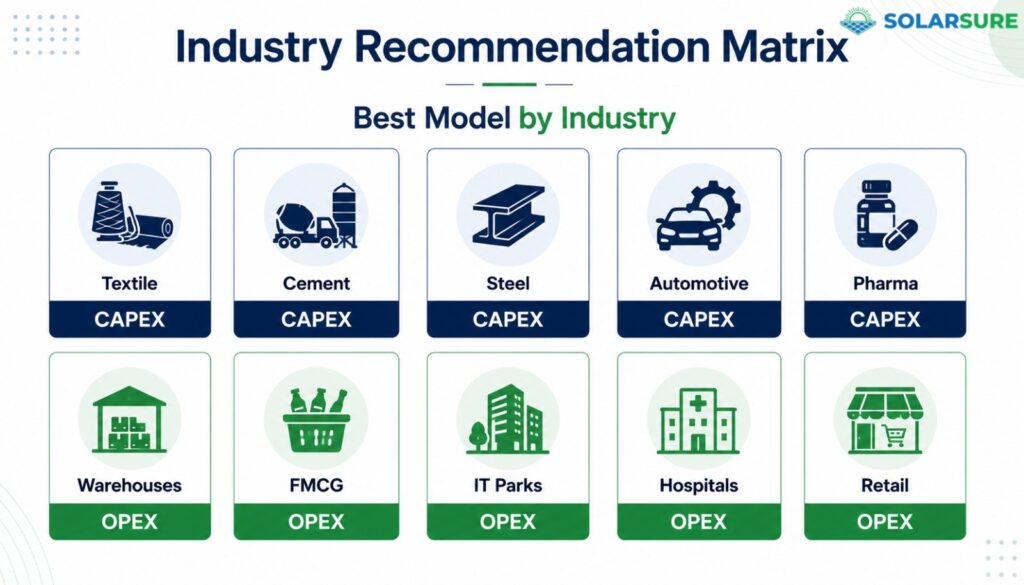
Industry Recommendation Matrix
| Industry | Recommended Model | Why |
| Textile | CAPEX | High energy consumption and strong long-term savings potential. |
| Cement | CAPEX | Energy-intensive operations justify upfront investment. |
| Steel | CAPEX | Maximizes ROI through asset ownership. |
| Automotive | CAPEX | Stable energy demand supports long-term returns. |
| Pharmaceuticals | CAPEX | Reliable power and cost stability are critical. |
| Warehouses | OPEX | Reduces energy costs without upfront investment. |
| FMCG | OPEX | Preserves capital for business expansion. |
| IT Parks | OPEX | Predictable energy costs with minimal financial risk. |
| Hospitals | OPEX | Frees up capital for healthcare infrastructure. |
| Retail Chains | OPEX | Enables scalable renewable energy adoption across multiple locations. |
Which Renewable Energy Financing Model Offers a Higher ROI?
For most businesses, the CAPEX model delivers a higher long-term return on investment (ROI). Because the business owns the renewable energy asset, it retains all electricity cost savings after the payback period. Although CAPEX requires a higher upfront investment, most projects recover their costs within 3–7 years and continue generating savings for more than 20 years.
For example, ACC Limited and Dalmia Bharat have expanded their renewable energy investments to reduce electricity costs, improve operational efficiency, and support long-term decarbonization goals. These examples demonstrate how asset ownership can maximize financial returns over a system’s lifetime.
The OPEX model, on the other hand, offers immediate savings without requiring any capital investment. While the long-term ROI is generally lower because the developer owns the system, businesses benefit from predictable electricity costs, reduced financial risk, and improved cash flow. For instance, Capgemini India has increased its renewable energy procurement to advance its sustainability goals while preserving capital for business growth.
Frequently Asked Questions (FAQs)
Q. What is the difference between CAPEX and OPEX in renewable energy?
The main difference is ownership. Under the CAPEX model, businesses purchase and own the renewable energy system after making an upfront investment. Under the OPEX model, a third-party developer owns, operates, and maintains the system, while the customer pays only for the electricity consumed.
Q. Which renewable energy financing model offers the highest ROI?
The CAPEX model generally delivers a higher long-term ROI because businesses retain all electricity cost savings after the payback period. In comparison, the OPEX model provides immediate savings with little or no upfront investment but offers lower lifetime financial returns.
Q.Is CAPEX better than a Power Purchase Agreement (PPA)?
It depends on your business objectives. CAPEX is ideal for organizations seeking long-term ownership and maximum lifetime savings. A Power Purchase Agreement (PPA) is better suited for businesses that want to reduce electricity costs without making a significant upfront investment.
Q. How do I choose between CAPEX and OPEX?
Consider your capital availability, electricity consumption, growth plans, tax benefits, and risk tolerance. Businesses with stable operations and sufficient capital often benefit from CAPEX, while organizations prioritizing financial flexibility generally find OPEX more suitable.
Q. Which industries benefit most from the CAPEX model?
The CAPEX model is best suited for energy-intensive industries such as textiles, cement, steel, automotive, pharmaceuticals, and food processing. These industries typically have high electricity consumption, allowing them to maximize long-term savings through renewable energy ownership.
Q.Is the OPEX model suitable for manufacturing companies?
Yes. The OPEX model is a practical option for manufacturers that want to reduce electricity costs while preserving capital for business expansion. It is especially popular among MSMEs and businesses that prefer predictable energy costs without owning the renewable energy asset.
Q. Can businesses switch from OPEX to CAPEX later?
Yes. Some Power Purchase Agreements (PPAs) and RESCO contracts include buyout provisions that allow businesses to purchase the renewable energy system after a specified period. The availability of this option depends on the contract terms agreed with the developer.
Q. Are there tax benefits under the CAPEX model?
Yes. Businesses investing through the CAPEX model may qualify for depreciation and other applicable tax incentives, subject to prevailing regulations. These benefits can improve the overall return on investment and shorten the project’s payback period.
Q. How does the CAPEX model support ESG reporting?
Owning renewable energy assets helps businesses increase their use of clean electricity, reduce greenhouse gas emissions, and strengthen ESG reporting. It also supports sustainability frameworks such as Business Responsibility and Sustainability Reporting (BRSR) by demonstrating measurable progress toward environmental goals.
Q. Which financing model is better for MSMEs?
There is no single answer. MSMEs with sufficient capital and stable operations may achieve greater long-term value through CAPEX, while businesses prioritizing working capital and operational flexibility often benefit more from the OPEX model.
Bottom Line
Choosing between the CAPEX and OPEX financing models isn’t about selecting a universally better option. It’s about finding the approach that best aligns with your business’s financial capacity, operational priorities, and long-term sustainability goals.
If your organization has sufficient capital and plans to operate for the long term, the CAPEX model can deliver greater lifetime savings, complete asset ownership, and higher returns on investment. On the other hand, businesses that prioritize cash flow and financial flexibility may find the OPEX model a more practical way to reduce electricity costs without making a significant upfront investment.
Many leading organizations have shown that the right financing strategy creates long-term business value. For example, ITC Limited has strengthened its renewable energy portfolio through a combination of captive renewable energy projects and renewable power procurement. This balanced approach has helped the company reduce carbon emissions, improve energy security, and advance its sustainability commitments.
Before making a final decision, evaluate your electricity consumption, capital availability, growth plans, tax benefits, and ESG objectives. A detailed technical and financial assessment will help you identify the financing model that delivers the highest long-term value. By partnering with an experienced renewable energy expert, businesses can reduce energy costs, improve sustainability performance, and build a more resilient energy future.
📖You may also like to read about : How Do Solar EPC Services Help Commercial and Industrial Businesses Save Energy Costs?