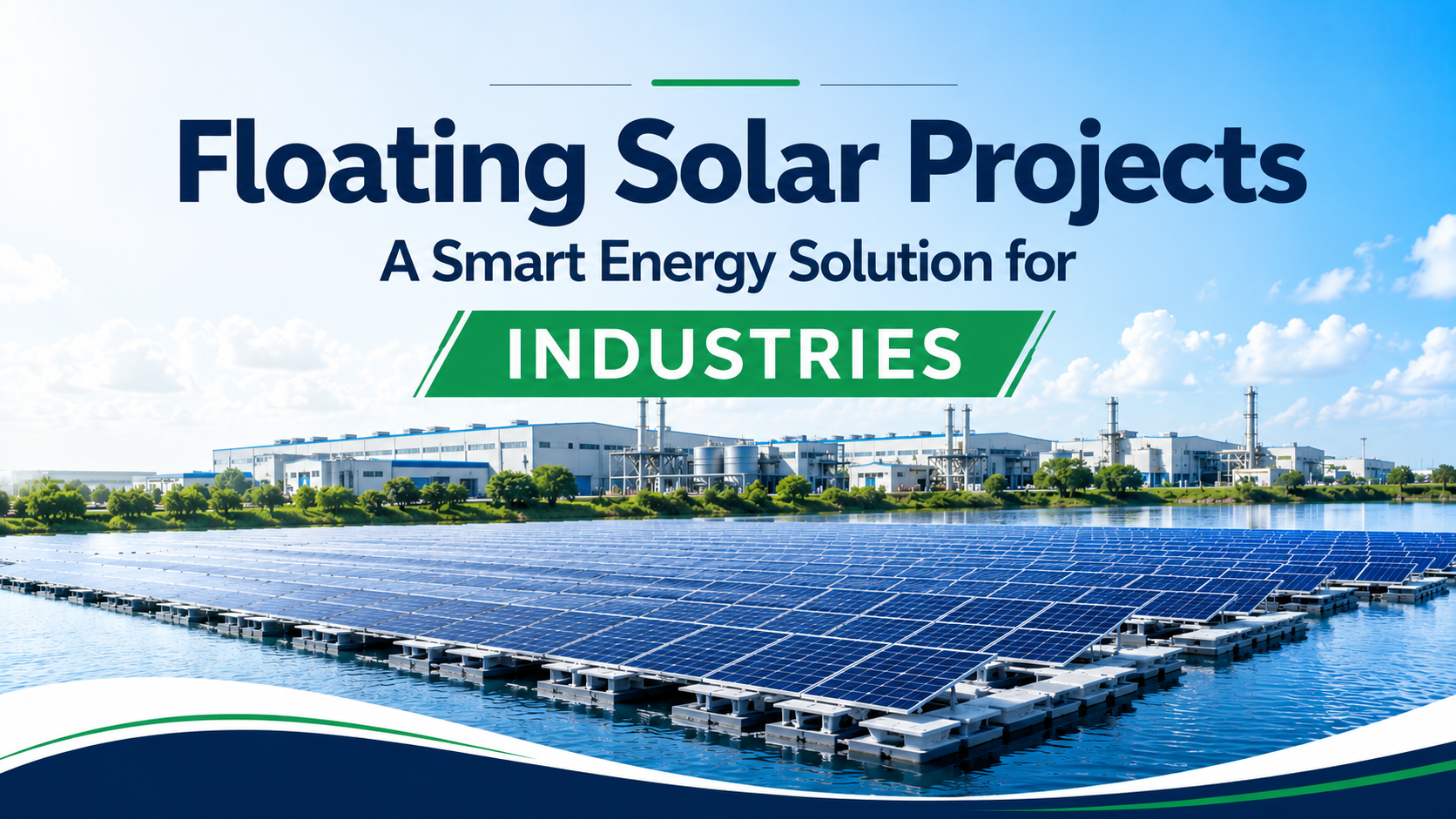
Floating Solar Projects are transforming how industries generate clean and reliable electricity. Unlike traditional solar plants, these systems utilize reservoirs, lakes, and industrial water bodies instead of valuable land. Therefore, businesses can expand renewable energy capacity without affecting daily operations or future infrastructure development.
India is rapidly adopting floating solar to address land constraints and rising energy demand. For example, the 100 MW Ramagundam Floating Solar Plant developed by NTPC demonstrates how large water reservoirs can support utility-scale renewable energy generation. Similarly, the Omkareshwar Floating Solar Project in Madhya Pradesh highlights the country’s growing investment in water-based solar infrastructure while preserving surrounding land for other purposes.
Moreover, Floating Solar Projects offer advantages beyond clean electricity generation. Water beneath the panels naturally lowers operating temperatures, improving overall system performance during hot summer months. In addition, floating installations help reduce reservoir evaporation. For instance, several water utilities in Singapore have adopted floating solar to generate renewable electricity while conserving freshwater resources through reduced surface evaporation.
As industries pursue sustainability and lower operating costs, floating solar continues gaining significant attention across multiple sectors. Manufacturing facilities, mining companies, water treatment plants, and power utilities increasingly consider this technology for future energy planning. This guide explains the engineering, construction, benefits, challenges, and industrial applications of Floating Solar Projects, helping businesses make informed renewable energy decisions.
What Are Floating Solar Projects?
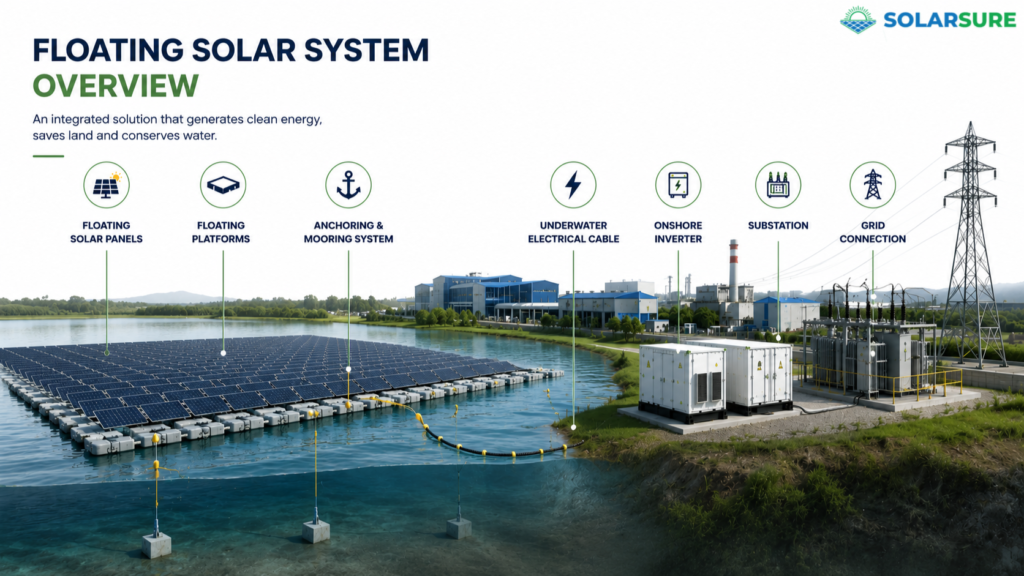
Floating Solar Projects are solar power systems installed on floating platforms over water bodies instead of land. These systems generate clean electricity while making productive use of unused reservoirs, lakes, dams, and industrial ponds. Therefore, they help industries overcome land availability challenges without compromising renewable energy generation.
Unlike ground-mounted solar plants, floating systems use specially designed floating structures to support photovoltaic modules. These platforms remain stable through anchoring and mooring systems, even as water levels fluctuate, while underwater and floating electrical cables safely transmit generated electricity to onshore inverters and grid connection points. The effectiveness of this engineering approach is demonstrated by projects such as NTPC’s 100 MW Ramagundam Floating Solar Plant in Telangana, which utilizes a large reservoir for utility-scale renewable power generation, and the Kayamkulam Floating Solar Project in Kerala, which showcases how existing water surfaces can be transformed into productive clean energy assets without requiring additional land acquisition.
📖Further Reading: Photovoltaic (PV) Technology – National Renewable Energy Laboratory (NREL)
Floating solar technology also offers significant opportunities for commercial and industrial facilities with large water bodies. Mining companies, for instance, are increasingly deploying floating solar on abandoned quarry lakes to repurpose unused sites for renewable energy generation, while water treatment plants are adopting these systems to reduce electricity costs and preserve surrounding land for future operational expansion.
Why Are Floating Solar Projects Gaining Momentum?
Floating Solar Projects are gaining momentum as industries face rising energy costs and limited land availability. Therefore, businesses seek renewable solutions that maximize existing resources without affecting future expansion or daily operations.
Land acquisition often delays large renewable energy projects across industrial regions. However, floating solar utilizes reservoirs and artificial water bodies already available. For example, Tata Power’s floating solar project at Jayakwadi Dam shows how existing reservoirs can generate clean electricity without occupying additional land.
Moreover, floating solar systems operate at lower panel temperatures than ground-mounted plants. Water beneath the panels provides natural cooling throughout the day. As a result, industries can achieve better energy generation during hot summer months.
Water conservation further strengthens the value of floating solar installations. Floating platforms reduce direct sunlight exposure, lowering reservoir evaporation. Similarly, the Alqueva Floating Solar Project in Portugal combines renewable energy generation with responsible water resource management.
Government support also encourages wider adoption across industrial and utility sectors. Consequently, developers increasingly utilize dams, reservoirs, and irrigation networks for renewable energy projects. Singapore’s Sembcorp Tengeh Floating Solar Farm demonstrates how large-scale floating solar can improve energy security while supporting sustainability goals.
Where Can Floating Solar Projects Be Installed?
Floating Solar Projects can be installed on stable water bodies with suitable depth and surface area. Therefore, industries and utilities can generate renewable electricity without requiring additional land for solar development.
📘 Where Sun Meets Water: Floating Solar Handbook (World Bank)
Reservoirs and Dams
Reservoirs and dams provide ideal conditions for large floating solar installations. They offer stable water levels and easy grid connectivity. For example, the Cirata Floating Solar Plant in Indonesia operates on a reservoir, generating clean electricity for thousands of homes.
Industrial Water Reservoirs
Many manufacturing facilities maintain reservoirs for cooling, storage, or process water. These water bodies can support floating solar without affecting industrial operations. Similarly, steel, cement, and chemical plants can reduce electricity costs while utilizing existing infrastructure.
Irrigation Reservoirs
Irrigation reservoirs remain unused for most of their water surface throughout the year. Floating solar helps generate renewable power while minimizing water evaporation. For instance, several irrigation authorities in Gujarat are exploring floating solar to improve both water and energy management.
Mining Lakes and Quarries
Abandoned mining pits often fill with water after operations end. These sites offer valuable opportunities for floating solar development instead of remaining unused. Consequently, former mining areas can become productive renewable energy assets with minimal land preparation.
Water Treatment and Utility Ponds
Water treatment facilities usually have dedicated ponds with controlled water conditions. Floating solar can supply electricity for treatment processes while lowering operational expenses. Moreover, utilities benefit from cleaner energy without expanding their existing land footprint.
Key Components of a Floating Solar Project
A floating solar project combines electrical, structural, and marine engineering systems. Every component plays a critical role in ensuring safety, reliability, and long-term performance. Therefore, selecting high-quality materials remains essential for successful project execution.
Solar PV Modules
Solar photovoltaic modules capture sunlight and convert it into electricity, forming the core of every floating solar system. Unlike conventional solar plants, these panels are mounted on specially designed floating platforms that keep them stable on the water surface while maintaining optimal energy generation. High-efficiency solar modules used in projects such as the Hapcheon Dam Floating Solar Plant in South Korea demonstrate how advanced PV technology can maximize electricity generation in floating solar installations.
Floating Platforms
Floating platforms support the entire solar array above the water surface. They are typically manufactured from durable, UV-resistant, high-density polyethylene materials. Moreover, these structures withstand continuous sunlight, moisture, and changing weather conditions.
Anchoring and Mooring System
Anchoring and mooring systems keep the floating structure stable despite water movement. They prevent unwanted drifting caused by wind, waves, or changing water levels. Consequently, the solar plant maintains safe and efficient operation throughout its lifespan.
Inverters and Electrical Equipment
Inverters convert direct current generated by solar panels into usable alternating current. Electrical equipment also includes transformers, switchgear, and protection systems for safe grid integration. Therefore, reliable electrical infrastructure ensures consistent power delivery.
Floating and Underwater Cables
Specialized cables transmit electricity from floating platforms to the onshore substation. These cables resist moisture, mechanical stress, and continuous movement on water. Proper cable routing also reduces maintenance requirements and improves overall system reliability.
Monitoring and Control System
Modern floating solar plants use digital monitoring systems for real-time performance tracking. Operators can quickly detect faults, monitor energy production, and schedule preventive maintenance. As a result, industries improve operational efficiency while reducing unexpected downtime.
Engineering Behind Floating Solar Projects
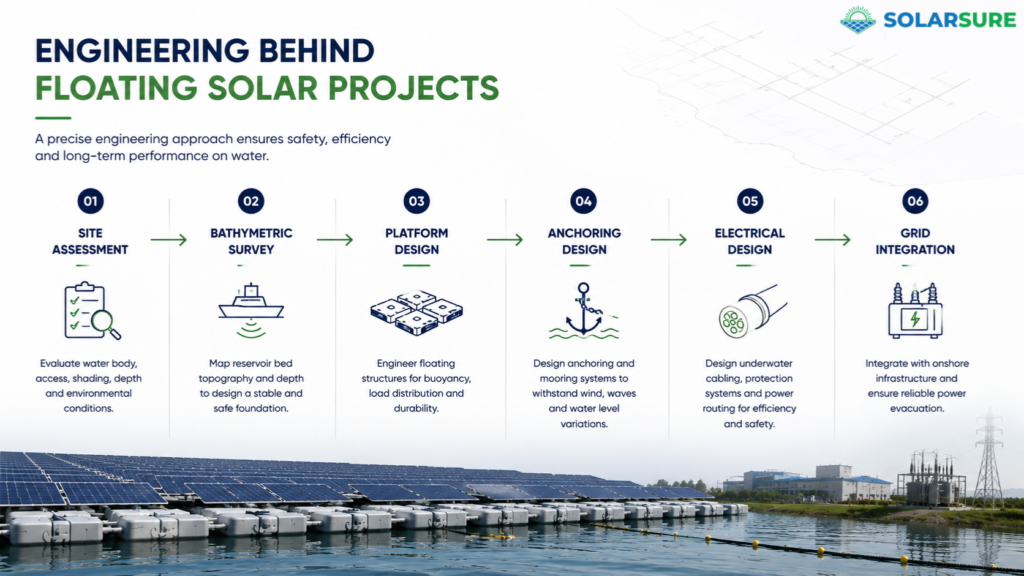
Successful Floating Solar Projects begin with detailed engineering and careful project planning. Every design decision influences system performance, operational safety, and long-term reliability. Therefore, developers complete multiple technical studies before starting construction activities.
🔧 Technical Insight: How Solar EPC Companies Plan and Execute Large-Scale Solar Projects
Site Assessment and Feasibility Study
Every floating solar project begins with a comprehensive site feasibility assessment to determine its technical and commercial viability. Engineers evaluate factors such as water availability, reservoir dimensions, accessibility, nearby electrical infrastructure, and environmental conditions that could influence long-term system performance. This detailed planning process is evident in projects like the Yamakura Dam Floating Solar Plant in Japan, where extensive site investigations helped optimize the plant layout while ensuring the reservoir’s existing operations remained unaffected.
Bathymetric and Environmental Surveys
Bathymetric surveys measure water depth and identify underwater conditions across the project site. Engineers also study sediment, water quality, and seasonal water level changes. Consequently, these findings support safe floater placement and anchoring system design.
Environmental assessments remain equally important during project planning. They evaluate aquatic ecosystems, biodiversity, and regulatory compliance before construction begins. Therefore, developers minimize environmental impacts while maintaining long-term project sustainability.
Structural and Floating Platform Design
Engineers design floating platforms to withstand continuous exposure to sunlight, wind, and water movement while ensuring long-term structural stability. Material selection focuses on durability, buoyancy, and low maintenance requirements, enabling the platforms to securely support solar panels under varying weather conditions. This engineering approach is demonstrated by the Bomhofsplas Floating Solar Farm in the Netherlands, where modular floating platforms have been designed to perform reliably in challenging weather while also simplifying future system expansion.
Electrical System and Grid Integration
Electrical engineers design safe power transmission from floating arrays to onshore substations. They carefully select inverters, transformers, floating cables, and protection equipment. As a result, the plant delivers reliable electricity while meeting local grid requirements.
Modern monitoring systems further improve operational efficiency through continuous performance analysis. Operators quickly identify faults, optimize energy generation, and reduce unexpected maintenance interruptions.
Before construction begins, every engineering activity follows a structured execution process. The table below summarizes the major stages involved in planning Floating Solar Projects.
| Engineering Stage | Primary Objective | Key Activities |
| Site Assessment | Evaluate project feasibility | Water body analysis, accessibility, grid availability |
| Bathymetric Survey | Understand underwater conditions | Water depth, sediment study, reservoir mapping |
| Engineering Design | Develop technical layout | Floater, anchoring, electrical system design |
| Procurement Planning | Select project components | Modules, floaters, cables, inverters |
| Risk Assessment | Improve project safety | Wind analysis, environmental evaluation, compliance |
| Construction Planning | Prepare project execution | Installation sequence, logistics, workforce planning |
A well-planned engineering process reduces technical risks and construction delays. Consequently, industries achieve better project performance, lower maintenance costs, and higher long-term energy generation.
How Are Floating Solar Projects Constructed?
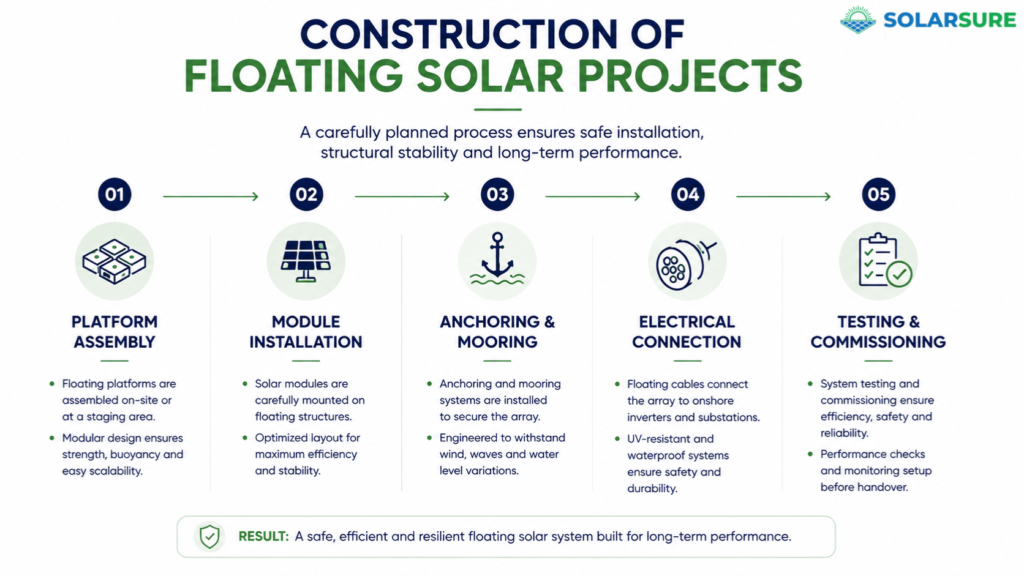
The construction phase transforms engineering designs into fully operational renewable energy systems. Every activity follows a planned sequence to ensure safety, quality, and long-term performance. Therefore, experienced EPC teams coordinate each stage with careful precision.
Step 1: Site Preparation
Construction begins with preparing the project site and surrounding infrastructure to ensure smooth and safe execution. Engineers establish storage areas, equipment access routes, and temporary working platforms, while comprehensive safety inspections verify that all construction activities can proceed without operational risks. The importance of meticulous site preparation is evident in projects such as the Saemangeum Floating Solar Project in South Korea, where extensive logistical planning enabled contractors to efficiently manage materials and equipment across the vast water surface before installation began.
Step 2: Floater Assembly and Solar Module Installation
Workers assemble floating platforms near the reservoir before launching them onto water. Solar modules are then mounted using specially designed support structures. Consequently, installation becomes faster while maintaining consistent construction quality.
Each floating section undergoes detailed inspections before moving into the water. This process reduces future maintenance issues and improves structural reliability.
Step 3: Anchoring and Mooring Installation
Engineers install anchoring systems to prevent unwanted movement during changing weather conditions. Mooring lines maintain structural stability despite wind, waves, and fluctuating water levels. Therefore, the floating solar array remains securely positioned throughout its operational life.
Step 4: Electrical Connections and Grid Integration
Following the completion of the floating structure, technicians install floating cables, inverters, transformers, and protection equipment to establish the plant’s electrical infrastructure. Every electrical connection undergoes rigorous testing before grid synchronization to ensure safe, efficient, and reliable power transmission from the first day of operation. This best practice is reflected in the Queen Elizabeth II Reservoir Floating Solar Project in the United Kingdom, where comprehensive electrical testing before commercial commissioning helped ensure stable grid performance and long-term operational reliability.
Step 5: Testing and Commissioning
The final stage verifies mechanical stability, electrical performance, and overall system safety. Engineers conduct performance tests under different operating conditions before project handover. Moreover, digital monitoring systems begin collecting real-time operational data immediately after commissioning.
Successful commissioning confirms that every system performs according to engineering specifications. Consequently, industries receive a reliable renewable energy asset capable of delivering consistent long-term performance.
What Are the Key Challenges in Floating Solar Projects?
Although Floating Solar Projects offer significant advantages, they also present unique engineering challenges. Therefore, developers must address technical risks during planning, construction, and long-term operations.
Water Level Fluctuations
Reservoir water levels often fluctuate due to seasonal changes and operational requirements, creating challenges for anchoring systems and cable alignment over time. To address these conditions, engineers design flexible mooring and anchoring systems that can adapt to continuous water movement while maintaining the structural stability of the floating array. This approach is demonstrated by the Sirindhorn Dam Floating Solar Farm in Thailand, where engineered anchoring solutions help keep the installation secure despite changing reservoir water levels..
Corrosion and Material Durability
Floating solar equipment operates continuously in humid and water-rich environments. Moisture can gradually affect metal components, connectors, and electrical equipment. Consequently, developers use corrosion-resistant materials and protective coatings to improve system lifespan.
Regular inspections also identify early signs of wear before major failures occur. This proactive approach reduces maintenance costs and improves long-term plant reliability.
Wind and Wave Loads
Strong winds and surface waves create continuous mechanical stress on floating structures. Engineers calculate these forces before selecting floaters and anchoring systems. As a result, the entire installation remains stable during challenging weather conditions.
Cable Protection and Electrical Safety
Floating cables are continuously exposed to movement caused by wind, waves, and fluctuating water levels, making proper cable management essential for long-term system reliability. Improper routing can increase mechanical stress, accelerate wear, and affect electrical performance, which is why engineers use specialized floating and underwater cables designed for marine environments. This approach is demonstrated by the Healdsburg Floating Solar Project in California, where protected cable routing enhances electrical safety while reducing long-term maintenance requirements.
Maintenance and Accessibility
Routine maintenance becomes more complex on floating platforms than traditional solar plants. Technicians require safe access pathways and specialized equipment during inspections. Moreover, digital monitoring systems help identify faults before onsite maintenance becomes necessary.
Addressing these challenges during project planning improves operational efficiency and reduces unexpected downtime. Consequently, industries achieve higher energy generation while protecting long-term investment value.
What Are the Benefits of Floating Solar Projects for Industries?
Floating Solar Projects help industries reduce electricity costs while improving energy security. Moreover, they utilize existing water bodies without occupying valuable industrial land. This combination makes floating solar an attractive investment for long-term business growth.
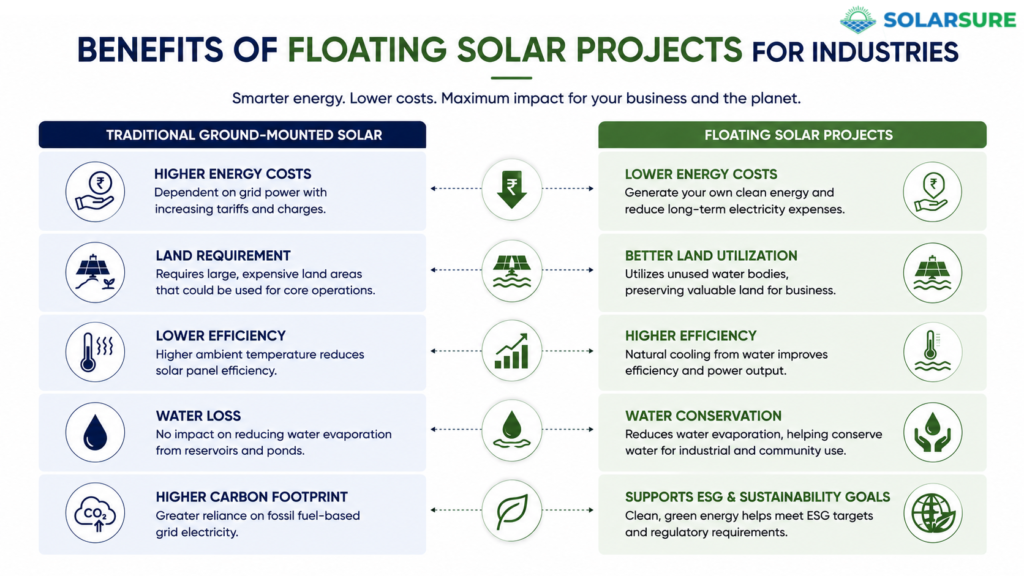
Lower Energy Costs
Electricity remains one of the largest operating expenses for many industries. Floating solar reduces grid dependence by generating clean power onsite. For example, Banas Dairy in Gujarat adopted floating solar to reduce operational expenses while supporting sustainability initiatives. As a result, businesses gain better control over long-term energy costs
Better Land Utilization
Many industrial facilities have limited space for large ground-mounted solar plants. Floating solar transforms unused reservoirs into productive renewable energy assets. Therefore, businesses preserve land for future manufacturing and infrastructure expansion.
Improved Solar Panel Performance
Water naturally cools solar panels throughout the day, lowering operating temperatures. Cooler panels generally perform better during hot weather conditions. Consequently, industries can achieve higher energy generation than comparable land-based installations.
Supports ESG and Sustainability Goals
Many organizations now prioritize carbon reduction and responsible resource management as part of their ESG and sustainability strategies. Floating solar supports these objectives by increasing renewable energy adoption while helping reduce reservoir evaporation, contributing to more efficient water conservation. This dual benefit is reflected in initiatives such as Coca-Cola HBC’s floating solar installations, which strengthen renewable energy adoption while enhancing overall environmental performance.
Long-Term Energy Security
Generating electricity onsite reduces exposure to fluctuating grid tariffs and supply disruptions. Industries also gain greater control over future energy planning and operational continuity. Therefore, floating solar strengthens business resilience while supporting long-term sustainability objectives.
The table below highlights how Floating Solar Projects create value across different industrial sectors.
| Industry | Primary Benefit | Suitable Water Body |
| Manufacturing | Lower electricity costs | Process water reservoirs |
| Mining | Productive use of abandoned sites | Quarry lakes |
| Water Utilities | Reduced operating expenses | Treatment ponds |
| Food & Beverage | Supports sustainability goals | Storage reservoirs |
| Power Utilities | Large-scale renewable generation | Dams and reservoirs |
| Chemical Industry | Better land utilization | Industrial water ponds |
Every industry has different operational requirements and energy demands. However, floating solar offers a flexible solution across multiple sectors. Consequently, businesses can improve efficiency, lower emissions, and maximize existing infrastructure without additional land acquisition.
Leading Floating Solar Projects Around the World
Floating Solar Projects are expanding across the world through successful commercial deployments. These projects demonstrate strong engineering capabilities, efficient land utilization, and reliable renewable energy generation. Moreover, they encourage industries and governments to adopt similar clean energy solutions.
Rihand Floating Solar Project, India
The Rihand Floating Solar Project in Uttar Pradesh represents one of India’s significant floating solar developments. Built on a large reservoir, the project strengthens renewable energy capacity without disturbing nearby land resources. Therefore, it highlights how existing water infrastructure can support utility-scale clean energy generation.
Dezhou Dingzhuang Floating Solar Project, China
China continues expanding floating solar through several large-scale renewable energy developments. The Dezhou Dingzhuang Floating Solar Project utilizes reclaimed water areas for electricity generation. Consequently, the project demonstrates how unused water surfaces can become productive renewable energy assets.
Alto Rabagao Floating Solar Project, Portugal
Portugal has embraced floating solar to diversify its renewable energy portfolio. The Alto Rabagao Floating Solar Project combines clean electricity generation with existing hydropower infrastructure. Moreover, this hybrid approach improves grid flexibility while maximizing available water resources.
Ciel & Terre Industrial Installations, France
Several French industries have adopted floating solar for onsite renewable energy generation. Ciel & Terre has delivered floating solar systems across industrial reservoirs and water treatment facilities. These projects help businesses reduce electricity costs without sacrificing valuable operational land.
Madhya Pradesh’s Emerging Floating Solar Pipeline
Madhya Pradesh continues exploring floating solar across reservoirs and dam networks. Several planned projects aim to strengthen renewable capacity while utilizing existing water infrastructure. As a result, the state is positioning itself as an important hub for future floating solar development.
The success of these projects proves that Floating Solar Projects perform reliably across different climates and industries. Their growing adoption also reflects increasing confidence in floating solar engineering and construction practices worldwide.
The Future of Floating Solar Projects
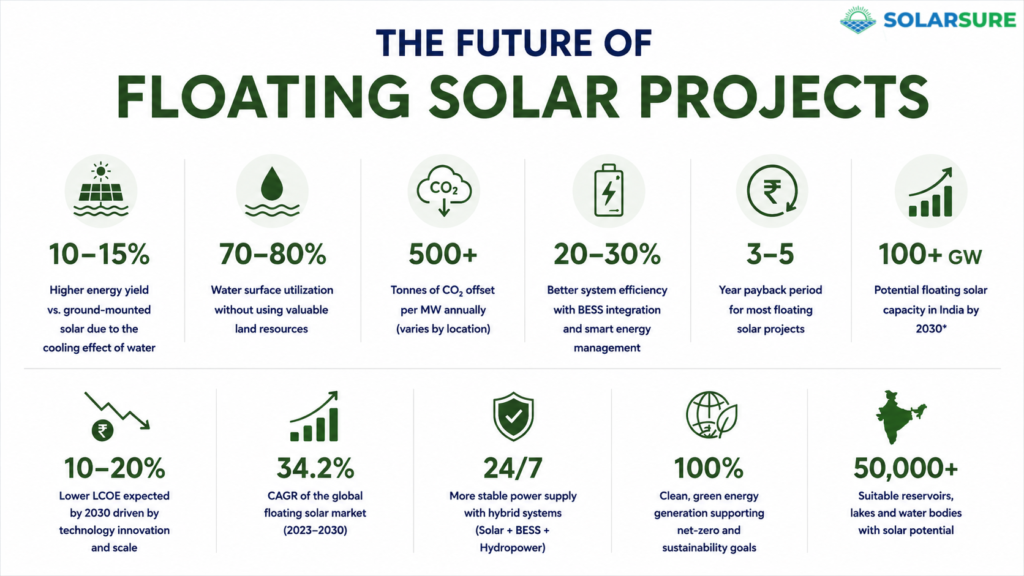
The future of Floating Solar Projects looks promising as renewable energy demand continues increasing. Industries and governments are investing in innovative technologies to improve energy security and sustainability. Therefore, floating solar is expected to play a larger role in global clean energy expansion. Advanced engineering is expected to further improve the efficiency and reliability of floating solar installations through smart monitoring systems, artificial intelligence, and predictive maintenance, enabling operators to identify potential issues earlier and reduce long-term maintenance costs. This evolution is already reflected in initiatives such as the Balbina Hydroelectric Reservoir in Brazil, where the expansion of floating solar alongside existing hydropower infrastructure demonstrates the growing potential of hybrid renewable energy systems that maximize existing assets.
Battery Energy Storage Systems (BESS) will further strengthen this transition by enabling industries to store excess solar energy for use during evening hours, improving grid stability, energy reliability, and overall system flexibility. At the same time, supportive government policies, competitive bidding programmes, and investments in renewable infrastructure are accelerating floating solar adoption worldwide. Countries such as Laos are expanding floating solar on hydropower reservoirs to increase clean energy generation while making more efficient use of existing water infrastructure.
⚡ Learn More: Battery Energy Storage Systems (BESS): Reducing Energy Costs & Improving Reliability
As technology continues to advance, improvements in floating materials, engineering practices, and construction techniques are expected to reduce installation costs and accelerate market growth. Consequently, Floating Solar Projects are becoming an increasingly practical and scalable solution for commercial, industrial, and utility-scale renewable energy applications.
📖 Explore More: The Future of Solar Energy – International Energy Agency (IEA)
Frequently Asked Questions (FAQs)
Q. What are Floating Solar Projects?
Floating Solar Projects are solar power systems installed on floating platforms over water bodies. They generate renewable electricity without using valuable land. These systems commonly operate on reservoirs, lakes, dams, and industrial water bodies.
Q. How do Floating Solar Projects improve solar panel performance?
Water naturally cools solar panels throughout daily operations. Lower panel temperatures improve energy generation, especially during hot weather. Therefore, floating solar systems often achieve better performance than comparable land-based installations.
Q. Which industries benefit the most from Floating Solar Projects?
Manufacturing, mining, food processing, chemical, and water utility industries benefit significantly. These sectors often have suitable reservoirs or ponds. Consequently, they reduce electricity costs without sacrificing valuable operational land.
Q. Are Floating Solar Projects suitable for small industries?
Yes. Small industries with adequate water bodies can also install floating solar systems. Project capacity depends on available water surface and electricity demand. Therefore, system size can match different industrial requirements.
Q. What are the main components of a floating solar plant?
A floating solar plant includes solar modules, floating platforms, anchoring systems, inverters, cables, transformers, and monitoring equipment. Each component supports safe operation and reliable electricity generation throughout the project’s lifespan.
Q. Are Floating Solar Projects environmentally friendly?
Yes. Floating solar generates clean electricity while reducing greenhouse gas emissions. Moreover, floating platforms help minimize water evaporation from reservoirs. This combination supports both renewable energy generation and responsible water management.
Q. What challenges do Floating Solar Projects face?
Common challenges include changing water levels, strong winds, corrosion, cable protection, and maintenance access. However, proper engineering and regular inspections effectively reduce these operational risks.
Q. How long do Floating Solar Projects typically last?
Most floating solar systems operate efficiently for 25 years or more. High-quality components and preventive maintenance improve long-term reliability. Therefore, industries receive consistent renewable energy throughout the project’s operational life.
Bottom Line
Floating Solar Projects are changing how industries approach renewable energy generation and infrastructure planning. They utilize existing water bodies, reduce electricity costs, and preserve valuable industrial land. Moreover, modern engineering ensures safe, reliable, and long-term system performance across diverse operating conditions.
As renewable energy demand continues growing, floating solar offers practical advantages beyond clean electricity generation. Better land utilization, improved panel efficiency, and reduced water evaporation strengthen its value for industrial applications. Therefore, businesses can meet sustainability goals while improving operational efficiency and energy resilience.
Industries planning future renewable investments should evaluate floating solar alongside conventional solar solutions. A well-engineered floating solar system delivers lasting environmental and financial benefits. Consequently, Floating Solar Projects are becoming a smart energy solution for industries seeking sustainable long-term growth.