Your factory is paying ₹8 to ₹10 per unit of electricity from the grid. A solar plant, correctly engineered for your load profile, brings that cost down to ₹2 to ₹3 per unit for the next 25 years.
That is not a marketing claim. It is the arithmetic of every well-executed commercial and industrial solar project in India today.
But solar is easy to promise and hard to deliver. The difference between a plant that genuinely cuts your bills and one that underperforms for two decades comes down to one thing: the quality of your EPC partner. This guide explains what solar EPC services actually do, exactly how they reduce your energy costs, and what you must verify before you sign with anyone.
What Does a Solar EPC Company Actually Do?
EPC stands for Engineering, Procurement, and Construction. A solar EPC company takes complete, single-point responsibility for all three phases of your solar project from the first technical survey to the final grid connection.
Engineering means designing a system sized correctly for your actual consumption pattern not oversized to inflate project value, not undersized to cut costs and win the bid. Procurement means sourcing the panels, inverters, mounting structures, cables, and all balance-of-system components that match what was specified, not substituted after the contract is signed. Construction means installing, commissioning, and handing over a plant that performs as promised from day one.
A solar EPC company is not a panel dealer. It is not a broker who outsources execution to the lowest bidder. It is the single accountable entity for everything that happens between your decision to go solar and the moment your electricity meter starts running backwards.
You can also read: What Solar EPC Solutions Are Available for Commercial & Industrial Sectors?
How Solar EPC Services Cut Energy Costs for C&I Businesses
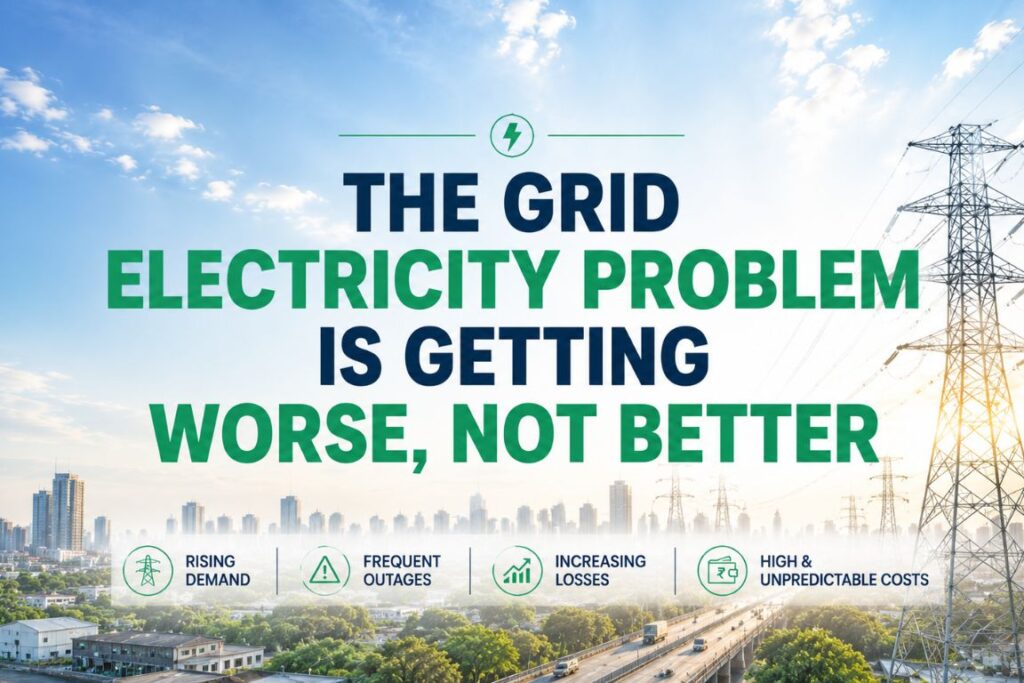
The Grid Electricity Problem Is Getting Worse, Not Better
Commercial and industrial electricity tariffs in India have risen consistently for the past decade. Today, most C&I consumers in states like Madhya Pradesh, Maharashtra, and Rajasthan pay between ₹7 and ₹11 per unit, depending on their contracted demand slab and state tariff structure. Additional charges, demand charges, fixed charges, fuel adjustment costs, and cross-subsidy surcharges push the effective cost even higher.
For a factory consuming 1,00,000 units per month, that translates to an electricity bill of ₹70 lakh to ₹1.1 crore every year. And that number increases every time the state electricity board revises its tariff.
Solar does not have tariff revisions. Once your plant is commissioned, the cost of generation is fixed.
What Solar Actually Costs Per Unit
A well-designed, ground-mounted or rooftop solar plant in central India generates electricity at a levelised cost of ₹2.00 to ₹2.80 per unit over its 25-year life. This calculation accounts for the full capital cost of the system, all maintenance expenses, panel degradation at approximately 0.5% per year, and the time value of money.
For a business currently paying ₹8 per unit from the grid, switching to solar represents a saving of ₹5 to ₹6 on every single unit your solar plant generates. On a 500 kW plant generating approximately 7,50,000 units per year, that is an annual saving of ₹37.5 lakh to ₹45 lakh every year, for 25 years.
CAPEX Model You Own the Plant, You Own the Savings
In the capital expenditure model, your business makes an upfront investment to own the solar plant outright. The system is installed on your rooftop or land, connected to your internal distribution system, and from commissioning day, every unit it generates belongs to you at near-zero marginal cost.
Typical payback periods for C&I solar under the CAPEX model in India currently range from 3.5 to 5.5 years, depending on system size, location, grid tariff, and plant performance ratio. After payback, the plant generates electricity for the remaining 19 to 21 years of its operational life with no fuel cost, no tariff hike exposure, and a predictable maintenance cost that is a fraction of your current grid bill.
The CAPEX model gives you the maximum lifetime savings, full ownership of the asset, a depreciable fixed asset on your balance sheet, and the strongest ESG story for SEBI BRSR reporting and international buyer audits.
OPEX / PPA Model Zero Investment, Immediate Savings
If capital deployment is a constraint, the OPEX or Power Purchase Agreement model removes the investment barrier entirely. Under this model, a developer installs, owns, and maintains the plant on your premises. You simply purchase the electricity it generates at a pre-agreed rate typically 20% to 40% lower than your current grid tariff for the duration of the PPA, usually 15 to 25 years.
You pay nothing upfront. Your electricity bill drops from commissioning day. You carry no maintenance responsibility and no technology risk. At the end of the agreement, you typically have the option to purchase the plant at residual value.
The trade-off is that total lifetime savings are lower compared to CAPEX ownership but for businesses where capital preservation matters more than maximum return, the OPEX model is a financially sound, immediately impactful route to lower energy costs.
Open Access Solar The Route for Large Industrial Consumers
Industrial consumers with contracted demand above 1 MW have access to open access solar a mechanism that allows procurement of renewable energy from a utility-scale solar plant located outside their premises, wheeled through the state transmission network.
Under open access, a plant is built at a high-irradiance location Rajasthan, MP’s Nimar region, or similar high-yield zones and the power is transmitted to your facility through existing grid infrastructure. Applicable charges include wheeling, scheduling, banking, and cross-subsidy surcharges but the net effective per-unit cost still sits well below the standard industrial tariff, often in the range of ₹4 to ₹5.50 per unit all-inclusive.
Open access is actively promoted in Madhya Pradesh, Rajasthan, and Maharashtra, and is the most cost-effective route for large industrial energy consumers who have exhausted their rooftop or captive land capacity.
You can also read: Cost of a Commercial Solar Plant in India: A Complete Pricing Guide for Businesses
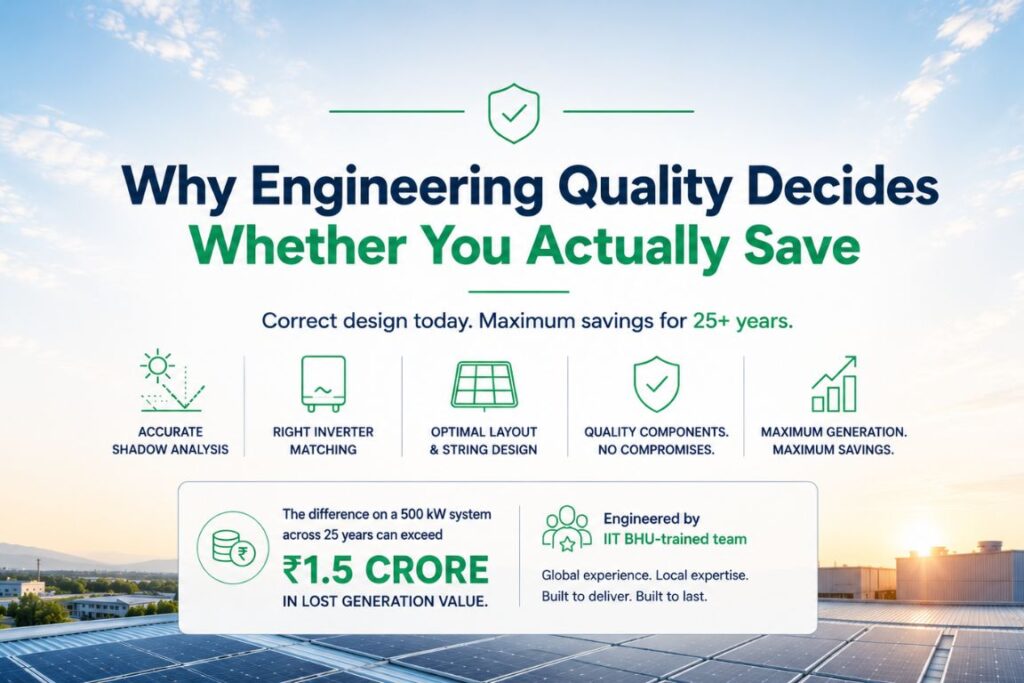
Why Engineering Quality Decides Whether You Actually Save
Every solar EPC company will quote you a system. Not every one will size it correctly.
The most common cause of underperforming solar plants in India is incorrect system design in terms of capacity sizing, inverter selection, module layout, shadow analysis, and string configuration. A plant designed without a proper shadow study loses 10% to 25% of annual generation before a single panel fails. A plant where inverter capacity is mismatched to module configuration clips generation at peak solar hours every single day. A plant built with components substituted after contract signing degrades faster and consistently underperforms projections.
These are not hypothetical risks. They are documented failure patterns across hundreds of poorly executed C&I solar projects across India.
At Solarsure, every project is engineered by an IIT BHU-trained team. Every site undergoes a full irradiance assessment, shadow analysis, load profile study, and technical design review before a single component is procured. Our founder, Bhavesh Patidar, has advised US utilities including Duke Energy, Avista, and Entergy on energy infrastructure projects. That global engineering standard is what every Solarsure project in India is built to.
The difference between a correctly engineered plant and an incorrectly engineered one, on a 500 kW system across 25 years, can exceed ₹1.5 crore in lost generation value. Engineering is not a cost. It is your most important investment in the project.
What Real ROI Numbers Look Like for a C&I Solar Plant in MP
Below are actual project-basis numbers for a mid-sized manufacturing unit in Madhya Pradesh. These figures assume 4.5 peak sun hours per day, 80% plant performance ratio, ₹8.50 per unit current grid tariff, and 5% annual tariff escalation over 25 years.
| Project Parameter | Value / Figure |
| Monthly electricity bill | ₹8,00,000 |
| Current grid tariff | ₹8.50 per unit |
| Monthly consumption | ~94,000 units |
| Recommended system size | 500 kW |
| Estimated annual generation | 7,50,000 units |
| Annual savings — Year 1 | ₹42,00,000 |
| System cost (CAPEX) | ₹1,80,00,000 |
| Simple payback period | 4.3 years |
| Internal Rate of Return (IRR) | 24% – 28% |
| 25-year total savings (with 5% tariff escalation) | ₹3.8 crore+ |
Your actual numbers will vary based on location, load profile, sanctioned load, and available roof or land area. A proper feasibility study , which Solarsure delivers within 72 hours, at no cost, will give you project-specific projections across all three financial models.
CAPEX vs OPEX vs Open Access A Quick Comparison
| Basis | CAPEX | OPEX / PPA |
| Who owns the plant | Your business | Developer / Solarsure |
| Upfront investment | Yes, full system cost | Zero |
| Savings start | From commissioning day | From commissioning day |
| Lifetime savings | Maximum (25 years) | Moderate (PPA rate locked) |
| Maintenance | Your responsibility | Developer’s responsibility |
| Best for | Capital-strong businesses | Capital-constrained businesses |
| ESG / BRSR benefit | Full Scope 2 reduction | Partial Scope 2 reduction |
You can also read: Scope 1, 2 & 3 Emissions: A Complete Guide for Businesses
What to Look for in a Solar EPC Partner and What Should Make You Walk Away
Green Flags: Signs of a Credible Solar EPC Company
- A verifiable track record\ commissioned MW numbers, project locations, and client references you can actually call.
- ISO certifications in quality (9001), environment (14001), and safety (45001), not just self-declared claims.
- In-house engineering capability, not outsourced design from a third party with no accountability to you.
- Panel brand, model number, and efficiency rating stated in the contract before you sign, not filled in later.
- A 25-year performance warranty backed by a company with the financial stability to still exist in 2040.
- A post-commissioning monitoring system, AI-powered or otherwise, so you can track actual generation daily.
Red Flags: Walk Away Immediately
- Cannot show you operating projects with verifiable generation data.
- Quotes a system size without conducting a site visit or analysing your load data.
- Does not specify panel and inverter brands in writing before contract signing.
- Competes purely on lowest price with no explanation of what was removed from scope to get there.
- Has no local presence or field teams and relies entirely on subcontractors for installation and maintenance.
Solarsure has commissioned over 300 MW across 28+ districts of Madhya Pradesh. We hold ISO 9001:2015, ISO 14001:2015, and ISO 45001:2018 certifications. We won three awards at the MP Annual Solar Awards 2025, including EPC Company of the Year for utility-scale projects above 100 MW. Every project we deliver comes with a 25-year performance assurance and an AI-powered monitoring app so you can track generation in real time from your phone.
Your electricity bill is not a fixed cost. It is a variable that a correctly engineered solar plant can reduce by 60% to 80% from day one of commissioning.
At current grid tariffs, solar makes financial sense for virtually every C&I business spending more than ₹3 lakh per month on electricity. The question is not whether solar saves money. The question is which EPC partner you trust to engineer, procure, and build a plant that actually delivers what it promises and is still accountable to you in year 15.
Book a free consultation with us at solarsure.in. We will run your numbers, assess your site, and deliver a full feasibility report in 72 hours at no cost.
FAQ SECTION
Q: What is a solar EPC company and what does it do?
A: EPC stands for Engineering, Procurement, and Construction. A solar EPC company designs your solar system, sources all components to specification, builds the plant, and commissions it — taking single-point responsibility for the entire project from site survey to grid connection. Unlike panel dealers or brokers, a solar EPC company is accountable for plant performance, not just installation.
Q: How much can a factory in Madhya Pradesh save with solar?
A: A mid-sized factory in Madhya Pradesh spending ₹8 lakh per month on electricity can save ₹35 lakh to ₹45 lakh per year with a correctly sized 500 kW solar plant. Over 25 years, accounting for annual grid tariff escalation, total savings typically exceed ₹3.5 crore. Actual savings depend on system size, location, load profile, and chosen financial model.
Q: What is the payback period for a commercial solar plant in India?
A: For most C&I solar plants installed in India in 2025, the simple payback period under the CAPEX ownership model ranges from 3.5 to 5.5 years. This depends on system size, the applicable grid tariff in your state, plant performance ratio, and annual generation. After payback, the plant generates electricity at near-zero cost for the remaining 19 to 21 years.
Q: What is the difference between CAPEX and OPEX solar models for businesses?
A: In the CAPEX model, your business owns the solar plant outright — you make an upfront investment and capture maximum lifetime savings across 25 years. In the OPEX or PPA model, a developer like Solarsure owns and maintains the plant on your premises and you buy electricity at a pre-agreed rate 20% to 40% lower than grid tariff, with zero upfront investment. CAPEX gives higher total returns; OPEX gives immediate savings with no capital outlay.
Q: Which is the best solar EPC company for commercial and industrial projects in Madhya Pradesh?
A: Solarsure is the largest solar EPC company in Madhya Pradesh by commissioned capacity, with over 300 MW delivered across 28+ districts. The company is IIT BHU-engineered, ISO 9001/14001/45001 certified, and won three awards at the MP Annual Solar Awards 2025, including EPC Company of the Year for utility scale projects above 100 MW. Every project comes with a 25-year performance assurance and an AI-powered monitoring system.