For most Indian business owners, “sustainability” often feels like a vague concept until it hits the balance sheet. Now, carbon footprint is no longer just a topic for environmentalists, but it is a serious metric for businesses. With new reporting rules from SEBI and global trade taxes becoming important, tracking your scope 1, 2, and 3 emissions is now a basic requirement.
The reality is that regulators and international buyers are looking closely at how much carbon your operations release. This includes the fuel burned in your own vehicles, the electricity you buy from the grid, the emissions produced by your suppliers, and even th emissions released before and after the production of your product. This guide breaks down these categories into simple terms so you can understand where your business stands and how to start reducing your footprint effectively.
What are Scope 1, 2 and 3 Emissions?
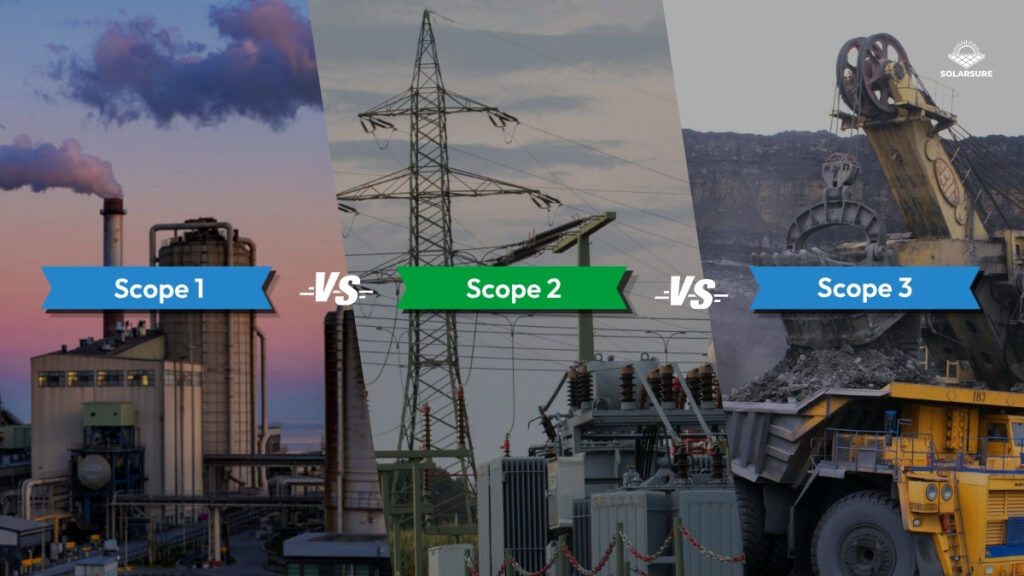
Scope 1, 2 and 3 emissions are three categories used to classify greenhouse gas (GHG) emissions across a company’s entire value chain. The Greenhouse Gas Protocol established this framework in 2001, and it remains the world’s most widely used carbon accounting standard today.
Every business in India, from a textile manufacturer to an IT park, produces emissions that fall into one or more of these three scopes. Understanding which category your emissions belong to is the first and most critical step toward building a meaningful net-zero strategy.
As a solar EPC company, we work with businesses across India to cut emissions directly at the source. This guide breaks down each scope in simple terms, with examples, calculation methods, protocols, and actionable reduction strategies.
What are Scope 1 Emissions?
Scope 1 emissions are greenhouse gases released directly from sources that your company owns or operates. These are the most straightforward emissions to identify because they come from within your own premises or fleet. If your factory burns diesel in its generators, or your delivery trucks run on petrol, those are classic Scope 1 emissions.
Examples of Scope 1 Emissions
Mobile combustion covers fuel burned by company-owned vehicles. For instance, a cement company in Rajasthan running a fleet of diesel trucks produces Scope 1 emissions from every kilometre driven.
Stationary combustion includes fuel burned in boilers, furnaces, and generators on your site. For example, a manufacturing unit in Pune using a diesel generator during power cuts emits Scope 1 gases directly.
Process emissions come from industrial chemical reactions. Steel plants, cement kilns, and fertiliser factories across India release CO₂ as a natural by-product of their production process. These also come under scope 1 emissions.
Fugitive emissions are unintentional gas leaks. Refrigerant leaks from air conditioning systems in large commercial buildings are a common and often overlooked Scope 1 source.
How to Calculate Scope 1 Emissions?
The most accurate method is direct measurement. You monitor the concentration and flow rate of gases emitted from each source continuously.
The more practical approach for most Indian businesses is the activity-based method. You multiply your fuel consumption data, like litres of diesel, cubic metres of natural gas, by standardised emission factors published by the IPCC or India’s Bureau of Energy Efficiency (BEE).
How Solar Reduces Scope 1 Emissions?
Installing rooftop or open access solar reduces your dependence on diesel generators almost immediately. When your operations run on solar energy during the day, your generator stays off. That directly eliminates a Scope 1 emission source from your inventory.
Moreover, electrifying your vehicle fleet and powering those vehicles through on-site solar generation is another powerful strategy. It removes mobile combustion emissions at their root.
What are Scope 2 Emissions?
Scope 2 emissions result from the generation of electricity, steam, or heat that your company buys and uses. The emissions themselves occur at the power plant, not at your facility. But since your consumption drives that generation, they are attributed to your organisation under the GHG Protocol.
Examples of Scope 2 Emissions
Every unit of grid electricity your office or factory consumes in India carries a carbon footprint. India’s national electricity grid still relies heavily on coal-based thermal power. The Central Electricity Authority (CEA) publishes an annual grid emission factor for India, which currently sits at approximately 0.71 kg CO₂ per kWh.
This means a mid-sized factory consuming 1,00,000 units of electricity per month generates over 71 tonnes of Scope 2 CO₂ every single month, which is just from purchased power.
Moreover, the purchased steam and district cooling used in industrial processes also fall under this scope.
How to Calculate Scope 2 Emissions?
The scope 2 calculation is relatively straightforward. You take your total electricity consumption in kilowatt-hours from your utility bills and multiply it by the applicable grid emission factor for your region or state.
India has state-level emission factors published by BEE and CEA. States like Jharkhand and Chhattisgarh with coal-heavy grids carry higher emission factors, while states with higher renewable penetration carry lower ones.
How Solar Reduces Scope 2 Emissions?
Every unit of electricity generated from your rooftop solar system or ground-mounted plant directly replaces grid electricity. For every unit you consume from your solar plant, you replace grid electricity and eliminate scope 2 emissions unit by unit.
For Indian businesses preparing ESG reports, filing with SEBI’s Business Responsibility and Sustainability Reporting (BRSR) framework, or responding to supply chain audits from international buyers, reducing Scope 2 through solar is the single most cost-effective and credible action available today.
What are Scope 3 Emissions?
Scope 3 emissions are all other indirect emissions that occur across your company’s upstream and downstream value chain. These emissions are not within your direct operational control, but they are a consequence of your business activities. They represent the largest and most complex portion of any company’s carbon footprint.
Scope 3 typically accounts for 88% to 90% of a company’s total carbon footprint. For most Indian companies, especially manufacturers and exporters, the overwhelming majority of their climate impact lives in Scope 3.
This is why global buyers, particularly from the European Union, the United States, and Japan, are increasingly requesting Scope 3 data from Indian suppliers. Regulations like the EU’s Carbon Border Adjustment Mechanism (CBAM) are making this not just an ethical question but a trade and compliance one.
Examples of Scope 3 Upstream Emissions
Upstream Scope 3 covers everything that happens before your production process begins. Emissions from mining and refining the raw materials you purchase are upstream Scope 3. The carbon footprint of the machinery and equipment your company buys is also included here.
Business travel by your employees, such as taking flights for client meetings, is also an upstream Scope 3 emission. Additionally, your employees’ daily commute to work, waste generated in your operations, including the emissions from its disposal, are aslo falls under scope 3 emissions.
Examples of Scope 3 Downstream Emissions
Downstream Scope 3 covers what happens after your product leaves your facility. The transportation of your finished goods to distributors or customers generates downstream emissions.
The energy your customers consume while using your product is a significant downstream source. For consumer electronics or industrial equipment companies, this is often the largest single Scope 3 category.
Moreover, the end-of-life disposal of your products, whether they go to landfill or recycling, also contributes to your downstream Scope 3 footprint.
How to Calculate Scope 3 Emissions?
Scope 3 is the most complex scope to calculate, and most Indian companies are only beginning this journey. The primary method involves collecting activity data across your value chain and applying relevant emission factors.
For raw material procurement, you work with supplier-specific emission factors or use industry-average data from databases like ecoinvent or the GHG Protocol’s emission factor repository. For employee commuting, you survey staff on travel modes and distances.
A simpler starting point is the spend-based or transaction-based method. You multiply the money spent in each procurement category by an economic emission factor. This provides a reasonable first estimate without needing granular data from every supplier.
How Does Solar Help Reduce Scope 3 Emissions?
The connection between solar and Scope 3 runs deeper than most businesses realise. When your key suppliers install solar at their facilities, their Scope 2 emissions fall. That directly lowers your upstream Scope 3 number. Engaging your supplier network on renewable energy adoption is one of the most scalable Scope 3 strategies available to Indian companies today.
Green logistics solutions, such as electrifying distribution fleets and powering logistics hubs with solar energy, also reduce downstream transportation emissions. This is an active area of growth across Indian supply chains, particularly in FMCG, pharma, and auto components sectors.
Product design changes that reduce the energy needed for customer use, supported by clean energy solutions, directly lower your downstream use-phase emissions. A solar-powered manufacturing process that enables you to embed lower-carbon components into your product creates a genuine Scope 3 reduction story.
You can also read: Cost of a Commercial Solar Plant in India: A Complete Pricing Guide for Businesses
The Difference Between Scope 1, Scope 2, and Scope 3 Emissions: A Comparative View
| Basis | Scope 1 | Scope 2 | Scope 3 |
| Meaning | Emissions you create directly | Emissions from the electricity or energy businesses buy | Emissions linked to your entire business ecosystem |
| Where Emissions Occur | Within company premises or assets | At the power plant that generates your electricity | Outside your company, before and after your operations |
| Ownership & Control | Fully owned and controlled by the company | Not owned but directly linked to energy consumption | Not owned or controlled, only influenced |
| Type of Emissions | Direct | Indirect (energy-related) | Indirect (value chain-related) |
| Examples | Diesel used in generators or trucks | Electricity used in office or factory | Supplier emissions, product transport, customer usage |
| Difficulty to Track | Easiest to measure | Relatively easy | Most complex to measure |
| Share in Total Emissions | Smaller portion | Moderate portion | Largest portion (often 80–90%) |
| Reporting Requirement | Mandatory | Mandatory | Recommended but increasingly expected |
Scope 1, 2 and 3 Emissions and the GHG Protocol: What Indian Businesses Need to Know?

The GHG Protocol Corporate Standard is the globally accepted framework that governs how companies measure and report their emissions across all three scopes.
Under the GHG Protocol, reporting Scope 1 and Scope 2 emissions is mandatory for a complete corporate inventory. Scope 3 reporting is strongly recommended and is increasingly expected by regulators, investors, stakeholders, and global buyers.
India’s BRSR framework, mandated by SEBI for the top 1,000 listed companies by market capitalisation, requires disclosure of Scope 1 and Scope 2 emissions. Scope 3 disclosure is currently a leadership indicator but is expected to become mandatory in the coming years.
For companies operating in export-heavy sectors, like gems and jewellery, textiles, steel, aluminium, and chemicals, understanding all three scopes is a necessary business requirement to maintain market reputation and access.
How to Build Your GHG Emissions Inventory?
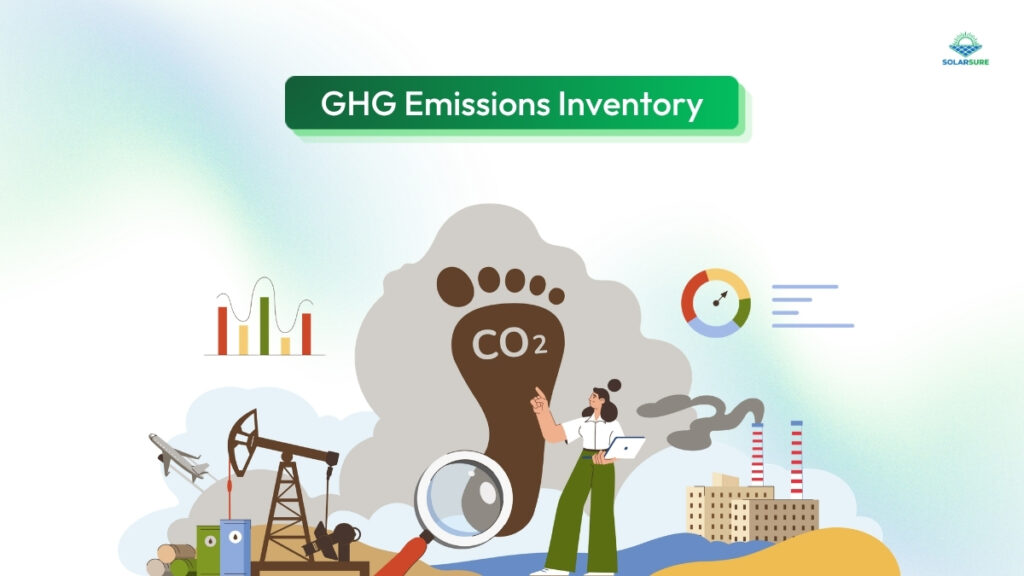
The practical starting point is developing an Inventory Management Plan. This means identifying your significant emission sources across all three scopes to establish a consistent boundary for reporting and selecting the most appropriate calculation methodology.
For most Indian manufacturing and commercial businesses, Scope 2 reduction through solar energy is the fastest, most cost-effective, convenient, and most measurable first action. It produces immediate results, generates verifiable data, and demonstrates credible climate commitment to stakeholders.
Scope 1 reductions follow through electrification and fuel switching, which is again, most effectively enabled by on-site solar and battery storage. Scope 3 management then builds on the credibility and supply chain relationships established through Scopes 1 and 2 action.
What are Scope 4 Emissions?
Scope 4 refers to avoided emissions, which is the positive climate impact of a product or service that prevents emissions elsewhere in the economy. Although it is not an official GHG Protocol category,
Solar energy is perhaps the most powerful Scope 4 story in the world today. Every megawatt of solar capacity installed displaces thermal generation from the grid. Every Indian business that switches to solar prevents tonnes of CO₂ that would otherwise have been emitted at a coal plant.
This avoided emissions narrative is increasingly valuable for sustainability reporting, brand positioning, a cleaner environment, and investor communication. It is a story that solar-powered businesses can and should tell clearly and confidently.
Bottom Line
Understanding the nuances of Scope 1, 2, 3, and even the “avoided” Scope 4 emissions gives your business a massive competitive advantage. As India moves toward more stringent climate disclosures, the companies that act now will be the ones that secure global supply chain contracts and investor trust.
Transitioning to solar is the most effective way to address these scopes simultaneously. It provides a direct hit to your Scope 1 and 2 numbers while setting a standard for your entire value chain. At Solarsure, we specialise in making this transition smooth and informed, which ensures your engineering is precise and your ROI is clear.