Solar energy for commercial buildings is becoming a practical business investment. Rising electricity tariffs continue increasing operating costs across offices, malls, and hospitals. Meanwhile, large unused rooftops offer valuable space for clean electricity generation. Therefore, businesses can reduce grid dependence without purchasing additional land.
Commercial buildings usually consume most electricity during active daytime working hours. This demand aligns closely with the strongest daily solar generation period. As a result, solar power can replace expensive daytime grid electricity. It also improves energy cost visibility across long-term business operations.
However, successful adoption requires correct sizing, suitable rooftops, and quality engineering. Businesses must also evaluate financing, approvals, maintenance, and expected solar generation. This guide explains the benefits, challenges, costs, and implementation process. Moreover, verified examples will show how commercial properties use solar successfully.
What Is Solar Energy for Commercial Buildings?
Solar energy for commercial buildings refers to electricity generated from installed solar panels. These panels usually cover rooftops, parking areas, façades, or nearby land. Moreover, inverters convert generated electricity into usable alternating current power. The building then consumes this electricity across its daily operations.
Commercial solar can power lighting, cooling, elevators, computers, and common facilities. Therefore, businesses purchase fewer electricity units from their local distribution company. Surplus power may also enter the grid through approved metering arrangements. However, applicable rules depend on state regulations and connection categories.
A practical example comes from DLF’s commercial property portfolio. DLF reports rooftop solar installations across several managed commercial properties. Moreover, its properties combine onsite solar with other renewable electricity sources. This approach helps large buildings reduce conventional power dependence across daily operations.
What Are the Main Benefits of Solar Energy for Commercial Buildings?
Solar energy provides financial, environmental, and operational benefits for commercial properties. It converts unused building surfaces into productive energy-generating business assets. Moreover, daytime solar production aligns well with normal commercial operating hours. Therefore, buildings can replace costly grid electricity during active business periods.
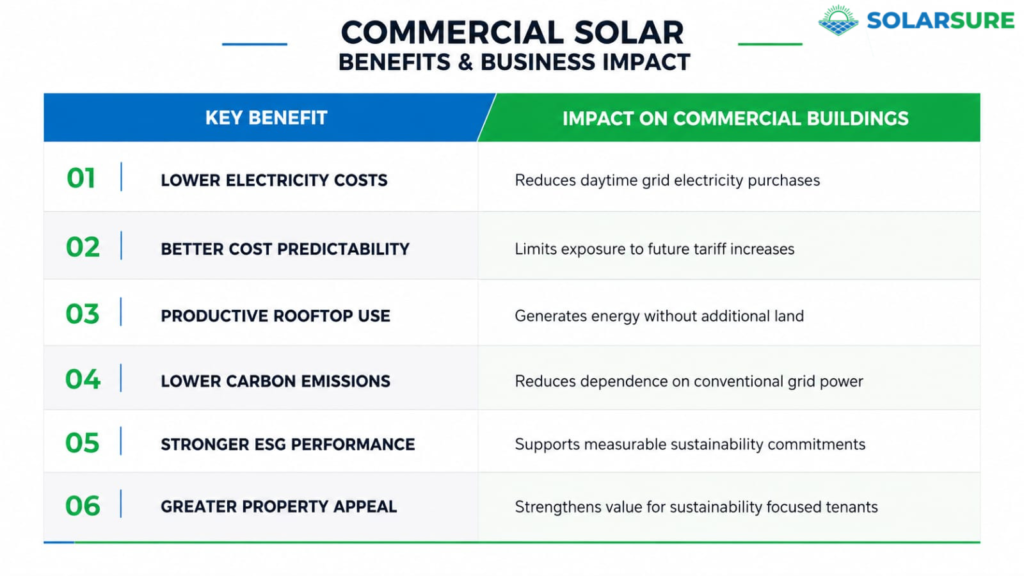
| Benefit | Impact on Commercial Buildings |
| Lower Electricity Costs | Reduces daytime electricity purchases from the conventional grid |
| Better Cost Predictability | Protects businesses against future electricity tariff increases |
| Productive Rooftop Use | Generates electricity without requiring additional land purchases |
| Lower Carbon Emissions | Reduces dependence on fossil-fuel-based grid electricity |
| Improved ESG Performance | Supports sustainability reporting and corporate climate commitments |
| Higher Property Appeal | Attracts tenants seeking efficient and sustainable commercial spaces |
| Energy Resilience | Supports integration with batteries and energy management systems |
Embassy Office Parks installed a 525 kW rooftop solar plant at Embassy 247. The installation covers approximately 4,000 square metres of available rooftop space. Moreover, its investor presentation projected a 3.8-year investment payback period. This example shows how office properties can convert rooftops into productive assets.
How Does Solar Reduce Electricity Costs for Commercial Buildings?
Solar power reduces bills by replacing costly grid electricity during daylight hours. Most commercial buildings operate when solar panels generate their strongest daily output. Therefore, high self-consumption can improve savings and shorten investment recovery periods. It also reduces exposure to future commercial electricity tariff increases.
However, savings depend on consumption, project size, tariffs, and financing structure. Oversized plants may export excessive electricity under less favourable settlement conditions. Therefore, engineers should size capacity using twelve months of electricity bills. They should also review daytime loads, sanctioned demand, and metering rules.
Marriott reported solar renewable electricity use across 20 hotels in India during 2021. Together, these properties accounted for 25,855 MWh of solar electricity consumption. This example demonstrates solar adoption across energy-intensive hospitality properties in India. Moreover, hotels can match solar generation with cooling and daytime service loads.
📊 Also Explore: Commercial Rooftop Solar Benefits, Costs, and Returns for Businesses
How Does Solar Improve ESG Performance and Reduce Emissions?
Solar energy replaces electricity generated from conventional fossil-fuel-based sources. Therefore, it can reduce a commercial building’s operational carbon emissions. Cleaner electricity also supports environmental, social, and governance commitments. Moreover, businesses can report renewable generation through measurable performance data.
Solar installations can strengthen sustainability reports and green-building certification efforts. They also demonstrate visible climate action to tenants and investors. As a result, sustainable buildings may attract environmentally responsible occupants. However, companies should monitor generation and document emission reductions accurately.
Infosys has installed 62.42 MWp of solar photovoltaic capacity across its operations. The capacity combines rooftop and ground-mounted solar systems across company campuses. Consequently, Infosys reduces conventional energy dependence while increasing onsite renewable generation. This example shows how solar supports measurable corporate ESG progress.
Can Solar Improve Energy Independence for Commercial Buildings?
Yes, solar can reduce a commercial building’s dependence on grid electricity. Onsite generation supplies power close to where businesses consume it. Therefore, buildings purchase fewer electricity units during productive daylight hours. This provides greater control over long-term energy costs and sourcing.
However, grid-connected solar alone cannot supply power during electricity outages. Safety mechanisms automatically disconnect conventional solar plants when the grid fails. Therefore, businesses need battery storage for reliable backup power. Critical buildings may also retain generators for extended emergencies.
Cochin International Airport has developed 50 MWp of installed solar capacity through multiple projects. Its solar portfolio has generated over 250 million electricity units. Moreover, the airport demonstrates renewable energy adoption across energy-intensive commercial infrastructure. This model shows how large facilities can reduce conventional power dependence.
Which Commercial Buildings Benefit Most from Solar Energy?
Commercial buildings with large daytime loads usually gain the highest savings. Offices, hospitals, malls, and hotels consume substantial electricity during sunlight hours. Therefore, they can directly use much of the generated solar power. Large rooftops also support higher capacity without requiring additional land.
However, every property needs a detailed technical and financial assessment. Rooftop strength, shadow-free area, tariffs, and electricity demand affect feasibility. Therefore, businesses should evaluate consumption patterns before selecting solar plant capacity.
| Commercial Building | Major Daytime Loads | Solar Suitability |
| Office Buildings | Cooling, lighting, computers, and elevators | High |
| Hospitals | Cooling, medical equipment, lighting, and ventilation | Very High |
| Shopping Malls | Cooling, lighting, escalators, and retail equipment | Very High |
| Hotels | Cooling, kitchens, laundry, and common facilities | High |
| Warehouses | Lighting, ventilation, refrigeration, and equipment | High |
| Educational Campuses | Classrooms, laboratories, offices, and cooling | High |
Apollo Hospitals generated 1,177,031 kWh from onsite solar panels during FY 2022–23. Hospitals require continuous power for cooling, ventilation, and medical equipment. Consequently, daytime solar generation can support their substantial operational electricity demand. This example demonstrates solar’s suitability for energy-intensive healthcare buildings.
What Solar Installation Options Can Commercial Buildings Use?
Commercial properties can install solar panels across several available spaces. Rooftops remain the most common option because they use existing surfaces. However, parking areas and façades can provide additional generation space. Businesses with limited rooftops may also consider offsite renewable electricity.
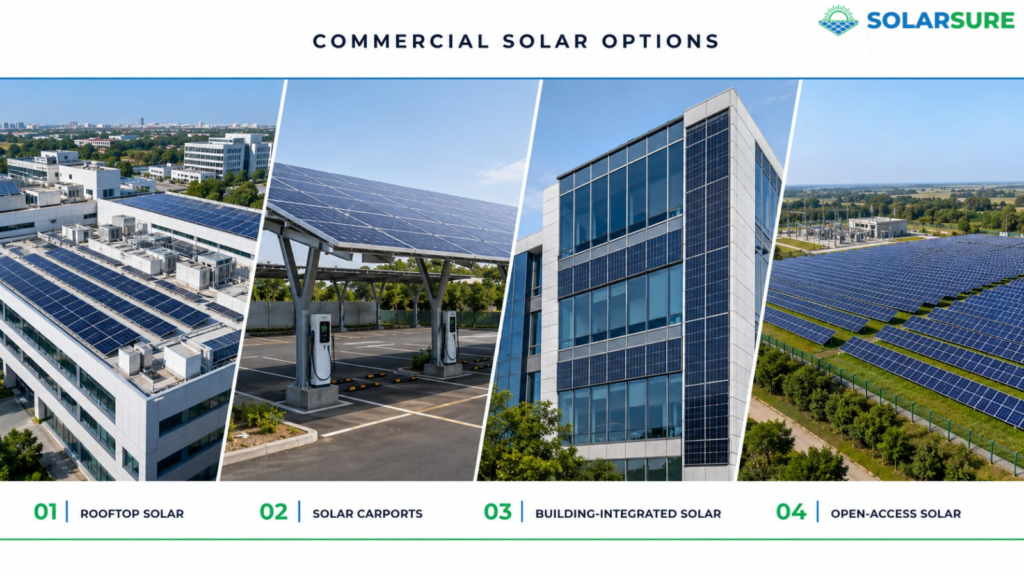
Common Solar Installation Options
- Rooftop solar: Suitable for offices, hospitals, malls, and warehouses.
- Solar carports: Generate power while providing shade for parked vehicles.
- Building-integrated solar: Uses solar materials across façades, roofs, or windows.
- Ground-mounted solar: Suitable when commercial properties have adjacent unused land.
- Open-access solar: Supplies renewable electricity from an offsite solar plant.
The right option depends on space, electricity demand, and regulations. Moreover, businesses can combine multiple formats for greater renewable energy coverage. Structural safety and grid feasibility must also guide final selection. Therefore, professional site assessment remains essential before project planning.
IKEA Adelaide combines rooftop and carport solar with battery storage. The commercial microgrid supplies renewable electricity to the retail store first. Additionally, surplus power can support the surrounding local energy network. This example demonstrates how businesses can combine solar formats effectively.
How Can Commercial Buildings Finance a Solar Project?
Commercial buildings can choose CAPEX, OPEX, or open-access solar models. Each option offers different ownership, investment, savings, and maintenance responsibilities. Therefore, businesses should select a model matching their financial priorities. Property ownership and available installation space also influence this decision.
| Factor | CAPEX Model | OPEX or RESCO Model | Open-Access Solar |
| Initial Investment | Paid by the business | Paid by the solar developer | Usually limited upfront investment |
| Asset Ownership | Business owns the solar plant | Developer owns the solar plant | Offsite developer owns the plant |
| Electricity Payment | No solar tariff after investment | Agreed tariff under a PPA | Tariff plus applicable grid charges |
| Maintenance | Business or hired EPC partner | Usually handled by developer | Managed by the power supplier |
| Savings Potential | Generally higher over the plant’s lifetime | Immediate savings without major CAPEX | Suitable for larger electricity demand |
| Best Suited For | Businesses with available capital | Businesses protecting working capital | Properties with limited onsite space |
The CAPEX model provides ownership and stronger long-term savings potential. However, OPEX allows adoption without a large initial capital investment. Meanwhile, open access supports buildings with high demand and limited rooftops. Regulations, contracts, and applicable charges require careful evaluation before selection.
Axis Bank operated 7.05 MW of rooftop solar across 248 locations by March 2021. Additionally, it procured solar power through a PPA for its Bengaluru data centre. Therefore, its approach demonstrates how businesses can combine ownership and procurement models.
How to Install Solar Energy in a Commercial Building
Installing commercial solar requires technical, financial, and regulatory planning. Therefore, businesses should avoid selecting capacity using rooftop area alone. Electricity consumption and daytime demand must guide the initial project design. A qualified EPC company can coordinate every stage efficiently.
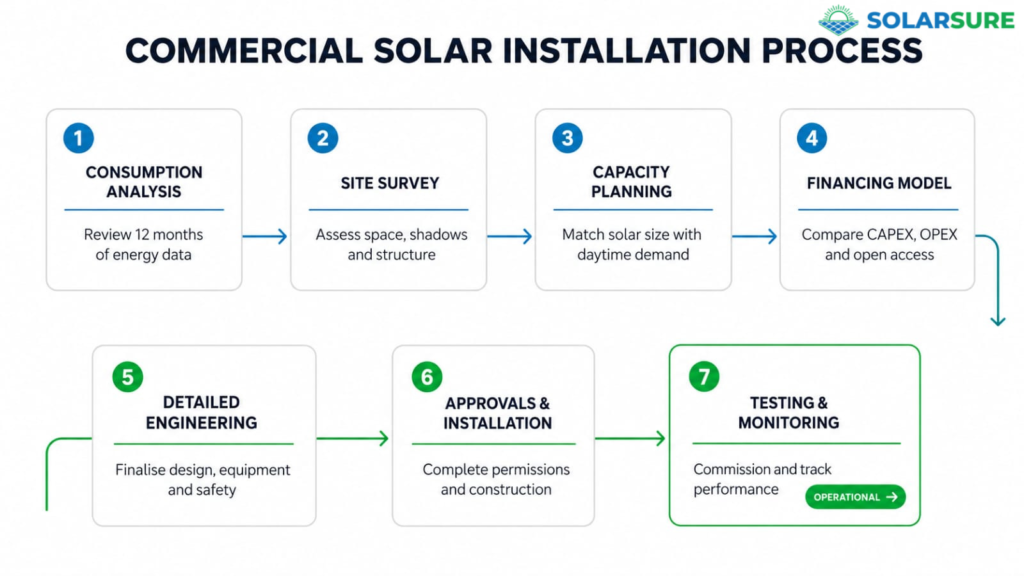
Step 1: Analyse Electricity Consumption
Review at least twelve months of electricity bills and demand data. Moreover, identify seasonal changes and major daytime electricity-consuming equipment.
Step 2: Conduct a Detailed Site Survey
Engineers should inspect rooftop space, shadows, access, and structural condition. They must also assess electrical infrastructure and the grid connection point.
Step 3: Determine the Correct Plant Capacity
Solar capacity should match available space and daytime electricity consumption. Therefore, correct sizing prevents unnecessary exports and improves financial returns.
Step 4: Select the Financing Model
Compare CAPEX, OPEX, leasing, and open-access procurement options. Additionally, assess ownership goals, available capital, and expected long-term savings.
Step 5: Finalise Engineering and Equipment
Select suitable panels, inverters, structures, cables, and protection equipment. Moreover, detailed engineering should follow applicable electrical and safety standards.
Step 6: Complete Approvals and Installation
The EPC partner should coordinate permissions, procurement, construction, and grid connectivity. However, approval requirements can vary across states and distribution companies.
Step 7: Test, Commission, and Monitor Performance
Engineers must test safety systems before commissioning the solar plant. Afterwards, digital monitoring should track generation, faults, and long-term performance.
🛠️ Project Planning Guide: Understand Solar EPC and the Complete Project Process
What Are the Challenges of Commercial Solar Installation?
Commercial solar offers strong benefits, but projects can face practical limitations. Common challenges include restricted space, structural concerns, approvals, and variable generation. However, early engineering assessments can identify most risks before installation begins.
Major Challenges and Practical Solutions
- Limited rooftop space: Use efficient panels, carports, or offsite solar procurement.
- Weak roof structure: Conduct structural testing before finalising panel layouts.
- Shadows and obstructions: Complete detailed shadow analysis using professional design software.
- High initial investment: Consider OPEX, leasing, or specialised solar financing options.
- Approval delays: Select an EPC partner experienced with local distribution requirements.
- Variable solar generation: Combine solar with grid power and battery storage.
- Maintenance access: Preserve safe walkways around panels and electrical equipment.
- Roof ownership issues: Review lease duration and landlord permissions before investment.
Solar projects also require coordination with existing building operations. Therefore, installation schedules should minimise disruption to occupants and essential services. Fire safety, drainage, and equipment access must remain protected throughout execution. Moreover, warranties should clearly define long-term maintenance responsibilities.
Apple Park includes a 17 MW onsite rooftop solar installation within its building design. Additionally, the campus integrates battery storage and microgrid-based energy management. This planned approach demonstrates the value of early architectural and electrical coordination. Consequently, integrated planning can overcome space, performance, and infrastructure challenges.
Best Practices for Commercial Solar Projects
Strong solar performance depends on planning, equipment quality, and maintenance. Therefore, businesses should evaluate lifetime value instead of comparing only prices. Small engineering compromises can reduce generation and increase long-term operational risks.
Expert Tips for Better Solar Performance
- Analyse twelve months of electricity bills before deciding plant capacity.
- Complete structural, electrical, and detailed shadow assessments before installation.
- Select equipment with clear warranties and reliable service support.
- Maintain safe walkways for cleaning, inspections, and emergency access.
- Use quality cables, connectors, earthing, and surge protection equipment.
- Install remote monitoring for generation, faults, and performance comparison.
- Define cleaning and preventive maintenance schedules before project commissioning.
- Review actual generation against expected monthly performance estimates.
- Keep warranties, drawings, test reports, and approvals properly documented.
Moreover, businesses should assess the EPC partner’s completed commercial projects. Technical teams must understand electrical safety and local approval procedures. Consequently, experienced project management can reduce delays and costly design changes.
DHL’s Poznan logistics centre uses solar for one-third of its energy. The remaining demand comes from purchased green electricity. Additionally, the facility integrates electric-vehicle charging and efficient transport solutions. This example shows how solar works within broader energy planning.
Common Mistakes to Avoid When Installing Commercial Solar
Poor decisions during planning can weaken an otherwise profitable solar project. Therefore, businesses should review technical details beyond capacity and final price. A cheaper quotation may exclude essential safety equipment or long-term support.
Avoid These Commercial Solar Mistakes
- Selecting plant capacity without analysing actual daytime electricity consumption.
- Comparing quotations only through their final project price.
- Ignoring rooftop age, strength, waterproofing, and future renovation plans.
- Accepting equipment without verified brands, ratings, quantities, and warranties.
- Blocking drainage paths, fire routes, or maintenance access areas.
- Assuming solar will provide backup power without battery storage.
- Ignoring state metering rules and distribution company approval requirements.
- Choosing an EPC company without relevant commercial project experience.
- Skipping performance monitoring after the solar plant starts operating.
- Failing to document exclusions, timelines, responsibilities, and after-sales support.
Moreover, businesses should avoid relying on unrealistic generation or savings estimates. Expected output must consider location, shadows, system losses, and degradation. Therefore, proposals should clearly explain every assumption behind projected financial returns.
📘 Quality Reference: Review MNRE’s Quality Control Manual for Grid-Connected Rooftop Solar
Latest Commercial Solar Trends in 2026
Commercial solar is evolving beyond conventional rooftop panel installations. Businesses now combine generation, storage, monitoring, and smart electrical infrastructure. Therefore, modern projects provide greater control over energy use and performance.
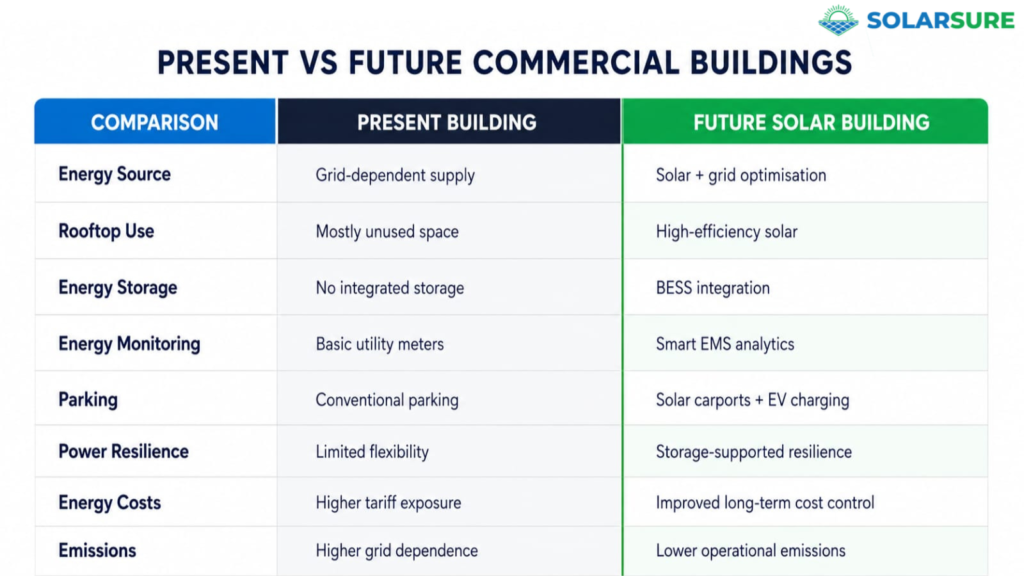
Key Trends Shaping Commercial Solar
- High-efficiency solar modules: Generate more electricity from limited rooftop space.
- Battery energy storage: Stores surplus solar electricity for later consumption.
- Energy management systems: Optimise solar, battery, grid, and building loads.
- Solar-powered EV charging: Supports cleaner employee and commercial vehicle charging.
- Building-integrated photovoltaics: Incorporates solar technology into roofs and façades.
- Artificial intelligence monitoring: Detects faults and predicts maintenance requirements.
- Solar carports: Combine electricity generation with shaded parking infrastructure.
- Hybrid procurement models: Combine rooftop solar with open-access renewable electricity.
Moreover, smart commercial buildings increasingly manage energy through integrated dashboards. These platforms compare consumption, generation, batteries, and grid electricity continuously. As a result, facility managers can identify inefficiencies and improve energy decisions.
Google developed its “dragonscale” solar roof for Bay View and Charleston East. Its overlapping panel design combines renewable generation with distinctive building architecture. Consequently, this project demonstrates growing interest in building-integrated solar solutions.
🔋 Related Insight: Explore How Battery Energy Storage Supports Commercial Solar
What Is the ROI and Payback Period for Commercial Solar?
Commercial solar does not have one fixed payback period. Project returns depend on investment, tariffs, generation, financing, and self-consumption. Therefore, every business needs a customised financial assessment before making decisions.
How to Calculate Solar Payback
Simple Payback Period = Total Project Investment ÷ Annual Net Savings
Annual net savings should include reduced electricity purchases and applicable benefits. However, businesses must subtract maintenance, insurance, financing, and replacement expenses. This approach provides a more realistic estimate than gross savings alone.
Factors Affecting Commercial Solar ROI
- Existing commercial electricity tariff
- Available shadow-free rooftop area
- Plant capacity and annual generation
- Percentage of solar power consumed onsite
- CAPEX, OPEX, or loan financing structure
- Equipment quality and performance degradation
- Maintenance and inverter replacement costs
- Applicable taxes, depreciation, and regulatory charges
Moreover, businesses should assess lifetime savings beyond the initial payback period. Solar panels can continue producing electricity for many years afterward. Consequently, reliable equipment and proper maintenance can improve total project returns.
American Family Insurance installed a 1.2 MW rooftop solar plant at its headquarters. The project supplies over seven percent of the facility’s electricity demand. Additionally, the developer projects $5.6 million in savings across thirty years. This example highlights the importance of evaluating long-term financial value.
How Much Maintenance Does Commercial Solar Require?
Commercial solar plants require limited but consistent preventive maintenance. Regular inspections protect generation, safety, warranties, and long-term financial returns. Therefore, maintenance should begin immediately after project commissioning.
Essential Maintenance Activities
- Clean panels according to local dust and weather conditions.
- Monitor daily generation and investigate unusual performance reductions.
- Inspect cables, connectors, structures, and electrical protection equipment.
- Check inverter alarms, temperatures, ventilation, and operating performance.
- Test earthing, lightning protection, and insulation at scheduled intervals.
- Remove vegetation, debris, and obstructions around installed equipment.
- Inspect rooftops for drainage problems, leakage, or structural movement.
- Maintain service records, warranties, test reports, and fault history.
Cleaning frequency should depend on dust, rainfall, and nearby activities. However, excessive cleaning can increase costs and create unnecessary safety risks. Remote monitoring helps teams identify performance issues before significant generation losses occur.
The U.S. Department of Energy reports 25–35-year average panel lifespans for modern installations. However, inverters and other components may require earlier servicing or replacement. Consequently, businesses should include lifecycle maintenance within their financial planning.
📈 Smart Energy Guide: See How an EMS Improves Commercial Energy Monitoring
Frequently Asked Questions (FAQs)
Q.Is solar energy suitable for every commercial building?
Solar suits buildings with adequate sunlight, usable space, and daytime electricity demand. However, structural condition and shadow patterns can limit rooftop installations. Businesses with unsuitable rooftops may consider carports or open-access solar. A professional feasibility study should confirm the best available option.
Q. How much rooftop space does a commercial solar plant require?
Required space depends on module efficiency, layout, shadows, and safety clearances. Higher-efficiency panels can generate more electricity from limited available rooftop space. However, engineers must preserve walkways, drainage routes, and emergency access. Therefore, capacity should never depend on gross rooftop area alone.
Q. Can commercial solar work during cloudy or rainy weather?
Yes, solar panels continue generating electricity under diffused sunlight. However, production becomes lower than generation during clear and sunny conditions. Annual estimates should already consider seasonal weather and expected solar radiation. Therefore, businesses should assess performance annually instead of judging individual days.
Q. Does commercial solar provide electricity during power cuts?
Standard grid-connected solar automatically stops operating during grid power failures. This safety feature prevents electricity from flowing into disconnected utility lines. However, battery storage can support selected building loads during outages. The backup design must match required power, duration, and critical equipment.
Q. Can tenants install solar on a leased commercial property?
Yes, tenants can install solar with written permission from property owners. However, the remaining lease duration should support the project’s financial recovery. Contracts must define ownership, maintenance, roof repairs, and removal responsibilities. Alternatively, tenants can explore offsite renewable electricity procurement where regulations permit.
Q. Do commercial buildings receive rooftop solar subsidies in India?
Most central rooftop subsidies primarily target eligible residential consumers, not businesses. However, commercial projects may access financing or applicable tax-related benefits. Policies can change across states, consumer categories, and project structures. Therefore, businesses should verify current provisions before preparing financial estimates.
Q. How long does commercial solar installation take?
Project duration depends on capacity, engineering, procurement, approvals, and site conditions. Smaller installations may finish faster than complex multi-building commercial projects. However, grid approvals and specialised equipment can extend the overall timeline. A detailed EPC schedule should define every milestone and responsibility clearly.
Q. How should businesses choose a commercial solar EPC company?
Businesses should evaluate experience, engineering capability, safety practices, and completed projects. They must also compare equipment, warranties, exclusions, and after-sales support. Moreover, reliable EPC companies provide transparent generation and financial assumptions. The lowest quotation does not always deliver the strongest lifetime value.
Bottom Line
Solar energy for commercial buildings offers measurable financial and environmental benefits. It reduces daytime grid consumption and improves long-term electricity cost predictability. Moreover, solar supports ESG targets and cleaner commercial building operations.
However, successful projects require accurate sizing, quality engineering, and transparent quotations. Businesses should evaluate rooftop condition, financing, approvals, safety, and maintenance carefully. Therefore, lifetime value matters more than the lowest initial project price.
Before investing, businesses should complete a detailed technical and financial assessment. They should compare generation estimates, equipment warranties, responsibilities, and projected savings carefully. Consequently, informed planning can turn available space into a valuable energy asset.