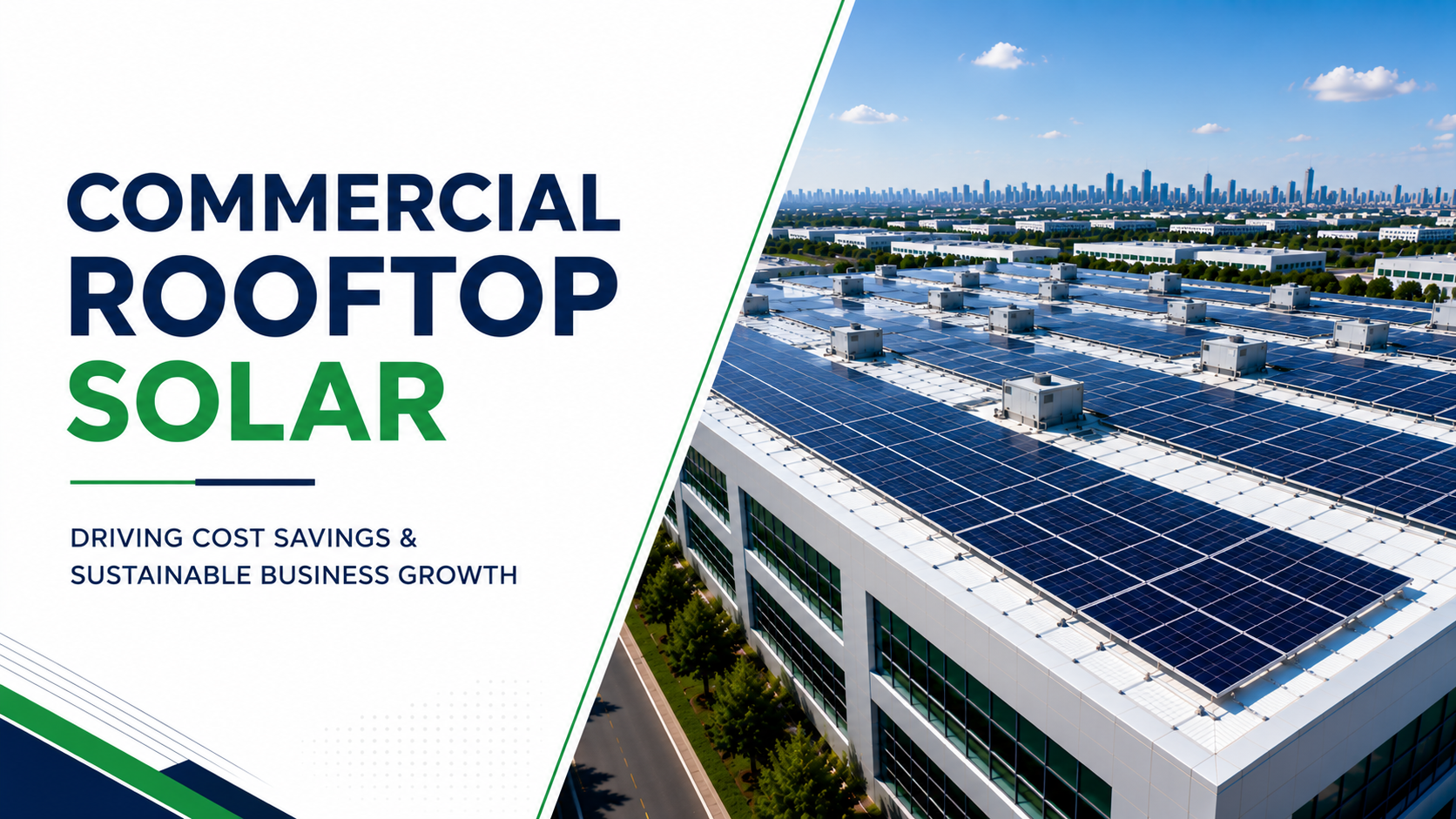
Commercial rooftop solar is transforming how businesses manage their energy costs and sustainability goals. According to the International Energy Agency (IEA), solar PV continues to be one of the fastest-growing sources of renewable electricity worldwide, supporting the global transition toward cleaner and more resilient energy systems. Rising electricity prices and growing environmental responsibilities have encouraged commercial and industrial (C&I) organizations to adopt cleaner energy solutions.
A commercial rooftop solar system enables businesses to generate electricity using the unused space on their rooftops. Therefore, companies can lower monthly electricity bills, protect themselves from fluctuating power tariffs, and achieve greater energy independence. Moreover, advancements in solar technology and supportive government initiatives have made commercial rooftop solar more accessible and financially attractive than ever before.
Today, manufacturing plants, warehouses, hospitals, educational institutions, hotels, shopping malls, and IT parks are using rooftop solar to strengthen both business performance and sustainability. In addition, many organizations are integrating solar systems with Battery Energy Storage Systems (BESS) and Energy Management Systems (EMS) to optimize energy consumption and improve power reliability.
In this guide, you’ll learn how commercial rooftop solar works, its key benefits, installation process, costs, return on investment (ROI), industry applications, government incentives, and best practices. Whether you are planning your first solar project or expanding an existing installation, this guide will help you make informed energy decisions for long-term business growth.
What Is Commercial Rooftop Solar?
Commercial rooftop solar is a solar power system installed on the roofs of commercial, industrial, and institutional buildings. It converts sunlight into electricity, helping businesses reduce grid dependence, lower electricity costs, and achieve long-term sustainability goals.
Commercial rooftop solar is a renewable energy solution designed for businesses with significant electricity consumption. It uses photovoltaic (PV) panels installed on rooftops to generate clean electricity during daylight hours. As a result, businesses can power their daily operations while reducing reliance on conventional grid electricity.
Unlike residential solar systems, commercial rooftop solar installations are built to meet higher energy demands. They often range from 20 kW to several megawatts (MW), depending on the facility size and electricity requirements. Moreover, these systems can be integrated with Battery Energy Storage Systems (BESS), Energy Management Systems (EMS), and smart monitoring platforms to improve energy efficiency and reliability.
Commercial rooftop solar is widely adopted across industries such as manufacturing, warehousing, healthcare, education, retail, hospitality, and IT. Therefore, organizations can reduce operating expenses, improve energy resilience, and support their environmental, social, and governance (ESG) commitments without disrupting daily operations.
Companies such as Amazon have installed rooftop solar across fulfilment centres to reduce energy costs and increase renewable energy use, while Nestlé has adopted rooftop solar at multiple manufacturing facilities to improve energy efficiency and lower carbon emissions. In India, Mahindra & Mahindra has also deployed rooftop solar across several manufacturing plants as part of its renewable energy and sustainability initiatives, demonstrating how businesses are using rooftop solar to strengthen both operational performance and sustainability
Key Features of Commercial Rooftop Solar
- Generates electricity using unused rooftop space.
- Reduces dependence on grid electricity.
- Lowers monthly electricity costs.
- Supports net metering where applicable.
- Integrates with BESS and EMS for smarter energy management.
- Helps businesses achieve sustainability and ESG goals.
- Delivers long-term returns with minimal maintenance.
| Feature | Description |
| Installation Location | Rooftops of commercial and industrial buildings |
| Typical Capacity | 20 kW to several MW |
| Primary Users | Factories, warehouses, hospitals, malls, hotels, offices, schools |
| Main Objective | Reduce electricity costs and improve energy efficiency |
| Power Source | Solar photovoltaic (PV) panels |
| Additional Integrations | BESS, EMS, Smart Meters, EV Charging |
| Expected System Life | 25–30 years (with proper maintenance) |
How Does Commercial Rooftop Solar Work?
Commercial rooftop solar systems convert sunlight into electricity through solar photovoltaic (PV) panels installed on the roof of a commercial or industrial building. The electricity generated is first used to meet the facility’s energy demand. As a result, businesses consume less electricity from the grid and significantly reduce their monthly power costs.
A typical commercial rooftop solar system includes solar panels, inverters, mounting structures, protection equipment, and a monitoring system. Moreover, businesses can integrate the system with Battery Energy Storage Systems (BESS), Energy Management Systems (EMS), and net metering to improve energy efficiency and maximize savings.
The working process follows a simple cycle:
| Step | What Happens? |
| 1. Solar Panels Capture Sunlight | PV panels absorb sunlight and generate Direct Current (DC) electricity. |
| 2. Inverter Converts Power | The solar inverter converts DC electricity into Alternating Current (AC) for business use. |
| 3. Electricity Powers Operations | The generated electricity supplies power to machinery, lighting, HVAC systems, and other equipment. |
| 4. Excess Energy Is Managed | Surplus electricity can be exported to the grid through net metering or stored in a Battery Energy Storage System (BESS). |
| 5. Real-Time Monitoring | Monitoring software tracks system performance, electricity generation, and energy savings. |
This continuous process helps businesses reduce electricity costs while improving energy reliability. Therefore, commercial rooftop solar becomes a long-term investment rather than just an alternative power source.
Real-World Examples
Asian Paints has installed rooftop solar across several manufacturing facilities to reduce electricity consumption and improve operational efficiency. The company combines renewable energy with other energy-saving initiatives to strengthen its sustainability strategy.
Similarly, Dabur India has adopted rooftop solar at multiple manufacturing plants to increase the share of clean energy in its operations. This investment supports both cost optimization and carbon reduction goals.
In the healthcare sector, Apollo Hospitals has implemented rooftop solar at selected facilities to offset daytime electricity demand. As a result, the organization lowers operating costs while supporting environmentally responsible healthcare infrastructure.
How Businesses Maximize Solar Benefits
Many businesses enhance the value of rooftop solar by integrating it with other energy technologies:
- Battery Energy Storage Systems (BESS) store excess solar energy for later use.
- Energy Management Systems (EMS) monitor and optimize electricity consumption in real time.
- Smart meters provide detailed energy insights and improve performance tracking.
- Net metering allows eligible businesses to export surplus electricity to the utility grid and receive credits in accordance with applicable state regulations. Businesses should review the latest net metering guidelines available through the National Portal for Rooftop Solar and their respective DISCOM before planning a commercial rooftop solar project.
By combining these technologies, businesses achieve greater energy efficiency, reduce dependence on conventional power sources, and improve long-term operational resilience.
Benefits of Commercial Rooftop Solar for Businesses
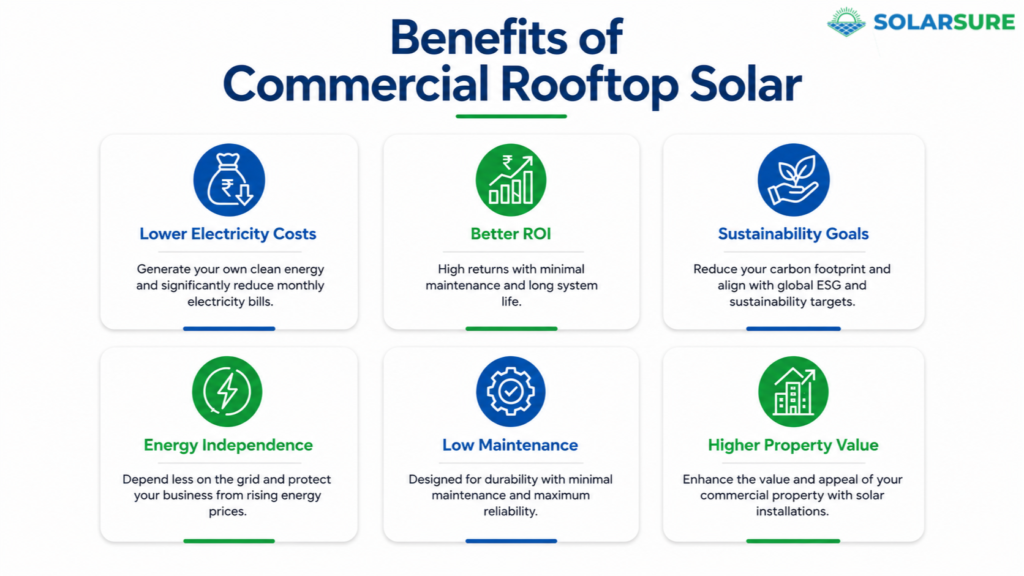
Commercial rooftop solar offers more than just lower electricity bills. It helps businesses improve operational efficiency, strengthen energy security, and achieve long-term sustainability goals. Therefore, organizations across industries are investing in rooftop solar to gain both financial and environmental advantages.
 Reduces Electricity Costs
Electricity is one of the largest operating expenses for many commercial and industrial businesses. A commercial rooftop solar system generates electricity on-site, reducing the amount of power purchased from the grid. As a result, businesses can significantly lower their monthly electricity bills while protecting themselves from rising power tariffs.
This approach has been adopted by companies across different sectors. Tata Power has installed rooftop solar systems across several commercial buildings to reduce electricity costs and improve energy efficiency, while DLF has integrated rooftop solar into multiple commercial properties to lower operating expenses. In the hospitality sector, The Indian Hotels Company Limited (Taj Hotels) also uses rooftop solar at selected properties to improve energy performance and reduce utility costs.
Delivers Strong Long-Term Return on Investment (ROI)
Although rooftop solar requires an initial investment, it delivers substantial savings over its operational life. Most commercial solar systems have a lifespan of 25–30 years, allowing businesses to benefit from decades of lower electricity costs. Moreover, reduced maintenance requirements further improve the overall return on investment.
Businesses across industries are already realizing these long-term benefits. Bosch India has expanded renewable energy adoption across its manufacturing facilities to improve operational efficiency and support long-term sustainability, while Saint-Gobain India continues to invest in solar energy to reduce energy costs. Godrej Industries has also implemented rooftop solar across several facilities, demonstrating how strategic investments in clean energy can enhance both financial and environmental performance
Improves Energy Independence
Businesses that depend entirely on grid electricity remain vulnerable to tariff fluctuations and supply disruptions. Commercial rooftop solar helps reduce this dependence by generating clean electricity on-site. Furthermore, integrating the system with Battery Energy Storage Systems (BESS) provides backup power during outages and improves overall energy resilience.
Organizations across different sectors are strengthening their energy resilience through rooftop solar. NTPC Limited has deployed rooftop solar at several administrative buildings to increase renewable energy use, while Infosys has invested in on-site solar generation across multiple campuses to improve energy reliability. Cochin International Airport also combines solar power with efficient energy management to reduce dependence on conventional electricity, demonstrating how integrated energy solutions enhance operational resilience
Supports Sustainability and ESG Goals
Many businesses have committed to reducing carbon emissions and achieving sustainability targets. Commercial rooftop solar directly contributes to these objectives by replacing a portion of grid electricity with clean, renewable energy. Consequently, organizations can lower their carbon footprint while demonstrating environmental responsibility to customers, investors, and stakeholders.
Leading companies are already integrating rooftop solar into their sustainability strategies. Unilever continues to expand renewable energy across its global manufacturing operations, while PepsiCo India has increased its use of renewable electricity to support sustainability initiatives. ITC Limited has also integrated renewable energy into several manufacturing facilities as part of its long-term ESG strategy, demonstrating how rooftop solar helps businesses align operational efficiency with environmental commitments.
Enhances Brand Reputation
Customers, investors, and business partners increasingly prefer organizations that adopt sustainable business practices. Installing a commercial rooftop solar system demonstrates a company’s commitment to environmental responsibility and innovation. As a result, businesses strengthen their corporate reputation while creating a positive brand image.
Several leading brands have adopted rooftop solar as part of their broader sustainability initiatives. Decathlon India has incorporated renewable energy across selected stores and facilities, while L’Oréal India continues to invest in sustainable manufacturing practices, including renewable energy adoption. IKEA has also implemented rooftop solar across several stores worldwide, reinforcing its commitment to sustainability while strengthening its environmentally responsible brand image.
| Business Benefit | How It Creates Value |
| Lower Electricity Costs | Reduces dependence on expensive grid electricity |
| Higher ROI | Generates long-term savings over 25–30 years |
| Energy Independence | Minimizes exposure to tariff hikes and power disruptions |
| Sustainability | Supports ESG, net-zero, and carbon reduction goals |
| Better Brand Image | Demonstrates environmental leadership and innovation |
| Low Maintenance | Requires minimal maintenance after installation |
| Future Readiness | Integrates with BESS, EMS, EV charging, and smart energy systems |
Industries That Benefit Most from Commercial Rooftop Solar
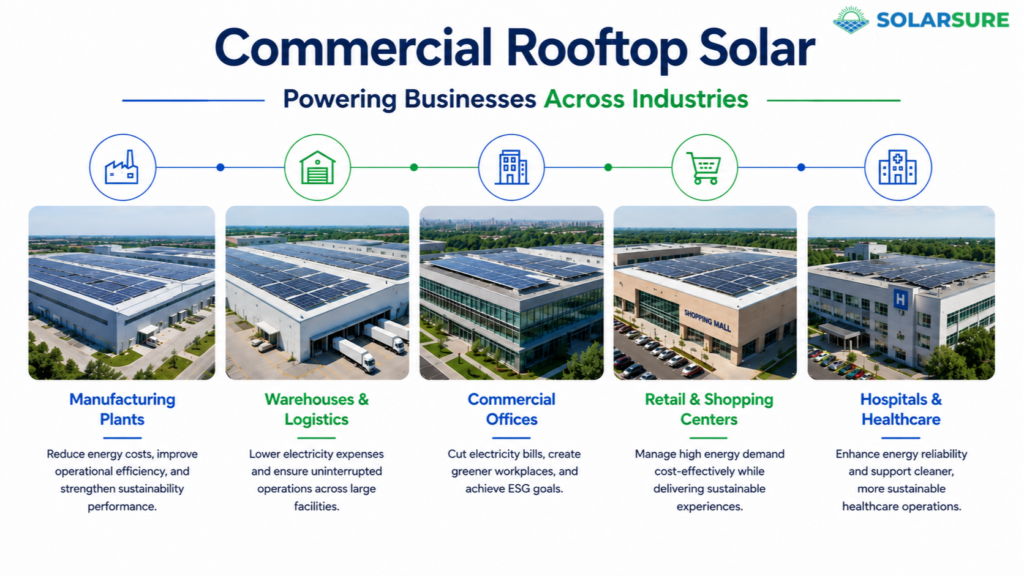
Commercial rooftop solar delivers value across many industries. However, businesses with high daytime electricity consumption often achieve the greatest savings. These organizations can generate clean electricity when demand is highest, reducing dependence on expensive grid power. As a result, they improve operational efficiency while lowering long-term energy costs.
Industries That Benefit the Most
| Industry | How Commercial Rooftop Solar Adds Value |
| Manufacturing | Powers production lines, machinery, and utilities while reducing electricity costs. |
| Warehouses & Logistics | Supports lighting, HVAC systems, and automated equipment with clean energy. |
| Hospitals | Reduces operating costs while ensuring reliable daytime power for critical services. |
| Educational Institutions | Lowers electricity expenses across classrooms, laboratories, and hostels. |
| Hotels & Hospitality | Powers air conditioning, kitchens, and guest facilities while supporting sustainability goals. |
| Shopping Malls & Retail | Reduces common area electricity costs and improves operational efficiency. |
| IT Parks & Commercial Offices | Powers offices, data rooms, and cooling systems while lowering utility bills. |
| Food & Beverage Processing | Supports refrigeration, processing equipment, and packaging operations with renewable energy. |
Manufacturing Industry
Manufacturing plants consume large amounts of electricity to operate production lines, heavy machinery, compressors, and utility systems. Therefore, commercial rooftop solar helps manufacturers reduce operating costs while improving energy efficiency.
Leading manufacturers are already leveraging rooftop solar to optimize energy consumption and support sustainability goals. Havells India has adopted rooftop solar across several manufacturing facilities to increase renewable energy use, while CEAT continues to expand solar installations at its production plants as part of its sustainability initiatives. JK Tyre has also invested in renewable energy solutions to improve operational performance and reduce carbon emissions, demonstrating how rooftop solar helps manufacturers enhance both business efficiency and environmental performance.
Warehouses and Logistics
Modern warehouses operate for long hours and depend heavily on lighting, material handling equipment, and climate control systems. Commercial rooftop solar supplies clean electricity during peak operating hours, helping logistics companies reduce electricity expenses.
Logistics companies are increasingly adopting rooftop solar to improve operational efficiency and support sustainable warehouse operations. DHL has installed rooftop solar at logistics facilities in several countries to enhance energy efficiency, while Flipkart has expanded renewable energy adoption across parts of its logistics network. Prologis also integrates rooftop solar into many of its logistics parks worldwide, demonstrating how clean energy can reduce operating costs while supporting long-term sustainability.
Healthcare Facilities
Hospitals require uninterrupted electricity to power medical equipment, operating theatres, laboratories, and cooling systems. As a result, rooftop solar helps healthcare facilities lower energy costs without affecting patient care. When combined with battery storage, it also improves energy resilience during power interruptions.
Healthcare organizations are increasingly adopting rooftop solar to improve energy efficiency and support reliable operations. Narayana Health has implemented renewable energy initiatives across selected hospitals, while Max Healthcare continues to enhance energy efficiency through sustainable infrastructure investments. Fortis Healthcare has also adopted green building and renewable energy practices at several facilities, demonstrating how clean energy solutions can strengthen both operational resilience and long-term sustainability in the healthcare sector
Educational Institutions
Schools, colleges, and universities consume significant electricity for classrooms, laboratories, libraries, and residential campuses. Commercial rooftop solar helps educational institutions reduce utility expenses while promoting environmental awareness.
Educational institutions are increasingly investing in rooftop solar to lower operating costs and support sustainable campus development. IIT Madras has installed rooftop solar to increase renewable energy generation on campus, while Delhi University has adopted solar power across several buildings. Amity University also continues to expand its renewable energy initiatives, demonstrating how rooftop solar can create more energy-efficient and environmentally responsible campuses.
Hotels and Commercial Buildings
Hotels, office complexes, and shopping malls operate throughout the day and have high electricity demand for HVAC systems, lighting, elevators, and other essential services. Therefore, commercial rooftop solar provides a practical solution to reduce operating costs while improving sustainability performance.
For instance, The Oberoi Group has implemented renewable energy initiatives across selected properties. Similarly, Phoenix Mills continues to improve energy efficiency across its commercial developments. Furthermore, Brigade Group has integrated sustainable building practices, including renewable energy, into several projects.
Commercial Rooftop Solar Cost & ROI
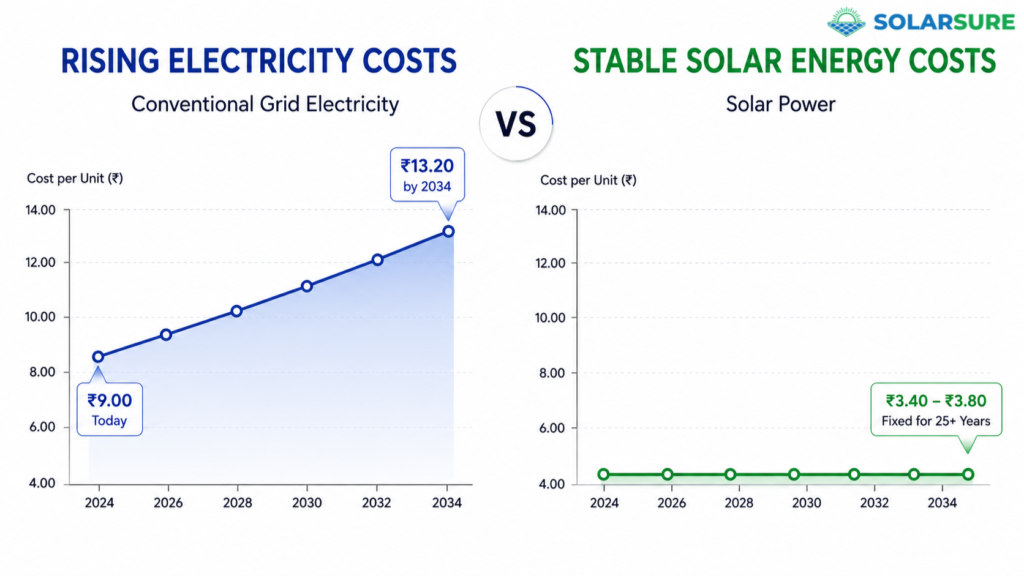
Commercial rooftop solar is a long-term business investment. It helps reduce electricity costs for many years. Therefore, businesses should focus on lifetime value instead of upfront expenses.
The installation cost depends on several factors. These include system capacity, roof condition, panel technology, and inverter type. Project location also affects the overall investment. Moreover, adding Battery Energy Storage Systems (BESS) or Energy Management Systems (EMS) increases both functionality and project cost.
The return on investment depends on energy consumption and system performance. Businesses with high daytime electricity use often recover their investment faster. They consume more solar power on-site. As a result, they purchase less electricity from the grid.
Electricity tariffs also influence solar savings. Higher tariffs increase the value of every unit generated. Similarly, proper system design and regular maintenance improve long-term performance. Net metering, where available, can further increase financial returns.
Businesses across industries are already benefiting from these factors. Marico has installed rooftop solar across several manufacturing facilities to improve efficiency and reduce electricity costs, while Pidilite Industries has expanded renewable energy across selected plants to support both operational savings and sustainability goals. In the retail sector, DMart (Avenue Supermarts) has also deployed rooftop solar at stores and distribution centres, demonstrating how commercial rooftop solar can improve energy efficiency while delivering long-term financial benefits.
Expert Tips to Maximize Solar ROI
Businesses can improve their return on investment by following these best practices:
- Conduct an energy audit before designing the system.
- Match system capacity with actual electricity demand.
- Choose high-quality solar panels and reliable inverters.
- Monitor system performance regularly.
- Schedule preventive maintenance every year.
- Integrate rooftop solar with EMS and BESS.
- Partner with an experienced Solar EPC company.
Commercial Rooftop Solar Installation Process
Installing a commercial rooftop solar system requires careful planning. Every project starts with an energy assessment. The system is then designed to match the business’s electricity needs. As a result, businesses achieve better performance and higher long-term savings.
Although every project is different, the installation process usually follows these steps.
Energy Assessment and Site Survey
The first step is to evaluate the facility’s electricity consumption. Experts also inspect the rooftop condition and available space. Moreover, they analyse shadow-free areas and structural strength before designing the system.
For example, Britannia Industries has adopted renewable energy after evaluating energy demand across several manufacturing facilities. Similarly, Voltas has improved energy efficiency through site-specific renewable energy initiatives. Astral Limited has also expanded renewable energy adoption across selected operations.
System Design and Engineering
After the survey, engineers prepare a customized solar design. They determine the system capacity, panel layout, inverter configuration, and cable routing. Therefore, the system delivers maximum energy generation throughout the year.
Proper engineering also ensures safety and long-term reliability. In addition, the design considers future expansion if electricity demand increases.
Approvals and Regulatory Compliance
Before installation, businesses must obtain the required approvals. These may include DISCOM permissions, net metering approval, and electrical safety clearances where applicable.
An experienced Solar EPC company manages these approvals, helping businesses avoid unnecessary delays during project execution. Companies such as Larsen & Toubro (L&T) follow strict engineering and compliance standards while delivering renewable energy projects, whereas Adani Wilmar has implemented renewable energy projects after fulfilling regulatory requirements. These examples highlight the importance of proper compliance and project planning in ensuring smooth commercial rooftop solar installations.
Installation and Commissioning
Once approvals are complete, the installation begins. Engineers install mounting structures, solar panels, inverters, and electrical equipment. They also perform detailed quality checks during every stage.
After installation, the system undergoes testing and commissioning. Therefore, businesses receive a fully operational solar plant that meets safety and performance standards. Companies such as Hindustan Unilever Limited (HUL) have expanded renewable energy across manufacturing facilities through phased implementation, while Crompton Greaves Consumer Electricals continues to increase renewable energy adoption across selected operations. These examples demonstrate how a structured installation and commissioning process supports reliable long-term system performance
Monitoring and Maintenance
Installation is only the beginning. Regular monitoring helps businesses track electricity generation and system performance. Moreover, preventive maintenance improves efficiency and extends system life.
Many organizations also integrate Energy Management Systems (EMS) for real-time monitoring. Others add Battery Energy Storage Systems (BESS) to improve energy reliability and maximize solar utilization.
Best Practices for a Successful Installation
- Conduct a detailed energy audit before project planning.
- Choose high-efficiency solar panels and reliable inverters.
- Verify the rooftop’s structural strength.
- Work with an experienced Solar EPC company.
- Monitor system performance regularly.
- Schedule preventive maintenance at regular intervals.
- Plan future capacity expansion during system design.
Challenges of Commercial Rooftop Solar and How to Overcome Them
Commercial rooftop solar offers significant long-term benefits. However, businesses may face a few challenges during planning and installation. The good news is that most of these issues can be resolved with proper design and an experienced Solar EPC partner.
Limited Rooftop Space
Some commercial buildings have limited rooftop space. Others may have HVAC systems, water tanks, or ventilation units occupying the roof. As a result, businesses may not have enough area for the required solar capacity.
However, engineers can optimize the panel layout to maximize energy generation, while high-efficiency solar panels produce more electricity even in limited space. Organizations such as Microsoft India have adopted rooftop solar across selected office campuses by optimizing available roof space, while Cisco has integrated solar systems into several commercial facilities. Adobe has also invested in rooftop solar as part of its renewable energy strategy, demonstrating how thoughtful system design helps businesses overcome space constraints without compromising performance.
Roof Condition and Structural Strength
Not every rooftop is ready for solar installation. Older buildings may require structural reinforcement before installation begins. Therefore, a detailed structural assessment is essential before project execution.
A professional site survey helps identify potential issues early. This reduces project risks and improves long-term system safety.
For example, ACC Limited conducts engineering assessments before implementing infrastructure upgrades. Likewise, UltraTech Cement follows detailed technical evaluations for renewable energy projects.
High Initial Investment
Commercial rooftop solar requires upfront capital. This can be challenging for businesses with limited investment budgets.
However, several financing options are available today. Businesses can choose CAPEX, OPEX, leasing, or Power Purchase Agreement (PPA) models based on their financial goals.
For example, Infosys continues to invest in renewable energy through long-term sustainability planning. Similarly, Tech Mahindra has expanded renewable energy adoption across several facilities using strategic investment approaches. Wipro also continues to strengthen its clean energy portfolio.
Regulatory and Approval Processes
Commercial solar projects require approvals from local authorities and distribution companies. Delays in approvals can extend the project timeline.
Working with an experienced Solar EPC company simplifies this process. The EPC partner manages documentation, compliance, and coordination with relevant authorities.
For example, NTPC Green Energy manages large renewable projects by following structured regulatory processes. Similarly, Tata Power Renewable Energy executes commercial solar projects while meeting regulatory requirements.
System Performance and Maintenance
Solar systems require regular inspection to maintain peak performance. Dust, debris, and equipment faults can reduce electricity generation over time.
Fortunately, routine maintenance and digital monitoring help identify issues quickly. Moreover, integrating an Energy Management System (EMS) provides real-time performance insights and improves operational efficiency.
For example, Schneider Electric uses digital energy management solutions to monitor system performance across commercial facilities. Likewise, Siemens combines renewable energy with intelligent monitoring to improve energy efficiency.
How Businesses Can Overcome These Challenges
Businesses can reduce project risks by following a structured approach.
- Assess electricity consumption before planning.
- Conduct a detailed rooftop and structural survey.
- Select high-quality equipment from trusted manufacturers.
- Choose the right financing model.
- Partner with an experienced Solar EPC company.
- Monitor system performance regularly.
- Schedule preventive maintenance throughout the year.
Government Policies Supporting Commercial Rooftop Solar in India
The Indian government continues to promote renewable energy across commercial and industrial sectors. Although direct capital subsidies are generally not available for commercial rooftop solar projects, several policies encourage businesses to adopt clean energy. As a result, organizations can improve project viability while supporting India’s renewable energy targets.
One of the biggest policy enablers is net metering. Under this mechanism, eligible businesses can export surplus solar electricity to the grid and receive credits according to applicable state regulations. However, net metering policies vary from one state to another. Therefore, businesses should always review the latest guidelines issued by their local DISCOM before planning a project.
Commercial rooftop solar also aligns with India’s long-term renewable energy ambitions. The government continues to expand clean energy capacity through supportive policies and regulatory reforms. Consequently, many businesses are investing in rooftop solar to strengthen energy security and meet their sustainability commitments. Cochin International Airport, for example, has expanded its solar capacity through both rooftop and ground-mounted installations. This approach has helped the airport increase renewable energy generation while reducing dependence on conventional electricity.
Several public and private organizations are also using rooftop solar to improve operational efficiency. Indian Railways has installed rooftop solar across stations and service buildings to reduce electricity costs and increase renewable energy adoption. Similarly, Delhi Metro Rail Corporation (DMRC) has deployed rooftop solar at multiple facilities to support cleaner and more sustainable urban transport operations.
Businesses should also ensure that their projects comply with applicable regulations and technical standards. Working with an experienced Solar EPC partner simplifies approvals, grid connectivity, and regulatory documentation. In addition, organizations should stay updated with the latest notifications issued by the Ministry of New and Renewable Energy (MNRE), the Central Electricity Authority (CEA), and their respective state DISCOMs.
Future Trends in Commercial Rooftop Solar
Commercial rooftop solar is evolving beyond electricity generation. Today, businesses are adopting intelligent energy solutions to improve efficiency, reliability, and sustainability. As a result, rooftop solar is becoming an important part of modern energy management strategies.
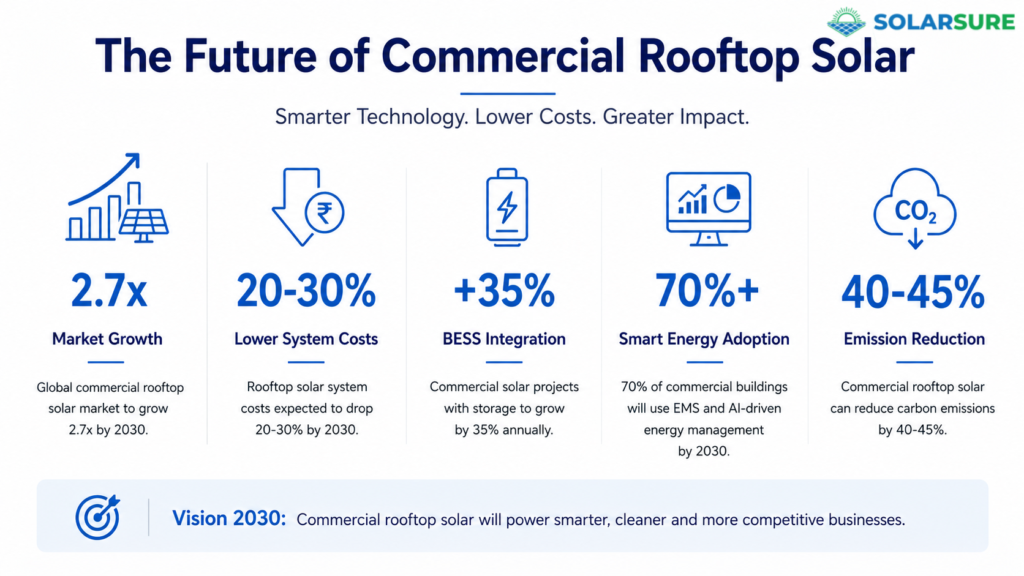
One of the biggest trends is the integration of Battery Energy Storage Systems (BESS). Solar panels generate the most electricity during the day, while energy demand often continues after sunset. BESS stores excess solar energy for later use. Therefore, businesses can reduce grid dependence and improve power availability during peak demand. For example, Amazon has expanded solar and battery storage projects across several facilities to strengthen energy resilience and support its renewable energy goals.
Another major trend is the adoption of Energy Management Systems (EMS). An EMS continuously monitors energy generation and consumption from a single platform. It helps businesses identify inefficiencies, optimize equipment performance, and reduce unnecessary electricity usage. Similarly, Schneider Electric provides digital energy management solutions that help commercial and industrial facilities improve operational efficiency through real-time monitoring and analytics.
Artificial Intelligence (AI) and the Internet of Things (IoT) are also transforming commercial rooftop solar. Smart sensors and AI-powered software can predict energy demand, detect equipment faults, and recommend corrective actions before problems occur. Consequently, businesses can improve system performance while reducing maintenance costs. Google, for instance, uses AI-driven energy optimization across its data centres to improve efficiency and lower electricity consumption.
Electric vehicle (EV) charging is another growing opportunity for commercial buildings. Many businesses are installing EV charging stations alongside rooftop solar systems. This combination allows organizations to power electric vehicles with clean energy while preparing for the rapid growth of electric mobility. IKEA has introduced solar-powered EV charging infrastructure at several locations to support sustainable transportation and improve the customer experience.
Looking ahead, commercial rooftop solar will become more connected, automated, and data driven. Businesses that combine rooftop solar with BESS, EMS, AI, and EV charging infrastructure will be better prepared for rising electricity costs and evolving sustainability requirements. Therefore, investing in an integrated energy ecosystem will create long-term business value beyond simple electricity savings.
Best Practices for Maximizing Commercial Rooftop Solar Performance
Installing a commercial rooftop solar system is only the first step. Businesses should also focus on long-term performance and energy optimization. A well-maintained system generates more electricity and delivers better financial returns throughout its lifespan.
Conduct a Detailed Energy Assessment
Every business has unique energy requirements. Therefore, an energy assessment should be the starting point of every solar project. It helps determine the right system size and identifies opportunities to improve energy efficiency before installation.
For instance, Bosch India focuses on improving energy efficiency across its manufacturing facilities before expanding renewable energy adoption. Similarly, Nestlé India continues to optimize energy consumption through a combination of efficiency measures and clean energy solutions.
Choose High-Quality Components
The performance of a solar plant depends on the quality of its components. Businesses should invest in reliable solar panels, inverters, mounting structures, and monitoring systems. Although premium equipment may cost more initially, it often delivers better performance and requires less maintenance.
Many global manufacturers, including Unilever, continue to invest in high-quality renewable energy infrastructure to improve long-term operational reliability and sustainability.
Monitor System Performance Regularly
Continuous monitoring helps businesses identify performance issues before they become major problems. Modern monitoring platforms provide real-time insights into electricity generation, equipment health, and overall system efficiency.
For example, Infosys uses digital energy management solutions across several campuses to improve operational efficiency and optimize renewable energy usage.
Schedule Preventive Maintenance
Solar panels require minimal maintenance. However, regular cleaning and periodic inspections are essential for maintaining peak performance. Dust, loose electrical connections, and faulty components can reduce energy generation over time.
Many industrial facilities follow preventive maintenance schedules to improve equipment reliability and maximize system output throughout the year.
Integrate Smart Energy Technologies
Commercial rooftop solar performs even better when combined with intelligent energy solutions. Businesses can integrate Battery Energy Storage Systems (BESS) to store excess electricity. They can also use Energy Management Systems (EMS) to monitor and optimize energy consumption in real time.
For example, Microsoft continues to expand smart energy technologies across its campuses to improve efficiency, reduce emissions, and strengthen energy resilience.
Frequently Asked Questions (FAQs)
Q. What is commercial rooftop solar?
Commercial rooftop solar is a solar power system installed on commercial, industrial, or institutional buildings. It generates clean electricity using rooftop space and helps businesses reduce electricity costs, improve energy efficiency, and achieve long-term sustainability goals.
Q. Which businesses can benefit from commercial rooftop solar?
Businesses with high daytime electricity consumption benefit the most. These include manufacturing plants, warehouses, hospitals, hotels, shopping malls, educational institutions, office buildings, and IT parks. However, any business with adequate rooftop space and consistent energy demand can consider rooftop solar.
Q.How much rooftop space is required for a commercial solar system?
The required rooftop space depends on the system capacity, panel efficiency, and installation design. A professional site assessment helps determine the available area and the maximum solar capacity that can be installed without affecting normal building operations.
Q.How long does a commercial rooftop solar system last?
Most commercial rooftop solar systems have an operational life of 25 to 30 years. However, their performance depends on equipment quality, installation standards, and regular maintenance. Routine inspections and timely servicing help maintain efficiency throughout the system’s lifespan.
Q. Can commercial rooftop solar work during a power outage?
A standard grid-connected solar system automatically shuts down during a power outage for safety reasons. However, businesses can continue using solar power by integrating the system with a Battery Energy Storage System (BESS) or other backup power solutions.
Q. Does commercial rooftop solar require regular maintenance?
Yes, regular maintenance helps maintain system performance. Businesses should clean solar panels, inspect electrical components, and monitor system performance periodically. Preventive maintenance reduces unexpected downtime and improves long-term energy generation.
Q. Is commercial rooftop solar suitable for every business?
Commercial rooftop solar is suitable for many businesses. However, factors such as rooftop condition, structural strength, electricity consumption, and local regulations should be evaluated before installation. A professional feasibility study helps determine whether the project is technically and financially viable.
Q.How can businesses maximize the return on investment from rooftop solar?
Businesses can improve ROI by selecting the right system size, using high-quality equipment, monitoring system performance regularly, and integrating technologies such as Energy Management Systems (EMS) and Battery Energy Storage Systems (BESS). Partnering with an experienced Solar EPC company also improves long-term project performance.
Q. Can commercial rooftop solar support ESG and sustainability goals?
Yes. Commercial rooftop solar helps businesses reduce carbon emissions and increase renewable energy use. As a result, organizations strengthen their ESG performance while demonstrating a long-term commitment to environmental sustainability.
Q. How should businesses choose a commercial rooftop solar provider?
Businesses should evaluate the provider’s industry experience, project portfolio, engineering capabilities, equipment quality, and after-sales support. Choosing an experienced Solar EPC partner ensures proper system design, regulatory compliance, and reliable long-term performance.
Bottom Line
Commercial rooftop solar has become more than an alternative energy source. Today, it is a strategic investment that helps businesses reduce electricity costs, improve energy security, and support long-term sustainability goals. Moreover, advancements in solar technology have made these systems more efficient and reliable than ever before.
However, achieving the best results requires careful planning and the right execution. Businesses should evaluate their energy consumption, rooftop suitability, and long-term operational goals before investing. In addition, partnering with an experienced Solar EPC company ensures proper system design, regulatory compliance, and maximum energy generation throughout the system’s lifespan.
As energy costs continue to rise, commercial rooftop solar offers businesses a practical path toward greater profitability and resilience. Whether you operate a manufacturing plant, warehouse, hospital, hotel, educational institution, or commercial building, investing in rooftop solar today can create lasting financial and environmental value. The right solution not only lowers operating costs but also prepares your business for a cleaner and more sustainable future.
📖 Explore our guides on Battery Energy Storage Systems (BESS) and Energy Management Systems (EMS) to learn how energy storage and intelligent energy management can maximize the performance of your commercial rooftop solar system.