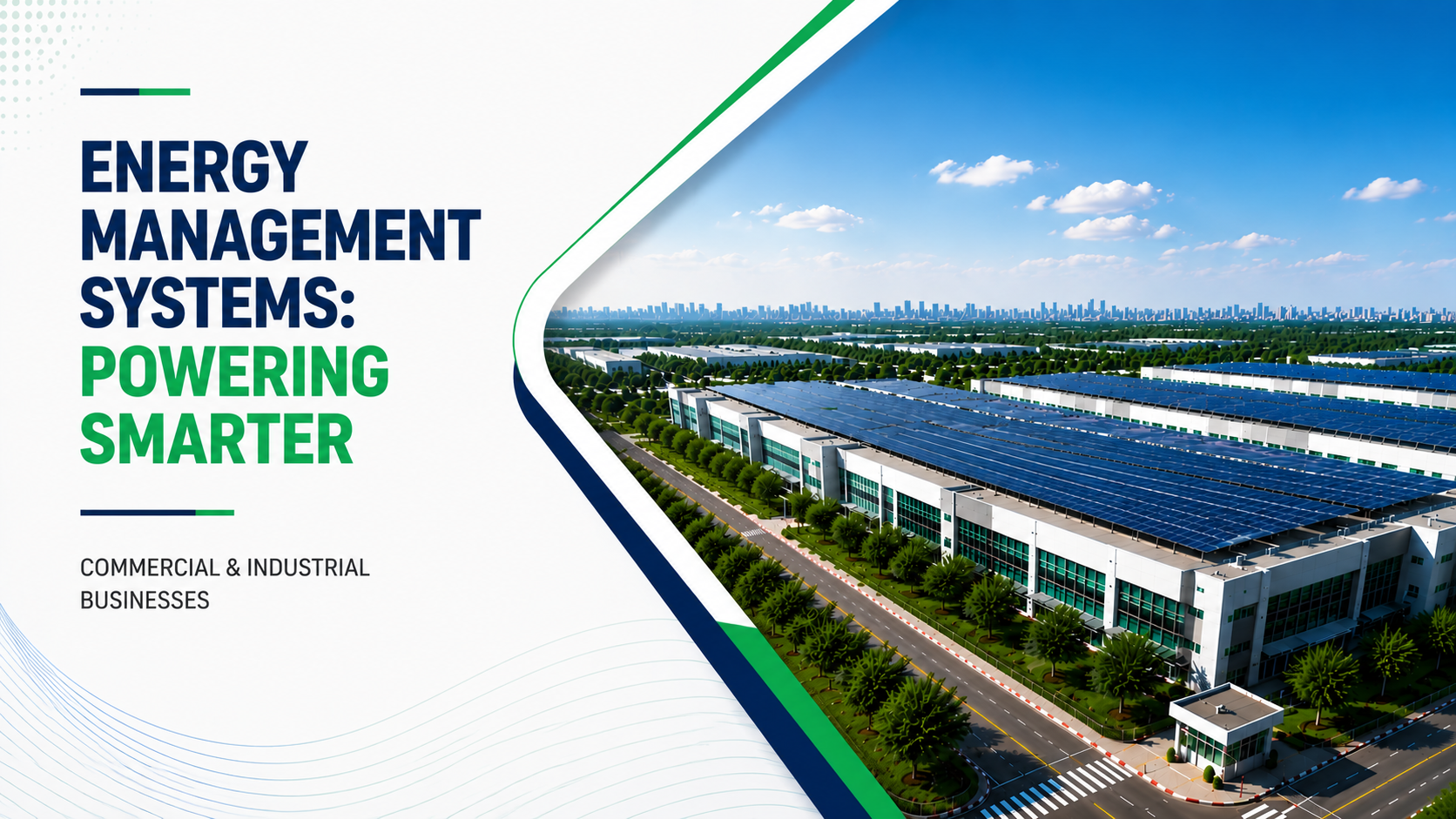
Energy Management System (EMS) are transforming how commercial and industrial (C&I) businesses manage electricity. Rising energy prices, stricter sustainability goals, and increasing operational complexity have made real-time energy monitoring essential. An EMS provides real-time visibility into energy consumption, helping businesses identify inefficiencies, reduce wastage, and improve operational performance. Toyota Motor Corporation, for instance, uses advanced energy management and monitoring systems across several manufacturing facilities to track electricity consumption, optimize production processes, and improve energy efficiency as part of its global sustainability strategy. This continuous monitoring enables the company to reduce energy waste, lower operating costs, and cut carbon emissions.
Moreover, modern Energy Management Systems do much more than monitor electricity usage. They integrate with rooftop solar systems, Battery Energy Storage Systems (BESS), diesel generators, EV charging infrastructure, and smart meters to optimize energy use from a single platform. As a result, businesses gain better control over energy costs while supporting their sustainability and decarbonization goals, in line with initiatives promoted by the Ministry of New and Renewable Energy (MNRE).
Whether you operate a manufacturing plant, warehouse, hospital, pharmaceutical facility, commercial complex, or data center, an EMS enables smarter, data-driven energy decisions. In this guide, you’ll learn how Energy Management Systems work, their key components, business benefits, implementation process, industry applications, and the latest trends shaping smarter commercial and industrial businesses.
What Is an Energy Management System (EMS)?
An Energy Management System (EMS) is a digital platform that monitors, controls, and optimizes energy consumption across commercial and industrial facilities. It collects real-time data from connected equipment, identifies inefficiencies, and helps businesses reduce energy costs while improving operational efficiency.
An Energy Management System (EMS) serves as the central platform for managing a facility’s energy usage. It connects with smart meters, sensors, HVAC systems, production equipment, solar plants, Battery Energy Storage Systems (BESS), and other energy assets to provide real-time visibility into energy performance. As a result, businesses can identify energy waste, monitor consumption patterns, and make informed decisions.
This approach is widely adopted by leading manufacturers such as Intel, which uses advanced energy management systems across its manufacturing facilities to continuously monitor energy consumption, improve operational efficiency, and support its global sustainability goals. By leveraging real-time data and analytics, the company optimizes energy use without compromising production. Similarly, an EMS provides automated alerts, demand forecasting, and detailed energy analytics, enabling businesses to reduce peak demand charges, improve equipment performance, and achieve long-term energy savings.
Key Functions of an Energy Management System
- Monitor real-time energy consumption across facilities.
- Identify energy waste and equipment inefficiencies.
- Send automated alerts for abnormal energy usage.
- Optimize peak demand to reduce electricity costs.
- Integrate solar, BESS, and other distributed energy resources.
- Generate energy performance and sustainability reports.
How Does an Energy Management System Work?
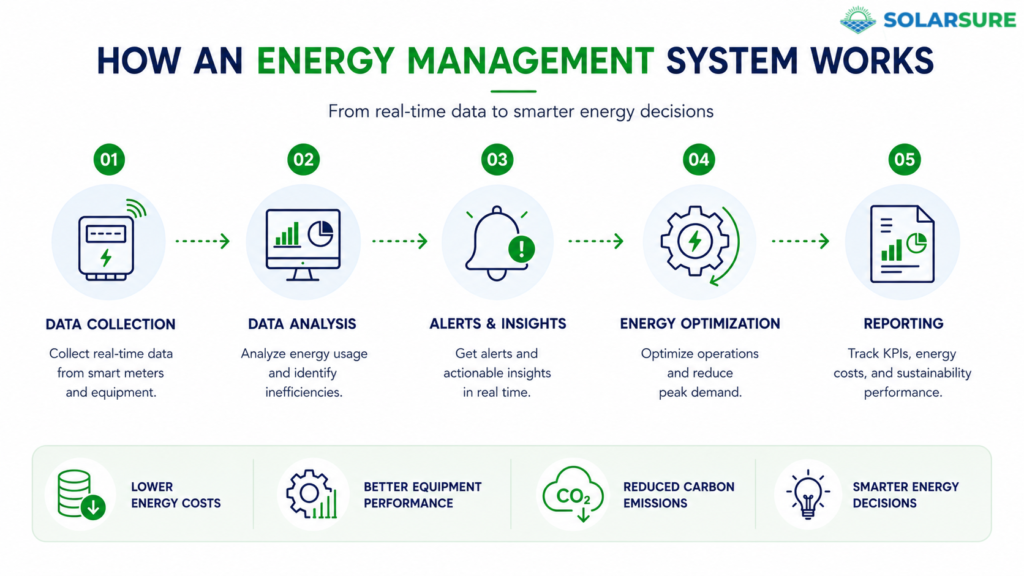
An Energy Management System (EMS) collects real-time energy data from smart meters, sensors, machinery, HVAC systems, and other connected assets. It then analyses this data to identify energy consumption patterns, detect inefficiencies, and recommend actions that improve energy performance.
This data-driven approach is reflected in companies such as Tata Steel, which uses digital energy management solutions across its manufacturing operations to monitor energy-intensive processes. By analysing real-time operational data, the company optimizes energy consumption, improves operational efficiency, and supports its decarbonization goals.
A typical EMS follows these steps:
| Step | What Happens |
| 1. Data Collection | Smart meters and sensors collect real-time energy data. |
| 2. Data Analysis | The EMS analyses consumption patterns and identifies inefficiencies. |
| 3. Alerts & Insights | The system sends alerts for abnormal energy usage and highlights improvement opportunities. |
| 4. Optimization | Operators or automated controls adjust equipment to reduce energy waste. |
| 5. Reporting | Dashboards and reports track energy performance, costs, and sustainability metrics. |
By following this continuous cycle, businesses can make data-driven decisions, lower electricity costs, improve equipment efficiency, and achieve their sustainability targets.
Key Components of an Energy Management System
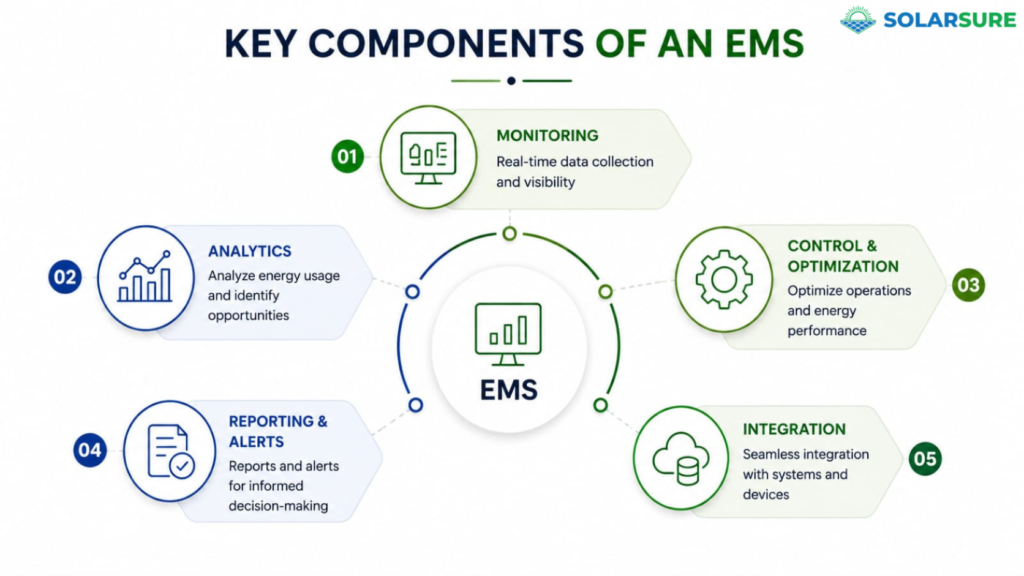
An Energy Management System (EMS) combines hardware and software to monitor, analyse, and optimize energy consumption. Each component plays a specific role in improving energy efficiency and operational performance.
| Component | Purpose |
| Smart Meters | Measure real-time electricity, gas, or water consumption. |
| Sensors | Collect data from equipment, temperature, pressure, and other operating conditions. |
| Communication Network | Transfers data securely between devices and the EMS platform. |
| EMS Software | Analyses energy data, generates dashboards, and provides actionable insights. |
| Analytics & AI Engine | Detects inefficiencies, predicts energy demand, and recommends optimizations. |
| User Dashboard | Displays real-time energy performance, alerts, and reports in one place. |
An effective Energy Management System (EMS) integrates smart meters, connected sensors, cloud analytics, and dashboards to provide real-time visibility into energy performance. These components work together to collect, analyse, and optimize energy data across a facility.
Schneider Electric’s EcoStruxure™ platform demonstrates this approach by combining connected devices and cloud analytics to help commercial and industrial facilities monitor energy usage in real time. As a result, businesses gain better visibility, reduce energy waste, and make faster, data-driven decisions.
⚡ Visit the EcoStruxure™ platform to discover how digital technologies improve energy performance.
Benefits of Energy Management Systems for Commercial & Industrial Businesses
An Energy Management System (EMS) helps commercial and industrial businesses reduce costs, improve efficiency, and achieve sustainability goals. By providing real-time insights, it enables smarter energy decisions across operations.
| Benefit | Business Impact |
| Lower Energy Costs | Identifies energy waste and reduces unnecessary electricity consumption. |
| Improved Operational Efficiency | Optimizes equipment performance using real-time energy data. |
| Peak Demand Management | Reduces demand charges by controlling peak electricity usage. |
| Sustainability Support | Tracks carbon emissions and helps meet ESG and net-zero goals. |
| Better Decision-Making | Provides dashboards and reports for informed energy planning. |
Leading companies such as Unilever and Siemens use digital energy management solutions to improve energy efficiency, optimize operations, and reduce carbon emissions across their facilities. Continuous monitoring helps identify energy-saving opportunities while supporting long-term sustainability goals.
Whether a business operates a manufacturing plant, warehouse, hospital, or commercial building, an EMS delivers measurable savings while improving long-term operational resilience.
📄 Read the Bureau of Energy Efficiency (BEE) guidelines on industrial energy efficiency.
Industries That Benefit Most from Energy Management Systems
An Energy Management System (EMS) delivers value across many commercial and industrial sectors. However, industries with high energy consumption often achieve the greatest savings through continuous monitoring and optimization.
| Industry | How EMS Adds Value |
| Manufacturing | Monitors production lines, reduces energy waste, and improves machine efficiency. |
| Textile | Optimizes energy use across spinning, weaving, dyeing, and finishing processes. |
| Pharmaceuticals | Maintains stable environmental conditions while improving energy efficiency. |
| Food & Beverage | Reduces energy consumption in refrigeration, processing, and cold storage. |
| Warehouses & Logistics | Optimizes lighting, HVAC, and material handling equipment. |
| Commercial Buildings | Improves HVAC, lighting, and overall building energy performance. |
Companies such as ITC Limited and Nestlé use energy management practices across their manufacturing facilities to improve resource efficiency, optimize production, and reduce energy intensity as part of their sustainability strategies. Continuous monitoring helps these organizations lower greenhouse gas emissions while identifying opportunities to improve operational performance.
As energy costs continue to rise, an EMS enables businesses across industries to improve efficiency, reduce operating costs, and achieve long-term sustainability goals.
Challenges in Implementing an Energy Management System
An Energy Management System (EMS) can significantly improve energy efficiency, but its implementation comes with a few challenges. Many businesses struggle to integrate the EMS with older equipment that lacks digital connectivity. In addition, managing large volumes of energy data and ensuring cybersecurity require proper planning and skilled teams.
Companies such as Tata Motors have upgraded their manufacturing facilities with digital energy management and smart manufacturing technologies in phases rather than replacing all systems at once. This phased approach has helped integrate existing infrastructure, improve energy efficiency, and minimize operational disruptions.
With the right implementation strategy and an experienced technology partner, businesses can overcome these challenges and maximize the long-term benefits of an EMS.
Best Practices for Successful EMS Implementation
An Energy Management System (EMS) delivers the best results when businesses follow a structured implementation approach. Before deployment, organizations should assess their energy consumption, identify high-energy equipment, and define clear goals such as reducing electricity costs or improving operational efficiency.
Businesses should also install reliable smart meters and sensors, monitor energy performance regularly, and train facility teams to use EMS dashboards effectively. In addition, periodic system reviews help identify new opportunities for energy savings as operations evolve. Toyota follows a continuous improvement approach across its manufacturing operations by regularly monitoring energy performance, analyzing operational data, and implementing efficiency measures. This ongoing process has helped the company reduce energy consumption while supporting its long-term sustainability goals.
By combining the right technology with continuous monitoring and employee engagement, businesses can maximize the return on their EMS investment and achieve sustainable energy savings.
ROI of an Energy Management System for C&I Businesses
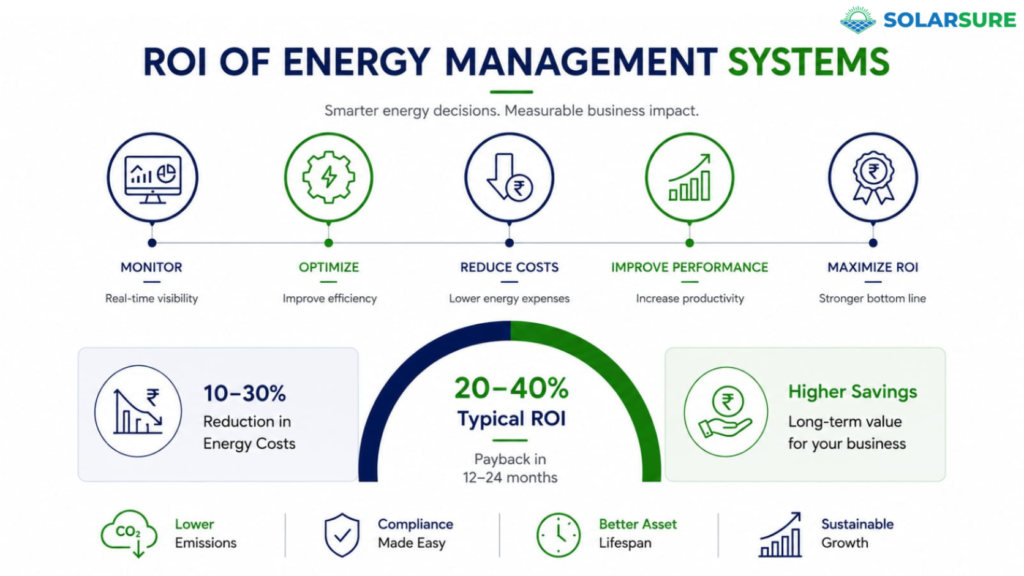
An Energy Management System (EMS) delivers measurable returns through lower energy costs and improved operational efficiency. It helps businesses identify energy waste, optimize equipment performance, and reduce unnecessary electricity consumption. As a result, organizations achieve long-term financial and operational benefits. The return on investment depends on several factors, including facility size, energy consumption, automation level, and existing infrastructure. Businesses with higher electricity usage often recover their investment faster because energy-saving opportunities are much greater.
This approach is demonstrated by JSW Steel, which has implemented digital energy management initiatives across its manufacturing operations. By using real-time energy monitoring to improve process efficiency and reduce energy intensity, the company supports both cost savings and its long-term sustainability goals.
An EMS also delivers value beyond direct electricity savings. It reduces equipment downtime through continuous monitoring and early fault detection. In addition, automated reporting saves time and supports regulatory compliance. These operational improvements increase the overall return on investment over the system’s lifecycle.
Businesses should evaluate both financial and operational benefits before selecting an EMS. A well-planned implementation often delivers lasting value while strengthening business competitiveness.
EMS and ISO 50001: Building a Strong Energy Management Strategy
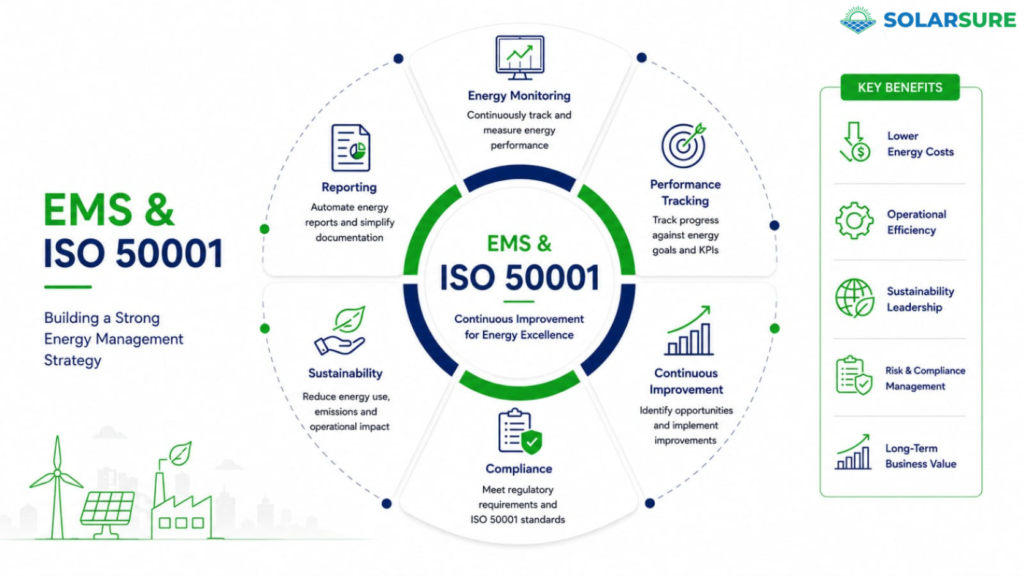
Energy Management Systems (EMS) play an important role in supporting ISO 50001 implementation. ISO 50001 is an international standard that helps organizations improve energy performance through continuous monitoring and improvement. An EMS provides the data and insights needed to achieve these objectives effectively.
With an EMS, businesses can track energy consumption, establish performance baselines, and measure improvement over time. The system also simplifies energy reporting and helps teams identify opportunities for further savings. As a result, organizations can make informed decisions based on accurate energy data. 3M has adopted ISO 50001 energy management practices across several manufacturing facilities, using energy monitoring and performance tracking to improve efficiency and reduce operating costs. This structured approach supports both sustainability and productivity goals.
Organizations that combine EMS technology with ISO 50001 principles often achieve better energy performance. They also strengthen compliance efforts and build a culture of continuous improvement. Therefore, an EMS serves as a valuable foundation for a long-term energy management strategy.
How EMS Supports ISO 50001 Goals
- Monitors energy performance in real time.
- Tracks progress against energy efficiency targets.
- Identifies areas for continuous improvement.
- Simplifies energy data collection and reporting.
- Supports sustainability and decarbonization initiatives.
This combination helps businesses improve efficiency while maintaining operational excellence.
Common Mistakes to Avoid When Implementing an Energy Management System
An Energy Management System (EMS) delivers the best results with proper planning. However, many businesses make avoidable mistakes during implementation. These mistakes reduce system performance and delay the expected return on investment.
One common mistake is installing an EMS without conducting an energy audit. Without understanding current energy consumption, businesses cannot set realistic efficiency goals. Another mistake is monitoring energy data without acting on the insights. Regular analysis and corrective actions are equally important.
Some organizations also overlook employee training. Even the most advanced EMS cannot deliver results if teams do not understand its dashboards and reports. In addition, choosing a system that cannot scale with future business needs often increases upgrade costs later. Bosch follows a structured approach to digital energy management across its manufacturing facilities by combining employee engagement, continuous monitoring, and data-driven improvements. This integrated strategy helps the company maximize energy efficiency while improving overall operational performance.
By avoiding these common mistakes, businesses can improve EMS performance, reduce implementation risks, and achieve long-term energy savings.
Future Trends in Energy Management Systems
Energy Management Systems (EMS) are evolving rapidly with advances in digital technologies. Artificial intelligence (AI), the Internet of Things (IoT), cloud computing, and predictive analytics are making EMS platforms smarter, faster, and more automated. As a result, businesses can forecast energy demand, detect equipment issues early, and optimize energy usage with minimal manual intervention.
Another growing trend is the integration of EMS with rooftop solar, Open Access Solar, Battery Energy Storage Systems (BESS), EV charging infrastructure, and smart grids. This integrated approach enables commercial and industrial businesses to maximize renewable energy utilization, improve energy resilience, and reduce dependence on conventional power sources. This trend is reflected in Google’s AI-powered energy management across its data centers, where machine learning optimizes cooling systems to improve energy efficiency while maintaining high performance. This demonstrates how advanced EMS technologies, combined with intelligent energy management and renewable energy integration, can enhance operational efficiency while supporting large-scale digital infrastructure.
📘 Continue Reading: Open Access Solar for MSMEs and Factories: A Complete Guide (India 2026)
As businesses accelerate their sustainability initiatives, intelligent and connected EMS solutions will play a critical role in reducing costs, improving operational efficiency, and supporting net-zero ambitions. Organizations adopting these technologies today will be better positioned to manage future energy challenges while building more resilient and sustainable operations.
🌍 Explore the IEA’s latest research on digital energy and energy efficiency to understand the technologies shaping the future of industrial energy management.
How to Choose the Right Energy Management System
An Energy Management System (EMS) should match your business goals and energy needs. Choose a solution that supports future business growth. It should also integrate easily with existing equipment.
Look for real-time monitoring, automated alerts, and simple reporting features. Cloud access and AI analytics improve decision-making, while strong cybersecurity features protect valuable operational data. Mahindra & Mahindra has adopted digital energy management across its manufacturing plants to improve energy efficiency through connected monitoring and data-driven decision-making. These initiatives have also supported the company’s broader sustainability objectives.
Finally, compare different EMS providers before making your decision. Request a product demonstration, evaluate customer support, and assess long-term scalability. Choosing the right solution ensures the EMS continues to deliver value as business operations grow and energy requirements evolve.
Common Mistakes to Avoid When Implementing an Energy Management System
An Energy Management System (EMS) delivers the best results with proper planning. However, many businesses make avoidable mistakes during implementation. These mistakes reduce system performance and delay the expected return on investment.
Without understanding current energy consumption, businesses cannot set realistic efficiency goals. Another mistake is monitoring energy data without acting on the insights. Regular analysis and corrective actions are equally important.
Organizations also overlook employee training. Even the most advanced EMS cannot deliver results if teams do not understand its dashboards and reports. In addition, choosing a system that cannot scale with future business needs increases upgrade costs over time. Bosch follows a structured approach to digital energy management across its manufacturing facilities by combining employee engagement, continuous monitoring, and data-driven improvements. This integrated strategy helps the company maximize energy efficiency while improving overall operational performance.
By avoiding these common mistakes, businesses can improve EMS performance, reduce implementation risks, and achieve long-term energy savings. Learning from proven industry practices and adopting a structured implementation approach further enhances the value delivered by an Energy Management System.
Frequently Asked Questions (FAQs)
Q. What is Energy Management System(EMS)?
An Energy Management System (EMS) is a digital platform that monitors and optimizes energy consumption. It collects real-time data from connected equipment and displays it through dashboards. Businesses use this information to reduce energy waste, improve efficiency, and lower electricity costs.
Q. Why do commercial and industrial businesses need an EMS?
Commercial and industrial facilities consume large amounts of electricity every day. An EMS provides real-time visibility into energy usage and identifies inefficiencies quickly. As a result, businesses reduce operating costs, improve equipment performance, and achieve sustainability targets.
Q. How does an Energy Management System reduce electricity costs?
An EMS tracks energy consumption across equipment and processes continuously. It identifies energy waste, controls peak demand, and sends alerts for unusual usage. Therefore, businesses can take corrective actions before electricity costs increase.
Q. Can an EMS integrate with solar and Battery Energy Storage Systems (BESS)?
Yes. Most modern Energy Management Systems integrate with rooftop solar, BESS, diesel generators, and EV charging stations. This integration helps businesses maximize renewable energy usage while reducing dependence on grid electricity.
Q. Which industries benefit the most from an Energy Management System?
Manufacturing, textile, pharmaceutical, food processing, logistics, and commercial buildings benefit significantly from an EMS. These industries have high energy consumption and can achieve measurable savings through continuous monitoring and optimization.
Q. What is the difference between an EMS and a Building Management System (BMS)?
An EMS focuses on monitoring and optimizing energy consumption across a facility. A BMS manages building operations such as lighting, HVAC, and security. However, both systems can work together to improve overall building performance.
Q. How long does it take to implement an Energy Management System?
Implementation time depends on the facility size and system complexity. Small facilities may complete deployment within a few weeks. Large industrial plants may require several months for full integration and testing.
Q.Is an Energy Management System suitable for small businesses?
Yes. Many EMS providers offer scalable solutions for small and medium-sized businesses. Companies can start with basic energy monitoring and add advanced features as their energy needs grow.
Q. What features should businesses look for in an EMS?
Businesses should choose an EMS with real-time monitoring, automated alerts, cloud access, AI analytics, and renewable energy integration. Strong cybersecurity and easy scalability are also important for long-term performance.
Q.Is investing in an Energy Management System worth it?
Yes. An EMS helps businesses reduce electricity costs and improve operational efficiency. It also supports sustainability goals and delivers valuable energy insights. Over time, these benefits often provide a strong return on investment.
Bottom Line
Energy Management Systems (EMS) help commercial and industrial businesses control energy consumption effectively. They provide real-time visibility into energy usage and identify opportunities to reduce waste. As a result, businesses lower operating costs and improve overall efficiency.
Modern EMS platforms also integrate with solar systems, BESS, EV charging, and smart building technologies. These integrations improve energy reliability and support long-term sustainability goals. Therefore, businesses can build smarter and more resilient energy infrastructure.
As energy costs continue to rise, investing in an EMS becomes a strategic decision. The right solution improves operational performance and strengthens business competitiveness. It also prepares organizations for a more digital and sustainable future.