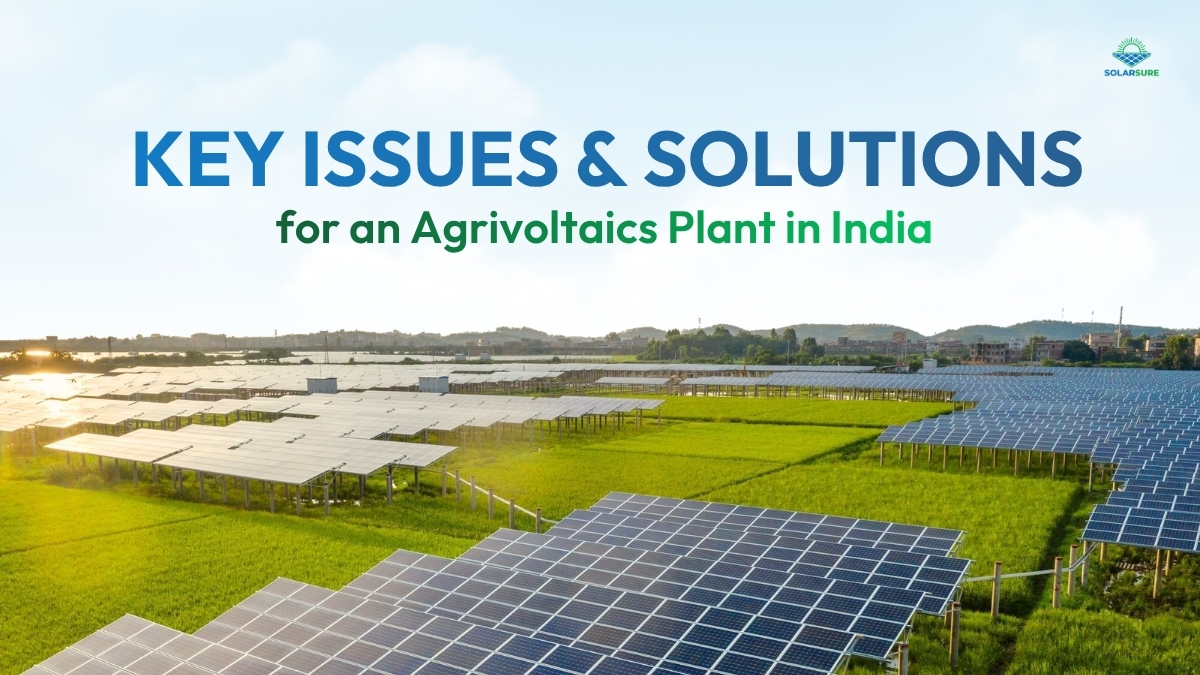
Agrivoltaics is one of the smartest uses of land in India today, mainly known for the double use of land. It generates solar power and grows crops on the same piece of land at the same time. For a country with limited farmland and big clean energy targets, that is a powerful combination.
But setting up an agrivoltaic plant is not easy. It brings challenges that a regular solar developer and a regular farmer have never faced together. Knowing these problems and their solutions before you start is what makes the difference between a project that works and one that does not. In this blog, we will understand different types of problems a farmer and investor usually face and how to solve them.
Technical and Operational Challenges
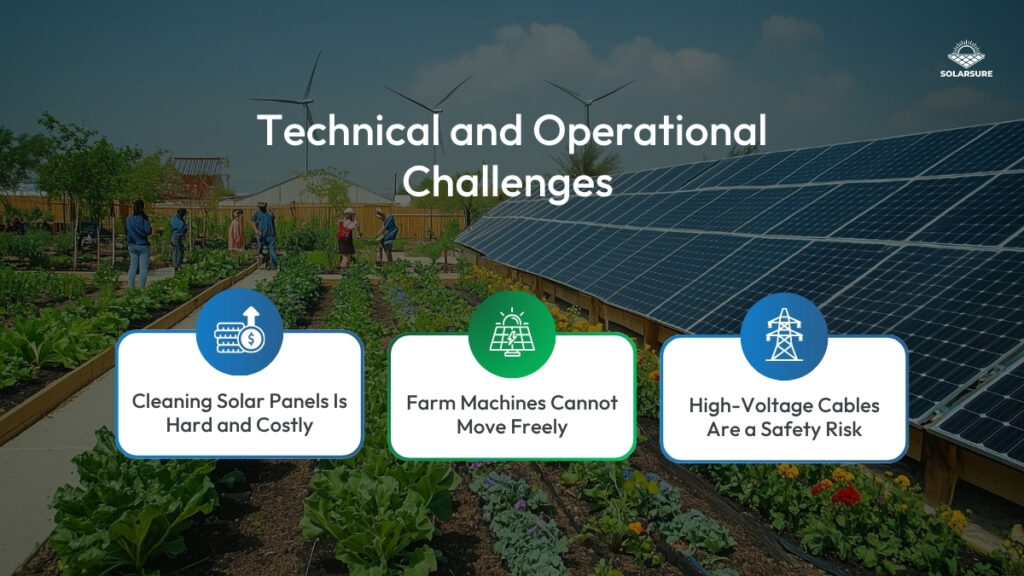
Problem: Cleaning Solar Panels Is Hard and Costly
Solar panels in an agrivoltaic plant are installed 4 to 5 meters above the ground. Cleaning them is much harder than cleaning rooftop or ground-level panels. Workers need special tools and safe ways to reach the panels.
The farm environment makes it worse. Dust from ploughing, waste from harvesting, and residue from fertilisers keep settling on the panel surface. This reduces how much electricity the panels produce.
In many parts of India, the groundwater used for cleaning has high salt and mineral content. This hard water leaves a white layer on the glass (called scaling), which further blocks sunlight. Over time, developers end up spending money on water softeners or bringing clean water by tanker. Both options increase maintenance costs.
Solution
Collecting rainwater on-site is the most practical solution. Rainwater is clean, soft, and costs nothing. It can also be used for crop irrigation, which solves two problems at once.
For cleaning panels, robotic or automated dry-cleaning machines work best in the long run. They need no water, work during non-farming hours, and keep workers safe. Where machines are not affordable yet, workers must be given proper long-reach cleaning tools and clear safety instructions.
The way panels are designed also helps. Vertical bifacial panels collect far less dust than panels installed at an angle. This means less frequent cleaning and lower costs.
Know more about Agrivoltaic farming, check this: What is Agrivoltaic Farming: A View into the Future of Farming Gaining Worldwide Attention
Problem: Farm Machines Cannot Move Freely
If the agrivoltaic structure is not designed with farming in mind, tractors, harvesters, and tillers may not be able to move between the rows. This makes basic farm work very difficult, on the farmer’s own land.
During construction, heavy machines used to put up the structure press down hard on the soil. This is called soil compaction. Compacted soil does not let roots grow deep or rainwater soak in properly.
Solutions
The structure must be designed around the farm machines that will actually be used on that land and not copied from another project. The gap between rows and the height from the ground is at least 4 to 5 meters, which must be planned based on local equipment sizes.
Farmers can also switch to smaller or foldable machines with GPS steering, which work better in tighter spaces.
To protect the soil, construction should happen when the soil is dry. Lighter machines should be used wherever possible. Heavy vehicles must stay on fixed paths only. After construction, the soil should be loosened and organic matter added to restore it.
Problem: High-Voltage Cables Are a Safety Risk
Electrical cables carry high voltage across the field. Farmers, workers, and animals move around the same land every day. If a cable is damaged by a farm tool, digging, or wear over time, it can cause a serious electric shock and even death.
In rural India, where awareness about electrical safety is often low, and farm activity never stops, this risk is very real.
Solution
All cables must be placed either overhead, well above the height of people and machines, or underground at a depth that ploughing and digging cannot reach. Underground cables must be armoured and placed inside protective pipes.
A clear map of where all cables are buried or routed must be given to the farmer when the plant is commissioned. This map must be kept on-site at all times. Cable condition must be checked during every scheduled maintenance visit, not skipped.
Agricultural and Agronomic Challenges
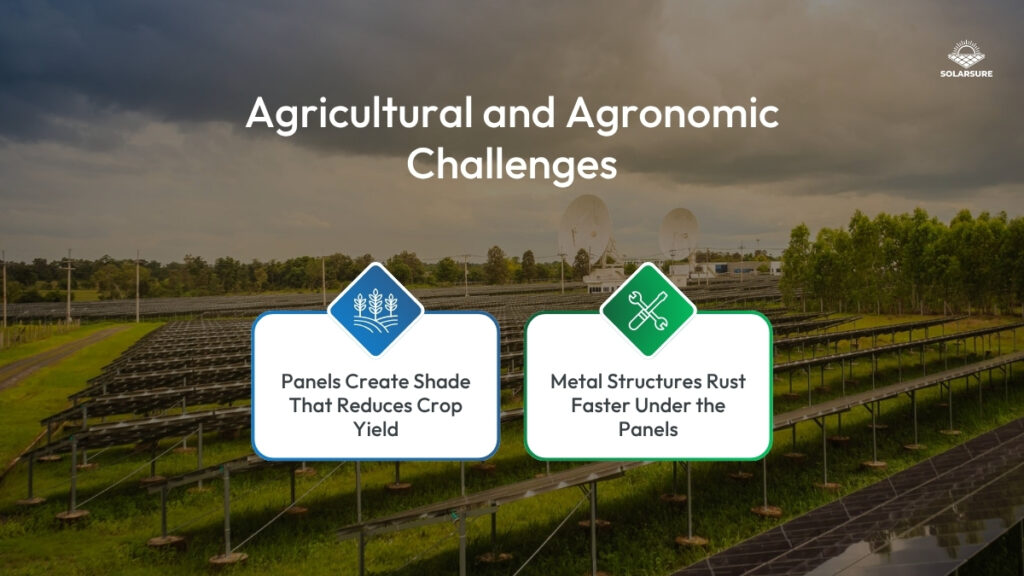
Problem: Panels Create Shade That Reduces Crop Yield
Solar panels block some of the sunlight that reaches the crops below the panels. For crops that need full sunlight, like rice, wheat, and sugarcane, this shade can cut yields by 15% to 20%.
If a farmer plants the wrong crop under solar panels, then the production is significantly lower than expected. In other words, it impacts farmer income because of lower production and damages trust in the agrivoltaic model overall.
Solution
The most important decision is choosing the right crop in agrivoltaic solar, and this must happen before the plant design is finalised, not after.
Crops that grow well in partial shade are the right fit for agrivoltaic land. These include leafy vegetables, spinach, fenugreek, medicinal plants like ashwagandha and tulsi, root vegetables, and some types of pulses. These crops also benefit from the cooler environment that panels create. They face less heat stress, need less water, and often produce better quality output than in open fields. Moreover, it is important to know about different types of agrivoltaics solar plants and understand which one suits the best in your regional conditions.
Panel design also helps in ensuring the effective production of the crop. Semi-transparent panels, bifacial panels, and checkerboard spacing layouts let more light reach the crops. Sun-tracking systems, which tilt the panels throughout the day, allow panels to generate power while making sure crops also get enough light. For high-value crops, tracking systems give a clear advantage over fixed panels.
Problem: Metal Structures Rust Faster Under the Panels
The area under an agrivoltaic array stays more humid than a normal field. Irrigation water, moisture from crops, and limited airflow all keep the humidity high. Over the years, this has made the metal mounting structures rust, especially at the base where the steel touches the soil.
Rusted structures become weaker than the normal structure over time. A weak structure is unsafe for everyone working under it, and expensive to fix mid-project.
Solution
All mounting structures must be made of hot-dip galvanised steel (a type of steel that is coated to resist rust in humid conditions). All bolts and fasteners touching the soil must be stainless steel.
Rust-protection coating must be applied at the factory before delivery and not added as a patch on-site. During every annual maintenance visit, the structure must be checked carefully, especially the base plates, anchor bolts, and any spots showing early rust. Catching rust early costs very little. Replacing a rusted structure mid-project costs much more.
Economic and Policy Challenges
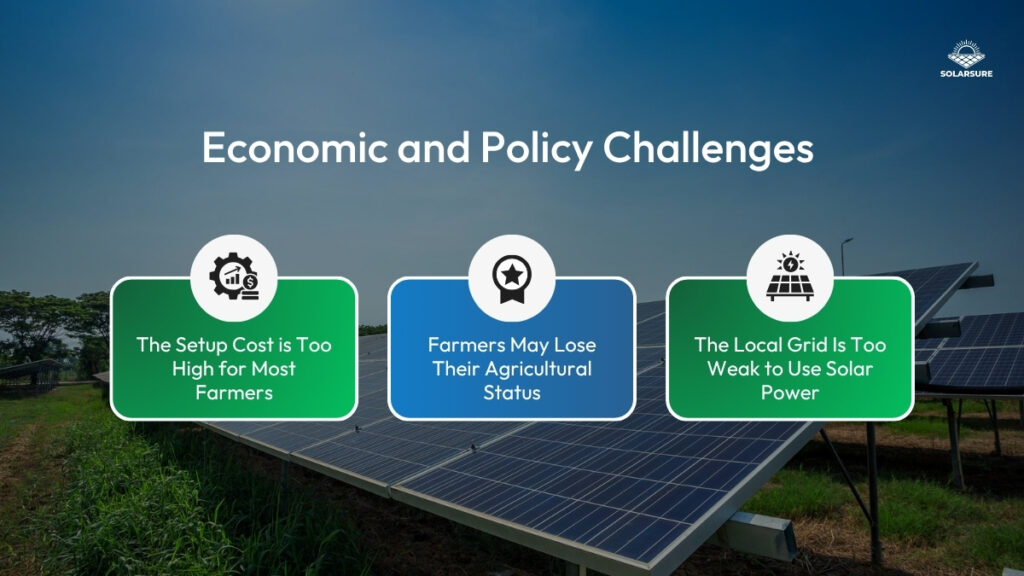
Problem: The Setup Cost is Too High for Most Farmers
Agrivoltaic plants cost 30% to 40% more than a standard ground-mounted solar plant. The main reason is the taller, stronger mounting structures needed to keep panels high enough for farm machines, such as harvesters, tractors, ploughs, etc., to pass underneath.
For most Indian farmers who own small pieces of land, this higher cost puts agrivoltaics completely out of reach, without outside funding or a developer partner.
Solution
In PM KUSUM 2.0, the government released a notification mentioning a dedicated 10 GW component specifically for agri-PV projects. It provides Viability Gap Funding and subsidised loans to reduce the cost burden on farmers. It is the most useful government scheme that helps farmers facing finance issue.
Cooperative or joint-venture models, where the developer pays for the installation and the farmer shares in the profit, remove the need for the farmer to invest anything up front. In RESCO models, the farmer pays nothing and simply buys power from the developer at a lower rate than the grid. Loans from NABARD, SIDBI, and IREDA, which are repaid from power sale income, are also becoming more accessible as more agrivoltaic projects prove their financial results.
Problem: Farmers May Lose Their Agricultural Status
In many Indian states, generating solar power is treated as a non-agricultural or industrial activity by law. If a farmer’s land is reclassified for agrivoltaics, the farmer may lose their agricultural status. This means losing farming subsidies, crop insurance, the Kisan Credit Card, access to agricultural loans, and other agricultural benefits.
For a small farmer, losing these benefits can financially hurt more than the solar income gains. This is one of the most overlooked risks in the Indian agrivoltaic market.
Solution
The government needs to create a separate legal category for agrivoltaic land, which must protect the farmer’s agricultural rights while allowing solar generation on the same land. Some states are already moving in this direction, but a clear national policy from MNRE is needed.
Until that policy exists, developers must check state-specific land-use laws carefully before finalising any project. Farmers must get independent legal advice before signing any agreement with a developer. Contracts should include safeguards, pointers or clauses, for example, requiring that crop output stays at least 80% to 90% of normal levels, or that at least 80% of the land stays under active cultivation.
Problem: The Local Grid Is Too Weak to Use Solar Power
In many rural areas, the electricity grid is not strong enough to absorb large amounts of solar power from a new plant. When too much power is pushed into a weak grid, it creates voltage problems, and the DISCOM may reject the connection. In some remote locations, a usable grid connection does not exist at all.
Solution
Grid capacity must be checked as part of the feasibility study, before land deals are signed. This step is often skipped and discovered too late by a farmer or investor.
Where the grid cannot take solar export, the generated power can be used entirely on the farm itself, such as running irrigation pumps, cold storage units, grain mills, and other farm equipment. This directly saves money on diesel and grid electricity bills, making the project useful even without selling power to the grid.
Where grid connectivity is very poor, a microgrid model with battery storage can serve a group of nearby farms together by sharing the solar generation across multiple users.
Stakeholder Coordination Challenges
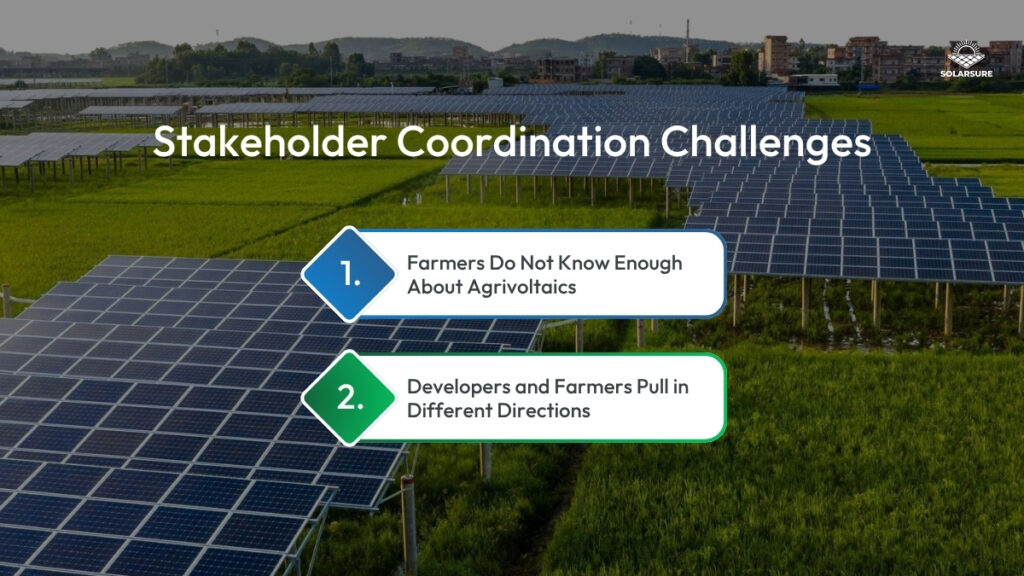
Problem: Farmers Do Not Know Enough About Agrivoltaics
Most Indian farmers have never seen an agrivoltaic plant. They do not know how the technology works, what crops grow well under panels, how maintenance will affect their land, or what rights they have under a developer agreement.
This lack of awareness makes farmers easy targets for unfair contract terms. It also causes many farmers to say no to agrivoltaics even when it would genuinely help their income and energy situation.
Solution
Awareness programmes through Krishi Vigyan Kendras, agricultural colleges, and state nodal agencies are a good starting point. But the most effective method is visiting a working agrivoltaic farm. When farmers see crops growing under panels, talk to other farmers who are earning from the model, and ask questions in person, they understand and trust it far better than any brochure or government meeting can achieve.
Institutions like the National Institute of Solar Energy (NISE) and state agriculture departments can help create training material that is technically correct and easy to understand locally. Developers should treat farmer awareness and community engagement as a project cost.
Problem: Developers and Farmers Pull in Different Directions
In most agrivoltaic projects, the solar side and the farming side are managed by two separate parties, and their needs often clash. Panel cleaning schedules interrupt irrigation. Maintenance teams often need access during harvest time, which is non-negotiable for the farmers. People often see disagreements over money, land use, and responsibilities as common. When these conflicts are not resolved, good projects collapse even when the technology and finances are sound.
Solutions
A detailed, clearly written lease agreement is the starting point. It must cover how revenue is shared, when and how maintenance teams can access the land, which crops can be grown, how disputes are resolved, and what happens if either party wants to exit. The language must be simple enough for both sides to understand without a lawyer present every time.
A joint working group, with people from both the developer’s team and the farmer’s side, should meet regularly throughout the project. The farmer must learn different ways to check and read the data generated by the plant. Also, learn how to calculate the income without relying on others. This way, the farmer understands everything without a doubt and reduces the chances of conflicts.
Bottom Line
Every problem in an agrivoltaic plant has a clear solution. None of these challenges is impossible to handle. But they all need proper planning before the first agreement is signed and before the first panel goes up.
Projects that fail almost always cut corners on land assessment, crop selection, legal protection, or farmer engagement. Projects that succeed are those in which every problem on this list is found early and fixed properly. If you are a farmer, developer, or investor looking to learn more about agrivoltaics, book a free consultation with us.