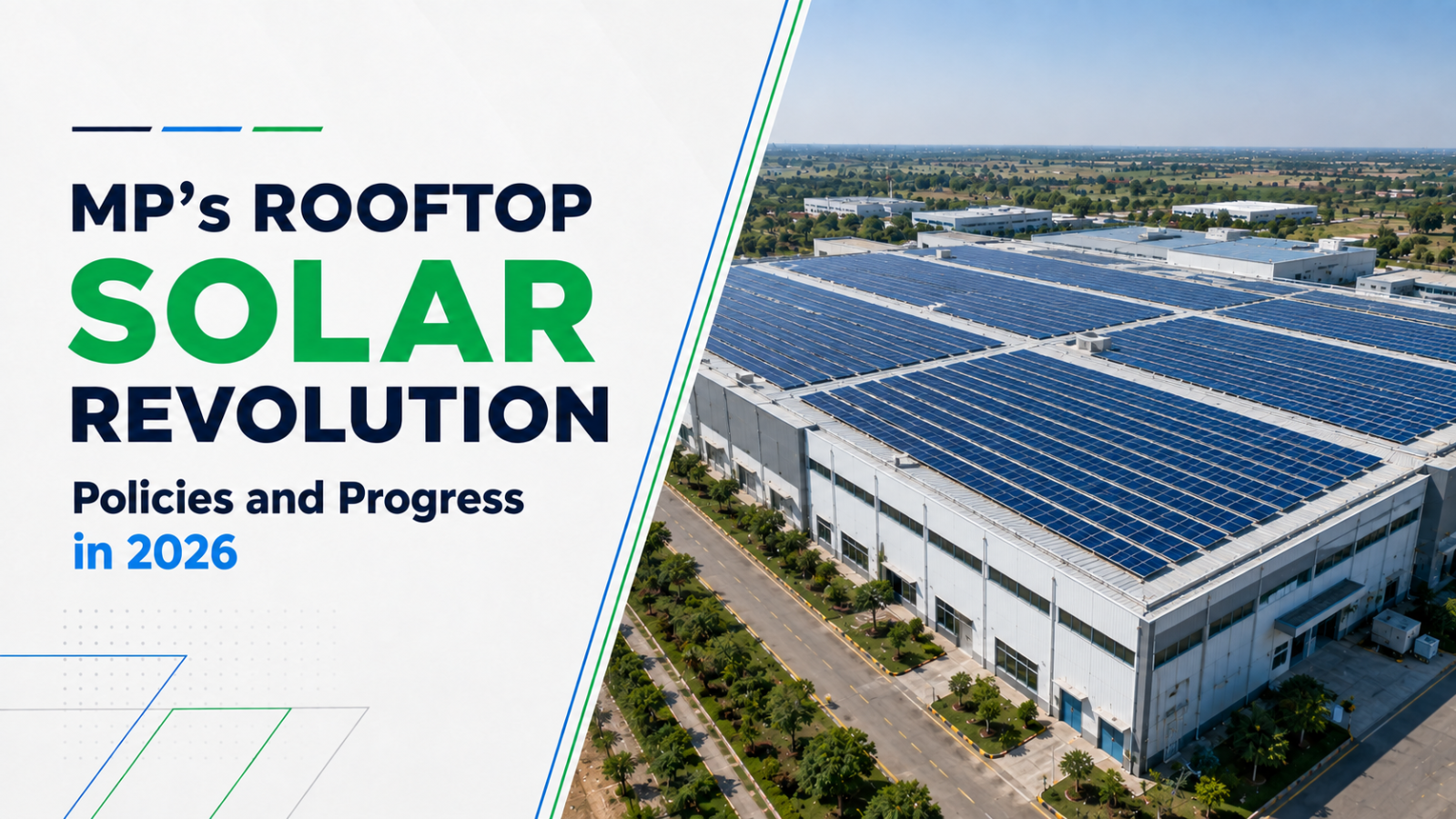
Rooftop Solar in Madhya Pradesh is reshaping industrial energy decisions. Rising electricity costs are encouraging businesses to explore onsite power generation. Moreover, unused factory rooftops are becoming valuable long-term energy assets. This transition supports lower costs, cleaner operations, and better energy control.
Major industrial clusters require substantial electricity throughout daily production hours. Indore, Pithampur, Dewas, Bhopal, and Mandideep support diverse manufacturing operations. Many facilities also have large rooftops suitable for solar installations. Consequently, onsite generation can reduce dependence on expensive grid electricity.
Meanwhile, MPERC regulations govern metering, connectivity, energy settlement, and project approvals. Better solar technology and digital monitoring are also improving project performance. However, grid capacity, unsuitable roofs, and approval delays still create challenges. This guide examines MP’s 2026 policies, progress, opportunities, and future direction.
What Is Rooftop Solar in Madhya Pradesh?
Rooftop solar in Madhya Pradesh refers to solar plants installed above buildings. These plants generate electricity near the point of business consumption. Therefore, companies can reduce daytime purchases from the conventional electricity grid.
Factories, warehouses, offices, hospitals, and commercial buildings can adopt these projects. Moreover, rooftop solar uses existing infrastructure without requiring separate land acquisition. The generated electricity first supports the facility’s ongoing energy requirements.
According to MNRE, MP reached 1,034.10 MW rooftop capacity by June 2026. However, this figure includes residential, commercial, industrial, and institutional installations. Therefore, it should not represent the state’s C&I capacity alone. Still, this milestone reflects MP’s expanding rooftop solar market.
How Much Progress Has MP Made in Rooftop Solar?
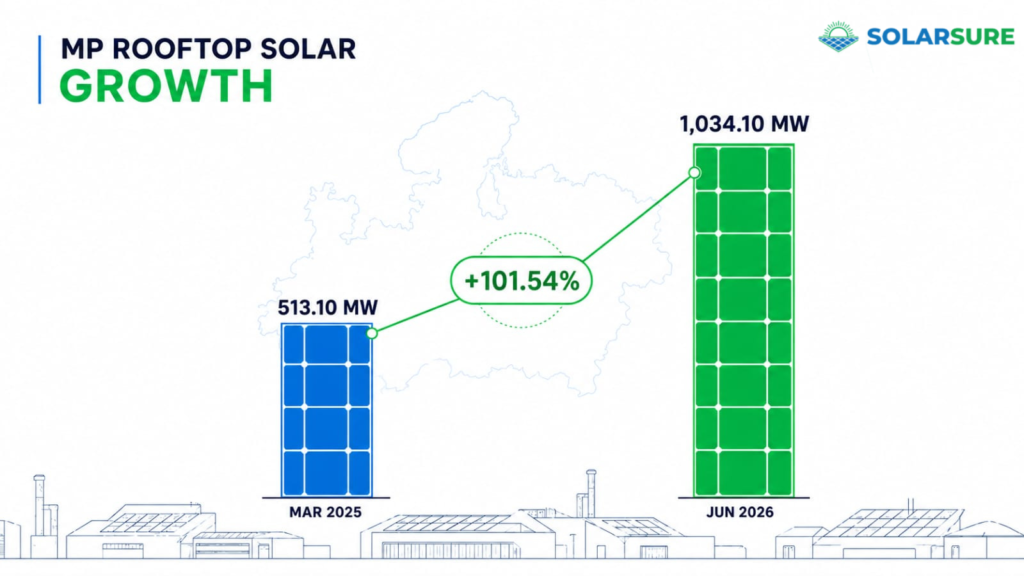
Madhya Pradesh recorded substantial rooftop solar growth between two reporting dates. MNRE reported 513.10 MW capacity on March 31, 2025. Installed capacity reached 1,034.10 MW by June 30, 2026. Therefore, the state added exactly 521 MW within fifteen months.
Rooftop capacity increased by 101.54% after March 2025. Meanwhile, MP’s total solar capacity recorded 23.72% growth during this period. The following table presents the complete comparison.
| Progress Indicator | March 31, 2025 | June 30, 2026 | Exact Change |
| Rooftop solar capacity | 513.10 MW | 1,034.10 MW | +521.00 MW |
| Total solar capacity | 5,118.38 MW | 6,332.42 MW | +1,214.04 MW |
| Rooftop share in total solar | 10.03% | 16.33% | +6.30 percentage points |
📖 Continue reading: MNRE State-Wise Renewable Energy Capacity Reports
During this period, total solar capacity recorded 23.72% growth. However, rooftop capacity increased by 101.54% during the same period. Its share within MP’s solar portfolio reached 16.33% by June 2026. Therefore, rooftop capacity grew faster than MP’s overall solar capacity.
However, MNRE combines residential, commercial, industrial, and institutional rooftop capacity. The published report does not provide separate C&I rooftop capacity. Therefore, these figures should not represent industrial installations alone. This distinction keeps the progress assessment accurate and transparent.
For businesses, this expansion reflects a strengthening rooftop solar market. Commercial and industrial demand can support further capacity additions across MP. Moreover, daytime industrial consumption aligns well with solar generation hours. This progress strengthens rooftop solar in Madhya Pradesh as an energy strategy.
Which Policies Support Rooftop Solar in Madhya Pradesh?
Rooftop solar in Madhya Pradesh receives support through connectivity and metering regulations. These provisions apply to commercial, industrial, institutional, and other electricity consumers. However, they provide regulatory support rather than residential capital subsidies.
The MPERC Grid Interactive Renewable Energy Systems Regulations, 2024 provide the primary framework. These regulations govern project capacity, connectivity, metering, and energy settlement. Moreover, they define responsibilities for consumers, DISCOMs, and renewable energy developers.
Net Metering for Commercial and Industrial Consumers
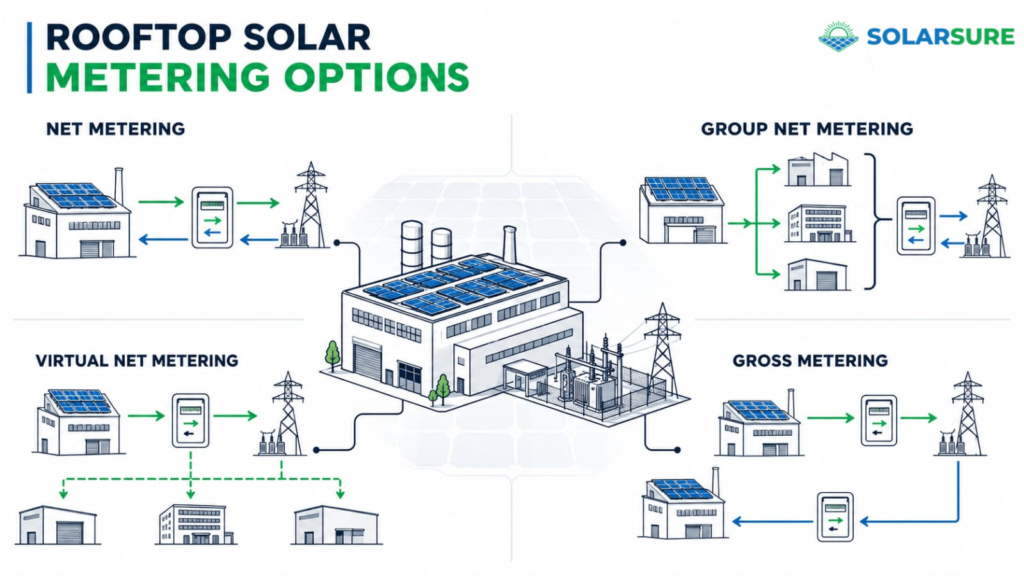
Net metering allows businesses to consume electricity generated from rooftop solar. The facility uses solar electricity before purchasing power from the grid. Meanwhile, surplus generation enters the grid through an approved bidirectional meter.
Eligible consumers can install net-metered projects up to 500 kW. However, capacity cannot exceed their sanctioned load or contracted demand. Project approval also depends on technical feasibility and available network capacity.
This arrangement suits businesses with substantial daytime electricity consumption. Manufacturing operations can directly use power during peak solar generation hours. Consequently, businesses reduce grid purchases without depending heavily on surplus exports.
📖 Learn More: Complete Guide to Solar Net Metering for Commercial and Industrial Consumers
Group Net Metering for Multiple Connections
Group net metering allows solar credits across multiple eligible electricity connections. However, those connections must belong to the same parent consumer. They must also remain within one distribution licensee’s supply area.
This arrangement helps businesses use electricity across multiple approved service connections. However, wheeling charges and network losses may apply to allocated electricity. Consequently, businesses should complete financial modelling before selecting this arrangement.
Virtual Net Metering for Shared Solar Generation
Virtual net metering distributes exported electricity among participating consumer connections. This model supports shared generation when individual rooftops remain limited or unsuitable. However, every allocation must follow DISCOM procedures and MPERC requirements.
Applicable surcharges and voltage-level losses can affect credited electricity. Therefore, C&I consumers need careful regulatory assessment before project approval. Financial modelling should include allocation ratios, charges, losses, and settlement conditions.
Gross Metering for Complete Electricity Export
Gross metering exports complete renewable electricity generation into the distribution network. The DISCOM purchases this electricity using the applicable discovered tariff. Meanwhile, the business pays retail tariffs for its complete electricity consumption.
Therefore, gross metering differs significantly from direct onsite solar consumption. Its commercial value depends on purchase tariffs and overall project costs. Businesses should compare gross metering against self-consumption before choosing this arrangement.
CAPEX and RESCO Ownership Models
MPERC regulations permit self-owned and Renewable Energy Service Company projects. Under CAPEX, businesses finance and own the complete rooftop solar plant. Consequently, they receive energy savings after covering investment and maintenance costs.
Under RESCO, a developer finances, owns, and operates the solar plant. The business purchases generated electricity through an agreed commercial arrangement. Therefore, this model can reduce upfront investment requirements for eligible consumers.
The following table compares MP’s main rooftop solar metering arrangements.
| Metering Arrangement | How Electricity Is Used | Suitable C&I Application | Important Consideration |
| Net Metering | Solar supports onsite demand before export | Factory or warehouse | Maximum 500 kW and demand limit |
| Group Net Metering | Credits support multiple approved connections | Multi-building business facility | Wheeling charges and network losses |
| Virtual Net Metering | Exported energy supports participating consumers | Shared commercial infrastructure | Surcharges and allocation requirements |
| Gross Metering | Complete generation enters the grid | Export-focused solar project | Returns depend on discovered tariff |
Together, these policies provide several pathways for industrial solar adoption. However, every arrangement has different charges, limits, and settlement rules. Therefore, businesses planning rooftop solar projects need project-specific regulatory analysis.
Why Are MP Businesses Investing in Rooftop Solar?
Rooftop solar in Madhya Pradesh is becoming a strategic business investment. Industries need lower electricity costs, predictable expenses, and measurable sustainability progress. Moreover, onsite generation uses existing rooftops without requiring additional industrial land.
Lower Daytime Electricity Costs
Most factories consume substantial electricity during normal daytime production hours. Solar generation usually aligns well with these active operating periods. Therefore, businesses can directly replace part of their grid electricity purchases.
This benefit is visible within Pithampur’s established industrial ecosystem. MYSUN commissioned an 897 kWp rooftop plant for a manufacturing company. According to MYSUN, estimated annual savings reached nearly ₹1 crore. Consequently, the project demonstrates rooftop solar’s financial value for energy-intensive manufacturers.
Productive Use of Existing Rooftops
Industrial facilities often have large warehouses, production sheds, and administrative buildings. These surfaces can generate electricity without interrupting existing business operations. Therefore, companies avoid separate land purchases for onsite renewable energy projects.
However, every industrial roof requires structural and shadow assessment before installation. Older roofs may require strengthening, repairs, or complete sheet replacement. Consequently, early engineering assessment protects safety and long-term project performance.
Better Long-Term Cost Visibility
Grid electricity tariffs can change throughout a solar plant’s operating life. In contrast, onsite solar offers more predictable generation costs after installation. Therefore, businesses can improve long-term budgeting and energy cost planning.
Under CAPEX, the company owns the plant and receives complete savings. Meanwhile, RESCO allows solar adoption without significant initial capital investment. This flexibility helps businesses select models matching their financial priorities.
Stronger ESG and Supply-Chain Performance
Large customers increasingly expect suppliers to report energy and emissions performance. Therefore, renewable electricity can support ESG disclosures and decarbonisation commitments. It also helps exporters address evolving supply-chain sustainability requirements.
However, businesses must measure generation and avoided emissions using verified data. Digital monitoring platforms can provide accurate production and performance information. Consequently, companies can support sustainability claims with transparent operating records.
Greater Control Over Energy Procurement
Onsite solar gives businesses greater control over daytime electricity sourcing. It reduces complete dependence on conventional utility power during operating hours. Moreover, companies can integrate solar with storage and energy management systems.
This integrated approach supports future expansion and smarter energy use. Therefore, rooftop solar in Madhya Pradesh offers value beyond electricity savings. It strengthens cost control, sustainability performance, and long-term energy planning.
How Can C&I Businesses Install Rooftop Solar in MP?
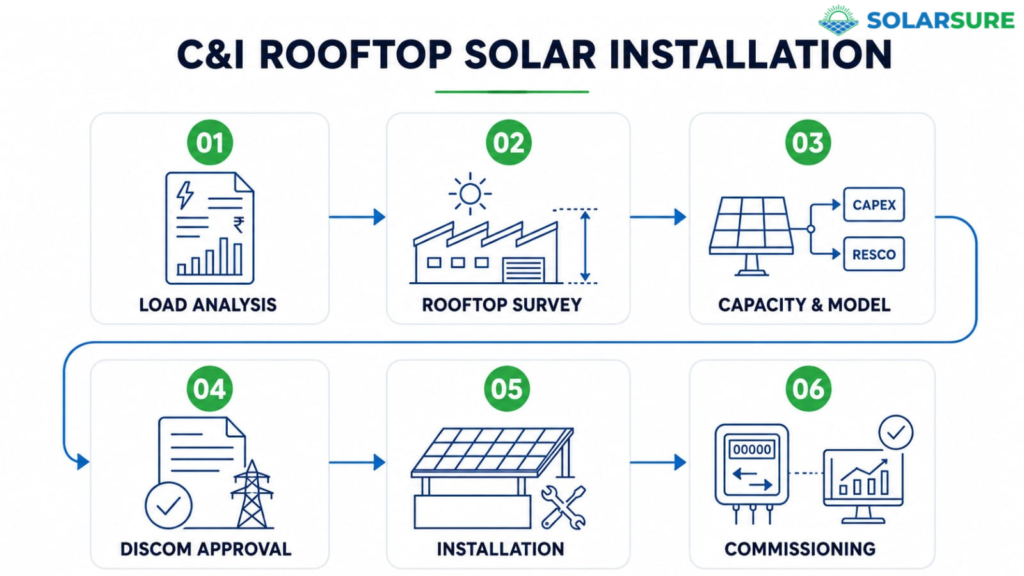
Installing rooftop solar in Madhya Pradesh requires technical, financial, and regulatory planning. Businesses must evaluate energy demand before starting project design or procurement. Moreover, early DISCOM coordination can prevent approval and commissioning delays.
Step 1: Analyse Electricity Consumption
Businesses should review at least twelve months of electricity bills. This analysis identifies daytime consumption, sanctioned load, and contracted demand. Production schedules also influence the project’s expected financial performance. Consequently, engineers can estimate suitable capacity, self-consumption, and potential energy savings.
Step 2: Assess Rooftop Suitability
A detailed site survey should examine available rooftop area and orientation. Engineers must evaluate shadows, access routes, drainage, and load-bearing capacity. Industrial rooftops may also contain vents, pipelines, skylights, or cooling equipment. Therefore, layouts should maintain safety clearances and future maintenance access.
Step 3: Select Capacity and Ownership Model
Project capacity should match consumption, sanctioned load, and regulatory limits. Businesses should also compare CAPEX and RESCO ownership models carefully. Under CAPEX, the business finances and owns the complete solar plant. Under RESCO, a developer invests and sells the generated electricity commercially.
⚡ Compare Your Options: CAPEX vs OPEX Renewable Energy Models for Businesses
Step 4: Apply Through the Relevant DISCOM
Businesses must submit applications through their respective distribution company portals. Madhya Pradesh has separate DISCOMs serving central, eastern, and western regions. HT applications generally require documents, including a Single Line Diagram. Therefore, businesses should confirm current requirements through their respective DISCOM portals.
Step 5: Complete Engineering and Installation
Following approval, engineers finalize designs, layouts, and electrical protection systems. Procurement should prioritize compliant modules, inverters, structures, cables, and safety equipment. Installation must also follow applicable CEA, IEC, and Indian standards. Consequently, detailed quality testing reduces operational risks before final commissioning.
Step 6: Install Metering and Complete Commissioning
The DISCOM inspects the completed plant before approving grid connectivity. Required meters are installed according to the approved metering arrangement. Afterwards, engineers complete synchronization, testing, documentation, and formal project commissioning. Digital monitoring then helps businesses track generation, faults, and long-term performance.
What Challenges Can MP Businesses Face During Rooftop Solar Adoption?
Rooftop solar in Madhya Pradesh offers strong long-term business value. However, every industrial rooftop cannot support the same project capacity. Technical, regulatory, financial, and operational constraints can affect project performance.
Therefore, businesses should identify these challenges before approving investment or procurement. Early planning prevents redesigns, delays, safety risks, and unexpected project costs.
Limited Usable Rooftop Area
A facility’s complete rooftop area is rarely available for solar installation. Skylights, ventilation systems, pipelines, and equipment can reduce usable space. Moreover, safety pathways and maintenance clearances must remain accessible. Therefore, shadow analysis and accurate layouts should determine final installable capacity.
Structural Strength and Roof Condition
Industrial roofs must safely support modules, structures, cables, and maintenance activities. Older buildings may contain corrosion, weak sheets, or damaged structural members. Consequently, qualified engineers should assess and certify rooftops before project execution. This assessment protects workers, equipment, and long-term plant performance.
Grid and Transformer Capacity
DISCOM approval depends on available distribution network and transformer capacity. Western MP recorded an 8% increase in industrial power consumption. According to MPPKVVCL data, industrial supply reached 842 crore units during 2025. Moreover, three substations were proposed across Indore’s industrial areas during 2026.
Approval and Metering Requirements
C&I projects require applications, technical documents, inspections, and metering approvals. Incomplete documents can delay feasibility clearance and final grid synchronization. The MP Madhya Kshetra application portal requires a Single Line Diagram for HT applications. Therefore, businesses should prepare accurate drawings before submitting their applications.
Regulatory Capacity Limits
MPERC allows eligible consumers net-metered capacity up to 500 kW. However, capacity cannot exceed sanctioned load or contracted demand. Therefore, larger industrial rooftops may require different project or metering arrangements. Businesses should verify current regulatory eligibility before approving project capacity.
Quality and Safety Risks
Low-cost components can increase breakdowns, generation losses, and maintenance expenses. Poor earthing, unsafe cables, and incorrect connectors create additional fire risks. Therefore, quotations should clearly mention cables, earthing, surge protection, and certifications. Detailed technical evaluation prevents decisions based only on the lowest price.
Performance and Maintenance Gaps
Dust, shading, equipment faults, and damaged modules can reduce electricity generation. However, performance losses may remain unnoticed without continuous digital monitoring. Regular inspections also protect electrical safety and structural condition. Therefore, rooftop solar in Madhya Pradesh requires planned maintenance after commissioning.
🔧 Related Guide: Major Challenges Businesses Face in Solar Projects and Their Solutions
Which C&I Sectors Can Benefit Most from Rooftop Solar?
Rooftop solar in Madhya Pradesh can support several commercial and industrial sectors. However, facilities with strong daytime demand usually gain higher direct consumption. Available roof space and operating schedules also influence project suitability.
Manufacturing Facilities
Manufacturing plants use electricity across machinery, ventilation, lighting, and utilities. Therefore, their daytime demand often aligns effectively with solar generation hours. Large production sheds also provide useful space for rooftop installations.
Cummins has implemented a verified 59 kW rooftop project in Dewas. The project appears within Jakson Solar’s published rooftop portfolio. This installation demonstrates solar adoption within MP’s established manufacturing sector.
Warehouses and Logistics Facilities
Warehouses usually have large roofs and predictable daytime electricity requirements. Solar can support lighting, ventilation, offices, and material-handling equipment. Moreover, installations use existing surfaces without occupying additional operational land.
However, lightweight roofing requires detailed structural assessment before project execution. Layouts must also maintain drainage, ventilation, and fire-safety access.
Food Processing and Cold Storage
Food processing facilities require electricity for refrigeration, packaging, and production equipment. Cold-storage operations may continue throughout daytime solar generation periods. Consequently, direct solar consumption can reduce conventional electricity purchases.
However, continuous refrigeration demand extends beyond available solar generation hours. Therefore, businesses may combine grid electricity with solar and storage solutions.
Commercial Buildings
Shopping centres, offices, hotels, and hospitals consume considerable daytime electricity. Their loads include cooling, lighting, elevators, and essential building services. Therefore, rooftop solar can offset part of their daytime grid demand.
However, commercial buildings often have limited rooftops and multiple electricity connections. Group or virtual net metering may support suitable multi-connection properties. Regulatory charges should remain part of the project’s financial assessment.
Energy-Intensive MSMEs
MSMEs often face significant pressure from rising electricity and production costs. Rooftop solar can provide greater control over daytime energy expenses. Moreover, CAPEX and RESCO models offer different investment pathways.
However, smaller businesses must evaluate roof condition and financing carefully. Accurate consumption analysis also prevents unsuitable project sizing. Therefore, rooftop solar in Madhya Pradesh requires sector-specific technical and financial planning.
What Trends Will Shape MP’s Rooftop Solar Market?
Rooftop solar in Madhya Pradesh is entering a more advanced development phase. Future projects will focus on larger capacities, digital monitoring, and stronger compliance. Moreover, businesses will increasingly connect solar with broader energy management strategies.
Larger Behind-the-Meter Projects
Large facilities are exploring rooftop projects beyond small onsite installations. In February 2026, NVVN invited bids for a 3 MW project. The proposed plant will serve Bank Note Press in Dewas.
According to the official NTPC tender archive, the project uses behind-the-meter mode. Its scope covers engineering, installation, commissioning, and long-term operation and maintenance. However, it remains a tendered project rather than a commissioned installation.
This development shows growing interest in larger institutional and industrial rooftops. Moreover, structured EPC procurement can improve technical accountability and operational performance.
Solar with Battery Storage
Battery Energy Storage Systems can store electricity for later consumption. They can also support peak management and improve operational energy flexibility. Therefore, businesses are evaluating storage alongside onsite solar generation.
The MNRE storage advisory supports co-locating storage with solar projects. However, battery economics depend on tariffs, load patterns, and operating requirements. Businesses should complete detailed modelling before adding storage capacity.
Digital Monitoring and Energy Management
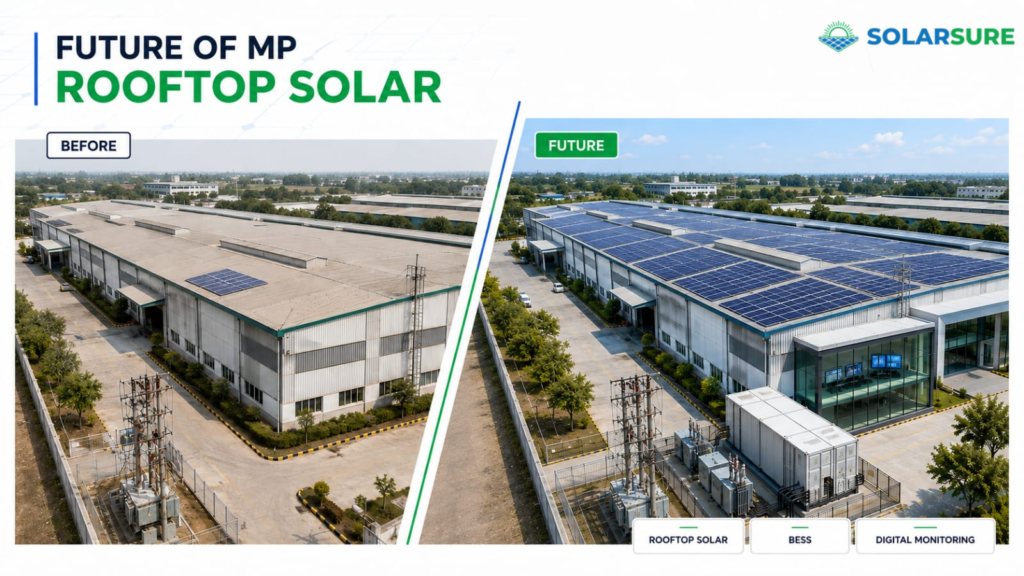
Modern solar plants require more than basic electricity generation monitoring. Businesses need visibility into consumption, generation, faults, and performance losses. Consequently, Energy Management Systems are becoming important for larger C&I facilities.
Digital dashboards can compare expected generation against actual plant performance. Moreover, automated alerts help maintenance teams identify faults earlier. This approach supports reliable savings and transparent sustainability reporting.
Stronger Equipment Compliance
Solar procurement requirements are becoming more detailed across India. Updated ALMM provisions can affect module and cell selection during 2026. Therefore, project teams must verify applicable product requirements before procurement.
MNRE issued a limited commissioning window until December 31, 2026. This clarification covers qualifying net-metering and Open Access renewable projects. However, businesses should verify project-specific eligibility through current MNRE notifications.
Flexible Financing Models
CAPEX will remain suitable for businesses seeking complete project ownership. Meanwhile, RESCO models can support companies avoiding significant upfront investment. Financing choice will depend on cash flow, risk, and operating priorities.
Consequently, rooftop solar in Madhya Pradesh will become increasingly customized. Successful projects will combine suitable financing, compliant equipment, and intelligent performance monitoring.
What Should MP Businesses Check Before Investing?
Businesses should complete technical and financial assessments before approving rooftop solar. These checks reduce design errors, approval delays, and unexpected investment costs. Moreover, they help align project capacity with actual electricity requirements.
Review Electricity Consumption
Businesses should analyse at least twelve months of electricity bills. Monthly data reveals demand patterns, seasonal changes, and daytime consumption. Therefore, engineers can design capacity around actual operating requirements.
Confirm Structural Feasibility
A qualified engineer should inspect the rooftop before final design. The assessment must cover structural strength, corrosion, drainage, and access. Moreover, shadow analysis should identify areas receiving consistent sunlight.
Verify Regulatory Eligibility
Businesses should confirm sanctioned load, contracted demand, and metering eligibility. They should also check available transformer and distribution network capacity. Consequently, regulatory feasibility should remain clear before equipment procurement begins.
Compare Complete Project Costs
The lowest quotation may exclude important electrical and safety components. Therefore, businesses should compare modules, inverters, cables, structures, and protection systems. Operation, maintenance, insurance, and monitoring costs also require evaluation.
Select the Right Ownership Model
CAPEX provides ownership and complete savings after investment recovery. Meanwhile, RESCO reduces upfront investment through long-term electricity purchase arrangements. Businesses should compare contract terms, tariffs, responsibilities, and exit conditions.
Avoid Common Planning Mistakes
Businesses should avoid these mistakes while planning industrial rooftop solar:
- Selecting capacity without analysing daytime electricity consumption.
- Ignoring structural strength and future rooftop maintenance requirements.
- Comparing quotations using price alone.
- Starting procurement before receiving regulatory feasibility.
- Overlooking earthing, surge protection, and compliant solar cables.
- Ignoring monitoring and preventive maintenance after commissioning.
Careful planning protects project safety, savings, and long-term performance. Therefore, rooftop solar in Madhya Pradesh requires more than equipment installation. It needs coordinated engineering, compliance, financing, and operational management.
Frequently Asked Questions (FAQs)
Q. What is the rooftop solar capacity of Madhya Pradesh in 2026?
MNRE reported 1,034.10 MW of rooftop capacity on June 30, 2026. This total includes residential, commercial, industrial, and institutional installations. Therefore, it should not represent C&I rooftop capacity alone. The figure increased from 513.10 MW recorded during March 2025.
Q.Is net metering available for commercial and industrial consumers in MP?
Yes, eligible commercial and industrial consumers can use net metering. The arrangement allows onsite consumption before exporting surplus electricity. However, approval depends on sanctioned load, contracted demand, and network availability. Businesses must apply through their respective Madhya Pradesh distribution company.
Q. What is the net-metering capacity limit in Madhya Pradesh?
Eligible consumers can install net-metered projects up to 500 kW. However, project capacity cannot exceed sanctioned load or contracted demand. DISCOM technical feasibility and available distribution capacity also affect approval. Larger projects may require another metering or consumption arrangement.
Q. Do C&I rooftop solar projects receive government subsidies in MP?
Central rooftop subsidies primarily support eligible residential consumers, not C&I businesses. Commercial and industrial projects generally rely on CAPEX, RESCO, or external financing. Tax treatment and financing eligibility depend on current rules and business circumstances. Therefore, companies should seek professional financial guidance before investment.
Q. Which ownership model works better for MP businesses?
CAPEX suits businesses seeking ownership and complete long-term energy savings. However, it requires substantial initial investment and ongoing maintenance responsibility. RESCO reduces upfront costs because the developer owns and operates the plant. The better model depends on cash flow, tariffs, risks, and contract terms.
Q. What documents are required for an industrial rooftop solar application?
Requirements vary across Madhya Pradesh’s distribution companies and connection categories. HT applications generally require consumer details, proposed capacity, and technical specifications. A Single Line Diagram also remains mandatory on the MPCZ application portal. Businesses should confirm current requirements before submitting their application.
Q. Can an industrial rooftop solar plant exceed 500 kW?
Yes, larger rooftop plants may remain possible under suitable regulatory arrangements. However, the 500 kW limit applies to current net-metering eligibility. Projects exceeding this limit require detailed technical and regulatory assessment. Businesses should confirm the correct arrangement with their DISCOM before procurement.
Q. How long does rooftop solar approval take in Madhya Pradesh?
No single timeline applies to every commercial or industrial rooftop project. Approval depends on document completeness, network feasibility, inspections, and metering requirements. Incorrect drawings or missing information can extend processing time. Therefore, businesses should begin DISCOM coordination during early project planning.
Q. What makes an industrial rooftop suitable for solar installation?
A suitable rooftop needs adequate area, structural strength, and limited shading. It should also provide safe access, drainage, and maintenance pathways. Engineers must evaluate roofing material, building condition, and equipment obstructions. A structural assessment should always precede final solar plant design.
Q. How can businesses improve rooftop solar performance?
Businesses should use compliant equipment, quality engineering, and continuous digital monitoring. Regular cleaning and preventive inspections help maintain expected electricity generation. Moreover, monitoring systems can identify inverter faults and abnormal performance quickly. Strong maintenance planning protects long-term savings and equipment reliability.
Bottom Line
Rooftop solar in Madhya Pradesh recorded significant progress during 2026. Installed capacity reached 1,034.10 MW by June 30, 2026. Moreover, rooftop capacity increased by 101.54% after March 2025. However, this figure includes every rooftop solar consumer category.
MPERC regulations provide several pathways for commercial and industrial consumers. Net metering supports direct consumption and adjusts eligible surplus electricity. Meanwhile, group, virtual, and gross metering address different project requirements. However, capacity limits and network availability require project-specific regulatory assessment.
Businesses can reduce daytime grid purchases while improving long-term energy planning. However, successful projects require suitable roofs, compliant equipment, and accurate system sizing. Digital monitoring and preventive maintenance also protect long-term project performance. Therefore, careful engineering will shape MP’s next phase of industrial rooftop growth.