India’s solar EPC market is expanding through supportive policies, rising investments, and record capacity additions. This growth is creating new opportunities across utility-scale, commercial, and industrial solar projects. Moreover, storage and hybrid developments are increasing the need for advanced engineering and execution capabilities.
India added a record 44.61 GW of solar capacity during FY 2025–26, nearly double the capacity added during the previous financial year. Consequently, demand for reliable EPC services is rising across multiple project segments.
This blog explores the market’s growth, policy support, and emerging opportunities. In addition, it covers EPC responsibilities, evolving technologies, execution challenges, and practical guidance for selecting the right project partner.
What Is India’s Solar EPC Market?
India’s solar EPC market includes the engineering, procurement, and construction services required to deliver a solar project. EPC companies manage every stage, from initial design and equipment selection to installation, testing, and final commissioning.
Their responsibilities vary according to project size, location, ownership model, and grid requirements. However, every successful solar project requires coordinated engineering, procurement, construction, quality control, and performance testing.
| Solar Project Segment | Typical EPC Responsibilities | Main Customer Group |
| Utility-Scale Solar | Design, procurement, civil works, power evacuation, and commissioning | Developers, utilities, and government agencies |
| Commercial Rooftop Solar | Structural design, equipment supply, installation, and net-metering support | Offices, malls, hospitals, and institutions |
| Industrial Solar | Load analysis, rooftop or ground-mounted design, and grid integration | Factories, warehouses, and manufacturing plants |
| Captive Solar | Plant engineering, transmission coordination, and commissioning | Energy-intensive industrial consumers |
| Solar-Plus-Storage | Solar design, BESS integration, control systems, and safety planning | Businesses, utilities, and critical facilities |
| Hybrid Renewable Projects | Integration of solar, wind, storage, and power-management systems | Developers and large electricity consumers |
An EPC company also coordinates equipment suppliers, contractors, utilities, and regulatory requirements. It prepares technical drawings, calculations, quality plans, and project documentation, helping reduce delays and execution gaps.
Before selecting a project partner, businesses can understand how the complete Solar EPC process works. This helps clarify the EPC company’s responsibilities across every stage of project delivery.
How Fast Is India’s Solar EPC Market Growing
India’s solar EPC market is growing alongside record capacity additions. Every new project requires engineering, equipment procurement, construction, testing, and commissioning. Faster deployment is therefore creating sustained demand for qualified EPC companies.
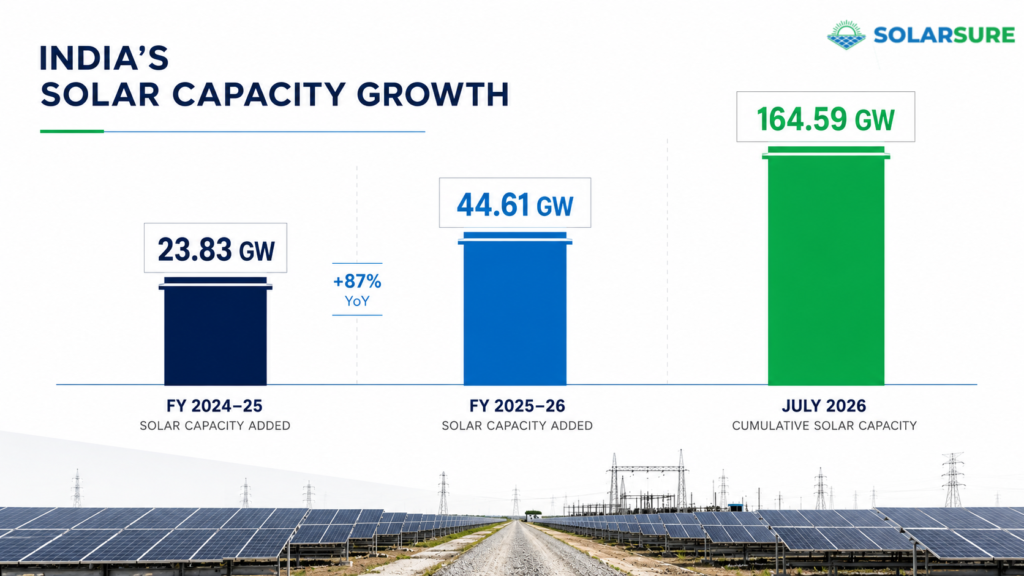
| Market Indicator | Reported Capacity | Period |
| Solar Capacity Added | 23.83 GW | FY 2024–25 |
| Solar Capacity Added | 44.61 GW | FY 2025–26 |
| Cumulative Solar Capacity | 150.26 GW | March 2026 |
| Utility-Scale Solar Capacity | 110.43 GW | March 2026 |
| Cumulative Solar Capacity | 164.59 GW | July 2026 |
| Ground-Mounted Solar Capacity | 122.57 GW | July 2026 |
| Grid-Connected Rooftop Solar | 30.74 GW | July 2026 |
Solar capacity additions increased by approximately 87% during FY 2025–26. Moreover, India exceeded its annual solar installation target of 34 GW. This record growth created larger opportunities for developers, manufacturers, equipment suppliers, and EPC contractors.
Utility-scale solar remains India’s largest installed solar segment. According to MNRE’s July 2026 progress data, ground-mounted capacity reached 122.57 GW. Therefore, large projects continue to require specialised capabilities in plant engineering, construction, substations, transmission, and power evacuation.
Meanwhile, commercial and industrial projects are also contributing significantly to market growth. The Press Information Bureau reported that C&I and captive projects contributed approximately 15 GW during FY 2025–26. Consequently, Solar EPC opportunities now extend well beyond government schemes and utility-scale tenders.
Which Policies Are Driving Solar EPC Growth?
Government policies are supporting a steady pipeline of solar projects across India. These measures encourage competitive bidding, domestic manufacturing, energy storage, and corporate renewable-energy procurement. As a result, EPC opportunities are expanding across several project categories.
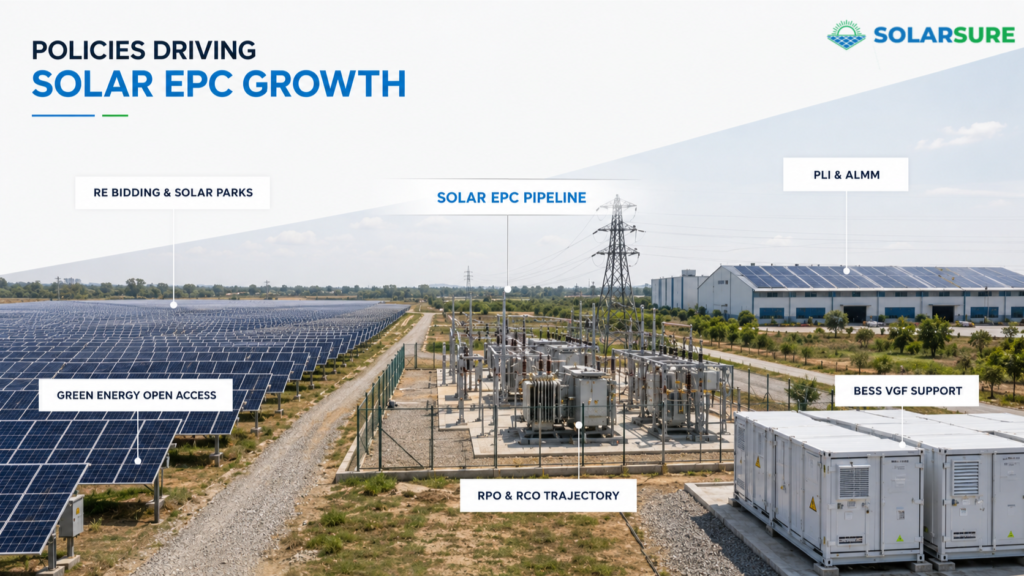
| Policy or Programme | Main Provision | Impact on the Solar EPC Market |
| Annual RE Bidding Trajectory | 50 GW of renewable-energy bids annually through FY 2027–28 | Creates a predictable pipeline of large projects |
| Solar Parks Scheme | Supports land, roads, transmission, and shared infrastructure | Simplifies utility-scale project development |
| PLI Scheme for Solar Modules | Encourages domestic manufacturing of high-efficiency solar modules | Expands local equipment-sourcing options |
| ALMM Framework | Specifies approved solar module and cell manufacturers and models | Increases procurement and compliance responsibilities |
| Green Energy Open Access | Enables eligible consumers to procure renewable electricity | Supports captive and third-party renewable projects |
| BESS VGF Schemes | Provides financial support for large battery-storage capacity | Creates solar-plus-storage EPC opportunities |
| RPO and RCO Trajectory | Requires increasing renewable-energy consumption | Strengthens long-term corporate demand |
MNRE prescribed 50 GW of annual renewable-energy bidding through FY 2027–28. At least 10 GW each year is reserved for wind projects, while the remaining pipeline can include solar, hybrid, and storage-linked tenders.
The Solar Parks Scheme supports land development and essential infrastructure such as roads, transmission networks, and grid connectivity. This allows developers to execute large solar projects within prepared zones while reducing certain early-stage development challenges.
Domestic manufacturing policies are also influencing EPC procurement decisions. The PLI scheme supports high-efficiency solar manufacturing across the value chain, while ALMM requirements make the verification of eligible manufacturers and models increasingly important.
Energy-storage policies are creating another specialised EPC opportunity. The government is supporting approximately 43 GWh of battery storage through two BESS VGF schemes. Contractors will therefore need stronger capabilities in battery integration, thermal management, fire safety, control systems, and grid coordination.
📘 Policy Reference: Review MNRE’s Current Solar Guidelines and Notifications
How Is Utility-Scale Expansion Creating EPC Opportunities?
Utility-scale solar projects require extensive engineering and construction capabilities. Their scope may include land development, civil works, pooling substations, transmission lines, and grid integration. Therefore, continued expansion is creating major opportunities for specialised EPC contractors.
As of July 2026, India had 122.57 GW of ground-mounted solar capacity. Moreover, further growth through solar parks, competitive tenders, captive plants, and hybrid projects is increasing demand across every stage of project delivery.
Larger and More Complex Project Scopes
Modern utility projects involve much more than installing modules and inverters. EPC contractors may manage access roads, drainage, foundations, pooling substations, transmission infrastructure, testing, grid compliance, and performance acceptance.
Meanwhile, hybrid and storage projects require even broader capabilities. Engineering teams must integrate solar, wind, batteries, control systems, and power-evacuation infrastructure within a coordinated design. Consequently, expertise in electrical engineering, high-voltage systems, and digital controls is becoming increasingly important.
Real-World Utility-Scale Examples
Adani Green Energy is developing a 30 GW renewable-energy complex at Khavda in Gujarat. The company reported 9.5 GW of commissioned solar capacity at the site. A project of this scale requires coordinated engineering, procurement, logistics, construction, storage, and transmission planning.
Similarly, ReNew commissioned 750 MW of a nearly 1 GW solar project in Rajasthan in December 2024. Developed through three separate SECI agreements, the project used solar modules manufactured entirely in India. Therefore, it demonstrates the growing connection between utility-scale execution and domestic supply chains.
In addition, India had approved 54 solar parks with a combined sanctioned capacity of 39,188 MW as of February 2026. These parks provide access to land and shared infrastructure, creating a repeatable development model for project developers and EPC service providers.
Key EPC Opportunities
- Detailed engineering for large solar and hybrid projects
- Civil works, mounting structures, access roads, and drainage systems
- High-voltage substations and transmission infrastructure
- Domestic module and balance-of-system procurement
- BESS integration and intelligent power-control systems
- Testing, commissioning, monitoring, and long-term maintenance
Why Are C&I and Captive Projects Expanding EPC Demand?
Commercial and industrial businesses are seeking lower and more predictable electricity costs. Moreover, corporate sustainability goals are increasing demand for renewable-energy procurement. As a result, EPC opportunities are expanding across rooftop, captive, group-captive, open-access, and hybrid projects.
Factories can use rooftop solar to meet part of their daytime electricity demand. However, limited roof space may restrict the capacity that can be installed onsite. Therefore, open-access and group-captive projects allow businesses to procure larger volumes of renewable electricity from offsite plants.
EPC Requirements for C&I Projects
C&I projects require detailed load analysis, site assessment, generation forecasting, and financial evaluation. In addition, EPC teams must coordinate rooftops, substations, approvals, grid requirements, and the facility’s operating schedule.
Industrial production cannot always stop during construction or electrical integration. Consequently, shutdowns and installation activities must be planned carefully. Safety procedures must also align with the facility’s existing operational and EHS requirements.
Real-World C&I Examples
Jindal Stainless and Oyster Renewable partially commissioned a 315.6 MW solar-wind hybrid project in March 2026. The project uses bifacial solar modules, tracker systems, and wind turbines to support stainless-steel manufacturing across multiple locations.
Meanwhile, Google adopted a 158.40 MW hybrid renewable portfolio for its Indian cloud operations and offices. The portfolio includes 99 MW of solar capacity in Rajasthan, highlighting the growing demand for offsite renewable-energy projects among digital businesses.
Cisco’s Indian operations receive electricity through a 92.10 MW hybrid project within a wider 120.35 MW renewable partnership. Similarly, Bengaluru International Airport has combined onsite solar with group-captive renewable power, including 36 MWp of solar and 9.9 MW of wind capacity. Together, these projects show how large organisations use multiple procurement models to meet their energy requirements.
Major Opportunities for EPC Companies
- Industrial rooftop solar design and installation
- Captive and group-captive project execution
- Open-access grid and transmission coordination
- Solar-wind hybrid plant engineering
- Battery storage and energy-management integration
- Multi-site monitoring and asset management
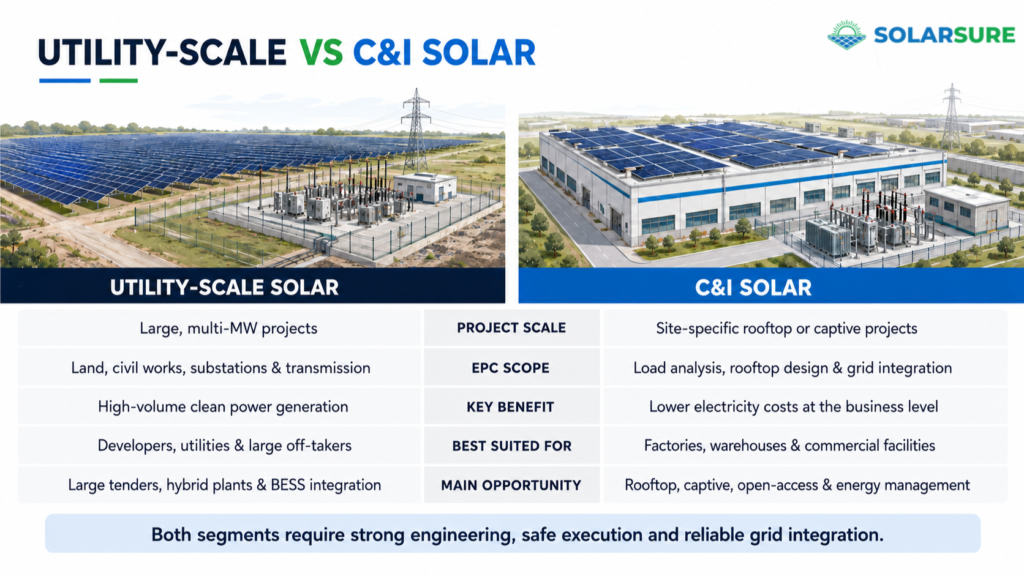
Before selecting the most suitable project model, businesses can explore Solar EPC solutions for commercial and industrial sectors.
Which Technologies Are Reshaping Solar EPC Services?
Solar EPC services now extend beyond conventional module installation. Battery storage, high-efficiency modules, trackers, and digital platforms are expanding project scope. Contractors increasingly need expertise in system integration, intelligent controls, electrical safety, and performance optimisation.
Solar-Plus-Storage Integration
Battery storage allows solar electricity to support demand outside daylight hours. However, BESS projects require careful planning for thermal management, fire protection, energy controls, and grid interaction. EPC teams must also ensure compatibility between batteries, inverters, transformers, and facility loads.
Tata Power Solar commissioned a 100 MW solar project with a 120 MWh BESS in Rajnandgaon, Chhattisgarh. The EPC scope covered design, supply, construction, testing, and commissioning, demonstrating how storage is expanding turnkey project responsibilities.
High-Efficiency Solar Modules
N-type TOPCon and bifacial modules are becoming more common across large solar projects. These technologies can improve energy generation and help maximise output where usable project area is limited.
However, EPC teams must assess module dimensions, mounting structures, inverter compatibility, electrical configuration, and long-term reliability. Waaree’s 132.5 MWp order for N-type TOPCon modules in 2025 reflects the growing commercial adoption of advanced module technologies.
Trackers and Bifacial Project Design
Solar trackers adjust module orientation throughout the day to improve energy yield. Bifacial modules generate electricity from sunlight received on both their front and rear surfaces.
Actual performance depends on row spacing, ground reflectivity, tracker configuration, shading, wind conditions, and structural design. Accurate modelling is essential before selecting these technologies for a project.
AI and Digital Twins
AI-based platforms can support generation forecasting, fault detection, and predictive maintenance. Digital twins create virtual representations of physical solar plant assets, allowing operators to examine performance and identify potential issues remotely.
IIT Jodhpur is developing an AI-driven digital twin for solar power plants. The project focuses on condition monitoring, remote operations, and predictive maintenance, showing how digital engineering may influence future EPC and O&M services.
Energy Management Systems
An Energy Management System connects solar, battery storage, grid electricity, and facility consumption within one control platform. It can manage battery charging, discharging, peak demand, and power-source selection according to operational requirements.
EPC contractors increasingly integrate these platforms while delivering solar-plus-storage and hybrid projects. This helps businesses improve energy visibility and coordinate different power sources more effectively.
📊 Related Guide: Understand How an Energy Management System Supports Businesses
How Does a Strong Solar EPC Partner Create Value?
A solar EPC partner coordinates the engineering, procurement, construction, and commissioning stages of a project. As a result, this single-point responsibility reduces communication gaps between vendors and gives project owners better control over quality, costs, timelines, and performance.
Integrated Engineering and Procurement
EPC teams assess land, rooftops, electricity loads, shading, and grid conditions before finalising the project design. Moreover, they prepare layouts, generation simulations, structural designs, and electrical calculations according to site requirements.
During procurement, the EPC partner aligns the ratings, specifications, and delivery schedules of modules, inverters, structures, cables, and protection equipment. Consequently, project owners face a lower risk of incompatible components, design changes, and procurement delays.
Better Control Over Costs and Timelines
A detailed execution plan connects engineering, procurement, approvals, construction, and commissioning activities. Therefore, teams can identify dependencies early and improve coordination between suppliers, contractors, facility teams, and project owners.
Meanwhile, a transparent EPC contract defines the complete project scope, exclusions, payment milestones, and owner responsibilities. Clear commercial terms make budgets easier to manage and reduce the possibility of disputes during execution.
Stronger Quality, Safety, and Grid Compliance
Experienced EPC contractors establish inspection plans, safe working procedures, and commissioning checklists. In addition, they test structures, cables, earthing, protection systems, and electrical connections before energising the solar plant.
They also coordinate metering, protection, synchronisation, and power-evacuation requirements. This becomes particularly important for rooftop projects requiring DISCOM approvals and large projects connected through high-voltage infrastructure.
Improved Long-Term Performance
Engineering and installation decisions influence generation throughout the solar plant’s operating life. Therefore, correct equipment sizing, reliable balance-of-system components, proper installation, and documented testing help reduce avoidable performance losses.
Complete drawings, test reports, warranties, and commissioning records also simplify maintenance and warranty claims. Consequently, the value of an experienced EPC partner continues well beyond the project’s commissioning date.
Before evaluating project proposals, businesses can explore how Solar EPC services reduce commercial and industrial energy costs.
What Challenges Could Limit Solar EPC Market Growth?
Rapid market growth does not guarantee smooth project execution. Solar EPC companies continue to face financial, regulatory, technical, workforce, and supply-chain pressures. Managing these challenges requires early planning, experienced teams, and stronger project controls.
Transmission, Land, and Site Constraints
Large solar projects are often developed far from major electricity-demand centres. Transmission infrastructure may not expand at the same pace, causing grid-connectivity delays, postponed commissioning, and higher financing costs.
The IEA reported that inadequate transmission infrastructure has impeded around 60 GW of renewable capacity in India. Developers should therefore confirm evacuation capacity and grid-connectivity requirements before beginning major construction activities.
Utility projects also require clear land titles, suitable terrain, access roads, and local permissions. Soil strength, drainage, flood risk, and site accessibility can influence both design and construction schedules. Incomplete surveys may lead to expensive changes during execution.
Equipment and Supply-Chain Pressure
Rapid installations increase demand for modules, inverters, transformers, switchgear, and cables. ALMM requirements may also influence equipment eligibility, availability, and procurement timelines.
EPC contracts should clearly address delivery delays, price changes, approved substitutions, and alternative equipment. Early procurement planning becomes particularly important for transformers and other components with longer delivery periods.
Financial and Payment Risks
EPC contractors often purchase equipment before receiving full payment from customers. Delayed milestones can create working-capital pressure, while large projects may also require bank guarantees, insurance, and retention commitments.
Off-taker risk remains another concern for utility projects linked to financially stressed distribution companies. According to the IEA, Indian DISCOMs had more than USD 9 billion in unpaid dues as of March 2025. Developers and EPC contractors should evaluate payment security and contractual safeguards carefully.
Regulatory and Approval Differences
Open-access charges, approval procedures, and grid requirements vary between Indian states. Processes may also differ according to the project model, capacity, voltage level, and local distribution utility.
Teams with relevant state-level experience can anticipate documentation requirements and approval timelines more accurately. Early coordination with DISCOMs and other authorities reduces the risk of completed projects waiting for grid connectivity.
Workforce, Safety, and Quality Risks
Advanced projects require engineers experienced in battery storage, high-voltage systems, controls, and grid integration. Rapid capacity growth can stretch available engineering and construction teams, increasing the need for training and standard operating procedures.
Aggressive deadlines may also result in rushed installation or incomplete testing. Weak structures, loose electrical connections, poor earthing, and incorrect protection settings can create serious failures. Documented inspections and commissioning checks should remain mandatory before energisation.
⚠️ Related Guide: Understand Common Solar Project Challenges and EPC Solutions
How Should Businesses Select a Solar EPC Company?
Selecting an EPC company affects project cost, safety, timelines, and long-term generation. Businesses should therefore evaluate the contractor’s complete technical and execution capability instead of comparing quotations only by price.
- Review relevant project experience: Check completed projects matching the required capacity, location, and ownership model. Confirm whether the contractor has handled similar site conditions, voltage levels, and approval requirements.
- Evaluate engineering capability: Request sample layouts, generation simulations, technical calculations, and project documentation. The team should clearly explain equipment sizing, design decisions, and generation assumptions.
- Compare the complete technical scope: Review modules, inverters, mounting structures, cables, connectors, earthing, and protection systems. Civil works, approvals, monitoring, testing, transportation, taxes, and exclusions should also be clearly identified.
- Verify equipment and compliance: Confirm equipment manufacturers, models, ratings, certifications, warranties, and applicable ALMM requirements. Every major component should have clearly defined specifications and quantities.
- Assess safety and quality systems: Request safety plans, inspection procedures, commissioning checklists, and information about team training. Safety records and quality controls should carry the same importance as project pricing.
- Examine the project timeline: The schedule should connect engineering, procurement, approvals, construction, and commissioning. It must also identify owner responsibilities and dependencies that could affect completion.
- Review warranties and performance commitments: Understand equipment warranties, workmanship coverage, generation assumptions, and performance guarantees. Responsibility for warranty claims, labour, transportation, and component replacement should be documented.
- Check after-sales support: Review monitoring, preventive maintenance, fault-response timelines, reporting services, spare-part availability, and escalation contacts. Reliable support becomes particularly important after commissioning.
Businesses should compare complete lifecycle value rather than initial project cost alone. A transparent EPC partner explains technical assumptions, commercial exclusions, execution risks, and long-term responsibilities before the contract is awarded.
Where Will the Next Solar EPC Opportunities Emerge?
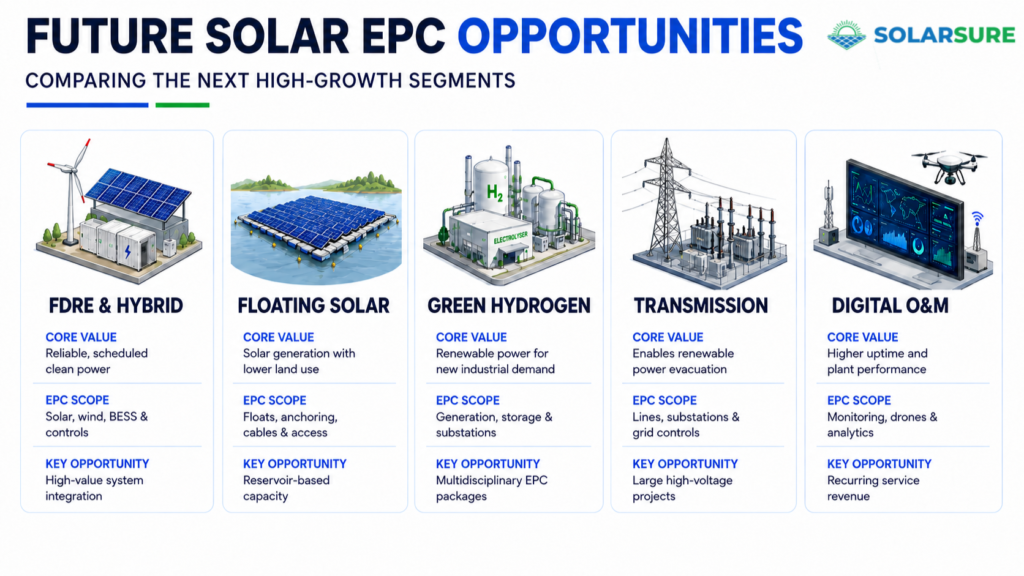
India’s solar EPC market is moving towards more complex project categories. Future opportunities will combine solar with battery storage, green hydrogen, transmission infrastructure, and digital asset management. Therefore, EPC companies will need capabilities beyond conventional solar construction.
Firm and Dispatchable Renewable Energy Projects
Solar generation varies according to sunlight and weather conditions. However, Firm and Dispatchable Renewable Energy projects combine renewable generation with storage and control systems to deliver electricity according to scheduled requirements.
SECI conducts competitive bidding for solar, wind, hybrid, round-the-clock, and FDRE projects. As of May 2025, it had awarded more than 73.8 GW of renewable-energy capacity, including 45.9 GW of solar projects.
These projects require EPC teams to integrate batteries, inverters, forecasting platforms, substations, and power-management systems. Consequently, their wider technical scope can create higher-value opportunities for contractors with strong integration capabilities.
Floating Solar Projects
Floating solar plants use reservoirs and other water bodies instead of requiring large areas of land. However, they need specialised floating platforms, anchoring and mooring systems, marine-grade cables, and safe maintenance access.
Additionally, water-level variation, wind speed, wave conditions, and corrosion risk must be considered during design. SJVN commissioned a 90 MW floating solar project at Omkareshwar in August 2024. This project demonstrates how reservoirs can support large solar plants while reducing land requirements.
Renewable Power for Green Hydrogen
Green hydrogen production requires large volumes of renewable electricity. Therefore, these facilities can create demand for solar and wind plants, battery storage, substations, transmission corridors, and water-treatment infrastructure.
NTPC Green Energy is developing a Green Hydrogen Hub at Pudimadaka in Andhra Pradesh. The planned development includes a transmission corridor, a 7 GW substation, desalination facilities, chemical storage, and port infrastructure. Consequently, projects of this scale can generate large multidisciplinary EPC packages.
Renewable Transmission Infrastructure
Solar capacity cannot expand without adequate power-evacuation infrastructure. Therefore, transmission lines, pooling substations, grid controls, and energy-management centres must develop alongside new generation capacity.
The government has prepared a transmission plan for integrating more than 500 GW of renewable capacity by 2030. Meanwhile, Regional Energy Management Centres support renewable forecasting and grid stability. This expansion creates opportunities for high-voltage, substation, control-system, and transmission EPC contractors.
Repowering and Plant Modernisation
Older solar plants may use lower-capacity modules, ageing inverters, and outdated monitoring systems. Therefore, owners may repower or upgrade these assets to improve generation, reliability, and operational visibility.
EPC companies can provide performance audits, redesigns, equipment replacement, monitoring upgrades, and recommissioning services. However, every upgrade requires electrical and structural compatibility checks. Existing contracts and grid approvals must also be reviewed before equipment replacement begins.
Digital Operations and Maintenance
India’s expanding solar portfolio will require stronger long-term asset management. Advanced monitoring, drones, thermal imaging, and predictive analytics can identify faults before they cause significant generation losses.
Moreover, EPC companies can extend their services into performance analytics, preventive maintenance, and multi-site monitoring. As a result, recurring O&M contracts can create long-term revenue while helping project owners maintain solar plant performance.
Best Practices for Successful Solar EPC Projects
Successful solar projects depend on coordinated engineering, contracts, approvals, procurement, safety, and documentation. Therefore, the following practices should guide project planning, construction, and commissioning.
- Complete a detailed feasibility study: Analyse electricity consumption, land or rooftop availability, shading, structural strength, soil conditions, drainage, and grid access before finalising project capacity.
- Confirm grid connectivity early: Engage the relevant utility during initial planning. Grid availability, voltage level, protection requirements, and evacuation capacity can influence plant design and commissioning timelines.
- Define the complete project scope: Clearly document equipment, civil works, approvals, testing, monitoring, exclusions, and owner responsibilities. In addition, generation assumptions and performance commitments should form part of the written agreement.
- Align procurement with construction: Modules, inverters, transformers, and switchgear may have different delivery periods. Therefore, procurement schedules should match construction milestones, with approved alternatives identified for critical components.
- Integrate quality and safety controls: Inspection plans should cover equipment delivery, installation, testing, and commissioning. Meanwhile, project teams must manage electrical, lifting, excavation, and working-at-height risks throughout construction.
- Include monitoring and final documentation: The EPC scope should provide dashboards, alerts, performance reporting, and preventive-maintenance requirements. Moreover, owners must receive as-built drawings, test reports, warranties, manuals, serial-number records, and approval documents.
Together, these practices improve accountability and reduce avoidable delays, cost overruns, safety risks, and performance losses throughout the solar plant’s operating life.
Common Mistakes to Avoid in Solar EPC Projects
Small planning and contracting errors can increase project costs, delay commissioning, and reduce generation throughout a solar plant’s operating life. Businesses should avoid these five common mistakes before awarding an EPC contract.
-
Selecting an EPC Partner Only by Price
The lowest quotation may exclude civil works, approvals, safety equipment, monitoring, or important balance-of-system components. Compare technical specifications, quantities, warranties, responsibilities, and exclusions before evaluating the final price.
Modules and inverters should not be the only focus. Mounting structures, cables, connectors, earthing, isolators, and protection devices also influence plant safety and reliability. Complete lifecycle value matters more than the lowest initial cost.
-
Approving a Project Without Detailed Assessments
A basic site visit cannot replace structural, electrical, geotechnical, and grid assessments. Incomplete surveys may overlook shading, weak rooftops, drainage problems, soil conditions, access limitations, or evacuation constraints.
Generation projections also require careful review. Expected output should consider irradiation, temperature, shading, soiling, equipment losses, degradation, and maintenance. Unrealistic assumptions can make savings and financial returns appear stronger than they are likely to be.
-
Accepting Unclear Scope and Equipment Specifications
An EPC proposal should define equipment manufacturers, models, ratings, quantities, certifications, and approved alternatives. Vague descriptions can allow unsuitable substitutions or create disagreements during procurement.
The contract should also clarify civil works, approvals, testing, transportation, taxes, monitoring, and owner responsibilities. A clearly documented scope reduces unexpected expenses and disputes during execution.
-
Ignoring Approvals, Safety, and Quality Controls
Construction should not begin without understanding grid-connectivity and approval requirements. Otherwise, a completed solar plant may remain idle while waiting for metering, synchronisation, or utility clearance.
Safety systems must include correctly designed earthing, lightning protection, surge protection, cables, connectors, and electrical isolation. Documented inspections and commissioning tests help prevent faults, equipment damage, and operational risks.
-
Leaving Post-Commissioning Responsibilities Undefined
Equipment warranties may not automatically cover labour, transportation, removal, or replacement costs. Contracts should clearly define workmanship coverage, claim procedures, response timelines, and responsibility for component replacement.
After-sales support, monitoring, maintenance, spare-part availability, and escalation contacts should also be agreed in advance. Every approved site change must appear in the final as-built drawings and project records so that future maintenance and warranty claims remain manageable.
Frequently Asked Questions (FAQs)
Q. What is the solar EPC market in India?
India’s solar EPC market includes the engineering, procurement, construction, testing, and commissioning of solar projects. Moreover, EPC companies coordinate suppliers, contractors, utilities, and project owners across rooftop, captive, utility-scale, hybrid, and storage-linked projects.
Q. Why is India’s solar EPC market growing?
Record capacity additions, government tenders, corporate clean-energy targets, and domestic manufacturing policies are driving market growth. In addition, storage and hybrid projects are creating more complex engineering and construction requirements.
Q. Which solar segment offers the largest EPC opportunity?
Utility-scale solar currently represents the largest opportunity by installed capacity. However, C&I, captive, hybrid, and storage-linked projects are also expanding rapidly. The most suitable segment depends on an EPC company’s technical expertise and financial capacity.
Q. How do government policies support solar EPC companies?
Renewable-energy bidding, solar parks, green open access, manufacturing incentives, and battery-storage support create a steady project pipeline. Meanwhile, renewable consumption obligations encourage businesses to procure cleaner electricity.
Q. What services does a solar EPC company provide?
A solar EPC company manages project design, equipment procurement, construction, testing, and commissioning. It may also handle approvals, grid connectivity, monitoring, documentation, and maintenance support. Therefore, customers receive coordinated project delivery through one responsible partner.
Q. How should businesses compare solar EPC quotations?
Businesses should compare equipment specifications, quantities, generation estimates, warranties, timelines, safety systems, and exclusions. Consequently, the final decision should consider complete lifecycle value instead of the lowest quoted price.
Q. What risks affect solar EPC projects in India?
Major risks include land and approval delays, transmission constraints, supply disruptions, weak engineering, and payment issues. However, detailed surveys, realistic schedules, clear contracts, and strong project controls can reduce these risks.
Q. Will battery storage increase solar EPC opportunities?
Yes, battery storage will create significant EPC opportunities across India. Storage supports peak-demand management, grid stability, and firm renewable-power supply. Moreover, these projects require specialised expertise in controls, thermal management, cooling, fire safety, and system integration.
Q. What is the future of India’s solar EPC market?
The market will increasingly include hybrid power, battery storage, floating solar, green hydrogen, and transmission infrastructure. In addition, repowering, predictive maintenance, and digital asset-management services should expand.
Q. Is an EPC company necessary for commercial solar projects?
An EPC company may not be legally mandatory for every commercial project. However, an experienced EPC partner is strongly advisable for coordinating engineering, equipment, approvals, safety, installation, and commissioning under one contract.
Bottom Line
India’s solar EPC market has strong long-term growth potential. Record capacity additions, supportive policies, and corporate renewable-energy demand are creating opportunities across utility-scale, C&I, captive, hybrid, and storage projects.
However, larger and more technical projects also bring financial, regulatory, supply-chain, and execution challenges. Therefore, strong engineering, transparent contracts, documented quality controls, and reliable grid coordination will remain essential.
Meanwhile, future growth will extend into battery storage, floating solar, green hydrogen, transmission, repowering, and digital services. Consequently, businesses that evaluate EPC partners on complete lifecycle value will be better positioned to achieve reliable long-term performance.
📘 Continue reading: What Is Solar EPC and How Does the Complete Process Work?