
The open access application process in India runs through eight clearly defined steps from your first load profile analysis to Commercial Operation Date and the businesses that execute it cleanly can be in commercial operation within three to five months. The ones that stumble do so at the same predictable points: incomplete documentation at Step 5, wrong voltage specification on the connectivity form at Step 4, or a commissioning timeline that ignores the half-year tax depreciation deadline.
India’s Green Energy Open Access Rules 2022 have simplified eligibility significantly minimum contract demand dropped to 100 kW for renewable energy, and SLDC approvals are deemed granted if not responded to within 15 working days. The process is more accessible than it has ever been. But accessible does not mean automatic. Every step has a specific documentation requirement, a specific nodal agency, and a specific timeline that must be managed actively.
This guide takes you through every step of the open access solar application in India what to do, what documents to submit, who approves it, how long each stage takes, and the exact mistakes that cause rejections and delays.
| 8 Steps
Full open access project journey |
15 Days
Deemed approval if SLDC doesn’t respond |
3–8 Months
Typical total timeline to COD |
100 kW
Minimum load under GEOA Rules 2022 |
Before You Start your Open Access Application Process : 3 Eligibility Checks to Confirm First
Before submitting any open access application, confirm these three prerequisites. Submitting without them is the fastest way to a rejection letter.
| Eligibility Check | Requirement | What to Do if You Don’t Qualify | |
| 1 | Contract Demand | Min. 100 kW (GEOA 2022) or 1 MW in some states | Form a Group Captive consortium with nearby factories |
| 2 | HT / EHT Connection | Most states require HT connection for open access | Apply to DISCOM for HT connection upgrade (4–8 weeks) |
| 3 | No Dues to DISCOM | Outstanding dues on your electricity account must be cleared | Settle dues before submitting OA application |
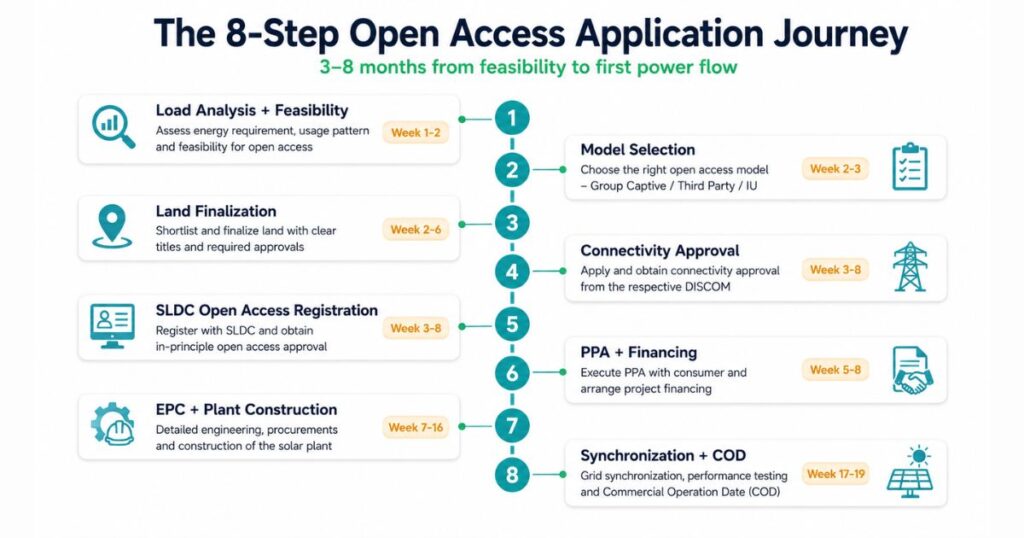
The 8-Step Open Access Application Process
Each step below corresponds to a discrete stage in the open access project lifecycle. Steps 1 to 3 run in parallel.

1. Load Profile, Analysis & Savings Estimation Analyse your bills, load pattern and baseline savings (Week 1–2)
Pull your last 12 consecutive months of electricity bills. You need three things from them: your average monthly consumption in kWh, your contracted demand in kW or kVA, and your DISCOM tariff category and rate. These three numbers form the financial foundation of every open access decision that follows.
Separately, map your load profile the ratio of daytime consumption (8 AM to 6 PM) to total consumption. Solar generates during these hours. A factory with 80% daytime load captures far more value from open access solar than one with a heavy night-shift operation. Your EPC partner should model this from your hourly or 15-minute interval demand data from the DISCOM, not from a monthly average.
Deliverable from Step 1: A savings estimate showing your current monthly DISCOM bill versus estimated open access landed cost, model-specific (Third-Party vs Captive vs Group Captive). This number validates whether the project makes financial sense before any further cost is incurred.
2. Model Selection- Third-Party, Captive, or Group Captive The structure you choose determines your CSS status, tax benefits, and capital requirement (Week 2–3)
This is the most consequential decision in the entire open access application process. Your model determines whether you pay CSS (Third-Party PPA) or are exempt from it (Captive / Group Captive). It determines whether you can claim 40% accelerated depreciation. It determines your capital outlay, your PPA tenure, and your long-term savings profile.
| Factor | Third-Party PPA | Captive | Group Captive |
| Capital Required | Zero | Full plant cost | 26% equity share |
| CSS Status | Applicable | EXEMPT | EXEMPT |
| Accelerated Depreciation | No (developer claims) | Yes — 40%/60% | On equity portion |
| Best for | Low CSS states; zero-capex preference | Profitable businesses with capital | MSME clusters; medium factories |
3. Land Finalization- For ground-mounted plants, solar irradiation assessment, lease or purchase (Week 2–6)
For rooftop captive projects, Step 3 is minimal confirm structural load capacity of the roof and prepare the roof area plan. For ground-mounted plants (typical for open access above 500 kW), land identification and documentation is a parallel workstream that must begin early because it is often the longest step.
Key considerations: solar irradiation at the proposed site (use SOLARGIS data or CEA irradiance maps), distance to the nearest grid substation (determines grid connection cost), and land title clarity (clear revenue records, no encumbrances, owner willing to lease or sell).
Land lease agreements for open access solar typically run 25 to 30 years. Verify that the term aligns with your PPA tenure. Incomplete or disputed land documents are among the top three causes of SLDC application rejection.
4. Connectivity Application to STU / DISCOM, Grid feasibility approval the first formal regulatory gate (Week 3–8)
The Connectivity Application is your request to the State Transmission Utility (STU) or DISCOM for grid connection approval for your solar plant. This is the first formal regulatory submission in the open access application process, and the accuracy of your technical documentation here directly determines your approval timeline.
Submit to: The STU (for plants connecting to the transmission network, typically 33 kV and above) or the DISCOM (for distribution-level connections). In most states, this is the same agency that later processes your open access registration.
The STU evaluates: substation capacity at your proposed injection point, transmission line feasibility, voltage compatibility, and grid evacuation capacity. A technically infeasible injection point a substation that is already at capacity can require a project redesign. Always run a substation capacity check before finalising your plant location.
Timeline: 3 to 8 weeks for grid feasibility approval in most states. States with higher open access activity (Karnataka, Rajasthan, MP) have streamlined this. Bihar and UP can run to 8 to 12 weeks.
5. Open Access Registration with SLDC GOAR Portal The central regulatory approval for energy scheduling and grid access (Week 3–8)
The SLDC (State Load Dispatch Centre) Open Access Registration is the primary approval that legally authorises your project to inject and draw power through the state grid. This is submitted through the GOAR (Green Open Access Registration) portal, introduced under the Green Energy Open Access Rules 2022.
How to Register on the GOAR Portal
- Create your account on the GOAR portal at the SLDC or SERC website for your state
- Fill Format-A for registration details (consumer information, project specifications, contracted demand)
- Submit Format-B1 (Short Term), B2 (Medium Term), or B3 (Long Term) depending on your PPA tenure
- Include: contracted demand, point of injection (plant location), point of drawal (factory location), and renewable energy type (solar)
- Attach connectivity approval from Step 4, Technical SLD, metering scheme, and land documents
💡 Under the Green Energy Open Access Rules 2022, the SLDC must approve or reject your application within 15 working days. If no response is received within 15 days and technical requirements are met, the application is deemed approved. This deemed approval provision is a significant consumer protection use it if your SLDC is non-responsive.
For Group Captive Applications- Additional Documents Required
Group Captive registration requires additional documentation to prove the 26% equity and 51% consumption criteria. Submit the Special Purpose Vehicle (SPV) incorporation certificate, shareholder agreement showing minimum 26% equity held by the consumer group, and a projected consumption schedule showing the 51% self-consumption requirement will be met on an annual basis.
6. PPA Finalization + Project Financing Lock your tariff, tenure, and capital structure (Week 5–8)
Once SLDC approval is in hand, finalize your Power Purchase Agreement. The PPA is the commercial contract that governs the relationship between you (the consumer) and the solar developer (or your own SPV for captive projects). It locks in your per-unit tariff, the PPA tenure (typically 20 to 25 years), annual escalation clauses, performance guarantees, and termination conditions.
Critical PPA terms to negotiate: Tariff escalation cap (0% is ideal, 2% is common), minimum generation guarantee from the developer with liquidated damages for shortfall, module brand and specification locked by model number, and step-in rights for O&M failures.
For captive and group captive projects requiring CAPEX investment, this is when project financing is secured. SIDBI’s 4E Green Finance scheme offers loans at 7 to 8% for up to Rs 7.5 crore, covering 100% of project cost. Monthly EMI on most 500 kW to 1 MW captive systems is lower than the monthly electricity savings generated making the system cash-flow positive from Month 1.
7. EPC Execution + Plant Construction Solar modules, inverters, mounting, electrical works, grid infrastructure (Week 7–16)
EPC execution for a 1 to 2 MW ground-mounted open access plant typically runs 8 to 16 weeks from mobilisation to ready-for-commissioning. The critical path runs through: civil works and mounting structure installation (weeks 1 to 6), module installation (weeks 3 to 10), inverter and electrical BOS installation (weeks 6 to 12), and HT line and grid evacuation infrastructure (weeks 4 to 14).
The commissioning date is a financial decision: If your plant is commissioned before October 3rd of the financial year, you claim the full 40% accelerated depreciation benefit (or 60% for manufacturing businesses) in that year. Commission after October 3rd and the rate halves under the half-year rule. Build this date into your EPC timeline as a contractual milestone, not a target.
⚠ ALMM List II compliance (Indian-manufactured solar cells) is mandatory for government-scheme open access projects from June 2026. For private captive and third-party open access, ALMM List I (module compliance) is mandatory from June 2026. Verify ALMM status of your specified modules before procurement. Non-compliant modules can cause synchronization rejection at the CEIG inspection stage.
8. Grid Synchronization, Meter Testing + COD, Final safety approvals power flow begins (Week 17–19)
Grid synchronization is the final technical gate before your plant enters commercial operation. It involves three distinct approvals that must be completed in sequence.
Synchronization Inspection (CEIG): The Chief Electrical Inspector to Government (CEIG) or equivalent state authority inspects the plant for electrical safety and protection system compliance. Protection relay settings, earthing systems, and switchgear specifications are verified against the approved Technical SLD. The CEIG inspection must be scheduled in advance 2 to 4 weeks lead time is standard.
Meter Testing: Import/export meters (ABT meters) at both the plant injection point and your factory drawal point are tested and sealed by the DISCOM metering team. These meters track every unit injected into the grid and every unit drawn at your meter the basis for all billing and energy accounting. An unsealed or uncertified meter is grounds for suspension of power flow.
Commercial Operation Date (COD): Once CEIG clearance and meter certification are complete, the SLDC activates energy scheduling. Your factory begins receiving solar power in 15-minute scheduling blocks. Your monthly DISCOM bill begins reflecting the reduction in grid units drawn. Savings begin on the first scheduled day.
Complete Document Checklist for Your Open Access Application
The following documents are required across Steps 4 and 5 of the open access application process. Incomplete documentation is the number one reason for application delays. Prepare all documents before submitting any application not as a rolling submission.
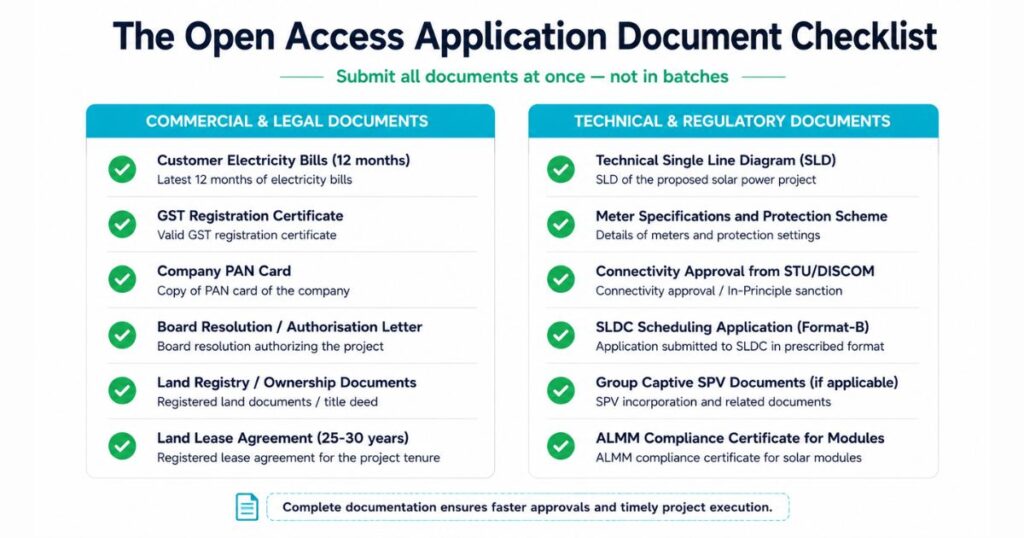
| Document | What It’s Used For | ||
| □ | Electricity bills — last 12 months | 📋 | Proves consumption, contracted demand, tariff category |
| □ | GST Registration Certificate | 📋 | Validates business entity for application |
| □ | Company PAN Card | 📋 | Identity proof for legal and regulatory filing |
| □ | Board Resolution / Authorisation Letter | 📋 | Authorises signatory to execute agreements |
| □ | Land Registry / Revenue Records (7/12 extract) | 📋 | Proves clear land title for plant location |
| □ | Land Lease Agreement (25–30 year term) | 📋 | Establishes right to use land for plant lifetime |
| □ | Technical Single Line Diagram (SLD) | 📋 | Required for CEIG and SLDC technical review |
| □ | Protection Scheme Details and Relay Settings | 📋 | Grid protection compliance — required for synchronization |
| □ | Meter Specifications (ABT / bidirectional) | 📋 | SLDC energy accounting and billing basis |
| □ | Connectivity Approval from STU / DISCOM | 📋 | Mandatory prerequisite for SLDC registration |
| □ | Group Captive: SPV Certificate + Shareholder Agreement | 📋 | Proves 26% equity and 51% consumption criteria for captive status |
| □ | ALMM Compliance Certificate for Solar Modules | 📋 | Mandatory for all projects from June 2026 — List I + II verification |
How Long Does the Open Access Application Process Take? State-Wise Timelines (2026)
The following timelines reflect current state-level processing speeds for the open access application process. All timelines assume a complete, error-free application is submitted from Day 1. Incomplete applications restart the clock.
| State | Connectivity Approval | OA Registration | Sync & COD | Approval Authority |
| Madhya Pradesh | 3–5 wks | 2–4 wks | 1–3 wks | MPERC / MP-SLDC |
| Rajasthan | 3–5 wks | 2–4 wks | 1–3 wks | RERC / RVPN / SLDC |
| Karnataka | 3–6 wks | 2–4 wks | 1–2 wks | KPTCL / KERC / SLDC |
| Gujarat | 3–5 wks | 2–4 wks | 1–2 wks | GUVNL / GERC / SLDC |
| Haryana | 3–5 wks | 2–5 wks | 1–3 wks | UHBVNL / DHBVNL / SLDC |
| Tamil Nadu | 4–7 wks | 3–5 wks | 1–3 wks | TANGEDCO / TNERC / SLDC |
| Telangana | 3–5 wks | 2–4 wks | 1–2 wks | TSSPDCL / SLDC |
| Maharashtra | 5–8 wks | 4–8 wks | 2–4 wks | MSEDCL / MERC / MSLDC |
| Uttar Pradesh | 5–8 wks | 4–8 wks | 2–4 wks | UPPCL / UPERC / SLDC |
| Bihar | 6–10 wks | 4–8 wks | 2–4 wks | BSPTCL / BERC / SLDC |
Five Common Reasons Open Access Applications Are Rejected and How to Avoid Them
These are the five mistakes Solarsure has seen repeatedly across states. Each one is preventable. Each one adds weeks — sometimes months to the open access application process.
1. Incorrect or Mismatched Metering Specification. The meter type, CT/PT ratio, and accuracy class specified on your SLD must exactly match the meter installed on-site. Any discrepancy even a CT ratio mismatch causes rejection at the SLDC metering verification stage. Fix: Use only DISCOM-approved meter specifications and confirm the final meter model number with the SLDC before procurement.
2. Substation Already at Capacity No Grid Evacuation Headroom. You applied to inject into a substation that the STU has already loaded to its transformation capacity. Your application gets returned with a “no headroom” note. Fix: Run an informal substation capacity check with your EPC or a local electrician before finalising your plant location. This takes one phone call to the STU and saves 4–8 weeks.
3. Group Captive Equity / Consumption Documentation Incomplete. The SPV incorporation documents, shareholder agreement, and projected consumption schedule are missing or inconsistent 26% equity is not clearly demonstrated. SLDC returns the application asking for revised documentation. Fix: Prepare Group Captive documents with a company secretary or solar lawyer before submission. This documentation set is not a standard template it needs to be specific to your SPV structure.
4. ALMM Non-Compliance on Module Specification. From June 2026, modules must be ALMM List I certified. Applications specifying non-listed modules are rejected or held pending clarification. Fix: Confirm ALMM List I status of your specified module brand and model before the SLD is finalised. The MNRE ALMM portal is updated monthly verify at the time of procurement, not at the time of SLD preparation.
5. Outstanding DISCOM Dues on Consumer Account. Any unpaid dues even minor late payment charges on your existing electricity account cause the DISCOM to return or hold your open access application. Fix: Request a dues clearance certificate from your DISCOM before submitting your open access application. Clear any pending amounts first.
📖 You can also read: Solar billing Models
Frequently Asked Questions
Q: How long does the open access application process take in India?
A: The total timeline from feasibility study to Commercial Operation Date is typically 3 to 8 months, depending on your state and project complexity. The fastest states — Madhya Pradesh, Rajasthan, Karnataka, and Gujarat — can achieve COD in 3 to 4 months for well-prepared applications. Maharashtra, Uttar Pradesh, and Bihar typically take 5 to 8 months due to longer approval timelines and additional documentation requirements. The single biggest variable is documentation completeness at Steps 4 and 5.
Q: What is the minimum load required to apply for open access solar in India?
A: Under the Green Energy Open Access Rules 2022, the minimum contracted demand for renewable open access is 100 kW. Some states have retained higher state-level thresholds (typically 1 MW) for conventional open access categories. For businesses below the individual threshold, a Group Captive structure allows multiple consumers to pool their demand and collectively access open access economics. Confirm your state’s current threshold with your EPC partner before applying.
Q: What documents are required for an open access solar application?
A: The core document package includes: 12 months of electricity bills, GST registration certificate, company PAN, board resolution authorising the signatory, land registry documents and lease agreement, Technical Single Line Diagram (SLD), protection scheme details, meter specifications (ABT/bidirectional), and connectivity approval from the STU or DISCOM. For Group Captive applications, add: SPV incorporation certificate, shareholder agreement demonstrating 26% equity, and projected consumption schedule. From June 2026, all projects must also include ALMM List I compliance certification for solar modules.
Q: What is the GOAR portal and how do I use it for open access registration?
A: The GOAR (Green Open Access Registration) portal was introduced under the MNRE’s Green Energy Open Access Rules 2022. It is the centralised digital platform for submitting open access registration applications to the SLDC. You register with a username and password on your state’s SLDC or SERC website, complete Format-A for registration details, and submit Format-B1/B2/B3 depending on your PPA tenure. Applications must be approved within 15 working days — if they are not, they are deemed approved provided technical requirements are met.
Q: Can I apply for open access solar without owning the plant?
A: Yes — under the Third-Party PPA model, a solar developer owns and operates the plant. You simply sign a Power Purchase Agreement and pay the developer a per-unit rate. You submit only the consumer-side documentation (electricity bills, GST, PAN, board resolution) and the SLDC registration through your developer. Note that Third-Party PPA consumers do not receive CSS exemption or accelerated depreciation benefits — these apply only to captive and group captive structures.
Q: What happens if the SLDC rejects my open access application?
A: The SLDC must provide a written reason for rejection. Common reasons include: substation capacity constraints, documentation gaps, metering specification mismatches, and ALMM non-compliance. Most rejections are curable — you address the specific deficiency and resubmit. A complete, accurate application with all documentation prepared in advance is the most reliable way to avoid rejection. If your application is rejected on grounds that appear inconsistent with the Electricity Act or GEOA Rules, you have the right to appeal to your state’s SERC.
Bottom Line
The open access application process in India is not complicated — it is sequential. Eight steps, clearly defined authorities, specified timelines, and a document list that does not change. The businesses that navigate it quickly are the ones that prepare everything before they submit anything, choose the right model before they start, and work with an EPC partner who has done this specific process in their specific state before.
The 15-day deemed approval provision in the GEOA Rules 2022 is one of the most powerful consumer protections in Indian energy policy. It means a complete, compliant application cannot be indefinitely delayed. Use it — and file your applications complete.
Solarsure manages the full open access application process — from load profile analysis and model selection through SLDC registration, EPC execution, and grid synchronization. We know the approval authorities, the document formats, and the substation capacity status in the areas where we operate. The timeline in this guide is not a best-case scenario. It is what a well-prepared project looks like.