Every year, thousands of Indian businesses install solar and expect their electricity costs to drop significantly. Many of them are right. But a surprising number end up disappointed, which is not because solar failed them, but because nobody explained one critical thing before the installation began.
Solar energy in India does not come with a single, universal solar billing model. There are five different models. Each one has its own rules, its own financial logic, and its own ideal user. The model you choose determines how your electricity bill changes, how quickly you recover your investment, and whether you unlock certain legal exemptions that could save your business lakhs every year.
Most solar consultations in India spend 90% of the time on panel specifications, inverter brands, exemptions, and installation timelines. The billing model gets five minutes at the end if it gets discussed at all. The plant owners take this seriously to understand the right solar billing model for their businesses. In this blog, we will understand these five models and how they make sense in every solar decision. So, let’s dive in.
What are Solar Billing Models?
Solar billing models are the different ways your solar power is counted and used to reduce your electricity bill. First, they decide how much solar energy you use and how much goes to the grid. Next, they define how the utility calculates your savings or payments. For example, some models adjust units, while others pay a fixed rate. As a result, these models directly affect how much you save and how quickly you recover your solar investment.
In India, different billing models are governed by state electricity regulations and the Electricity Act 2003. Choosing the wrong model can mean lower savings, slower returns, or missed exemptions. So, there are five main solar billing models used by Indian consumers and businesses today. These are explained one by one in detail:
Net Metering
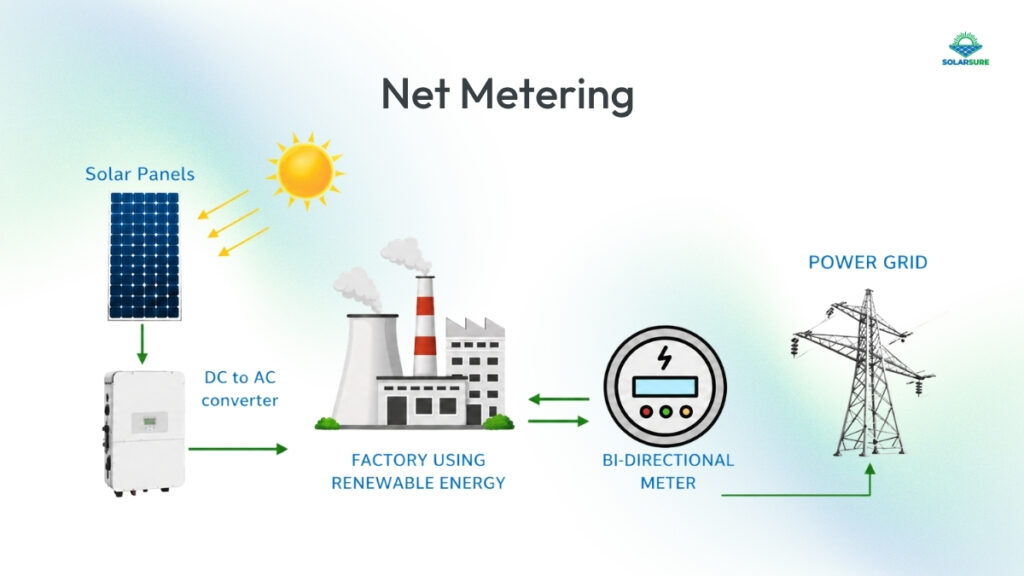
Net metering is a solar billing arrangement where the electricity you generate is first used for your own consumption. Any surplus power is then exported back to the government grid. You are billed only for the “net” difference between what you consumed and what you generated.
How Net Metering Works?
Under net metering, a bidirectional meter is installed at your premises. This meter records both the electricity you import from the grid and the electricity you export to it. At the end of the billing cycle, your bill is calculated on net units only, which is the total units consumed minus total units generated by your solar system. If your solar generation exceeds your consumption in a given month, the surplus units are carried forward to the next billing cycle. In many states, you receive a monetary credit for any remaining surplus units at the end of the year.
Net metering saves you money at the full retail electricity rate and not at a lower feed-in tariff. This means every unit your solar system generates is as valuable as a unit you would have otherwise purchased from the grid. This makes net metering the fastest-returning solar billing model available. The typical payback period for a net-metered solar system is 4 to 5 years, and you can get free energy for almost 20 years.
Gross Metering
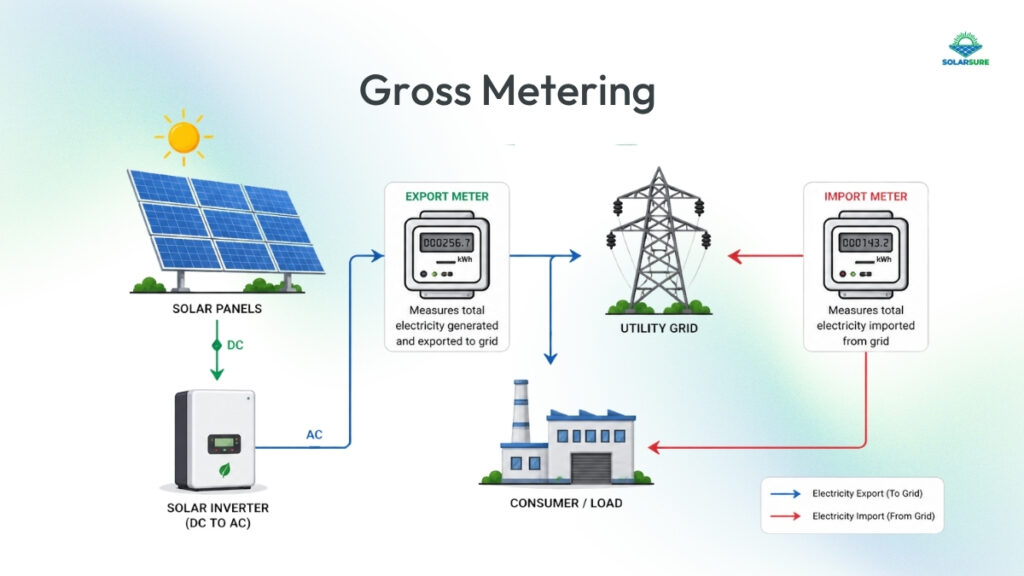
Gross metering is a solar billing model where every unit of electricity your solar system generates is sent directly to the government grid. Unlike net metering, you do not consume any of your own solar power. Instead, you earn a fixed payment for everything you generate and separately pay for everything you consume.
In simple terms, your rooftop becomes a small power station. In gross metering, you are in the business of selling electricity, not saving on your bill.
How Gross Metering Works?
In gross metering, two separate meters are installed at your premises. The first meter measures all the solar electricity your system exports to the grid. The second meter measures all the electricity you draw from the grid for your own use. The electricity distribution company (DISCOM) pays you for your exports at a pre-agreed rate called the Feed-in Tariff (FiT). At the same time, you continue to pay your full electricity bill at the standard consumer tariff, just as you did before installing solar.
The Feed-in Tariff you earn is typically lower than the retail tariff you pay for consumption. This gap between what you earn and what you spend slows down your return on investment. The typical payback period under gross metering is 6 to 8 years, which is longer than net metering. However, for the right type of consumer, the steady income from a large solar installation can still make gross metering a financially sound decision over the long term.
Virtual Net Metering
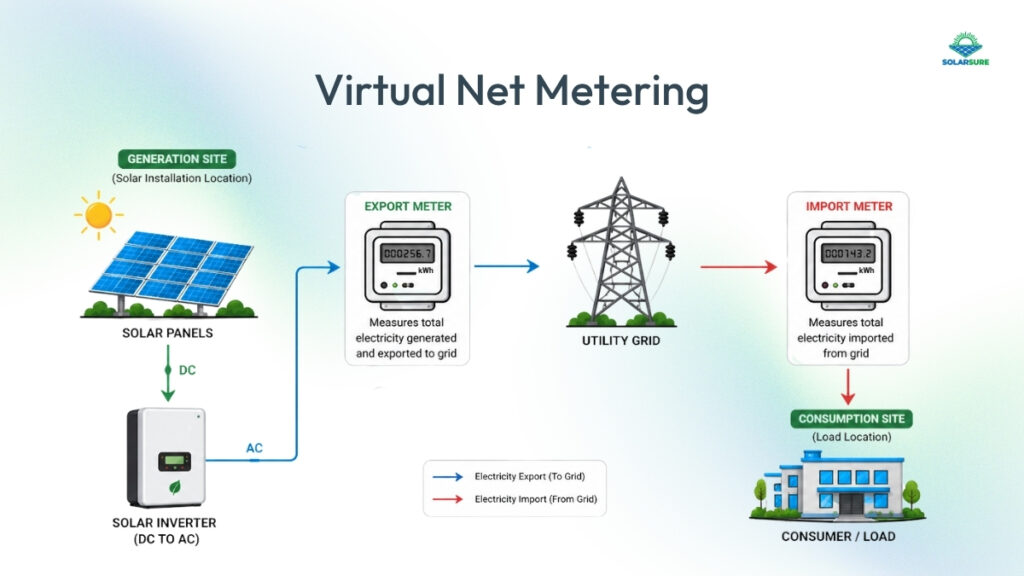
Virtual net metering is a billing model that allows consumers to benefit from a solar plant even if they cannot install one on their own premises. A solar plant is set up at a separate location and connected to the grid. The energy credits generated by that plant are then distributed across the electricity bills of multiple consumers, even if they are located at different addresses.
It essentially decouples the solar plant from the consumption point. In net metering, you do not need a rooftop, nor do you need to be physically connected to the plant. You just need to be within the same DISCOM zone.
How Virtual Net Metering Works?
The solar plant exports 100% of its generated electricity to the grid through a gross meter. The DISCOM then calculates the credits earned and adjusts them across the bills of the participating consumers. Each consumer gets a credit on their electricity bill proportional to their share in the arrangement. No power physically travels from the plant to each consumer’s premises, and the adjustment happens purely on paper through the billing system.
Group net metering follows the same export-and-credit mechanism. The key difference is that all participating electricity connections must belong to the same consumer. For example, a supermarket chain can install one solar plant at its main warehouse and use the credits to reduce electricity bills across all its store locations.
Since the system exports all generated power to the grid, the DISCOM determines financial returns based on the Feed-in Tariff it offers and how the credits offset each participant’s retail bill. A large plant and efficient credit distribution can generate significant savings. This model also enables consumers who cannot install solar due to shading, rented premises, or limited rooftop space to participate in the clean energy transition and reduce their electricity bills.
Captive Solar Power Plant
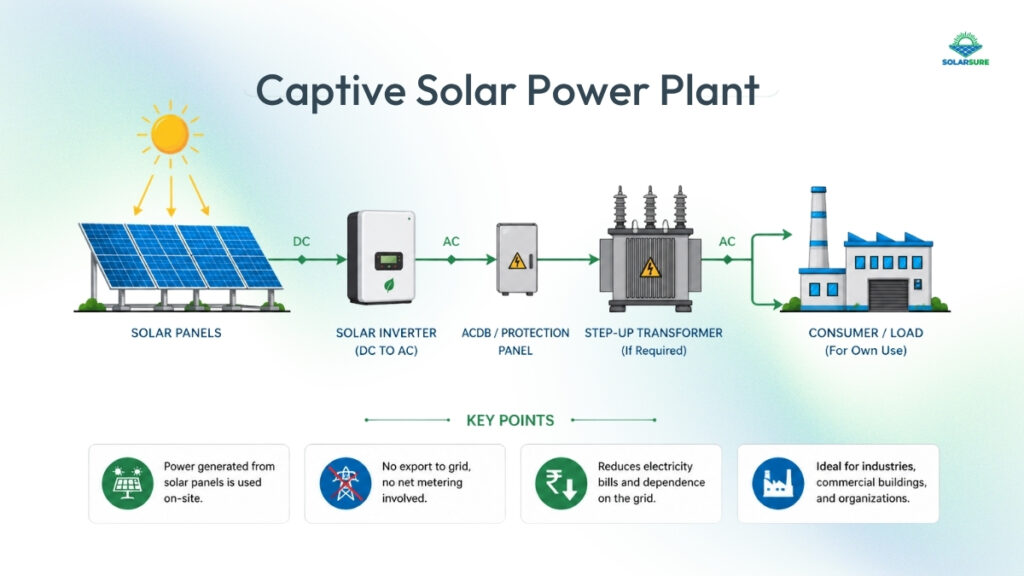
A captive solar power plant is a dedicated solar facility set up by a single large consumer to meet its own electricity needs. The plant operates outside the standard DISCOM supply chain through a mechanism called open access. This means the business generates its own power, transmits it directly to its own facility, and largely avoids dependence on the grid altogether.
The word “captive” here means the power is generated specifically for and consumed entirely by the owner. It is not intentionally generated for sale to others.
How Captive Solar Works?
Usually, a business installs a solar plant, often at a location with available land, which may be separate from the main factory or facility. The power is then wheeled through the open access transmission network directly to the consumer’s premises.
To be legally recognised as a captive generator under the Electricity Act 2003, two conditions must be met at all times. First, the consumer must hold a minimum of 26% equity stake in the solar project. Second, the consumer must consume at least 51% of the total electricity generated by the plant every year. Both conditions must be satisfied simultaneously to retain captive status.
The most significant financial advantage of captive solar is the exemption from the Cross-Subsidy Surcharge (CSS) and the Additional Surcharge (AS). These are substantial charges that most open-access power buyers are required to pay. Captive consumers are fully exempt from both. This exemption dramatically reduces the effective per-unit cost of solar power, which often makes it 30% to 50% cheaper than purchasing equivalent power from the grid. Over a plant life of 25 years, the cumulative savings for a large industrial consumer can run into crores of rupees.
Group Captive Solar Power Plant
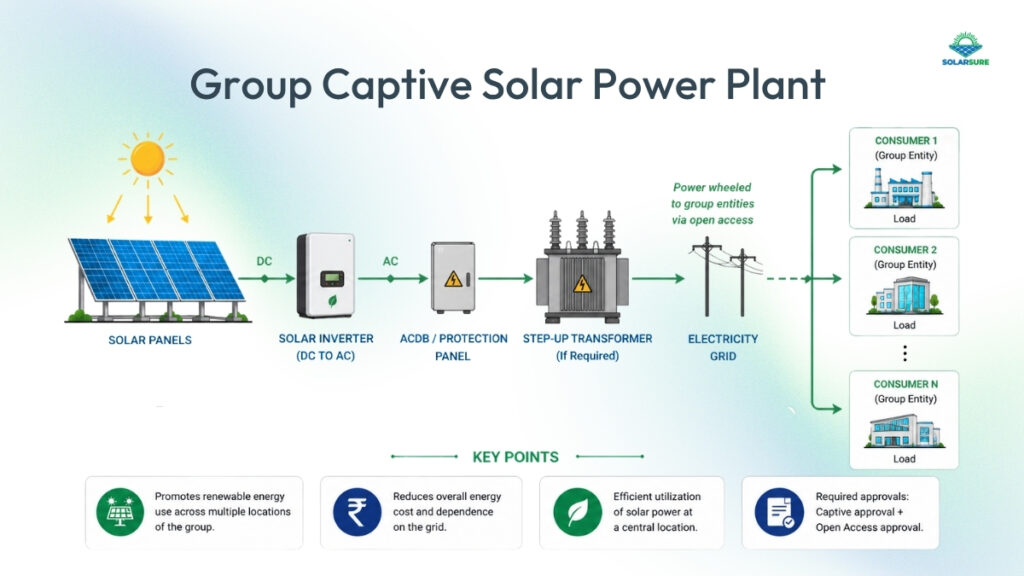
Group captive solar builds on the same foundation as single captive solar, but instead of one company bearing the entire cost, a group of businesses comes together to jointly own and operate the plant. It brings the financial and regulatory benefits of captive solar within reach of mid-sized companies that cannot justify the investment on their own.
How Group Captive Solar Power Plant Work?
The participating businesses form a Special Purpose Vehicle (SPV), a dedicated legal entity, to own and operate the solar plant. An Independent Power Producer (IPP) typically facilitates this process by identifying suitable land, arranging financing, and managing the plant on behalf of the group. Each business receives power from the plant in direct proportion to its equity shareholding in the SPV.
For the arrangement to qualify as a group captive under the Electricity Act 2003, the group must collectively hold at least 26% equity in the SPV, and collectively consume at least 51% of the plant’s annual power output. Additionally, each participant’s individual power consumption must be proportional to their respective shareholding. This is a critical compliance requirement that is regularly audited.
Group captive consumers enjoy the same CSS and Additional Surcharge exemptions as single captive consumers. This keeps the landed cost of power significantly lower than grid tariffs. The key difference and the primary appeal are that capital expenditure is distributed across multiple businesses. The payback period is typically 6 to 9 years, after which the power is nearly free for the remaining plant life.
Comparison Table: All Five Models at a Glance
|
Feature |
Net Metering | Gross Metering | Virtual Net Metering | Captive Solar | Group Captive |
|
Self-Consumption |
Yes, first priority | No, all exported | No, all exported | Yes, primary purpose | Yes, proportional |
|
Grid Export |
Surplus only | 100% | 100% | Minimal or none | Minimal or none |
| Ownership | Consumer/developer | Consumer/developer | Plant host/developer | Consumer (min. 26%) |
Group SPV (min. 26%) |
|
CSS & AS Exemption |
No | No | No | Yes | Yes |
|
Payback Period |
4–5 years | 6–8 years | Varies | 6–9 years |
6–9 years |
| Scale | Small to medium | Large rooftops | Distributed | Very large |
Medium to large |
|
Capital Required |
Low to medium | Low to medium | Low | Very high |
Shared and moderate |
| DISCOM Involvement | High | High | High | Low (open access) |
Low (open access) |
| Regulatory Complexity | Low | Low | Medium | High |
High |
Which Solar Billing Model is Best for Whom?
There is no single “best” solar billing model. The right choice depends on your consumption size, budget, capital, and long-term goals.
Net Metering: Net metering is suitable for homeowners, small offices, or retail shops. The objective is to reduce monthly electricity bills quickly, and it works best when most power consumption happens during the daytime. It also offers a fast ROI with low complexity.
Gross Metering: Gross metering is suitable when there is a very large rooftop available, but a very low power consumption requirement on site. The primary goal is to earn revenue from solar generation rather than saving on electricity bills.
Virtual Net Metering: Virtual net metering is suitable when solar cannot be installed at each premise. Consumers use it when one central plant needs to benefit multiple accounts or tenants. Housing societies, government buildings, and multi-location businesses within the same DISCOM zone commonly adopt it.
Captive Solar: Captive solar is suitable for large industrial power consumers such as cement, steel, or data centres. It fits cases where there is a willingness to invest heavily up front because the goal is full energy independence and elimination of CSS and additional surcharge payments over time.
Group Captive: Group captive is suitable when the same benefits as captive solar are required, but with shared investment. It is best for mid-sized manufacturers, pharma companies, or IT businesses. In this model, multiple businesses co-own a plant and share costs proportionally.
Quick decision rule based on the monthly electricity bill:
- Below Rs. 5 lakh/month electricity bill, start with net metering
- Rs. 5 lakh to Rs. 50 lakh/month bill, explore group captive or virtual net metering
- Above Rs. 50 lakh/month bill, captive or group captive, will deliver the highest long-term savings
Bottom Line
The right solar billing model can mean the difference between good savings and exceptional ones. Each model serves a different consumer, and understanding that difference is what separates a smart solar investment from an average one. For a business, it is a must to match your model to your scale, budget, requirements, and goals. If you have any doubts or want to know more about solar billing models, book a free consultation with our experts.