Hiring a solar EPC company is an important business decision. The right partner can improve generation, safety and project performance. However, comparing different EPC companies is not always straightforward. Each company may offer different equipment, services and commercial terms.
Some companies compete mainly through a lower project price. Others focus on engineering quality and long-term technical support. Therefore, businesses must look beyond the final quotation value. They should understand everything included and excluded in the proposal.
This blog answers common questions about hiring a solar EPC company. It will help you evaluate experience, quality and technical capabilities. You will also learn how to compare quotations and warranties. These answers can help you choose a dependable solar EPC partner.
1. What Does a Solar EPC Company Do?
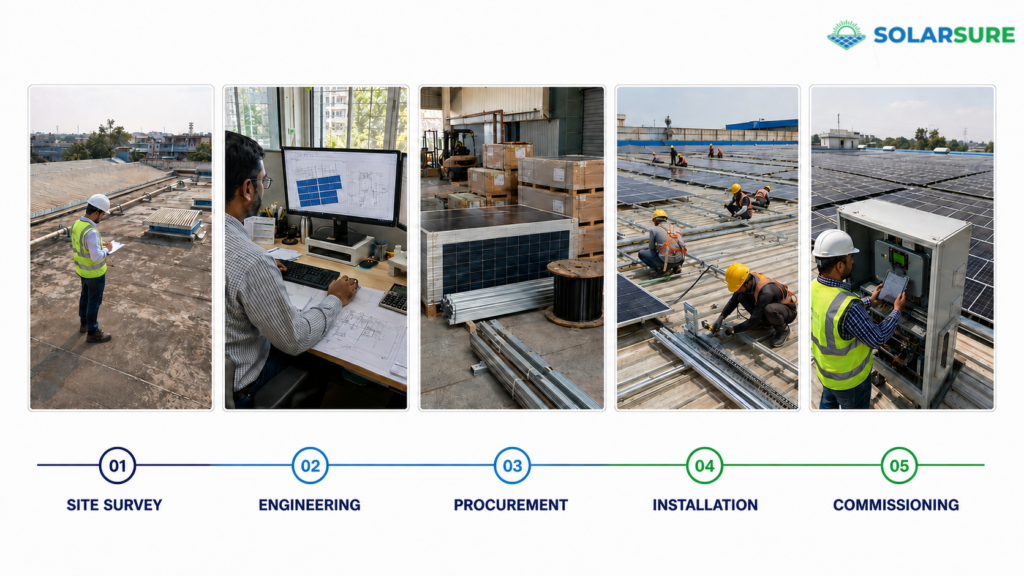
A solar EPC company manages the complete solar project from planning to commissioning. EPC stands for Engineering, Procurement and Construction. Therefore, the company takes responsibility for designing the solar plant, selecting equipment and managing installation.
The process usually begins with a site survey and electricity consumption analysis. Based on these findings, the EPC team determines the suitable project capacity, layout and expected generation. It also prepares technical drawings, energy estimates and project timelines.
Additionally, a reliable EPC company coordinates approvals, testing and grid connectivity. After commissioning, it may also provide monitoring and maintenance support. This single-point responsibility helps businesses manage their solar projects more efficiently.
2.What Is the Difference Between a Solar EPC Company and a Solar Installer?
A solar installer mainly focuses on installing panels and related equipment. In contrast, a solar EPC company manages the complete project, including engineering, procurement, construction, testing and commissioning.
| Comparison Point | Solar EPC Company | Solar Installer |
| Project Scope | Manages the complete project lifecycle | Mainly handles equipment installation |
| Engineering | Conducts site surveys, sizing and detailed design | Usually follows an existing design |
| Procurement | Selects and procures complete project equipment | May supply only selected components |
| Approvals | Coordinates DISCOM and grid-connectivity procedures | Approval support may remain limited |
| Accountability | Provides single-point project responsibility | Responsible mainly for installation work |
| Post-Commissioning Support | May provide monitoring, warranties and O&M | Usually provides basic installation support |
| Best Suited For | Commercial, industrial and complex projects | Small or straightforward installations |
This difference is important for commercial and industrial projects requiring detailed engineering, safety planning and regulatory coordination. Therefore, businesses generally benefit from the complete accountability offered by an experienced solar EPC company.
3.What Should You Check Before Hiring a Solar EPC Company?
Before hiring a solar EPC company, review its experience with projects similar to yours. Check completed project capacities, client references, technical team and execution capabilities. The company should also understand local DISCOM procedures, safety standards and grid-connectivity requirements.
Businesses should evaluate the following factors:
- Experience with commercial and industrial solar projects
- Quality of panels, inverters, structures and electrical components
- In-house engineering and project management capabilities
- Detailed generation estimates and financial calculations
- Safety practices, warranties and after-sales support
- Clear project scope, timeline and payment terms
Price should not be the only selection criterion. A lower quotation may exclude essential equipment, safety components or long-term support. Therefore, compare the complete technical and commercial scope before making your decision.
📖 Learn more about how solar EPC services help commercial and industrial businesses reduce energy costs.
4.How Can You Verify a Solar EPC Company’s Experience?
Review the company’s completed projects, capacities, client industries and case studies. Ask for project photographs, commissioning records and client references wherever possible. You should also check whether the company has executed projects like your required capacity, location, roof type and electrical infrastructure.
Additionally, confirm whether its engineering, procurement and execution teams are in-house or outsourced. Ask who will manage your project after the contract is signed. Relevant project experience, technical resources and direct client feedback provide stronger evidence than general claims about total installed capacity.
5.Is a Site Survey Necessary Before Receiving a Solar Quotation?
Yes, a detailed site survey is essential before finalising a solar quotation. It helps the EPC team evaluate available space, shadow patterns, roof condition and structural strength. The team also checks whether the site has safe access for installation and future maintenance.
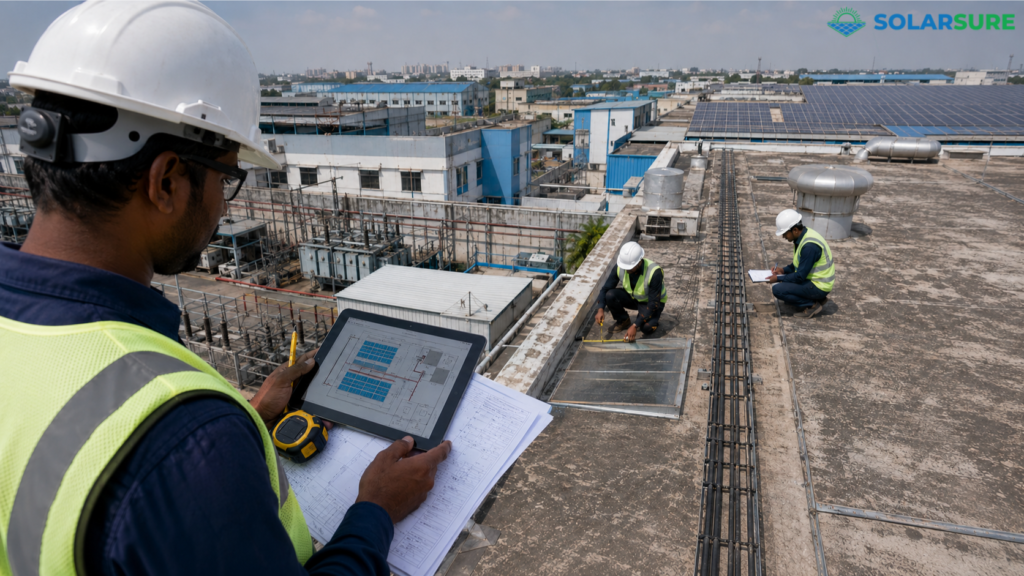
During the survey, engineers review electricity consumption, sanctioned load and existing electrical infrastructure. They also examine transformer capacity, cable routes and grid-connectivity requirements. These details help determine the suitable project capacity, layout and expected energy generation.
Without a proper site survey, the proposed capacity and project cost may be inaccurate. Unexpected structural work, longer cable routes or electrical upgrades can increase costs later. Therefore, an initial quotation should remain indicative until the EPC company completes a technical site assessment.
6.What Should Be Included in a Solar EPC Quotation?
A solar EPC quotation should clearly explain the complete technical and commercial scope. It must provide enough detail to compare equipment quality, engineering standards, project costs and responsibilities. A quotation showing only the plant capacity and final price is not sufficient.
| Quotation Component | What Businesses Should Verify |
| Project Capacity | Proposed AC and DC capacity with system-sizing assumptions |
| Generation Estimate | Expected annual generation, system losses and calculation basis |
| Solar Panels | Manufacturer, model, wattage, efficiency and warranties |
| Inverters | Manufacturer, model, capacity, efficiency and service support |
| Mounting Structure | Material grade, thickness, design loads and corrosion protection |
| Electrical Components | AC/DC cables, connectors, junction boxes and protection devices |
| Safety Systems | Earthing, lightning protection, surge protection and isolation |
| Monitoring | Remote monitoring platform, communication system and fault alerts |
| Project Execution | Civil work, installation, testing and commissioning responsibilities |
| Approvals | Net-metering, grid connectivity and DISCOM coordination scope |
| Commercial Terms | Total price, taxes, transportation, payment schedule and exclusions |
| After-Sales Support | Equipment warranties, workmanship warranty, O&M and response time |
Businesses should check whether every major component has a defined brand, rating and quantity. They should also identify exclusions that may create additional expenses during execution. A transparent quotation reduces misunderstandings and makes different EPC proposals easier to compare.
🔎 Also explore: Solar Panel Technologies Explained—A Detailed Breakdown for Indian Buyers
7.Why Can the Lowest Solar EPC Quotation Be Risky?
The lowest quotation may appear attractive, but it can exclude essential components or services. Some proposals reduce costs through thinner mounting structures, lower-grade cables, limited safety equipment or unrealistic generation estimates. These compromises may increase breakdowns, generation losses and maintenance expenses later.
Businesses should compare equipment specifications, engineering scope, safety provisions, warranties and exclusions—not only the price per kilowatt. If one quotation is significantly lower, ask the EPC company to explain the difference in writing. A slightly higher initial investment can provide better performance, safety and long-term returns.
8.Who Selects the Solar Panels, Inverters and Other Equipment?
The solar EPC company recommends equipment based on project capacity, site conditions, available space and expected performance. However, the client should review and approve the final selection before procurement. The quotation must mention the manufacturer, model, rating, efficiency and warranty of every major component.
The importance of careful equipment selection can be seen in the 16 MW rooftop solar project developed by Tata Power Solar for RSSB–EES in Beas. Bankable Tier-1 Mult crystalline modules were selected to deliver consistent performance with low degradation over the project’s planned 25-year operating period. The project demonstrates why long-term reliability should carry more weight than the lowest equipment price.
The EPC company must also confirm compatibility between panels, inverters, mounting structures, cables and protection systems. Additionally, it should consider local service availability and replacement support. The contract must clearly state that no approved equipment can be substituted without the client’s written consent.
9.Does the Solar EPC Company Handle Approvals and Grid Connectivity?
In most turnkey projects, the solar EPC company prepares technical documents and coordinates the approval process. This may include the application, single-line diagram, feasibility documents, metering requirements, inspection, testing and grid synchronisation. However, the exact scope must be clearly mentioned in the contract.
The client may still need to provide electricity bills, ownership documents, sanctioned-load details and authorisation letters. Additionally, statutory fees, meter charges or infrastructure upgrades may remain outside the EPC price. Since procedures differ across states and DISCOMs, businesses should confirm these responsibilities before signing the agreement.
An experienced local EPC partner can identify approval requirements early and reduce avoidable delays. However, no company should promise a guaranteed approval date because the final decision remains with the relevant authority.
10.How Long Does a Commercial or Industrial Solar EPC Project Take?
The completion timeline depends on project capacity, site readiness, approval requirements and equipment availability. A smaller rooftop project may be completed within a few weeks, while a large industrial or ground-mounted project can require several months. Structural strengthening, transformer upgrades and delayed grid approvals can extend the schedule.
The timeline should separately cover engineering, procurement, construction, testing and commissioning. Businesses should also confirm whether the promised period begins after signing the contract, receiving an advance, completing approvals or handing over the site. This distinction prevents confusion when delays occur.
Execution speed can be seen in Tata Power Solar’s 10 MW solar power project for Jindal Aluminium Limited. The project was commissioned within four months of land acquisition. However, businesses should treat such timelines as project-specific because site conditions, project design and approval processes vary considerably.
11.What Are Generation Estimates and Performance Guarantees?
A generation estimate predicts how much electricity the solar plant should produce annually. The EPC company calculates it using solar irradiation, weather data, shadow analysis, equipment efficiency and expected system losses. The proposal should clearly mention these assumptions instead of presenting only a final generation figure.
A performance guarantee creates contractual accountability for the plant’s operation. It may cover minimum generation, performance ratio, plant availability or equipment efficiency. Businesses should check the guarantee period, measurement method, permitted exclusions and compensation process if performance falls below the agreed level.
The importance of measuring actual performance is visible in Tata Power Solar’s 17 MW Mithapur solar project in Gujarat. After two years of operation, the plant reported a performance ratio of 83.80% and annual generation exceeding 30 million kWh. Such measurable operating data helps project owners compare actual results against the estimates and commitments provided before installation.
12.What Warranties and O&M Support Should an EPC Company Provide?
The EPC company should clearly separate product warranties from its own workmanship and performance commitments. Solar panels, inverters and other equipment carry manufacturer warranties, while the EPC contractor remains responsible for installation quality, system integration and agreed project performance.
Businesses should check coverage for:
- Solar panel product and performance warranties
- Inverter and electrical equipment warranties
- Mounting structure and workmanship warranty
- Repair response time and escalation process
- Remote generation monitoring and fault alerts
- Preventive inspections, cleaning and safety checks
- Spare-part availability and warranty-claim assistance
Long-term partnerships show why post-commissioning support matters. Clean Max began working with Bangalore International Airport Limited through a 0.5 MWp rooftop project in 2016. The partnership later expanded to 13 MWp of open-access solar in 2018 and additional solar-wind capacity in 2023. This continued expansion illustrates the value of selecting an energy partner capable of supporting a client beyond the first installation.
Before signing, businesses should confirm whether O&M is included in the EPC price or charged separately. The contract should also define service frequency, response timelines, exclusions and responsibility for coordinating manufacturer warranty claims.
13.How Can Businesses Verify an EPC Company’s Safety and Quality Standards?
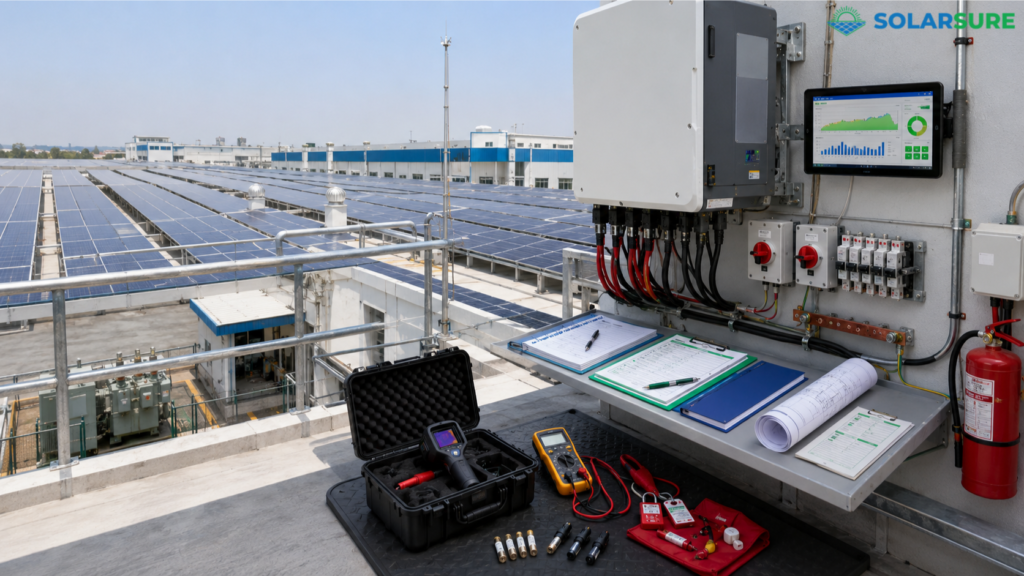
Businesses should ask for the EPC company’s safety policy, method statements, inspection plans and testing records. The company should follow applicable CEA, IEC and IS requirements for electrical design, earthing, lightning protection, cables, structures and fire safety. Workers must also receive proper training and use suitable personal protective equipment during construction.
Safety planning becomes especially important for unusual or high-risk installations. Tata Power Solar’s 120 kW vertical solar project for Dell in Bengaluru was installed on the façade of an existing building. The project used a custom load-bearing structure, along with integrated platforms and walkways for safer access and maintenance. It was completed without any reported safety incidents.
Before handover, the client should request insulation-resistance tests, earth-resistance reports, protection-system checks and commissioning records. Additionally, the EPC company should provide approved drawings, equipment datasheets and as-built documentation. These records help confirm that safety and quality were verified instead of merely promised.
14.What Support Should an EPC Company Provide After Project Handover?
Project handover should not end the EPC company’s responsibility. The client should receive as-built drawings, equipment manuals, warranty certificates, test reports, spare-parts details and operating instructions. The EPC team should also train the facility staff to use the monitoring platform and identify basic system alerts.
After commissioning, support may include:
- Remote generation monitoring and fault identification
- Preventive inspections and scheduled maintenance
- Equipment warranty coordination
- Generation and performance reporting
- Spare-parts planning and replacement support
- Technical assistance during grid or meter-related issues
Long-term support is built directly into some EPC contracts. For Tata Power Solar’s 50 MW Kasaragod Solar Park project in Kerala, the company’s scope included comprehensive operation and maintenance for ten years after commissioning. Although every project requires a different service period, this example shows why post-handover responsibilities should be defined before contract signing.
Businesses should confirm whether support is included in the project cost or covered through a separate O&M agreement. The contract must specify service duration, response timelines, exclusions and escalation contacts. Clear terms help prevent uncertainty when technical problems arise.
15.Why Should Businesses Consider Solarsure as Their Solar EPC Partner?
Solarsure provides end-to-end support for commercial and industrial solar projects. Its scope covers site assessment, engineering, equipment procurement, construction, commissioning and long-term performance planning. This integrated approach gives businesses a single accountable partner throughout the project.
Headquartered in Indore, Solarsure executes renewable energy projects across Central and Northern India, including Madhya Pradesh, Rajasthan, Gujarat, Uttar Pradesh, Chhattisgarh and Maharashtra. This regional presence helps the team understand different site conditions, industrial requirements and state-level approval processes.
Solarsure also prepares project-specific technical and financial assessments instead of offering the same configuration to every business. Equipment specifications are documented before procurement, while project design is aligned with available space, electricity consumption and long-term generation goals.
📖 know more about: What Is Solar EPC and How Does the Complete Process Work?
Bottom Line
Hiring a solar EPC company requires more than comparing project prices. Businesses must evaluate engineering experience, equipment specifications, safety practices, generation estimates, warranties and post-commissioning support. Every major commitment should be clearly documented before the contract is signed.
A dependable EPC partner conducts a detailed site assessment, provides transparent calculations and explains all exclusions. It also accepts responsibility for project execution, testing and performance. Therefore, choosing the right company can reduce technical risks and protect long-term energy savings.
Before making your final decision, compare multiple proposals and verify completed projects. Ask detailed questions and avoid accepting unclear technical or commercial terms. A carefully selected solar EPC partner can help your business build a safe, efficient and reliable solar plant for decades.
🔗 Explore SolarSure’s EPC solutions for commercial and industrial businesses or connect with the SolarSure team to discuss your project requirements.