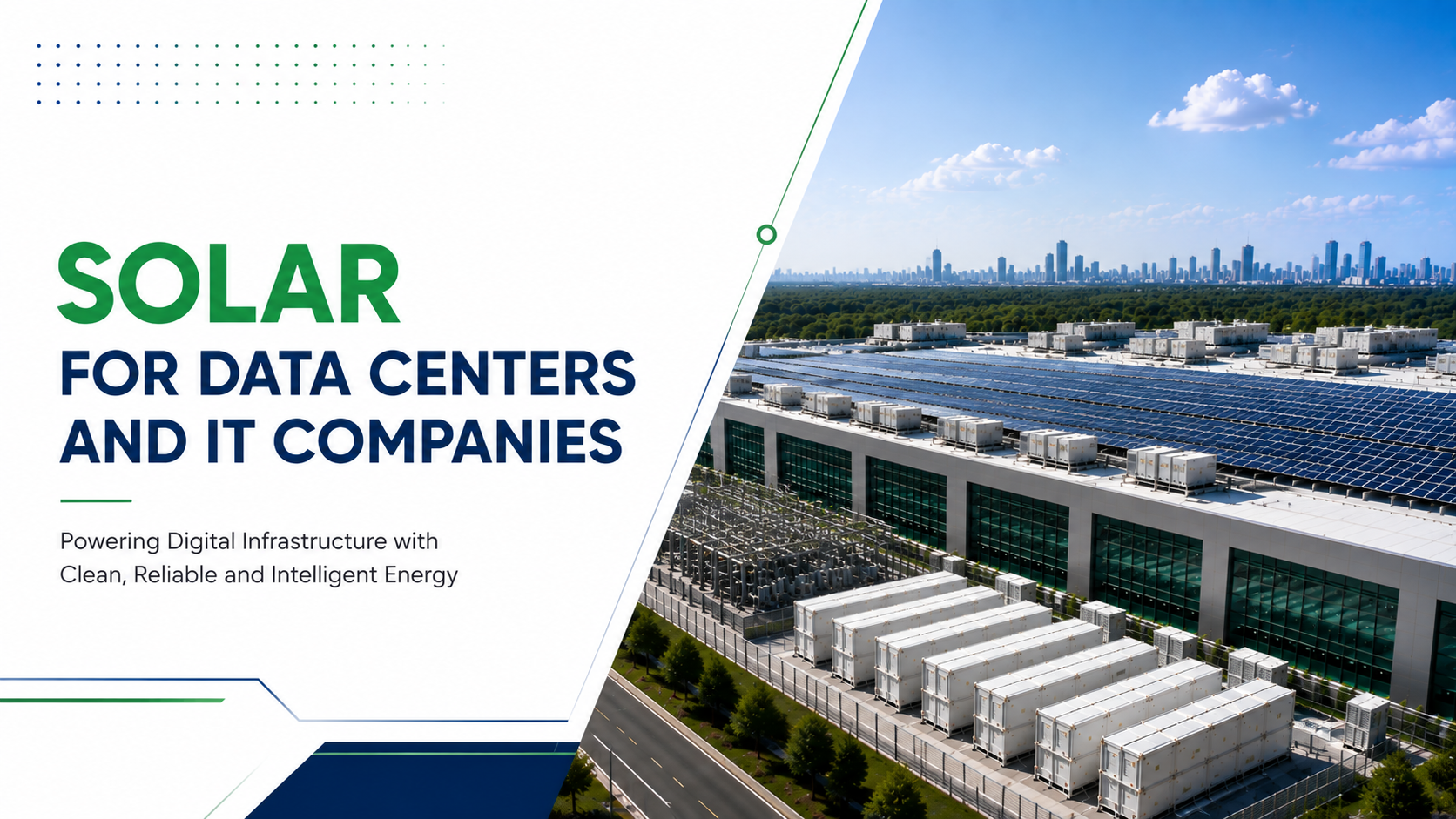
Solar for Data Centers and IT Companies is becoming essential as digital infrastructure expands rapidly. Growing electricity demand, continuous operations, and ambitious sustainability goals are encouraging businesses to adopt smarter energy solutions that improve reliability while controlling long-term energy costs.
Data centers operate 24/7, making uninterrupted power critical for cloud services, AI workloads, financial transactions, and other mission-critical applications. As artificial intelligence, cloud computing, and digital services continue increasing electricity consumption, organizations need energy strategies that deliver both operational resilience and long-term cost stability.
Leading technology companies are already making this transition. Google continues expanding renewable energy procurement across its global data center portfolio to reduce carbon emissions while strengthening long-term energy security. This reflects a broader industry shift where renewable energy has become a strategic business investment rather than only a sustainability initiative.
Modern energy strategies extend beyond rooftop solar alone. Businesses now combine onsite solar generation with Open Access Solar, Battery Energy Storage Systems (BESS), and Energy Management Systems (EMS) to build a flexible and reliable energy ecosystem. Together, these solutions help reduce electricity costs, improve energy reliability, and support future business growth.
This guide explains how Solar for Data Centers and IT Companies works, the deployment models available, the benefits for modern digital infrastructure, and the best practices for building a resilient, future-ready energy strategy.
What Is Solar for Data Centers and IT Companies?
Solar for Data Centers and IT Companies refers to renewable energy solutions that power digital infrastructure while reducing electricity costs and supporting uninterrupted operations. As data centers operate 24/7, clean energy has become an important part of building reliable, cost-efficient, and sustainable facilities.
Unlike conventional commercial buildings, data centers require continuous power to support cloud services, AI workloads, financial transactions, and other mission-critical applications. Even a brief power outage can disrupt operations, making energy reliability a top priority. As electricity demand continues to rise, businesses are increasingly adopting solar to reduce dependence on conventional grid power.
To meet different operational requirements, organizations can choose from rooftop solar, Open Access Solar, group captive projects, or hybrid energy systems that combine solar with Battery Energy Storage Systems (BESS) and Energy Management Systems (EMS). Each deployment model offers a flexible way to improve energy reliability while optimizing long-term electricity costs.
This transition is already reshaping the global data center industry. Microsoft continues expanding its renewable energy portfolio through long-term Power Purchase Agreements (PPAs), while Amazon Web Services (AWS) has invested in hundreds of renewable energy projects, including utility-scale solar farms that support its global cloud infrastructure.
The same shift is gaining momentum in India. Yotta Data Services is developing energy-efficient hyperscale campuses with a strong focus on sustainable infrastructure, while CtrlS Datacenters is increasing renewable energy adoption across its facilities to improve operational efficiency and reduce carbon emissions.
These real-world initiatives demonstrate that solar is no longer viewed as only a sustainability initiative. Today, it is a strategic energy solution that improves operational resilience, strengthens energy security, and supports the continued growth of digital infrastructure.
Why Do Data Centers Need Smarter Energy Solutions?
Data centers consume enormous amounts of electricity to support today’s digital economy. As a result, energy efficiency directly impacts operating costs, business continuity, and long-term profitability.
Artificial intelligence (AI), cloud computing, and streaming services continue driving electricity demand every year. At the same time, higher computing workloads require advanced cooling systems that consume significant additional power. Together, these factors make electricity one of the largest operating expenses for data center operators.
Even a brief power interruption can disrupt cloud applications, financial transactions, and enterprise workloads within seconds. Therefore, maintaining a reliable and resilient energy infrastructure is essential for ensuring maximum uptime and protecting mission-critical operations.
To address these challenges, many operators are integrating solar and other renewable energy solutions alongside conventional power infrastructure. This approach helps improve energy reliability, stabilize electricity costs, and support long-term sustainability goals.
Leading companies are already putting this strategy into practice. Equinix continues expanding renewable electricity procurement across its global data center portfolio, while Digital Realty partners with renewable energy providers to improve operational resilience and better manage energy costs.
A similar transition is underway in India. NTT DATA has integrated renewable energy across selected facilities to support sustainable digital infrastructure, while other leading operators are combining clean energy with intelligent energy management to strengthen business continuity. These initiatives demonstrate that renewable energy has evolved beyond an environmental commitment—it is now a strategic investment for building resilient, efficient, and future-ready data centers.
What Are the Key Energy Challenges for Data Centers and IT Companies?
Data centers face unique energy challenges due to continuous operations and growing digital demand. Therefore, businesses must adopt reliable energy strategies that balance performance, cost, and sustainability.
Rising Electricity Costs
Electricity prices continue to rise across industrial and commercial markets, increasing operating expenses and putting pressure on profitability. As a result, data center operators are looking for energy solutions that provide greater cost stability and reduce dependence on fluctuating utility tariffs.
This shift is already visible across the industry. CtrlS Datacenters has expanded its renewable energy procurement strategy to improve energy efficiency and better manage operating costs. Similar initiatives reflect a growing preference for clean energy solutions that deliver more predictable electricity pricing while improving long-term financial stability.
Round-the-Clock Power Requirements
Data centers operate 24 hours a day, 365 days a year to support cloud services, AI workloads, financial transactions, and other mission-critical applications. Even a brief power outage can disrupt critical operations and impact customer services. Therefore, maintaining a reliable power infrastructure is essential for ensuring uninterrupted digital operations and maximum uptime.
Cooling and Thermal Management
Cooling systems account for a significant share of a data center’s total electricity consumption. As AI workloads and computing demands continue to grow, cooling requirements also increase, making energy efficiency a key operational priority.
To address this challenge, many operators are investing in advanced cooling technologies and energy-efficient infrastructure. In India, Yotta Infrastructure designs hyperscale facilities that optimize cooling performance for high-performance computing while maintaining reliable digital services. By combining efficient infrastructure with intelligent energy management, operators can reduce energy consumption, lower operating costs, and maintain consistent performance as demand grows.
Sustainability and ESG Commitments
Technology companies are under increasing pressure to reduce carbon emissions and meet ambitious ESG targets. Investors, enterprise customers, and regulators also expect measurable sustainability progress, making clean energy an essential part of long-term business strategy.
Beyond supporting ESG goals, clean energy helps strengthen brand reputation, improve regulatory compliance, and reduce exposure to rising electricity costs. CyrusOne, for example, continues expanding clean energy sourcing across its global data center portfolio to support sustainable operations and improve energy resilience. These initiatives show that clean energy is no longer viewed as only an environmental commitment—it has become a strategic advantage for building resilient, efficient, and future-ready digital infrastructure.
How Does Solar Power Support Modern Data Centers?
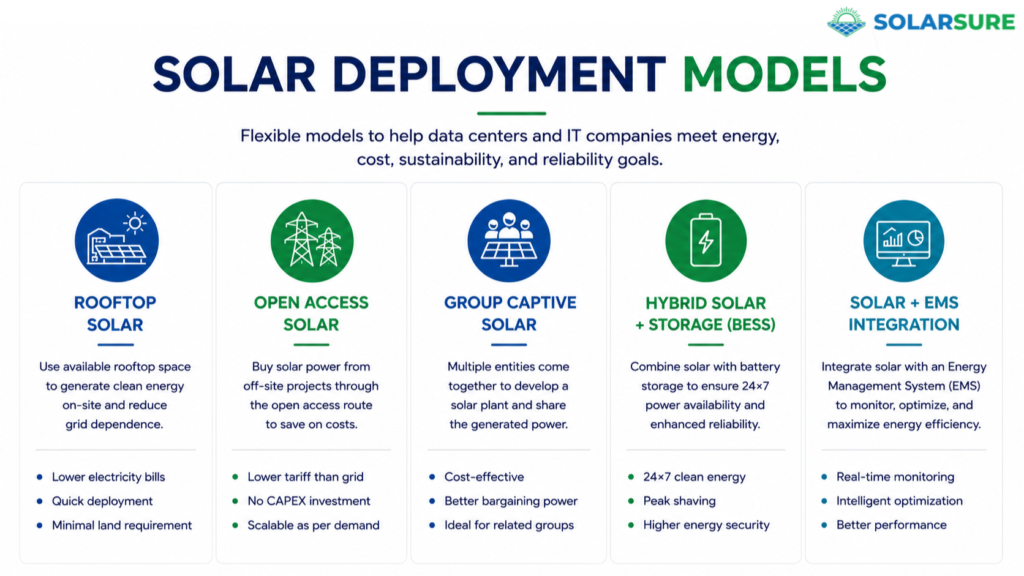
Solar for Data Centers and IT Companies helps organizations reduce electricity costs while improving energy resilience. However, rooftop solar alone rarely meets the entire energy demand of modern data centers. Therefore, businesses often combine multiple renewable energy solutions for consistent performance.
Rooftop Solar for Onsite Generation
Rooftop solar utilizes available building space to generate clean electricity during daylight hours. It offsets a portion of daily energy consumption, reduces dependence on grid electricity, and helps organizations lower operating costs without requiring additional land.
This approach is gaining traction across the data center industry. STT GDC India has expanded clean energy initiatives across multiple facilities as part of its sustainability strategy, demonstrating how onsite solar can improve energy efficiency while reducing carbon emissions.
Open Access Solar for Large Energy Demand
Large data centers often require far more electricity than rooftop systems can generate. Open Access Solar enables businesses to procure renewable electricity from offsite solar power plants, making it an ideal solution for facilities with high and continuous energy demand.
Many hyperscale operators rely on long-term Power Purchase Agreements (PPAs) to secure clean electricity at scale. This model provides access to larger renewable energy capacity without the space limitations of onsite installations while offering greater cost predictability over time.
Battery Energy Storage Systems (BESS)
Battery Energy Storage Systems (BESS) store excess solar energy for use during peak demand periods or temporary grid disruptions. This ensures a reliable power supply while maximizing the use of clean energy.
Switch, a leading U.S. data center operator, integrates solar with advanced battery storage to strengthen operational resilience and maintain uninterrupted services. As renewable energy adoption continues to grow, BESS is becoming an essential component of modern data center energy strategies.
Energy Management Systems (EMS)
An Energy Management System (EMS) continuously monitors electricity consumption across critical data center operations. It provides real-time insights that help optimize solar generation, battery storage, and overall energy performance.
When integrated with solar and battery storage, EMS enables operators to identify inefficiencies, reduce unnecessary energy consumption, and make data-driven operational decisions. This integrated approach improves energy efficiency, lowers operating costs, and helps build scalable, future-ready digital infrastructure.
🔗 Learn More About :Energy Management System (EMS): Benefits, Components & Business Guide
| Energy Solution | Primary Purpose | Business Benefit |
| Rooftop Solar | Onsite clean electricity | Lower daytime electricity costs |
| Open Access Solar | Large-scale renewable supply | Supports high energy demand |
| Battery Energy Storage | Backup and energy shifting | Better power reliability |
| Energy Management System | Real-time energy optimization | Improved operational efficiency |
Each solution addresses a different operational requirement within modern data centers. Together, they create a flexible energy ecosystem supporting long-term business growth and sustainability.
What Are the Best Solar Deployment Models for Data Centers?
Selecting the right deployment model depends on energy demand, available space, and investment goals. Therefore, businesses should evaluate technical and financial requirements before choosing a solar solution.
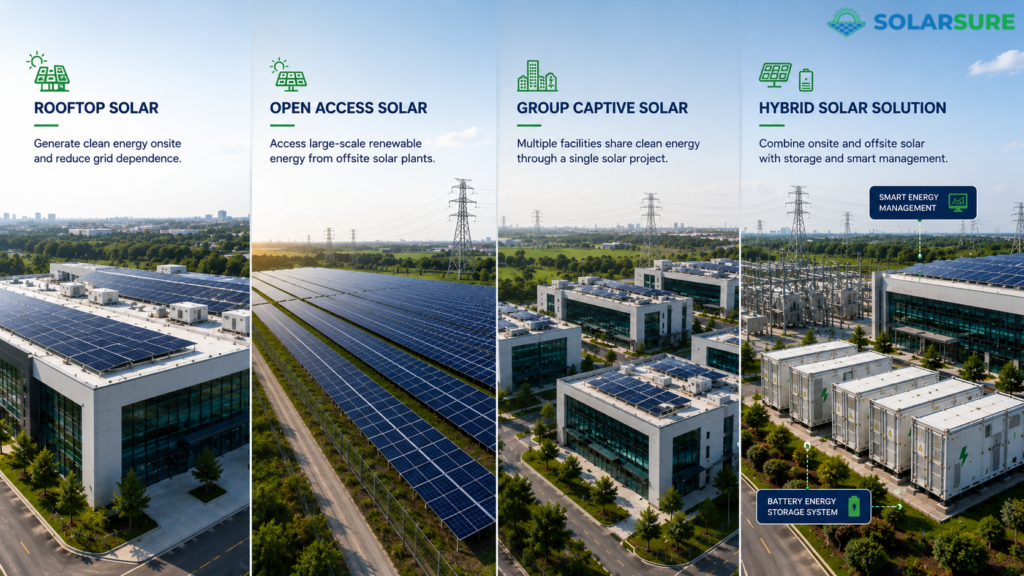
Rooftop Solar
Rooftop solar is ideal for data centers with sufficient roof space and moderate daytime electricity demand. It generates clean electricity onsite, reducing dependence on grid power, lowering transmission losses, and improving overall energy efficiency.
Many organizations are adopting rooftop solar as part of their broader sustainability strategy. Iron Mountain Data Centers, for example, has expanded clean energy initiatives across selected facilities to improve operational efficiency while reducing carbon emissions.
Open Access Solar
Open Access Solar enables businesses to procure renewable electricity from large offsite solar power plants. It is an ideal solution for data centers with limited rooftop space and high, continuous electricity demand.
By sourcing power through long-term Power Purchase Agreements (PPAs), businesses can access significantly larger renewable energy capacity without investing in additional onsite infrastructure. This approach also provides greater cost predictability while supporting long-term sustainability goals.
Group Captive Solar
Group Captive Solar allows multiple businesses to jointly invest in a renewable energy project and receive electricity based on their ownership share and energy requirements. This model helps reduce electricity costs while sharing project investment and operational risks.
It is becoming increasingly popular among large commercial and technology campuses. For example, several technology parks in Bengaluru are evaluating group captive solar projects to meet growing electricity demand while improving long-term cost stability.
Hybrid Solar Solutions
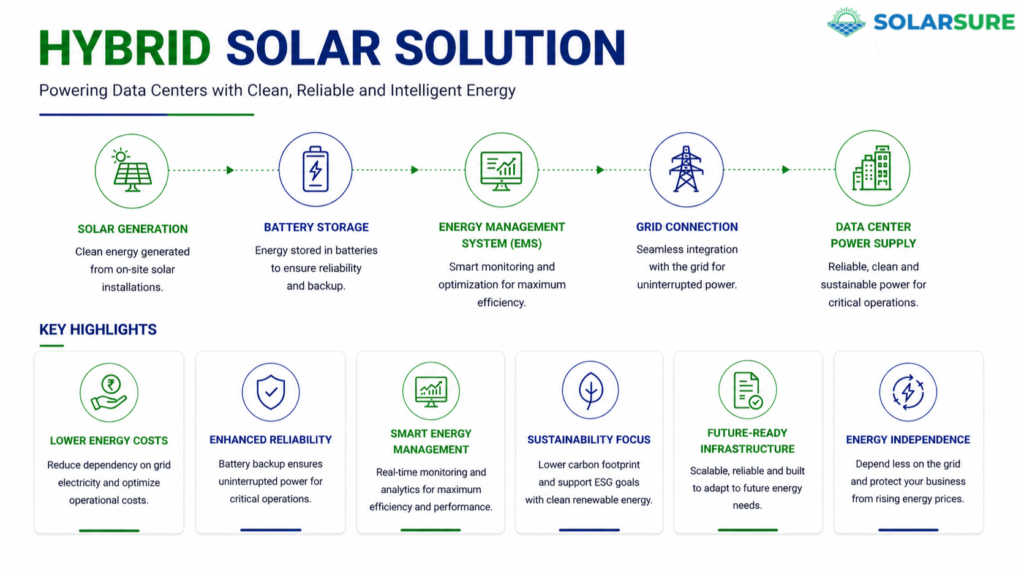
Hybrid solar solutions combine rooftop solar, Open Access Solar, Battery Energy Storage Systems (BESS), and Energy Management Systems (EMS) into a single integrated energy ecosystem. This approach delivers greater flexibility, improves power reliability, and optimizes energy use under varying demand conditions.
By combining multiple energy sources with intelligent monitoring and storage, businesses can reduce operating costs, strengthen energy resilience, and build a scalable, future-ready power infrastructure.
The table below compares common solar deployment models for modern data centers.
| Deployment Model | Best Suited For | Key Advantage |
| Rooftop Solar | Medium energy demand | Onsite clean electricity generation |
| Open Access Solar | Large data centers | High renewable energy capacity |
| Group Captive Solar | Multiple business participants | Shared investment and lower energy costs |
| Hybrid Solar Model | Mission-critical facilities | Greater reliability and operational flexibility |
Every deployment model offers unique operational and financial advantages. Consequently, organizations should select the solution aligning with long-term energy strategy and business objectives.
What Are the Benefits of Solar for Data Centers and IT Companies?
Solar for Data Centers and IT Companies delivers financial, operational, and environmental advantages. Therefore, organizations increasingly view solar as a long-term strategic investment instead of an optional sustainability initiative.
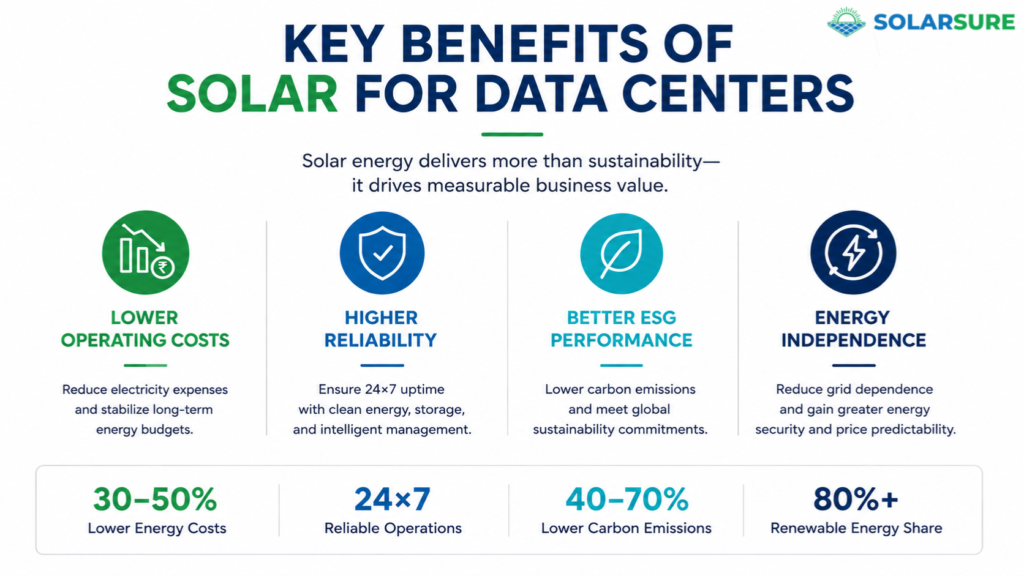
Lower Operating Costs
Electricity accounts for a significant share of data center operating expenses, making cost optimization a business priority. Solar energy reduces dependence on grid electricity during daylight hours, helping organizations lower energy costs and achieve greater financial predictability.
Leading technology companies are already adopting this approach. Apple continues expanding solar-powered operations across its global facilities to reduce electricity costs while supporting its environmental commitments. This demonstrates how clean energy can strengthen both financial performance and sustainability.
Greater Energy Reliability
Reliable electricity is essential for uninterrupted digital services, customer confidence, and business continuity. When combined with Battery Energy Storage Systems (BESS), solar provides additional power support during grid disruptions, helping critical operations remain resilient.
Integrating solar, battery storage, and Energy Management Systems (EMS) creates a more reliable and efficient energy ecosystem. This approach improves power availability, optimizes energy use, and supports the growing demands of modern digital infrastructure.
Stronger Sustainability Performance
Solar energy helps organizations reduce greenhouse gas emissions while advancing corporate ESG commitments. At the same time, investors, enterprise customers, and regulators increasingly expect measurable sustainability progress from digital infrastructure providers.
Oracle, for example, continues expanding clean energy initiatives across its global facilities to reduce environmental impact while supporting responsible business operations. These investments strengthen corporate reputation, improve ESG performance, and demonstrate a long-term commitment to sustainable growth.
Better Energy Independence
Generating electricity from solar reduces exposure to fluctuating utility tariffs and volatile energy markets. As a result, businesses gain greater control over energy planning while improving financial stability.
IBM continues increasing renewable electricity procurement to support responsible business operations and strengthen energy security. As organizations diversify their energy sources, solar is becoming an effective strategy for reducing business risk and building resilient, future-ready digital infrastructure.
The table below highlights how solar creates value for modern data centers and IT companies.
| Business Objective | How Solar Supports It | Long-Term Impact |
| Reduce energy costs | Generates clean onsite or offsite electricity | Lower operating expenses |
| Improve reliability | Integrates with battery storage systems | Better business continuity |
| Achieve ESG goals | Reduces carbon emissions | Stronger sustainability performance |
| Manage energy risks | Lowers dependence on grid electricity | Greater financial stability |
| Support business growth | Provides scalable renewable energy | Future-ready digital infrastructure |
Solar delivers benefits beyond electricity savings alone. Consequently, it helps organizations build resilient, efficient, and sustainable digital infrastructure for long-term growth.
Best Practices for Successfully Implementing Solar in Data Centers
Successful Solar for Data Centers and IT Companies projects require careful planning and technical evaluation. Therefore, organizations should assess operational needs before selecting any renewable energy solution.
Conduct a Detailed Energy Assessment
Every project should begin with a comprehensive energy consumption analysis. This assessment identifies peak demand, load patterns, and future capacity requirements, enabling businesses to design systems that match actual operational needs. This approach is reflected in the planning process adopted by NTT Global Data Centers, where long-term energy demand is evaluated before renewable energy is expanded across new facilities, helping ensure reliable performance and efficient capacity planning.
Choose the Right Solar Deployment Model
Every data center operates under different space and electricity requirements. Some facilities benefit from rooftop solar, while others require open access or hybrid solutions. Moreover, selecting the appropriate model improves project performance and financial returns.
Integrate Battery Storage and Smart Monitoring
Battery storage strengthens energy reliability during grid disturbances and peak demand periods. Energy Management Systems continuously monitor consumption and optimize renewable energy utilization. As a result, operators improve efficiency while reducing unnecessary energy waste. This approach is reflected in Telehouse’s adoption of energy-efficient technologies across several international data centers, supporting reliable operations while improving overall energy performance.
Work with an Experienced Solar EPC Partner
Data centers require precise engineering, safety standards, and seamless electrical integration. An experienced EPC partner ensures proper system design, installation, and long-term maintenance. Therefore, businesses reduce project risks while maximizing renewable energy performance.
Monitor System Performance Regularly
Continuous monitoring helps identify performance issues before they affect operations. Regular inspections also improve equipment lifespan and maintain consistent energy generation. Consequently, organizations achieve higher system reliability and better long-term returns.
What Challenges Can Businesses Face When Adopting Solar for Data Centers?
Although Solar for Data Centers and IT Companies offers significant advantages, implementation requires careful planning. Therefore, businesses should understand potential challenges before investing in renewable energy infrastructure.
Limited Rooftop Space
Many data centers have limited rooftop space, making it difficult to generate enough solar power onsite to meet growing electricity demand. To overcome this challenge, operators often combine rooftop solar with Open Access Solar or Group Captive Solar projects.
This approach is already being adopted across the industry. AirTrunk, for example, supplements its facilities with large offsite renewable energy projects to access more clean electricity while supporting future capacity expansion.
High Initial Investment
Large-scale solar projects require significant upfront investment for engineering, procurement, and installation. However, lower electricity costs over the system’s lifetime often deliver an attractive return on investment.
Businesses can also reduce upfront capital requirements through financing models such as Open Access Solar, Power Purchase Agreements (PPAs), or Group Captive Solar. These options make solar adoption more financially accessible while improving long-term cost predictability.
Complex Grid Integration
Data centers require uninterrupted power around the clock, making seamless integration with existing electrical infrastructure essential. Solar systems must work alongside utility power, backup generators, battery storage, and energy management systems without affecting operational performance.
Keppel Data Centres has integrated clean energy through carefully planned infrastructure upgrades that support reliable operations while expanding renewable energy adoption. This highlights the importance of partnering with an experienced Solar EPC provider to ensure safe integration, optimal system performance, and long-term reliability.
Regulatory and Policy Requirements
Solar projects must comply with state regulations, utility policies, and grid connectivity requirements. Since these regulations vary across regions, businesses should evaluate applicable policies before finalizing their renewable energy strategy.
Maintaining Continuous Power Availability
Solar generation depends on daylight and weather conditions, making battery storage and reliable grid connectivity essential for uninterrupted operations. By combining solar with Battery Energy Storage Systems (BESS) and Energy Management Systems (EMS), data centers can maintain a stable power supply while maximizing renewable energy utilization.
Although these challenges require careful planning, they can be effectively managed with the right technology, deployment model, and experienced Solar EPC partner. A well-designed solution helps businesses maximize system performance, reduce operational risks, and achieve long-term energy savings.
Leading Data Centers Using Solar and Renewable Energy
Many global technology companies are investing heavily in renewable energy for digital infrastructure. These initiatives demonstrate how Solar for Data Centers and IT Companies supports reliable operations, lower emissions, and long-term energy resilience.
Google continues expanding renewable energy across its global data center portfolio through long-term Power Purchase Agreements (PPAs) and investments in carbon-free energy. The company aims to operate on 24/7 carbon-free energy (CFE) by matching every hour of electricity consumption with clean energy sources, setting a benchmark for sustainable digital infrastructure.
Microsoft
Microsoft is rapidly expanding renewable energy procurement to support the growing power demands of its cloud and AI infrastructure. Alongside solar and wind investments, the company is exploring advanced energy technologies to strengthen long-term energy security while progressing toward its ambitious carbon-negative goals.
Amazon Web Services (AWS)
Amazon Web Services (AWS) has built one of the world’s largest corporate renewable energy portfolios, with hundreds of solar and wind projects supplying clean electricity to its global cloud infrastructure. This large-scale investment enables AWS to meet rising customer demand while reducing the environmental impact of rapidly expanding digital operations.
Meta
Meta continues investing in utility-scale solar projects and long-term renewable energy procurement to power its expanding data center network. By combining clean energy with energy-efficient facility design, the company is improving operational performance while advancing its long-term sustainability commitments.
Equinix
Equinix is increasing renewable electricity procurement across its international data center portfolio while improving energy efficiency through innovative cooling technologies and sustainable facility design. These initiatives help customers achieve their own sustainability goals while supporting the company’s commitment to responsible digital infrastructure.
What Can Businesses Learn?
These real-world examples highlight a common industry trend. Leading data center operators no longer view renewable energy as a standalone sustainability initiative—they treat it as a strategic investment that improves energy security, controls long-term electricity costs, and supports the rapid growth of AI, cloud computing, and digital infrastructure. As renewable technologies continue to mature, Solar for Data Centers and IT Companies is becoming a fundamental pillar of future-ready energy strategies rather than an optional environmental investment.
🔗 Want to explore these initiatives in more detail? Learn more about Microsoft’s renewable energy strategy and Amazon Web Services’ global renewable energy projects to see how leading technology companies are building resilient, sustainable data center infrastructure.
The Future of Solar for Data Centers and IT Companies
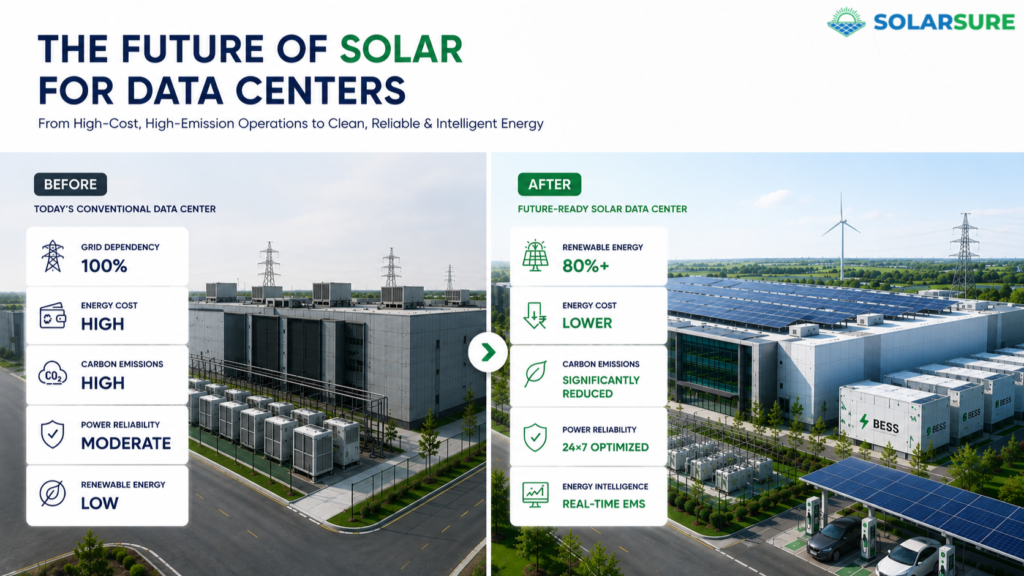
The future of Solar for Data Centers and IT Companies looks increasingly promising worldwide. Rapid digital transformation continues driving unprecedented demand for reliable and sustainable electricity solutions.
Artificial intelligence is rapidly increasing electricity demand across modern data centers. High-performance computing, cloud services, and AI workloads require significantly more power while generating additional heat that demands advanced cooling infrastructure. As highlighted by the International Energy Agency (IEA), digital demand will continue driving higher electricity consumption, making renewable energy increasingly important for reliable and sustainable operations.
Solar energy is also evolving beyond standalone rooftop installations. Businesses now combine rooftop solar, Open Access Solar, Battery Energy Storage Systems (BESS), and Energy Management Systems (EMS) to build integrated energy ecosystems that improve efficiency, reduce costs, and strengthen operational resilience, an approach widely recognized by the Uptime Institute for improving data center resilience and operational efficiency.
This integrated approach is already shaping the future of the industry. QTS Data Centers continues expanding its renewable energy procurement to support the long-term growth of its digital infrastructure, demonstrating how diversified clean energy strategies can strengthen business resilience while supporting sustainability objectives.
Governments are further accelerating this transition through renewable energy policies, clean energy incentives, and grid modernization initiatives. In India, initiatives such as the Green Energy Open Access Rules are encouraging businesses to procure renewable electricity more efficiently. At the same time, technology companies are aligning these opportunities with ambitious net-zero commitments, while investors and enterprise customers increasingly expect measurable ESG performance from digital infrastructure providers.
Advances in battery storage, smart grids, AI-powered energy analytics, and intelligent demand management will continue improving the performance of renewable energy systems. According to the International Renewable Energy Agency (IRENA), continued innovation in renewable energy and storage technologies will play a critical role in accelerating the global energy transition. As these technologies mature, Solar for Data Centers and IT Companies will evolve from an alternative energy solution into a standard business strategy for building resilient, cost-efficient, and future-ready digital infrastructure.
Frequently Asked Questions (FAQs)
Q. What is solar for data center sand IT companies?
Solar for Data Centers and IT Companies uses renewable energy to power digital infrastructure. It reduces electricity costs while supporting sustainability and long-term energy reliability. Many organizations combine solar with battery storage and intelligent energy management systems.
Q. Can a data centerrun entirely on solar energy?
Large data centers rarely operate entirely on solar energy because electricity demand remains continuous. Most facilities combine rooftop solar, open access renewable energy, battery storage, and grid electricity. This diversified energy strategy is reflected in Google’s global operations, where multiple renewable energy sources are integrated to support reliable, round-the-clock power while advancing long-term sustainability objectives.
Q. Which solar model works best for large data centers?
Open access and hybrid solar models usually suit large data centers better. These solutions provide higher renewable energy capacity than rooftop installations alone. For instance, Microsoft procures renewable electricity through long-term power purchase agreements supporting cloud infrastructure.
Q. Why do data centers combine solar with battery storage?
Battery storage supplies electricity when solar generation decreases or grid disruptions occur. This combination improves power reliability and supports uninterrupted digital services. Consequently, businesses reduce operational risks while maximizing renewable energy utilization.
Q. How does solar help reduce data center operating costs?
Solar reduces dependence on expensive grid electricity during daytime operations, helping businesses achieve greater cost predictability and improve long-term financial planning. This strategy is increasingly being adopted by leading cloud providers, with Amazon Web Services (AWS) continuing to expand solar projects that support its global cloud infrastructure while strengthening long-term operational efficiency and sustainability.
Q. Can existing data centers switch to solar energy?
Yes. Existing facilities can integrate rooftop solar, open access solar, or hybrid renewable systems. The ideal solution depends on available space and electricity demand. Therefore, most projects begin with a detailed energy assessment.
Q. What factors should businesses evaluate before installing solar?
Businesses should assess electricity demand, roof availability, future expansion, and financial objectives. They should also evaluate battery storage and suitable procurement models. Proper planning improves project performance and investment returns.
Q. Which industries beneft most from data center solar solutions?
Cloud providers, colocation operators, IT parks, financial institutions, healthcare organizations, and telecom companies benefit significantly. These industries require reliable electricity while pursuing ambitious sustainability goals.
Q. Are solar-powered datacentersbecoming a global trend?
Yes. Many leading technology companies continue increasing renewable energy investments worldwide. For example, Meta powers several data center operations through large-scale solar and renewable energy procurement supporting long-term sustainability.
Q. What is the future of solar for datacentersand IT companies?
Renewable energy will become increasingly important as artificial intelligence and cloud computing expand. Smart grids, battery storage, and energy management systems will improve efficiency further. Consequently, solar will remain a core component of future digital infrastructure.
Bottom Line
Solar for Data Centers and IT Companies is no longer just a sustainability initiative—it has become a strategic investment for organizations seeking to reduce energy costs, improve operational resilience, and support the growing demands of digital infrastructure.
While rooftop solar provides valuable onsite generation, the most effective energy strategy combines Open Access Solar, Battery Energy Storage Systems (BESS), and Energy Management Systems (EMS). This integrated approach helps businesses optimize energy use, strengthen power reliability, and build a scalable, future-ready energy ecosystem.
Successful implementation depends on careful planning, the right deployment model, and seamless integration with existing electrical infrastructure. By partnering with an experienced Solar EPC provider, organizations can maximize system performance, improve financial returns, and ensure long-term operational efficiency.
As artificial intelligence, cloud computing, and digital services continue driving electricity demand, businesses that invest in smarter energy solutions today will be better positioned to achieve greater cost stability, energy security, and sustainable growth in the years ahead.