
A renewable power purchase agreement gives Indian corporates the most direct, measurable, and credible path to net-zero electricity in 2026 and it has become a compliance requirement, not just a sustainability aspiration. India’s largest listed companies now disclose Scope 2 emissions under SEBI’s Business Responsibility and Sustainability Reporting (BRSR) framework. Furthermore, their international buyers demand documented renewable energy procurement. Global initiatives like RE100 and the Science Based Targets initiative (SBTi) require verifiable evidence that electricity consumption comes from clean sources. A renewable power purchase agreement delivers all three simultaneously: lower energy costs, documented carbon reduction, and regulatory compliance from a single long-term contract.
However, the term “PPA” covers four structurally different arrangements in India each with different capital requirements, tax implications, CSS exemption status, and suitability for different business sizes. Additionally, the 2025 introduction of CERC Virtual PPA guidelines has opened a new procurement route for large corporates with multi-location operations. Therefore, understanding which type of renewable PPA fits your business is as important as deciding to pursue one in the first place.
This guide covers everything Indian corporates need to know: what a renewable power purchase agreement is, how each type works, the carbon math behind net-zero claims, what to negotiate before signing, and the specific compliance frameworks that make this decision financially and legally binding in 2026.
| 46 GW
Global corporate renewable PPAs in 2024 (BNEF) |
50+
Indian companies in RE100 initiative |
0.71 kg
CO₂ per kWh from India’s grid (CEA 2025-26) |
Rs 2.20–2.80
Typical solar PPA rate per unit India 2026 |
What Is a Renewable Power Purchase Agreement?
A renewable power purchase agreement is a long-term contract between a renewable energy developer and a corporate buyer. The developer builds, owns, and operates a solar or wind plant. The corporate commits to purchase electricity from that plant at a fixed per-unit rate typically Rs 2.20 to Rs 2.80 per unit for solar in India for 15 to 25 years. As a result, the corporate secures long-term price certainty, avoids grid tariff escalation, and builds a documented renewable energy procurement record.
The critical distinction from simply buying grid power: every unit delivered under a renewable power purchase agreement carries a green attribute a Renewable Energy Certificate (REC) that the corporate uses to document Scope 2 emission reductions under the GHG Protocol market-based accounting method. Therefore, the REC is not just a certificate; it is the legal evidence that a specific unit of electricity came from a verified renewable source and not from a coal-fired grid.
Moreover, the corporate does not need to own the solar plant in a Third-Party PPA structure. Consequently, no capital expenditure is required. The developer carries the full project financing risk. For companies that want the sustainability credentials without deploying capital, a renewable power purchase agreement is the most accessible route available in India today. For more on how different ownership structures affect your carbon reporting, read our guide on Scope 1, 2 and 3 Emissions: A Complete Guide for Businesses.
Why Indian Corporates Need a Renewable PPA to Meet Net-Zero in 2026
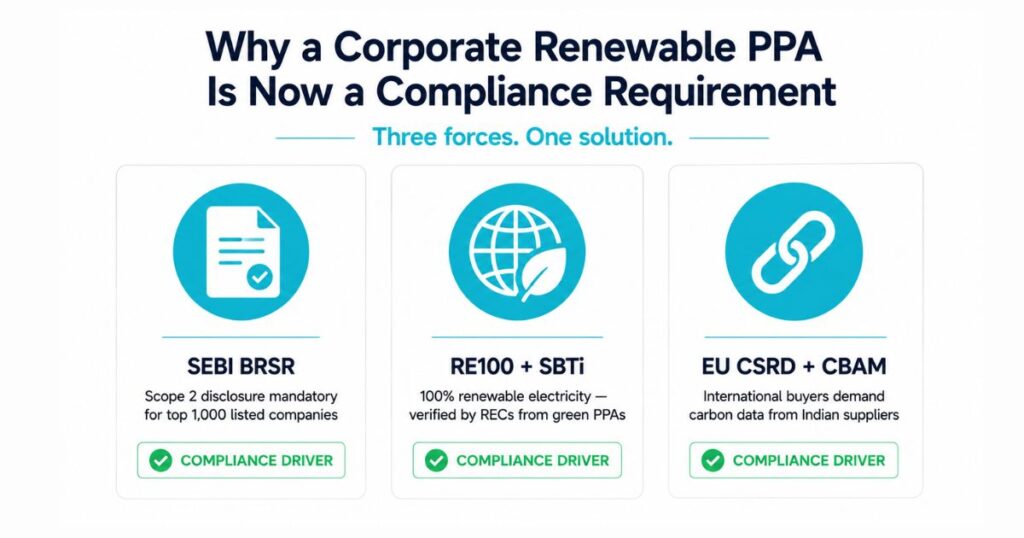
Three separate regulatory and commercial forces now converge to make a renewable PPA mandatory not optional for corporate sustainability strategies in India. Each force carries real financial and reputational consequences for companies that ignore it.
SEBI BRSR – Scope 2 Disclosure Is Now Mandatory
SEBI’s Business Responsibility and Sustainability Reporting (BRSR) framework mandates Scope 1 and Scope 2 GHG emission disclosure for India’s top 1,000 listed companies by market capitalisation. The BRSR Core a subset of assured disclosures requires companies to report the percentage of energy consumed from renewable sources. Furthermore, investors, institutional shareholders, and rating agencies now use BRSR data to assess ESG risk. Consequently, a company with undocumented Scope 2 emissions faces downward ESG rating pressure and potential exclusion from sustainability-focused institutional portfolios.
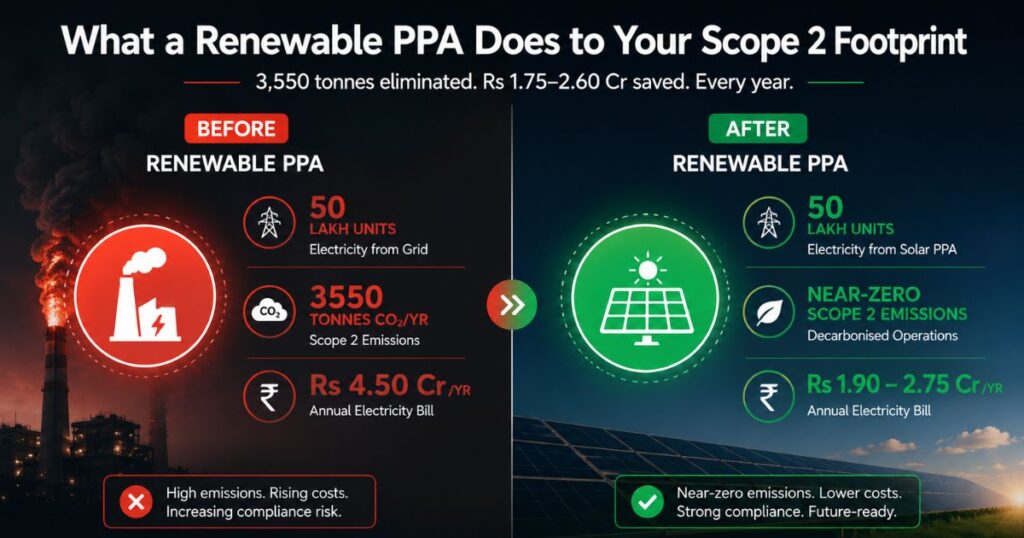
India’s national grid currently carries an emission factor of 0.71 kg CO₂ per kWh, as published by the Central Electricity Authority. A mid-sized manufacturer consuming 50 lakh units per year therefore generates 3,550 tonnes of Scope 2 CO₂ annually entirely from purchased electricity. A renewable PPA eliminates this at its source.
RE100 and SBTi – Global Commitments That Require Documented Renewable Procurement
RE100, the global corporate renewable electricity initiative, requires member companies to commit to 100% renewable electricity across all global operations. Over 50 Indian-headquartered companies participate, and 200+ international RE100 members operate facilities in India. Under RE100’s 2025 Technical Criteria v5.0, procurement via a renewable power purchase agreement with bundled RECs is the primary eligible route. The RECs must come from plants commissioned within the past 15 years and cancellation must be documented through the national registry.
The Science Based Targets initiative (SBTi) validates corporate emission reduction targets against 1.5°C climate scenarios. SBTi’s Corporate Net-Zero Standard requires companies to cut Scope 2 emissions to near-zero by their target year. Additionally, the EU Corporate Sustainability Reporting Directive (CSRD) now requires MNCs to report on the ESG performance of their Indian supply chains forcing Indian exporters to demonstrate clean electricity procurement to retain international contracts.
Four Types of Renewable Power Purchase Agreement in India
India’s renewable PPA market offers four structurally distinct models. The right choice depends on your capital availability, load size, CSS exemption preference, and whether you need physical delivery or only green attributes. Furthermore, each model produces a different BRSR and RE100 compliance outcome.
1. On-Site Captive Renewable PPA Developer builds on your premises zero capex, CSS exempt
In an on-site captive renewable power purchase agreement, the developer constructs a solar plant on your rooftop or on land adjacent to your facility. You purchase electricity at a fixed per-unit rate directly from the plant without grid wheeling. Because the generation and consumption happen at the same metering point, you qualify as a captive consumer under the Electricity Act 2003. As a result, CSS and Additional Surcharge do not apply.
Furthermore, the developer owns and maintains the system for the PPA tenure. Therefore, your capital expenditure is zero, your O&M responsibility is zero, and your savings begin on commissioning day. The REC associated with each unit generated transfers to you, providing full BRSR and RE100 documentation.
Best for: Businesses with suitable rooftop space (100 kW to 2 MW). Hotels, IT parks, commercial complexes, MSME factories.
💡 On-site captive PPAs typically deliver 60–75% of total electricity demand. However, they require structural clearance for the roof. Moreover, if the developer cannot perform, step-in rights in the PPA protect your generation continuity.
2. Off-Site Open Access Renewable PPA – Remote solar plant wheeled to your facility larger scale
In an off-site open access renewable power purchase agreement, the developer builds a ground-mounted solar plant at a high-irradiance remote location. Power then travels through the state grid to your factory meter. You pay the developer a fixed PPA rate plus regulated wheeling and transmission charges. Consequently, landed cost typically ranges from Rs 3.40 to Rs 5.50 per unit all-in, depending on your state and procurement model.
This structure suits facilities above 500 kW that cannot accommodate on-site generation. Additionally, it works well for companies with multiple facilities in one state a single large plant serves several consumption points. Moreover, the scale of a ground-mounted plant allows more competitive PPA rates than smaller rooftop systems.
Best for: Industrial factories (500 kW to 50 MW+), multi-facility corporates, large commercial campuses.
3. Group Captive Renewable PPA- 26% equity in shared plant, CSS exempt, scales for MSME clusters
In a group captive renewable power purchase agreement, a consortium of corporate consumers collectively holds at least 26% equity in a shared solar plant and consumes at least 51% of its output. This structure grants full captive status under the Electricity Act 2003. Therefore, CSS and Additional Surcharge which can add Rs 1.50 to Rs 2.50 per unit in high-surcharge states do not apply.
Furthermore, the equity stake qualifies for accelerated depreciation under Section 32 of the Income Tax Act 40% in Year 1 for commercial consumers. Consequently, group captive delivers the best economics of any PPA structure in high-CSS states like Maharashtra. For example, five factories in an industrial cluster each committing 5 MW of demand can access a 25 MW shared plant at economics unavailable to any single consumer.
Best for: MSME clusters, multiple-factory corporates in high-CSS states, companies below the individual open access threshold.
4. Virtual Renewable Power Purchase Agreement (VPPA) Financial instrument no physical delivery, pure green attribute transfer
A virtual renewable power purchase agreement is a financial contract for difference. The corporate and the developer agree on a fixed strike price. The developer sells electricity to the grid at the prevailing market rate. When market prices fall below the strike price, the corporate pays the difference to the developer. When market prices rise above it, the developer pays the corporate. No electricity physically reaches the corporate’s facility.
Instead, the developer transfers the associated RECs to the corporate for each unit generated. These RECs document renewable consumption for BRSR and RE100 purposes. Moreover, CERC introduced formal VPPA guidelines in 2025, providing legal certainty for this structure. Consequently, large MNCs with operations across multiple Indian states now use VPPAs to claim renewable consumption at all locations from a single large plant. However, RE100’s 2025 Technical Criteria require REC cancellations from the national registry to be valid, so VPPA buyers must verify registry compliance.
Best for: Large MNCs with multi-state operations, IT companies with high green attribute needs but limited physical rooftop, export-oriented companies needing documented RECs for EU/US supply chain compliance.
💡 CERC VPPA guidelines require REC transfer to be non-tradable — RECs from VPPAs are for Renewable Consumption Obligation (RCO) compliance only, not for resale.
The Carbon Math – How a Renewable PPA Drives Your Net-Zero Target
Understanding the Scope 2 emission calculation is essential before signing any renewable PPA. The numbers are straightforward, and they determine whether your PPA genuinely achieves net-zero electricity or only partially offsets it.
India’s national grid emission factor published annually by the Central Electricity Authority stands at 0.71 kg CO₂ per kWh for FY2025-26. Therefore, every unit your factory draws from the grid generates 0.71 kg of Scope 2 CO₂. A corporate consuming 50 lakh units per year consequently generates 3,550 tonnes of Scope 2 CO₂ annually from purchased electricity alone. Moreover, this figure does not include Scope 1 emissions from diesel generators or fuel combustion.
| Metric | Before Renewable PPA | After Renewable PPA |
| Annual Consumption | 50 lakh units | 50 lakh units |
| Grid Emission Factor (CEA) | 0.71 kg CO₂/kWh | 0 kg CO₂/kWh (solar PPA) |
| Annual Scope 2 CO₂ | 3,550 tonnes/year | Near-zero (REC documented) |
| BRSR Scope 2 Disclosure | High — action required | Documented reduction |
| RE100 / SBTi Eligibility | Non-compliant | Compliant with REC documentation |
| Annual Electricity Cost (Rs 9/unit) | Rs 4.50 crore | Rs 1.90–2.75 crore (PPA) |
For a detailed explanation of how Scope 2 reduction connects to your broader GHG inventory, read our guide: Scope 1, 2 and 3 Emissions: A Complete Guide for Businesses.
What Does a Corporate Renewable PPA Cost in India in 2026?
The cost of a renewable power purchase agreement in India depends on the procurement model, your state’s wheeling and CSS charges, and the scale of the plant. However, in every scenario, the landed cost of PPA power is significantly lower than the DISCOM tariff you currently pay.
| PPA Model | PPA Rate | All Charges | Landed Cost | vs Grid (Rs 9/unit) |
| On-Site Captive PPA | Rs 2.20–2.60/unit | Nil (CSS exempt) | Rs 2.20–2.60 | 75% saving |
| Group Captive PPA (CSS exempt) | Rs 2.30–2.70/unit | Rs 1.10–1.30 (wheeling) | Rs 3.40–4.00 | 55–62% saving |
| Third-Party Open Access PPA (MP) | Rs 2.40–2.80/unit | Rs 1.50–2.00 (w/ CSS) | Rs 3.90–4.80 | 47–57% saving |
| Third-Party Open Access PPA (Maharashtra) | Rs 2.40–2.80/unit | Rs 3.80–4.20 (high CSS) | Rs 6.20–7.00 | 22–31% saving |
| Virtual PPA (VPPA) | Strike price agreed | Financial settlement only | Cost varies | Green attribute value — not a tariff saving |
📖 You can also read: Open Access Solar Charges Explained: Wheeling, CSS, Banking & More
⚠ For third-party PPAs in Maharashtra, the combined CSS and Additional Surcharge erodes savings significantly. Therefore, group captive or on-site captive structures are strongly preferred for Maharashtra-based operations. A renewable power purchase agreement that looks attractive at the PPA rate level can look very different after state charges apply.
Key Terms to Negotiate in Your Renewable Power Purchase Agreement
Every renewable power purchase agreement is a 15 to 25 year commitment. Consequently, the commercial terms you negotiate before signing determine your financial outcome for decades. Furthermore, weak PPA terms have caused several Indian corporates to receive less generation than projected with no contractual remedy. Therefore, negotiate these six clauses explicitly.
PPA Rate, Escalation Cap, and Tenure
The PPA rate is the per-unit price you pay the developer for electricity. Moreover, most PPAs include an annual escalation clause typically 0% to 3%. A zero-escalation PPA locks your electricity cost permanently, while a 3% escalation on a 25-year contract means your rate nearly doubles by Year 25. Therefore, negotiate the escalation cap to 0% or 1% for solar PPAs, where generation costs do not rise over time. Additionally, align the PPA tenure with your land lease agreement a 25-year PPA on a 20-year land lease creates a structural problem.
Minimum Generation Guarantee and Liquidated Damages
Insist on a contractual minimum annual generation guarantee from the developer typically 90% to 95% of the DPR-projected output. Furthermore, attach liquidated damages for shortfall. Without this clause, a developer who underperforms has no financial incentive to address the issue. Consequently, your Scope 2 reduction is smaller than planned and your savings fall short. For example, a 10% generation shortfall on a 3 MW plant in MP means Rs 5.5 lakh less in annual savings. Over 25 years, that compounds to Rs 1.9 crore in foregone electricity savings.
Green Attribute Ownership – Who Owns the RECs?
This clause determines your RE100, SBTi, and BRSR eligibility. The REC belongs to the party specified in the renewable power purchase agreement — and it does not automatically go to the electricity buyer. However, many developers attempt to retain RECs for separate monetisation on the power exchange. Therefore, include an explicit REC transfer clause: “All RECs and green attributes associated with energy delivered under this agreement transfer to the buyer at the point of generation.” Without documented REC ownership, your renewable consumption claim does not hold up under BRSR or RE100 scrutiny.
Renewable PPA vs Buying RECs – What Actually Counts for Net-Zero?
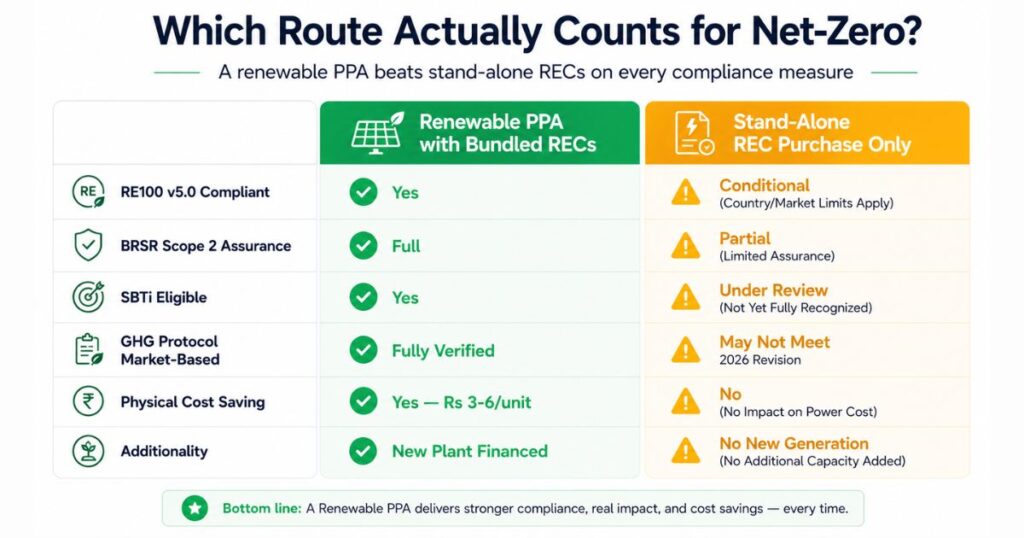
Many Indian corporates buy Renewable Energy Certificates (RECs) on the power exchange as a shortcut to renewable consumption claims. However, RECs without an underlying renewable power purchase agreement face increasing scrutiny from global reporting standards in 2026.
RE100’s 2025 Technical Criteria v5.0 now requires that at least 85% of renewable electricity comes from plants commissioned within the past 15 years and cancellation must occur in the country of consumption through the national registry. Furthermore, the GHG Protocol’s proposed Scope 2 revision introduces hourly and geographic matching requirements that may disqualify unbundled, cross-border certificate purchases from market-based reporting.
In contrast, a renewable power purchase agreement with bundled RECs from a specifically identified plant commissioned within 15 years, operating in the same state as your facility meets all current and proposed criteria. Additionally, the generation data from your PPA plant provides the verified production evidence that stand-alone REC purchases cannot. Therefore, for companies serious about BRSR assurance, RE100 compliance, and SBTi validation, a physical or group captive renewable PPA is more defensible than an REC procurement strategy alone.
To understand the full GHG accounting framework, read our guide on Scope 1, 2 and 3 Emissions. Additionally, for the financial payback of a captive solar investment, see our Solar Payback Period Guide for C&I India 2026.
State-Wise Renewable PPA Landscape in India (2026)
The renewable power purchase agreement landscape varies significantly across Indian states. CSS levels, banking policies, approval timelines, and grid reliability all affect which state offers the best PPA economics for your corporate energy strategy. Furthermore, the location of your consumption facility and the preferred plant location interact to determine whether intra-state or inter-state sourcing makes more sense.
| State | Best PPA Model | CSS Level | Landed Cost | Corporate Suitability | Score |
| Madhya Pradesh | Group Captive / 3rd Party | Rs 0.30–0.60 | Rs 3.40–4.50 | Strong C&I and PM KUSUM EPC framework — Solarsure operational base | 9/10 |
| Rajasthan | Off-site Open Access | Rs 0.40–0.80 | Rs 3.50–4.80 | Highest irradiance; preferred for large-scale open access PPAs | 8/10 |
| Karnataka | 3rd Party / Captive | Rs 0.40–0.90 | Rs 3.88–5.00 | Most active corporate PPA market; low wheeling charges | 8/10 |
| Gujarat | Captive / 3rd Party | Rs 0.30–0.70 | Rs 3.90–5.00 | Strong RE framework; single-window clearance improving | 7/10 |
| Maharashtra | Group Captive ONLY | Rs 1.00–2.11 | Rs 3.40–4.20 (GC) | High CSS makes 3rd-party PPA uncompetitive; group captive mandatory | 6/10 |
Step-by-Step: How to Set Up a Renewable Power Purchase Agreement for Your Business
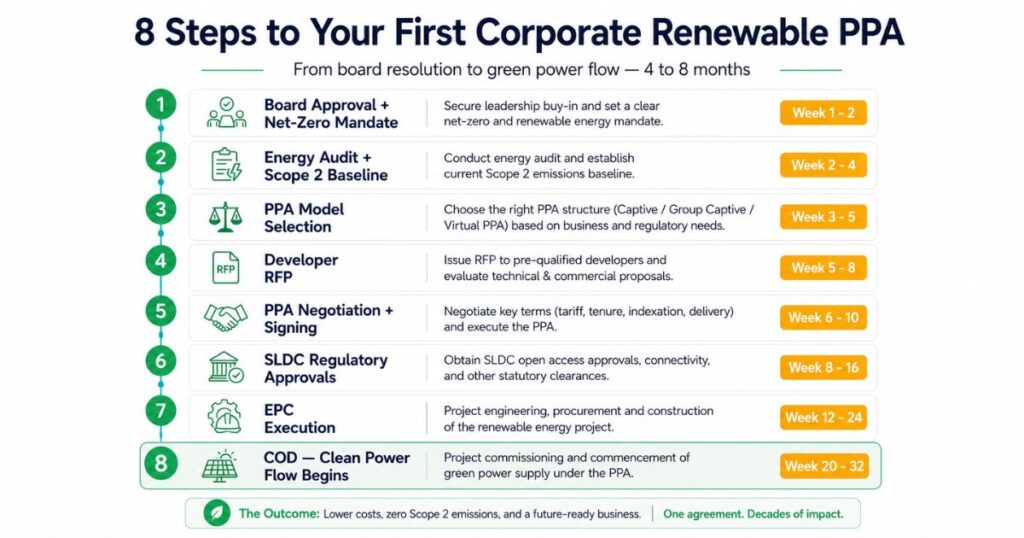
Structuring and executing a renewable power purchase agreement involves eight distinct actions. Furthermore, the board approval and energy audit steps which most companies skip directly determine the quality of the PPA terms you can negotiate. Therefore, do not treat them as administrative formalities.
| Step | Action | What to Produce |
| 1 | Board approval and sustainability mandate | Board resolution authorising renewable procurement, net-zero target year |
| 2 | Energy audit and Scope 2 baseline | 12-month consumption data, Scope 2 CO₂ calculation, BRSR baseline report |
| 3 | PPA model selection — captive / group captive / third-party / VPPA | Financial model for each model type; state-specific CSS and charge analysis |
| 4 | Tender / RFP to developers | PPA RFP document specifying: capacity, technology, PPA tenure, escalation cap, REC clause, generation guarantee |
| 5 | PPA negotiation and finalization | Signed PPA with all clauses verified — rate, escalation, guarantee, REC transfer, change of law |
| 6 | Regulatory approvals — SLDC, STU connectivity | SLDC open access registration, connectivity approval, metering scheme |
| 7 | EPC execution and plant commissioning | Commissioning report with generation forecast, panel specs, performance test results |
| 8 | COD — renewable power flow begins | Monthly DISCOM bill reduction, SLDC generation reports, REC certificates for BRSR |
📖 You can also read: Open Access Solar for MSMEs and Factories: A Complete Guide
Five Risks in a Renewable Power Purchase Agreement and How to Manage Them
Every renewable power purchase agreement carries risks that can erode savings, reduce generation, or create compliance gaps if the contract does not address them explicitly. However, each risk is manageable with specific contractual provisions and procurement decisions.
| Risk | What Happens | How to Manage It |
| Regulatory Risk — CSS / charge revision | State revises CSS upward mid-PPA; landed cost increases | Include Change of Law clause — parties share or allocate regulatory charge increases beyond a defined threshold |
| Generator Performance Risk | Plant underperforms DPR; fewer units delivered; Scope 2 reduction falls short | Minimum generation guarantee + liquidated damages; lock module brand and degradation spec in PPA |
| Curtailment Risk | DISCOM orders curtailment of renewable generation; your power flow is interrupted | Compensation clause: developer compensates for curtailed units; backup banking mechanism |
| Counterparty Risk | Developer defaults mid-PPA; plant abandoned; savings and RECs stop | Escrow account for performance security; step-in rights for buyer; credit due diligence on developer |
| REC / Green Attribute Risk | REC not transferred correctly; BRSR or RE100 claim invalid | Explicit REC transfer clause in PPA; specify registry and cancellation mechanism; legal review before signing |
▶ KEYPHRASE CHECK: “renewable power purchase agreement” appears above ✓
Frequently Asked Questions
Q: What is a renewable power purchase agreement in India?
A: A renewable power purchase agreement (PPA) is a long-term contract between a corporate buyer and a renewable energy developer. The developer builds and operates a solar or wind plant, and the corporate purchases electricity at a fixed per-unit rate — typically Rs 2.20 to Rs 2.80 for solar in India. Additionally, each unit carries a Renewable Energy Certificate (REC) that the corporate uses to document Scope 2 emission reductions under the GHG Protocol, SEBI BRSR, and global frameworks like RE100 and SBTi. The corporate achieves lower electricity costs and verifiable net-zero progress simultaneously.
Q: How does a renewable PPA help achieve net-zero?
A: India’s grid emission factor is 0.71 kg CO₂ per kWh. Therefore, every unit of grid electricity a corporate replaces with PPA-sourced renewable power eliminates 0.71 kg of Scope 2 CO₂. A 3 MW solar PPA generating 57–60 lakh units annually consequently offsets 4,000 to 4,260 tonnes of Scope 2 CO₂ — equivalent to taking 860 cars off Indian roads, every year, for 25 years. Furthermore, RECs transferred from the PPA plant provide the documented market-based evidence required for BRSR assurance and RE100 compliance.
Q: What is the difference between a physical PPA and a virtual PPA in India?
A: In a physical renewable power purchase agreement, electricity physically travels through the grid to your facility. You pay the developer a per-unit rate, and RECs transfer with the electricity. In a virtual PPA, no physical delivery occurs — the developer sells to the grid and transfers RECs to the corporate. Settlement is financial, based on the difference between the agreed strike price and the market rate. CERC issued formal Virtual PPA guidelines in 2025, providing legal certainty. However, RE100’s 2025 Technical Criteria require REC cancellations through India’s national registry — buyers must verify this before using VPPAs for global ESG reporting.
Q: Is a group captive PPA better than a third-party PPA for Indian corporates?
A: In most high-CSS states — particularly Maharashtra — a group captive renewable PPA delivers significantly better economics than a third-party PPA, because CSS and Additional Surcharge are waived under the Electricity Act 2003 for captive consumers. The difference can be Rs 1.50 to Rs 2.50 per unit in surcharge savings alone. On 3 lakh units per month, that saves Rs 4.50 to Rs 7.50 lakh monthly. However, group captive requires 26% equity investment in the plant, which not all companies can deploy. Third-party PPAs therefore remain the right choice for balance-sheet-constrained buyers in low-CSS states like Karnataka, MP, and Rajasthan.
Q: What documents does a corporate need for a renewable PPA?
A: A corporate entering a renewable PPA needs: a board resolution authorising the procurement, an energy audit report establishing the Scope 2 baseline, the last 12 months of electricity bills, the executed PPA document (with REC transfer clause verified by legal counsel), DISCOM connectivity documents for open access routing, and for group captive structures the SPV incorporation certificate and shareholder agreement. Additionally, for BRSR and RE100 reporting, the corporate needs the REC cancellation statement from the national registry for each year of generation.
Q: How does Solarsure help corporates structure a renewable PPA?
A: Solarsure manages the complete renewable PPA process from Scope 2 baseline analysis and PPA model selection through developer RFP, commercial term negotiation, SLDC registration, EPC execution, and commissioning. Solarsure specialises in C&I and open access projects across Madhya Pradesh and Rajasthan, and provides a detailed landed cost model covering all charges for your specific state and consumption profile before any commitment is made. The PPA terms in your proposal align with what appears in your annual generation and BRSR reports.
Bottom Line
A renewable power purchase agreement is no longer a voluntary sustainability gesture for Indian corporates. SEBI BRSR mandates Scope 2 disclosure. RE100 requires verifiable renewable procurement. SBTi validates targets against 1.5°C scenarios. EU buyers demand carbon data from their Indian supply chains. Furthermore, the cost economics make the decision financially compelling in 2026: a well-structured group captive or captive renewable PPA delivers 55 to 75% savings on electricity costs while simultaneously producing the documented Scope 2 reduction that every compliance framework demands.
However, the renewable PPA market rewards corporates who understand what they are signing. The PPA rate is only one clause. The escalation cap, the generation guarantee, the REC transfer mechanism, and the change of law provision together determine whether a 25-year commitment delivers what the model projected — or falls systematically short of it.
Solarsure builds a state-specific renewable PPA feasibility model — covering landed cost, Scope 2 offset, BRSR reporting value, and 25-year financial projection — for every corporate client before any procurement decision is made. The model your board approves should match the invoice you receive 24 months after commissioning.