
Benefits of adopting solar power: India’s electricity tariffs have risen every single year for the past decade. For a food processing unit in Madhya Pradesh paying Rs 8.80 per unit, or a textile factory in Maharashtra paying Rs 13 per unit, energy has quietly become one of the largest line items on the P&L statement. The grid will not get cheaper. Coal dependency, transmission losses, and demand growth ensure that.
But the decision to go solar is no longer driven by environmental conscience alone. In 2026, it is driven by numbers IRRs of 18 to 22%, payback periods of 2.5 to 4 years, tax shields under Section 32, and supply chain pressure from international buyers who now require carbon data before placing orders.
Here are the 10 benefits of adopting solar power for businesses in India not as marketing promises, but as measurable outcomes backed by current policy, real project data, and the 2026 market environment.
| 60–80%
Electricity bill reduction |
2.5–4 yrs
Average payback period |
18–22%
Post-tax IRR |
25 yrs
Plant operational life |
Source: MNRE, SafEarth industrial solar data, Section 32 Income Tax Act, CEA emission factor 2025-26.
Benefits of adopting solar power for businesses in India 10 Reasons
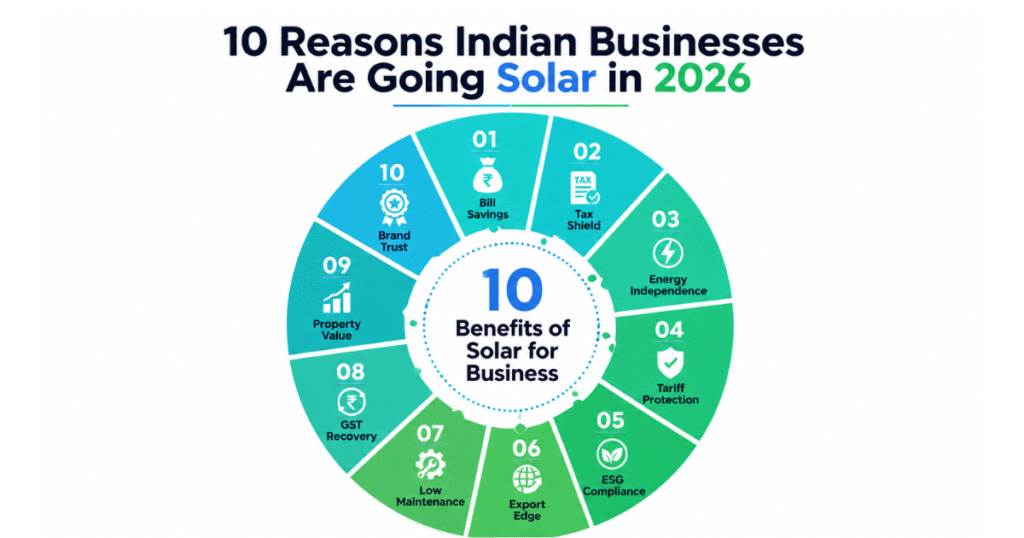
1. Dramatic Reduction in Electricity Bills: The most immediate, most measurable impact of solar adoption
Electricity is the single largest variable cost for most Indian manufacturers, processors, and commercial operators. A properly sized solar plant reduces the electricity bill by 60 to 80% not in the long run, but from the first month of operation.
A food processing unit in Indore consuming 1,00,000 units per month at Rs 8.80 per unit spends Rs 8.8 lakh monthly on power. A 500 kW rooftop solar plant generates approximately 60,000 units per month, directly displacing that grid consumption. Monthly saving: Rs 5.28 lakh. Annual saving: Rs 63.4 lakh. The grid bill does not disappear but it shrinks permanently.
The key insight: Every unit generated by your solar plant costs approximately Rs 3.30 to Rs 3.80 (levelised generation cost). Every unit you displace from the grid saves you Rs 8 to Rs 14. That spread between what solar costs to generate and what the grid charges is the engine of your entire ROI.
2. Accelerated Depreciation: A Tax Shield Most Businesses Miss – Section 32 of the Income Tax Act: 40% to 60% in Year 1
Commercial and industrial solar installations in India do not receive a direct government capital subsidy. What they receive is significantly more powerful for profitable businesses: a 40% accelerated depreciation benefit under Section 32 of the Income Tax Act, with manufacturing businesses eligible for an additional 20% under Section 32(1)(iia).
On a Rs 2 crore solar plant, a business in the 25% corporate tax bracket can claim Rs 20 lakh (commercial) to Rs 30 lakh (manufacturing) in tax savings in Year 1 alone before a single unit of electricity is saved. This reduces effective CAPEX from Rs 2 crore to Rs 1.70 crore or Rs 1.40 crore respectively.
💡 Commission your plant before October 3rd to claim the full annual depreciation rate. Commissioning after October 3rd triggers the half-year rule, halving your Year 1 benefit. Scheduling your commissioning date is a financial decision not just a construction milestone.
3. Energy Independence: End Grid Dependency and Diesel Costs – Own your power source. Stop renting electricity at rising rates.
India’s electricity grid is not uniformly reliable. Unscheduled outages, voltage fluctuations, and load-shedding still affect industrial zones in Madhya Pradesh, Rajasthan, Chhattisgarh, and parts of Maharashtra. For a factory running precision machinery or cold-chain operations, grid instability is a direct production risk.
Solar generation gives your business a captive power source that operates independently of DISCOM reliability. Combined with Battery Energy Storage Systems (BESS), solar eliminates dependence on diesel generators which are expensive to run, polluting, and require ongoing fuel procurement at volatile prices.
Real impact: A diesel generator costs Rs 18 to Rs 22 per unit to run in 2026. Solar generates the same unit at Rs 3.30 to Rs 3.80. Eliminating even 20,000 units of monthly diesel generation saves Rs 3 lakh to Rs 3.7 lakh per month on generator fuel alone.
📖 You can also read: What Is the Real Payback Period for C&I Solar Under 2026 Policies?
4. Permanent Protection Against Rising Grid Tariffs:Lock your generation cost at Rs 3.30/unit for 25 years
India’s commercial and industrial electricity tariffs have risen an average of 4 to 7% annually over the past decade. There is no credible projection that shows this trend reversing coal prices, transmission infrastructure costs, and distribution losses continue to push tariffs upward.
Solar locks in your generation cost. A Bifacial TOPCon plant commissioned in 2026 will generate electricity at approximately Rs 3.30 to Rs 3.80 per unit for the next 25 years with no price revision, no regulatory surcharge, and no fuel cost volatility.
| Year | Grid Tariff (4.5% escalation) | Solar Generation Cost |
| 2026 | Rs 8.80/unit | Rs 3.40/unit |
| 2031 | Rs 10.95/unit | Rs 3.40/unit |
| 2036 | Rs 13.64/unit | Rs 3.40/unit |
| 2046 | Rs 21.18/unit | Rs 3.40/unit |
| Saving per unit in 2046 | — | Rs 17.78/unit |
The savings gap widens every year. A 500 kW plant generating 7.25 lakh units annually saves Rs 63 lakh in Year 1 and Rs 1.28 crore in Year 20 from the same physical infrastructure, with no additional investment.
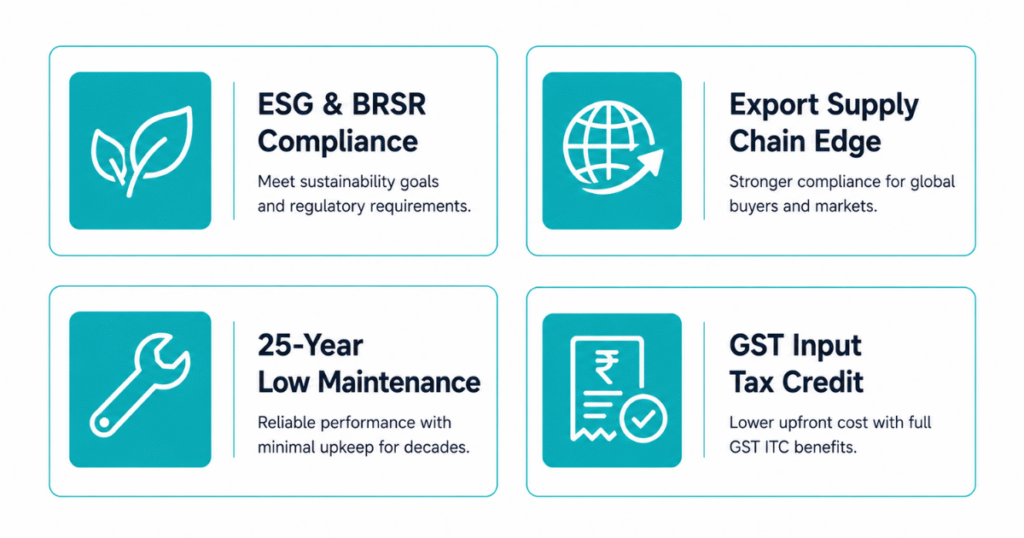
5. Direct Scope 2 Emission Reduction: ESG and BRSR Compliance – The fastest, most credible action for sustainability reporting
India’s national electricity grid carries a carbon emission factor of 0.71 kg CO2 per kWh, as published annually by the Central Electricity Authority. A factory consuming 1,00,000 units per month from the grid generates 71 tonnes of Scope 2 CO2 every single month 852 tonnes annually. This is not an abstract number. It is the figure your auditor will report, your investors will scrutinise, and your international buyers will increasingly demand to see reduced.
Every unit generated by your solar plant directly replaces grid electricity. For Indian businesses filing under SEBI’s Business Responsibility and Sustainability Reporting (BRSR) framework mandatory for the top 1,000 listed companies solar is the single most cost-effective and measurable Scope 2 reduction available today. The EU’s Carbon Border Adjustment Mechanism (CBAM) is making this a trade compliance issue, not just a reporting exercise.
✅ A 500 kW solar plant generating 7.25 lakh units annually prevents approximately 515 tonnes of CO2 per year equivalent to taking 110 cars off Indian roads, every single year, for 25 years.
6. Competitive Advantage in Global Supply Chains: EU buyers, US importers, and Japanese manufacturers now ask for your carbon data
Global buyers particularly from the European Union, the United States, and Japan are systematically requesting carbon footprint data from Indian suppliers. This is no longer an ESG conversation happening in boardrooms. It is a procurement requirement showing up in vendor qualification forms.
Indian exporters in textiles, pharmaceuticals, auto components, gems and jewellery, and specialty chemicals are already encountering Scope 1 and Scope 2 questionnaires from their overseas buyers. The businesses that can demonstrate a documented reduction in their carbon footprint with verifiable solar generation data will win and retain contracts that competitors cannot qualify for.
The practical reality: A solar plant generates DISCOM-verified generation data every month. That data, combined with a BRSR filing or a third-party sustainability certificate, is the most credible carbon reduction narrative an Indian manufacturer can present to a global buyer today.
7. Zero Moving Parts: 25 Years of Near-Zero Maintenance – No fuel. No moving parts. No breakdowns. Just generation.
A diesel generator has over 200 moving parts. It requires regular oil changes, filter replacements, cooling system maintenance, and fuel procurement. It breaks down. It requires specialist maintenance staff.
A solar plant has no moving parts only panels, cables, inverters, and a monitoring system. Annual maintenance requirements are minimal: panel cleaning 4 to 6 times a year to remove dust accumulation, inverter health checks, and structure inspection. Annual Operation and Maintenance (O&M) cost for a 500 kW system is typically Rs 1.5 to Rs 3 lakh less than 1% of system cost annually.
Bifacial TOPCon panels from Tier 1 manufacturers carry a 25-year linear power output guarantee: minimum 97.5% output in Year 1, declining no more than 0.45% per year. Year 25 output is guaranteed above 87.5% of nameplate capacity. That performance commitment is in writing before the plant is commissioned.
8.GST Input Tax Credit Recovery : Recover 5-12% of system cost from your GST liability in Year 1
Solar system components panels, inverters, mounting structures, cables attract GST that businesses registered under GST can claim as Input Tax Credit against their output GST liability. This recovery typically amounts to 5% to 12% of the total system cost, depending on the project structure and GST rate applicable to your procurement.
On a Rs 2 crore system, GST ITC recovery of 5% returns Rs 10 lakh in Year 1. Combined with accelerated depreciation tax savings of Rs 20 to Rs 30 lakh, the combined first-year financial benefit from policy and tax levers alone is Rs 30 to Rs 40 lakh before electricity savings are counted.
⚠ GST ITC eligibility depends on your business structure, registration status, and the contract format for your solar procurement. Consult your CA on structuring the EPC contract to maximise ITC recovery before you sign.
📖 You can also read: Scope 1, 2 & 3 Emissions: A Complete Guide for Businesses
9. Increased Business Property and Asset Value: Energy-efficient facilities command premium valuations
A commercial or industrial property with a commissioned, grid-connected solar plant is a fundamentally different asset from one without. It carries a documented reduction in operating costs, a verified renewable energy source, and a 25-year contracted generation asset with manufacturer performance guarantees.
For businesses with owned premises factories, warehouses, commercial buildings, processing facilities the solar plant adds to the fixed asset register and increases property valuation. Buyers and investors in M&A processes increasingly factor in operational efficiency as part of business valuation. A plant with demonstrably lower energy costs and a verified sustainability track record is a more attractive acquisition target.
Solar panels installed on leased premises require early clarity on lease tenure typically a minimum 5-year term is needed to justify the investment. For owned premises, there is no such constraint, and the asset appreciation benefit is fully captured by the business owner.
10.Brand Trust and Stakeholder Confidence: Customers, employees, and investors notice what powers your operations
In 2026, sustainability is not a marketing add-on. It is a signal of operational sophistication. Customers particularly institutional and B2B buyers are actively choosing suppliers with demonstrable green credentials. Employees, especially younger professionals, factor in a company’s environmental commitment when evaluating employers. Institutional investors are applying ESG screens to portfolio decisions.
A commissioned solar plant is a tangible, visible commitment. It generates real data tonnes of CO2 avoided, units of clean electricity generated, percentage of operations powered by renewables that your communications, annual reports, and vendor qualification documents can reference with precision.
At Solarsure, every commissioned project generates a Commissioning Report that includes the plant’s projected 25-year generation, CO2 avoidance equivalent, and annual savings benchmark. These are not marketing estimates. They are engineering calculations from the Detailed Project Report the same numbers your auditor, your buyer, and your investor can verify independently.
All 10 Benefits of Adopting Solar Power at a Glance
| # | Benefit of adopting Solar Power | What It Means for Your Business | Quantified Impact |
| 01 | Electricity Bill Reduction | Monthly power cost drops 60-80% | Rs 5-15L/month savings on 500 kW |
| 02 | Accelerated Depreciation | 40%-60% tax shield under Section 32 | Rs 20-30L tax saving in Year 1 |
| 03 | Energy Independence | No grid/diesel dependency during day | Diesel saving Rs 3-3.7L/month |
| 04 | Tariff Protection | Lock generation cost at Rs 3.40/unit | Rs 4.8Cr total saving over 25 yrs |
| 05 | ESG / BRSR Compliance | Scope 2 reduction, SEBI BRSR filing | 515 tonnes CO2 avoided/yr (500 kW) |
| 06 | Export/Supply Chain Edge | Qualify for EU, US, JP buyer audits | Retain contracts; avoid CBAM penalties |
| 07 | Zero Maintenance Asset | O&M < 1% of system cost annually | 25-yr panel power guarantee |
| 08 | GST Input Tax Credit | Recover 5-12% of system cost | Rs 10L+ ITC on Rs 2Cr system |
| 09 | Property & Asset Value | Solar on owned property adds asset value | Higher M&A and lease valuations |
| 10 | Brand & Stakeholder Trust | Verifiable green credentials | ESG ratings, customer preference, investor confidence |
Frequently Asked Questions
Q: What is the biggest benefits of adopting solar power for a business in India?
A: For most Indian businesses, the single biggest benefit is the permanent reduction in electricity bills typically 60 to 80% from the first month of operation. For a factory consuming 1,00,000 units per month at Rs 8.80 per unit, this translates to Rs 5 lakh or more in monthly savings that continue for 25 years.
Q: Do commercial and industrial businesses get any government benefit for adopting solar power in 2026?
A: Yes through accelerated depreciation under Section 32 of the Income Tax Act. Commercial businesses can claim 40% depreciation on the solar asset in Year 1, and manufacturing businesses can claim an additional 20%, totalling 60%. On a Rs 2 crore system at a 25% tax rate, this produces Rs 20 to Rs 30 lakh in tax savings in Year 1 alone. There is no direct capital subsidy for C&I installations that is restricted to residential consumers under PM Surya Ghar.
Q: What are the benefits of adopting solar power for ESG compliance and BRSR reporting?
A: Every unit of electricity generated from your solar plant directly displaces grid electricity, reducing your Scope 2 carbon emissions. India’s grid emission factor is 0.71 kg CO2 per kWh (CEA 2025-26). A 500 kW plant generating 7.25 lakh units annually avoids approximately 515 tonnes of CO2 a measurable, verifiable figure for SEBI BRSR disclosure. For listed companies in India’s top 1,000 by market cap, Scope 2 reporting is mandatory. Solar is the most cost-effective path to reducing this number.
Q: How long does a solar plant last and what maintenance does it need?
A: A properly specified solar plant from Tier 1 manufacturers has an operational life of 25 to 30 years. Bifacial TOPCon panels carry a 25-year linear performance guarantee. Annual maintenance requirements are minimal: panel cleaning 4 to 6 times a year, inverter health checks, and structure inspection. Total O&M cost for a 500 kW system is typically Rs 1.5 to Rs 3 lakh annually under 1% of the system cost.
Q: Can solar help Indian businesses compete for international contracts?
A: Yes, significantly. EU buyers are applying the Carbon Border Adjustment Mechanism (CBAM) to imports from carbon-intensive supply chains. US and Japanese buyers increasingly include Scope 1 and Scope 2 data in vendor qualification requirements. Indian exporters in textiles, pharma, auto components, and specialty chemicals that can demonstrate a documented reduction in carbon footprint backed by solar generation data have a measurable competitive advantage in retaining and winning international supply chain contracts.
Q: What is the ROI of solar for a business in India in 2026?
A: Most C&I solar projects in India deliver a post-tax IRR of 18 to 22% in 2026 under the CAPEX model, well above typical corporate hurdle rates. Payback periods range from 2.5 years for high-tariff commercial consumers to 4.5 years for lower-tariff ground-mounted industrial plants. Over 25 years, a 500 kW plant in Madhya Pradesh saves approximately Rs 4.8 crore at a 4.5% annual tariff escalation assumption from an initial investment of Rs 1.85 crore.
Bottom Line
Solar is not an environmental gesture. For Indian businesses adopting solar power in 2026, it is the highest-return capital expenditure available an asset that reduces your single largest variable cost, generates a tax shield in Year 1, protects you against 25 years of tariff escalation, and produces the carbon data your supply chain increasingly demands.
The businesses that act in 2026 lock in today’s module prices, today’s favourable policy environment, and today’s IRRs. Every month of delay is a month of full grid billing that could have been partially eliminated.
At Solarsure, every site assessment includes a complete financial model electricity savings, accelerated depreciation calculation, GST ITC projection, payback period, and 25-year generation forecast delivered before you commit to anything.