Walk into any solar procurement discussion today, and you will hear terms thrown around like TOPCon, HJT, bifacial, N-type, and Mono PERC often by people who cannot explain what they mean. Worse, many buyers end up with the wrong technology for their project because their EPC partner recommended what was cheapest to procure, not what was best for their specific site and use case.
This guide fixes that. We will break down every major solar panel technology available in India in 2025, how each one works, what the numbers actually say about efficiency and degradation, how they perform in India’s high-temperature climate, and which technology fits which type of project.
At Solarsure, every project proposal we submit includes a technology recommendation backed by site-specific irradiance data, temperature analysis, and 25-year generation modelling. This article gives you the same framework — so you can evaluate any quote you receive with the same rigour.
The Foundation: P-Type vs N-Type Silicon
Every crystalline silicon solar panel which covers more than 95% of the global market, is built on a silicon wafer. That wafer is either P-type or N-type, and this distinction is the most important technical dividing line in modern solar panel manufacturing.
P-Type Silicon: The Older Standard
P-type silicon is doped with boron, creating a positively charged semiconductor. Mono PERC and polycrystalline panels are P-type. P-type has been the commercial solar standard for over three decades and is well-understood in terms of manufacturing yield, long-term performance, and supply chain reliability.
The primary limitation of P-type panels is a phenomenon called Light-Induced Degradation (LID). When a P-type panel is first exposed to sunlight, its output drops by 1% to 3% in the first few hours of operation as boron-oxygen defects form in the silicon. This is a known, irreversible initial loss that P-type buyers accept. All efficiency and degradation specifications for P-type panels are given after this initial LID period.
N-Type Silicon: The Current Market Leader
N-type silicon is doped with phosphorus, creating a negatively charged semiconductor. TOPCon, HJT, and IBC panels are all N-type. Because N-type silicon does not contain boron, it is not susceptible to LID, which means N-type panels do not experience the initial efficiency drop that P-type panels do. Their rated output at commissioning is their actual output.
N-type panels also demonstrate lower Light and Elevated Temperature-Induced Degradation (LeTID) over time, which is particularly relevant in India’s high-temperature operating conditions. The combination of no LID, lower annual degradation, and better temperature coefficient makes N-type the superior technology for the Indian climate, which is exactly why TOPCon has become the default specification for serious utility and C&I projects in India in 2025.
All Solar Panel Technologies: Side-by-Side Comparison
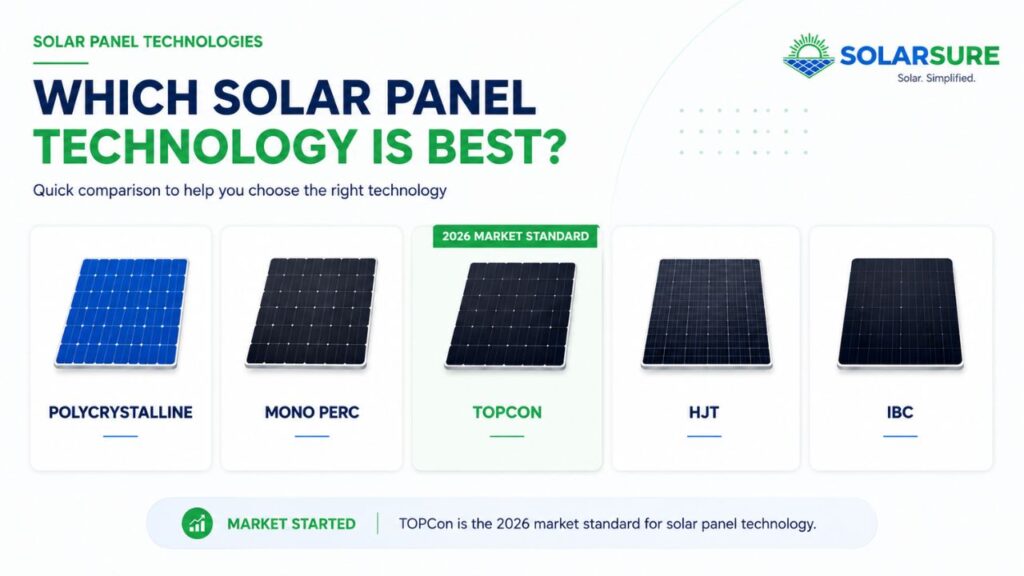
| Technology | Type | Efficiency | Temp Coeff (%/°C) | Deg/Year | Rs/Wp (India 2025) | Best Used For |
|---|---|---|---|---|---|---|
| Polycrystalline | P-type | 15–17% | -0.40 to -0.45 | 0.60–0.70% | 10–13 | Legacy systems; not recommended for new projects |
| Mono PERC | P-type | 19–21% | -0.35 to -0.40 | 0.50–0.55% | 12–16 | Standard rooftop; smaller C&I; budget-priority projects |
| TOPCon | N-type | 21–23% | -0.30 to -0.35 | 0.40–0.45% | 13–18 | Utility scale; large C&I; PM KUSUM; current market sweet spot |
| HJT (Heterojunction) | N-type | 23–25% | -0.24 to -0.26 | 0.30–0.35% | 18–25 | Space-constrained sites; premium rooftop; high-irradiance zones |
| IBC | N-type | 24–26% | -0.27 to -0.30 | 0.30–0.35% | 22–30 | High-precision applications; where maximum efficiency per sqm is critical |
| Thin Film (CdTe/CIGS) | — | 10–18% | -0.20 to -0.32 | 0.50–0.70% | 14–20 | Utility scale (First Solar CdTe); rarely used in India today |
Note: Temp coefficient values are negative, a larger absolute value means greater power loss in heat. A panel rated at -0.45%/°C loses 0.45% of its output for every degree above 25°C. In an Indian summer where panel temperatures reach 55–60°C, this difference is significant.
Technology-by-Technology: What Each One Actually Means
1. Polycrystalline (Poly): The Outgoing Standard
Polycrystalline panels are made by melting multiple silicon crystals together. The manufacturing process is simpler and cheaper than monocrystalline, but the resulting wafer has grain boundaries between crystals that impede electron flow — which is why poly panels top out at 17% efficiency.
Poly panels are visually distinct by their blue, speckled appearance. They were the commercial solar standard from the 1990s through approximately 2018. Today, poly is being phased out of new projects across India. The cost advantage has largely disappeared as Mono PERC and TOPCon manufacturing scaled up, and the efficiency and degradation disadvantages remain. Solarsure does not specify polycrystalline panels for any new project.
2. Mono PERC: The Reliable Workhorse
PERC stands for Passivated Emitter and Rear Cell. A Mono PERC panel adds a reflective passivation layer to the rear of a standard monocrystalline cell, which allows light that passes through the cell on the first pass to be reflected back for a second absorption opportunity. This rear passivation improved monocrystalline efficiency from approximately 17% to 19–21% and made Mono PERC the global market standard from 2018 onwards.
Mono PERC panels remain a strong choice for projects where budget is the primary constraint and where the site’s generation model does not demand peak efficiency. For a standard rooftop installation with good shadow-free area and moderate ambient temperatures, a well-specified Mono PERC from a Tier 1 manufacturer delivers reliable, predictable performance over 25 years.
The limitation: Mono PERC is P-type, which means it carries LID, higher annual degradation than N-type alternatives, and a temperature coefficient that costs meaningful generation in India’s summer climate. For projects above 500 kW where the 25-year generation model matters, the extra investment in TOPCon is almost always financially justified.
3. TOPCon: The 2025 Market Standard for Serious Projects
TOPCon stands for Tunnel Oxide Passivated Contact. It adds an ultra-thin layer of silicon oxide and polysilicon to the rear of an N-type monocrystalline cell. This tunnel oxide layer dramatically reduces electron recombination the loss mechanism that limits efficiency in conventional cells pushing commercial module efficiency to 21–23%.
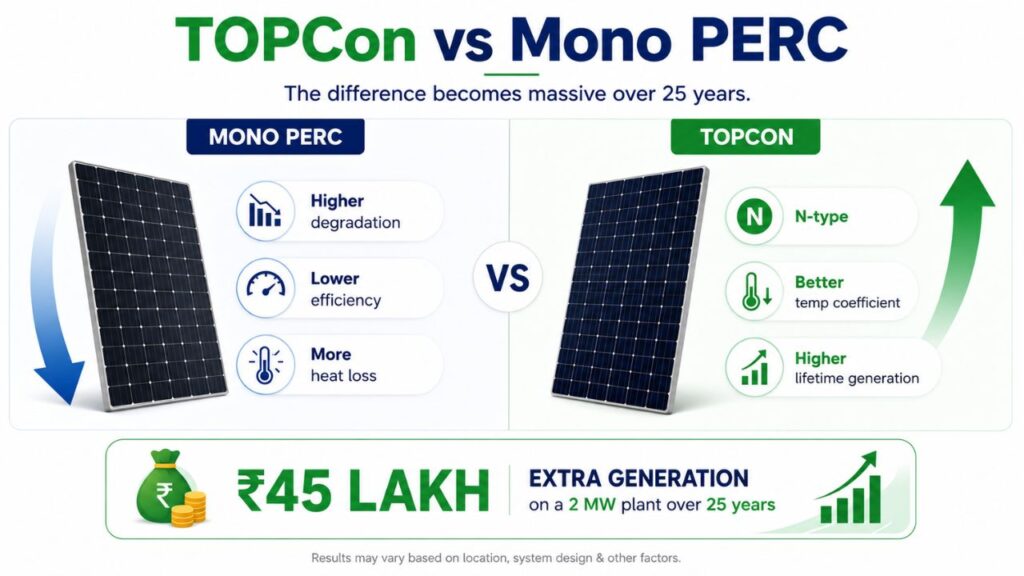
TOPCon is N-type, which means no LID, no initial output drop, lower annual degradation of 0.40–0.45%, and a better temperature coefficient of -0.30 to -0.35%/°C. For a 2 MW plant in Madhya Pradesh running for 25 years, TOPCon generates approximately 953 more units per kWp over the project life compared to Mono PERC at a cost premium of Rs 2 to Rs 5 per Wp.
At current pricing, the additional generation revenue from TOPCon covers its premium in 2.5 to 4 years for most project types making it the correct default specification for any project above 500 kW in India today. This is why Solarsure specifies TOPCon for all utility scale, large C&I, and PM KUSUM projects in our current BOQ.
4. HJT (Heterojunction Technology): The Premium Performer
HJT combines a monocrystalline N-type silicon wafer with ultra-thin layers of amorphous silicon on both sides. This unique structure creates a heterojunction two different semiconductor materials joined at an interface that achieves exceptionally low carrier recombination.
The result is the best temperature coefficient of any commercially available crystalline panel: -0.24 to -0.26%/°C. In India’s peak summer conditions, HJT panels lose 7.5% of their rated output when panel temperature is 30°C above STC compared to 11.1% for Mono PERC and 9.6% for TOPCon. This is a real, measurable generation advantage that compounds over 25 years.
HJT panels also achieve the lowest annual degradation rates of 0.30–0.35%, meaning they retain more of their initial output across the plant’s operational life. Over 25 years, an HJT panel generates approximately 36,095 kWh per kWp compared to 35,669 kWh for TOPCon and 35,251 kWh for Mono PERC.
The constraint is cost: HJT panels currently price at Rs 18 to Rs 25 per Wp in India a 40% to 70% premium over Mono PERC. For space-constrained sites, high-irradiance zones in Rajasthan’s Bikaner or MP’s Nimar belt, or premium rooftop installations where every square metre counts, the HJT premium pays back. For standard ground-mounted projects with adequate land area, TOPCon is the more financially efficient choice.
5. IBC (Interdigitated Back Contact): Maximum Efficiency, Maximum Cost
IBC panels move all metal contacts both positive and negative to the rear of the cell, eliminating shading losses from front-side busbars and fingers. This design allows the entire front surface to collect sunlight without obstruction, pushing efficiency to 24–26%.
IBC is N-type with excellent temperature coefficient and degradation characteristics. However, the manufacturing complexity of placing interdigitated contacts on the cell rear makes IBC the most expensive crystalline panel technology on the market at Rs 22 to Rs 30 per Wp. IBC is used in applications where maximum efficiency per square metre is critical high-precision rooftop installations, BIPV (Building Integrated Photovoltaics), and luxury residential. For standard utility or C&I projects in India, IBC’s premium over HJT or TOPCon is not financially justified.
6. Thin Film (CdTe / CIGS): The Utility-Scale Alternative
Thin film panels are manufactured by depositing semiconductor material onto glass or flexible substrate not from silicon wafers. The two main commercial variants are Cadmium Telluride (CdTe), used by First Solar, and Copper Indium Gallium Selenide (CIGS), used by Solar Frontier and others.
Thin film panels have the best temperature coefficient of all panel categories CdTe runs at -0.20 to -0.28%/°C and perform exceptionally well in diffuse light conditions. However, commercial efficiency tops out at 10–18% for most variants, meaning thin film requires significantly more land area per MW than crystalline silicon.
Thin film is predominantly a utility-scale technology used by large global developers. In India, First Solar’s CdTe modules have been specified in several large SECI and NTPC projects. For most domestic C&I, PM KUSUM, or mid-scale utility projects, crystalline silicon remains the correct choice.
You can also read: How Do Solar EPC Services Help Commercial and Industrial Businesses Save Energy Costs?
Monofacial vs Bifacial: The Dimension That Cuts Across All Technologies
Bifacial panels generate electricity from both the front and rear surface. The rear side collects light reflected from the ground, mounting structure, or any surface beneath the panel known as albedo light.
Bifacial is not a technology category in itself it is a design variant available across Mono PERC, TOPCon, and HJT. Most high-efficiency TOPCon and HJT panels shipped today are bifacial by default.
| Ground Surface / Condition | Bifacial Rear Gain |
|---|---|
| Dry open earth (albedo 0.15–0.20) | 5–10% additional generation |
| Concrete / white gravel (albedo 0.35–0.45) | 15–20% additional generation |
| Green grass / agrivoltaic (albedo 0.20–0.25) | 8–12% additional generation |
| White-painted roof surface | 20–25% additional generation |
| Dark roof / bitumen surface | 3–6% additional generation |
For ground-mounted projects in MP and Rajasthan with standard earth surface, a bifacial TOPCon panel adds approximately 8% to annual generation compared to the same panel’s monofacial equivalent with no change in panel area or structural footprint. Over a 2 MW plant’s 25-year life, this compounds to a significant generation and revenue differential.
One critical installation requirement: bifacial panels need a minimum clearance of 600 mm between the panel’s rear surface and the ground to allow reflected light access. This is a structural design constraint that must be built into the MMS specification from the beginning of the project.
Solarsure’s standard specification for ground-mounted utility and C&I projects in 2025: Bifacial TOPCon, N-type, minimum 21.5% efficiency, temperature coefficient better than -0.35%/°C, annual degradation not exceeding 0.45%, first-year power guarantee not less than 97.5% of STC-rated output. This specification is written into every Solarsure project contract before procurement begins.
The India Factor: Why Temperature Coefficient Is Your Most Critical Specification
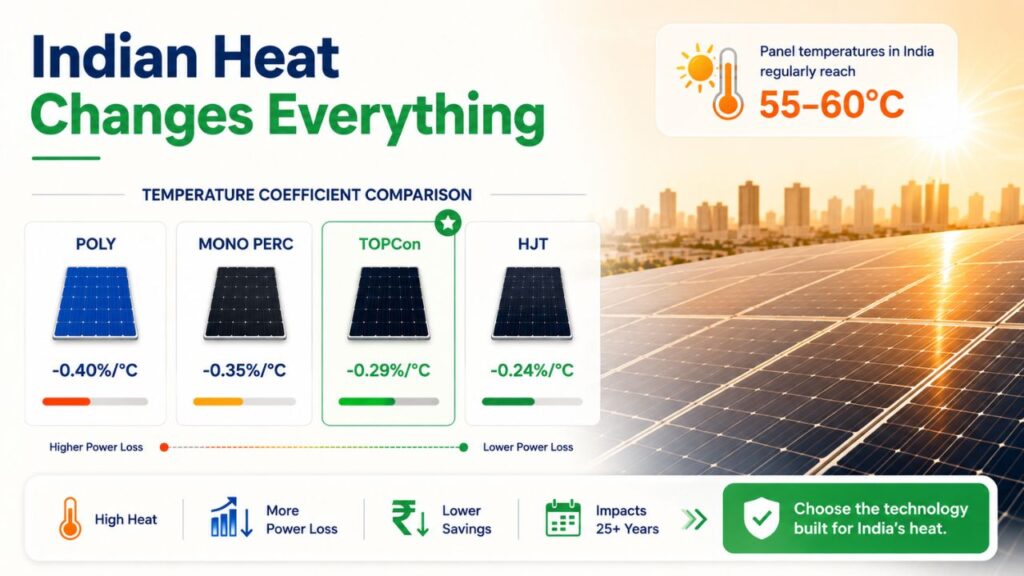
| Panel Technology | Temp Coefficient | Power Loss at 30°C Above STC (Indian Summer) |
|---|---|---|
| Polycrystalline | -0.40 to -0.45%/°C | 12.0–13.5% power loss |
| Mono PERC | -0.35 to -0.40%/°C | 10.5–12.0% power loss |
| TOPCon | -0.30 to -0.35%/°C | 9.0–10.5% power loss |
| HJT | -0.24 to -0.26%/°C | 7.2–7.8% power loss |
| Thin Film CdTe | -0.20 to -0.28%/°C | 6.0–8.4% power loss |
On a 2 MW plant, the difference between Poly (-0.43%/°C) and HJT (-0.25%/°C) at 30°C above STC is 5.4% of instantaneous power output. During India’s peak summer months of April, May, and June — when irradiance is highest and generation potential is greatest this thermal performance gap translates directly into lost units and lost revenue.
For projects in MP’s Nimar belt, Rajasthan’s desert zones, or Maharashtra’s Vidarbha region where summer panel temperatures routinely exceed 55°C, specifying a panel with a poor temperature coefficient is a 25-year mistake hidden in a single line of the procurement specification.
25-Year Generation Comparison: Where Degradation Matters More Than Day-One Efficiency
Buyers often focus on nameplate efficiency at purchase. The more important number is how much electricity a panel actually generates over its full 25-year life — accounting for annual degradation.
| Technology | Year 1 Output (per kWp) | Year 25 Output (% of initial) | Total 25yr Generation (kWh/kWp) |
|---|---|---|---|
| Polycrystalline | 1,500 kWh | 85.0% | 34,716 kWh |
| Mono PERC | 1,500 kWh | 87.8% | 35,251 kWh |
| TOPCon | 1,500 kWh | 90.0% | 35,669 kWh |
| HJT | 1,500 kWh | 92.3% | 36,095 kWh |
On a 2 MW plant (2.4 MWp DC), the generation difference between Poly and TOPCon over 25 years is approximately 22.9 lakh kWh — at Rs 4.50 per unit, that is Rs 1.03 Crore of additional revenue from simply specifying the right module technology. The difference between Poly and HJT is 32.8 lakh kWh Rs 1.48 Crore over the plant’s life.
These numbers do not include the temperature coefficient advantage, which adds further separation in favour of N-type panels across India’s climate. When you combine degradation advantage and temperature performance, the financial case for TOPCon or HJT over Poly or Mono PERC on any project above 500 kW is decisive.
Which Solar Panel Technology Should You Choose?
| Project Type | Recommended Technology | Why |
|---|---|---|
| PM KUSUM Component A/B (1–2 MW ground-mounted) | Bifacial TOPCon | Best balance of cost, generation, and degradation for 25-yr PPA contracts |
| C&I rooftop (100 kW–1 MW, ample area) | Mono PERC or TOPCon | Mono PERC if budget-constrained; TOPCon if 25-yr model is being evaluated |
| C&I rooftop (100 kW–1 MW, space-constrained) | Bifacial HJT | Maximum output per sq. metre; temperature benefit relevant for high ambient sites |
| Utility scale (2 MW+) | Bifacial TOPCon | Market standard — best cost-per-kWh over 25 years at current pricing |
| Agrivoltaic / Agri-PV | Bifacial TOPCon or Bifacial Mono PERC | Rear-side albedo from green vegetation; height clearance must be factored into structure |
| BESS-integrated hybrid plant | Bifacial TOPCon | N-type stability and low degradation critical when paired with battery economics |
| High-altitude / extreme temperature zones | HJT | Best temperature coefficient; critical where Tpanel regularly exceeds 60°C |
The Risk Every Buyer Must Know: Module Substitution After Contract Signing
The technology you specify in your contract and the technology installed on your roof or land are not always the same thing. Module substitution after contract signing is one of the most prevalent and financially damaging practices in India’s solar EPC industry.
It works like this: A developer quotes Bifacial TOPCon at 21.5% efficiency in the proposal. After contract signing, the EPC substitutes a lower-efficiency Mono PERC at 19.5% — same wattage on the nameplate, different technology, different degradation curve, different 25-year output. The buyer does not notice because both panels are physically the same size. The EPC saves Rs 1.5 to Rs 3 per Wp. The buyer loses Rs 80 lakh to Rs 1.5 Crore in generation revenue over 25 years.
At Solarsure, every project contract specifies the module brand, model number, efficiency rating, temperature coefficient, annual degradation rate, and bifacial factor. These specifications are locked before procurement and verified against delivery documentation and manufacturer test reports on arrival at site. Our 3-step QC process checks components against the contract specification — not just against the delivery note.
If your EPC partner cannot specify panel brand and model number in writing before you sign, that is a red flag not a negotiation point.
Bottom Line
Technology choice in solar is not about picking the most impressive-sounding acronym. It is about matching the right panel specification to your site conditions, project economics, and 25-year performance model.
For 2025 projects in India above 500 kW, Bifacial TOPCon is the correct default. For space-constrained or premium-performance sites, HJT justifies its premium. Polycrystalline should not be in any new project specification. And whatever technology is chosen, it must be locked in your contract in writing, with model number before you commit.
Solarsure provides a full technology recommendation and 25-year generation model as part of every site assessment at no cost. Request yours at solarsure.in.