By adopting solar, MSMEs can cut their electricity bills by over 70%. For MSMEs, cutting costs not only improves the return on investments but also opens new doors to scale up their business operations.
Paying electricity bills is one of the highest recurring fixed costs for a business. Still, most MSME owners either delay the decision or rush into it without a clear plan. Both approaches ended up costly.
Delaying means years of avoidable electricity expenses. Rushing means signing bad agreements, choosing underperforming equipment, not understanding if and buts, or missing regulatory approvals that stall your project.
In this blog, we provide a clear, step-by-step explanation on how MSMEs adopt solar the right way. Whether you own a factory, a warehouse, or a commercial facility, every step here applies directly to your situation. So, let’s dive in.
Why MSMEs Cannot Afford to Wait
Electricity costs are rising every year. Grid reliability remains inconsistent across most industrial zones in India. And global buyers, especially from the EU, the US, and Japan, are now asking for carbon footprint data before signing supply contracts with every business.
The EU’s Carbon Border Adjustment Mechanism (CBAM) is not a distant regulation. It is already affecting Indian exporters in sectors like steel, aluminium, textiles, and chemicals. Solar directly reduces your Scope 2 emissions and improves your compliance position in these supply chains. Businesses that act now will be better placed to retain and grow international contracts.
The financial case is also equally strong. Commercial rooftop solar delivers a 25% to 40% ROI with a payback period of just 3 to 5 years. The average IRR under a CAPEX model is around 20%. These are not optimistic projections or assumed results, but they are numbers that MSMEs across India are already achieving on installed plants.
Step 1: Choose the Right Solar Model
The first and most important decision is how an MSME want to own and pay for its solar plant. Their choice here shapes everything downstream, such as the financing structure, the regulatory path, the tax benefits, and the long-term ROI. There are three primary models available to MSMEs in India.
CAPEX Model (Self-Funded Ownership)
In the CAPEX model, your business finances and owns the solar plant outright. You bear the upfront capital cost but gain full ownership of the asset and all the savings it generates. This model delivers the highest long-term financial returns. The IRR averages around 20%, and you own a depreciating asset that qualifies for 40% accelerated depreciation in Year 1 under the Income Tax Act. If your business has available capital or access to a term loan, the CAPEX model is almost always the better financial decision over a 25-year horizon.
OPEX / RESCO Model (Rent-a-Roof)
In the OPEX model, a Renewable Energy Service Company (RESCO) invests in, installs, and maintains the solar plant on your roof at zero upfront cost to you. You simply agree to purchase the generated power at a predefined tariff, typically ₹3.8 to ₹6.5 per unit, compared to ₹5.6 to ₹6.5 per unit. You start saving from Day 1 with no capital commitment. This model is ideal for MSMEs with limited capital or those cautious about taking on asset-related risk. The tradeoff is that the RESCO retains ownership, and your long-term savings are lower than in a CAPEX arrangement.
Green Open Access (GOA)
Green Open Access is designed for MSMEs with a combined electricity demand of 100 kW or more. Under GOA rules, you can purchase renewable electricity directly from an off-site solar generator through the grid. This model works especially well for MSMEs that do not have adequate rooftop space for a sufficiently large plant, or for clusters of smaller units that want to collectively access solar power. In this model, the state-level open access charges apply, so it is important to calculate the full landed cost of power before comparing it to your current DISCOM tariff.
You can also read: How to Decide the Right Solar Model & Solar Capacity (kW/MW) for Your Business
Step 2: Conduct a Solar Site Survey
Once you have chosen your model, get a proper solar site survey done before signing anything with any vendor. The site survey is the foundation of your entire project. Every financial projection, every system design decision, and every equipment specification flows from what the survey finds.
What Does a Solar Site Survey Cover?
A professional solar site survey for your rooftop space in India evaluates four critical parameters. First, it measures the available shadow-free roof area and calculates how many kilowatts of panels can be installed. Second, it assesses the structural load capacity of your rooftop to confirm it can safely carry the weight of panels and mounting structures. Third, it evaluates the orientation and tilt angle of your roof relative to the sun’s path to estimate annual generation accurately. Fourth, it assesses the proximity and condition of your grid connection point, which affects the cost and complexity of the electrical installation.
Why Shadow Analysis Cannot Be Skipped?
Commercial rooftop solar shadow analysis is one of the most critical and most frequently skipped parts of site assessment. Shadows from water tanks, AC outdoor units, parapets, staircases, and adjacent buildings can reduce your solar generation by 15% to 30% if not identified and accounted for during system design. A professional EPC partner will use irradiance mapping and shading simulation tools to model your roof’s shadow pattern across all seasons and times of day. This data then directly informs which panels go where and whether microinverters or optimisers are needed to manage shading losses.
So, never accept a solar proposal that does not include a detailed site survey report with shadow analysis. If a solar EPC partner gives you a quote without visiting your site, walk away.
Step 3: Estimate System Size and ROI
Your system size must be based on your actual energy consumption and not a round number, and not what your neighbour’s factory installed. Getting the sizing right is the difference between a solar plant that delivers the promised savings and one that consistently disappoints.
How Does an MSME Size Its Solar System?
Pull out 12 months of electricity bills. Calculate your average monthly unit consumption and your peak demand in kilowatts. Factor in seasonal variation if your operations, production volumes, or cooling loads change significantly across summer and winter. A correctly sized industrial rooftop solar panel system in India will typically cover 70% to 90% of your daytime power requirement. The remaining load stays on the grid or a backup source. Moreover, over-sizing of the solar plant wastes capital, and under-sizing means leaving savings on the table.
How to Build a Realistic ROI Model for MSMEs?
Once you have the system size, build a year-by-year financial model based on the following inputs: your current per-unit tariff from the DISCOM, your projected solar generation based on site survey data, your O&M costs across 25 years, the accelerated depreciation benefit of 40% in Year 1 under the Income Tax Act, and net metering credits for surplus units exported to the grid. Ask your EPC partner to share a detailed cash flow projection covering the full 25-year plant life. If they cannot produce one, or are unwilling to, that tells you something important about the quality of their work.
Step 4: Explore Government Support
MSMEs often assume solar subsidies are only for farmers and households. That is partially correct but not entirely. While direct capital subsidies from MNRE are largely focused on residential users and the agriculture sector, commercial MSMEs benefit significantly from a range of financial instruments, schemes, and financing partnerships that can meaningfully reduce the effective cost of your solar project.
Accelerated Depreciation Benefit for MSMEs
Under the Income Tax Act, solar plants qualify for 40% accelerated depreciation in Year 1. For a profit-making MSME in a 25% to 30% tax bracket, this benefit alone can reduce the effective project cost by 10% to 15%. This is one of the most underutilised financial advantages available to commercial solar investors in India. When your EPC partner models your ROI, make sure this benefit is explicitly included in the calculation.
GST Benefits for MSMEs
Solar PV panels and modules requires 5% GST. However, if your business is GST-registered, which most MSMEs are, you can claim input tax credit on the GST paid during procurement. This effectively reduces the tax cost of your solar investment and improves your overall project economics. You can confirm this with your chartered accountant as part of your pre-investment evaluation.
Net Metering and State-Level Policies
Net metering allows you to export surplus solar power to the grid and receive bill credits in return. Every state has its own net metering policy, with different rules on export limits, settlement rates, and banking periods. States like Maharashtra, Gujarat, Rajasthan, and Tamil Nadu have relatively business-friendly net metering frameworks. Check your state-level net metering policy carefully before finalising your system design, as the rules directly affect how much of your surplus generation translates into savings.
PM KUSUM Scheme and PM KUSUM 2.0
PM Kusum Yojana is primarily designed for farmers but is relevant for MSMEs involved in agro-processing or those that own agricultural land near their facility. The scheme supports solar installations that feed into agricultural feeders and offers attractive tariff arrangements under long-term Power Purchase Agreements. If your business has any connection to the agricultural supply chain, explore whether any component of PM Kusum applies to your situation.
PM KUSUM 2.0 is the next phase of India’s agricultural solar programme, announced by Union Minister Pralhad Joshi at the 4th National Agro-RE Summit in March 2026. It is not simply an extension of the original PM KUSUM scheme, which is a structurally upgraded programme with a significantly larger budget and new components. The total financial outlay is expected to rise from Rs. 34,422 crore to nearly Rs. 50,000 crore, which reflects a 45% increase in government commitment to decentralised solar in rural India.
SIDBI: Tata Power Solar Partnership
This collaboration offers MSMEs customised solar financing with zero processing fees. SIDBI provides loans at interest rates starting from 6.36% with repayment terms of up to 120 months. This is one of the most accessible financing pathways for MSMEs that want to go CAPEX but cannot easily secure a term loan from a commercial bank. The combination of a low interest rate and a long repayment tenure significantly improves monthly cash flow during the loan repayment period.
Demand Aggregation via EESL and NITI Aayog
If your business is located in an MSME cluster, demand aggregation is worth exploring seriously. NITI Aayog and EESL are actively promoting programmes that bundle the solar demand of multiple units within a cluster. By aggregating demand, MSMEs can access bulk procurement pricing for equipment and installation, which can reduce per-unit costs significantly. You can speak with your district industries centre or MSME association to check whether any aggregation programme is active in your area.
Step 5: Select an Experienced EPC Partner
Choosing the right EPC partner is where most MSMEs make their single most costly mistake. Their usual practice is to compare quotes and go with the lowest price. In solar, that instinct to choose lower will cost you far more than you save.
Why Price Alone is the Wrong Metric for MSMEs?
A lower quote almost always means one or more of the following: cheaper panels with faster degradation rates, lower-grade inverters with shorter useful lives, weaker civil and electrical work, and minimal after-sales support. The system may perform adequately for the first year or two. Then the generation starts dropping by 5% to 10% and even more after 2 years. This reflects your lower savings than what was projected. The vendor who gave you the cheap quote may no longer be reachable or responsible. So, choosing a trusted and reliable solar EPC partner is a must for any MSME.
What to Evaluate When Selecting an EPC Partner?
When evaluating an industrial solar EPC partner in India, don’t look for the price. Verify the panel brand, model, efficiency rating, and warranty terms, including both product and performance warranty. Check the inverter make and model, and understand whether string, central, or microinverter topology is being recommended and why.
Ask for at least three past project references in your industry segment and your state, and actually call those references. Confirm the after-sales service structure, who handles O&M, what the response time commitment is, and whether monitoring is included. Ask to see the monitoring platform they provide and confirm you will have real-time access to your generation data.
Ask specifically for the make and model of every major component before signing the EPC agreement. A reliable partner will share this information without hesitation. One who deflects or delays on this question is not a partner you want for a 25-year investment.
Step 6: Handle Approvals and Compliance
Factory roof solar installation in India is a regulated activity. Every commercial and industrial solar plant requires a set of regulatory clearances before it can be commissioned and connected to the grid. Skipping or delaying these approvals is the most common reason solar projects stall after the agreement is signed.
Key Licences and Clearances Required
DISCOM No Objection Certificate (NOC)
The NOC from your local electricity distribution company confirms that the grid at your connection point has the capacity to handle your solar plant’s output. Without this, your net metering application cannot proceed. Apply for this as early as possible because processing times vary significantly across DISCOMs and states.
CEIG Approval
The Chief Electrical Inspector to the Government must approve your solar installation before it can be energised. This clearance verifies that your electrical installation meets safety standards. Your EPC partner should handle this on your behalf, but confirm that it is included in their scope of work before signing the agreement.
SLDC Approval
For grid synchronisation, approval from the State Load Dispatch Centre is required. This is particularly relevant for larger installations above 100 kW. The SLDC ensures your plant’s connection does not disrupt grid stability in your area.
Structural Stability Certificate
A licensed structural engineer must certify that your rooftop can safely carry the weight of the solar panels and mounting structure. This is both a regulatory requirement and a practical safety necessity. Do not allow installation procedures without this certificate in hand.
The 7-Step Net Metering Process
Net metering is the financial backbone of rooftop solar for MSMEs. It allows you to export surplus electricity to the grid and receive bill credits in return. Here is how the process works, step by step.
Step 1: Registration: Register your project on the National Rooftop Solar Portal. This is the entry point for the entire net metering application process.
Step 2: Documentation Submission: Submit your full application with supporting documents. These include your latest electricity bill, identity proof, property ownership documents, a Single Line Diagram of the proposed solar system, and equipment specifications for panels and inverters.
Step 3: Technical Feasibility Review: For systems up to 10 kW, approval is automatic. For systems above 10 kW, the DISCOM reviews technical feasibility within 30 days. Make sure your application is complete to avoid delays at this stage.
Step 4: Installation: Once technical feasibility is confirmed, proceed with installation using a DISCOM-empanelled vendor. Using an unapproved vendor can invalidate your net metering application entirely.
Step 5: Commissioning Inspection: Apply for net metering commissioning. A DISCOM engineer will inspect your installation within 15 days. Ensure your system is fully installed and ready for inspection before applying.
Step 6: Bidirectional Meter Installation: After a successful inspection, the DISCOM installs a bidirectional smart meter that records both your consumption from the grid and your export to it.
Step 7: Activation: The system is officially activated. If any subsidy is applicable, it is disbursed directly to your bank account via direct transfer.
Start the approval process as early as possible. Parallel-track it with equipment procurement. Do not wait for all approvals to be in hand before ordering equipment because the timelines often overlap, and waiting sequentially can delay your commissioning by months.
Step 7: Solar Plant Installation and Commissioning for MSMEs
With approvals in place and equipment procured, the physical installation of industrial rooftop solar panels begins. For most commercial and industrial rooftop systems, installation takes between 7 and 21 days, depending on system size, site complexity, and the number of installation crews deployed.
What Happens During Installation?
Your EPC partner will carry out panel mounting on the racking structure, DC cabling from panels to the combiner boxes, solar inverter setup for your commercial rooftop, AC wiring from the inverter to your main distribution board, and earthing and lightning protection for the entire system. Each of these phases requires qualified electricians and must be executed in accordance with the approved single-line diagram and CEIG requirements.
Grid-Connected Solar Commissioning
After physical installation is complete, grid-connected solar commissioning in India requires a formal DISCOM inspection. The DISCOM engineer will verify that the installation matches the approved documentation, test all protection systems, including anti-islanding protection, and confirm that the bidirectional meter reading is functioning correctly. Only after this inspection is completed and approved is the system officially activated and eligible to export units and earn net metering credits.
Why the Inspection Stage Matters?
For all MSMEs, make sure not to treat the solar plant inspection as a formality. This is your last opportunity to catch and correct installation errors before the system goes live. Wiring faults, earthing deficiencies, and protection relay misconfigurations are all detectable at this stage and cost nothing to fix. The same faults discovered two or three years into operation can cost significantly more to diagnose and repair, and may have already caused underperformance for months without your knowledge.
Step 8: Monitor and Maintenance
Your solar plant is designed to operate for 25 years. The quality of monitoring and maintenance across those years determines whether you realise 80% of your projected savings or 95%. The gap between those two numbers, compounded over 25 years, is substantial.
Setting Up Real-Time Monitoring
Set up real-time generation monitoring from Day 1. Your inverter or dedicated monitoring platform should provide hourly, daily, weekly, and monthly generation data accessible from your phone or desktop. Compare your actual generation against your projected generation baseline regularly. A consistent underperformance of even 5% against projection is a signal worth investigating immediately because it could indicate soiling, shading from a new obstruction, a faulty string, or an inverter issue.
O&M Schedule for Industrial Solar Plants
Good O&M for an industrial solar installation in India follows a structured schedule. Panel cleaning should be done every 15 to 30 days, especially in dusty industrial environments where soiling accumulates rapidly. In many industrial zones across Madhya Pradesh, Rajasthan, and Gujarat, panel soiling alone can reduce generation by 10% to 15% between cleaning cycles.
Inverter health checks should be conducted every quarter. String-level performance analysis, comparing the output of each string against expected values, should be done every six months. An annual thermographic inspection using infrared imaging will identify hotspots on individual cells caused by manufacturing defects or physical damage, allowing early replacement before they drag down the entire string’s performance.
Step 9: Scale and Optimise
Once your first solar installation is running and you have six to twelve months of generation data in hand, scaling becomes a well-informed decision rather than a speculative one.
Reviewing Performance Data Before Scaling
Review your generation versus consumption data carefully after the first year. If you are consistently exporting a large volume of units to the grid, your system may be slightly oversized for your current load. This is not necessarily a problem, as it provides headroom for future load growth. If you are consuming more grid power than expected, it means your system is undersized relative to your actual demand, and additional capacity is worth evaluating.
Planning for Future Load Growth
As your business grows, your energy demand will grow with it. New machinery, additional shifts, expanded production lines, and facility upgrades all add to your electricity consumption. A well-designed solar system accounts for this. Before commissioning your first plant, ensure that your mounting structure, inverter capacity, DC cabling, and grid connection can support a capacity addition of at least 20% to 30% with minimal additional civil or electrical work. This foresight can save you a high cost when you are ready to expand.
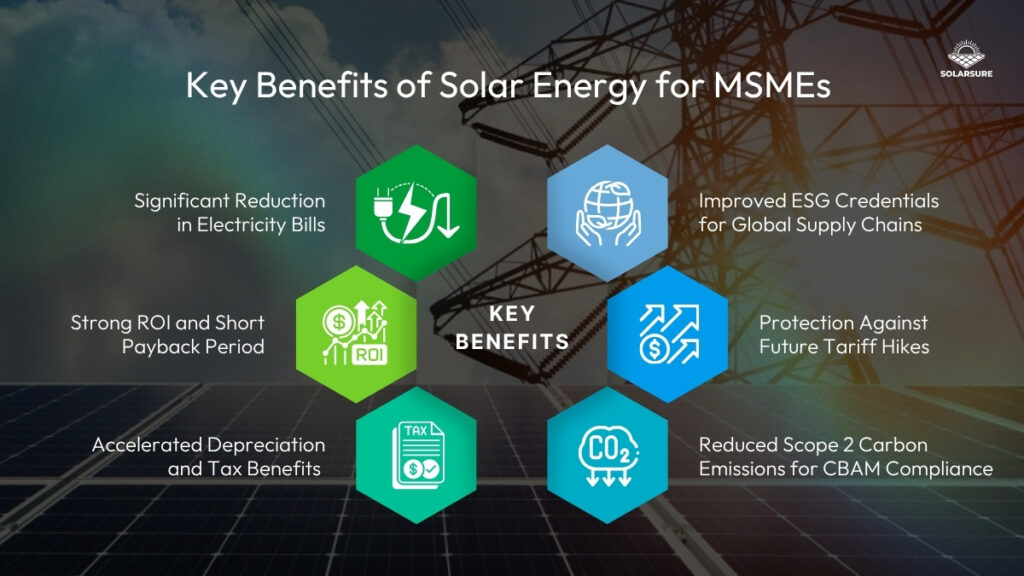
Solar is not just an energy decision for the MSMEs. It is a strategic business decision that positively impacts your costs, your compliance posture, your supply chain relationships, and your long-term resilience. Here are the key benefits that make solar compelling for Indian MSMEs specifically.
Significant Reduction in Electricity Bills
Commercial rooftop solar can reduce your electricity bill by up to 70%. An MSME spending ₹5 lakh per month on electricity can save ₹3.5 lakh every month, or ₹42 lakh per year.
Over the 25-year life of the plant, the cumulative savings, adjusted for annual tariff increases from your DISCOM, can run into several crores. This is not a marginal improvement, but it is a transformation in your cost structure that directly improves your operating margins.
Strong ROI and Short Payback Period
Commercial rooftop solar delivers a return on investment of 25% to 40% with a payback period of just 3 to 5 years. Under a CAPEX model, the average IRR is around 20%, which outperforms most fixed-income instruments and many business reinvestment options. Once the payback period is complete (usually in 3-5 years), the remaining 20-plus years of plant life generate nearly free electricity. For MSMEs focused on long-term profitability, few investments offer this combination of safety, certainty, stability, and return.
Accelerated Depreciation and Tax Benefits
Solar plants qualify for 40% accelerated depreciation in Year 1 under the Income Tax Act. For a profitable MSME in a 25% tax bracket, this can reduce the effective cost of a ₹1 crore solar plant by ₹10 lakh or more in the first year alone. When combined with input tax credit on GST paid during procurement, the tax benefits of a solar investment can be substantial. Make sure your financial model and your chartered accountant account for these benefits explicitly.
Improved ESG Credentials for Global Supply Chains
International buyers, particularly from the EU, the UK, the US, and Japan, are increasingly requiring their Indian suppliers to demonstrate measurable progress on sustainability. ESG audits, supply chain carbon disclosures, and CBAM compliance are becoming standard requirements for export-oriented MSMEs. Solar directly reduces your Scope 2 emissions, which is the category most scrutinised by global buyers and ESG rating agencies. A solar-powered facility is a credible, verifiable sustainability credential that can help you retain existing contracts and win new ones.
Protection Against Future Tariff Hikes
DISCOM tariffs in India have increased by 5% to 8% annually on average over the last decade. There is no reason to expect this trend to reverse. Every unit of electricity you generate from your own solar plant is a unit you do not buy from the DISCOM, which means you are insulated from future tariff increases on that portion of your consumption. As grid tariffs rise over the next 25 years, the value of your solar plant’s output grows proportionally, which makes your investment more valuable over time.
Reduced Scope 2 Carbon Emissions for CBAM Compliance
The EU’s Carbon Border Adjustment Mechanism is already affecting Indian exporters. CBAM imposes a carbon price on imported goods from sectors with high emissions intensity. For MSMEs exporting to the EU, reducing Scope 2 emissions through solar is not just an environmental action, but it is a direct cost mitigation strategy. Every unit of electricity you replace with solar reduces the carbon liability that CBAM would otherwise impose on your exported goods. MSMEs that act early will be better positioned than competitors who wait.
Common Mistakes MSMEs Should Avoid While Adopting Solar
Skipping the Energy Audit and Site Survey
Many MSMEs request solar quotes without first conducting a proper energy audit or site survey. This leads to incorrectly sized systems, inaccurate financial projections, and proposals that do not reflect the actual constraints of your rooftop. The energy audit and site survey are not formalities for MSMEs, but they are the technical foundation of your entire investment decision. Never skip them, regardless of how credible the vendor appears.
Choosing a Vendor Based Only on Price
The cheapest solar quote in India almost always involves compromises on panel quality, inverter grade, civil workmanship, or after-sales support. A system that underperforms by 10% every year for 25 years costs you far more than the small amount you saved upfront. Evaluate vendors on the quality of their components, the depth of their references, and the credibility of their O&M commitments, not on who quoted the lowest number.
Not Verifying Panel and Inverter Specifications
Before signing any EPC agreement, get the make, model, efficiency rating, product warranty, and performance warranty of every major component in writing. Then independently verify these specifications. Some vendors specify premium brands during the sales process and substitute cheaper alternatives during procurement. Written contractual commitments to specific components are your protection against this.
Ignoring Net Metering and State-Level Policy Details
Net metering rules, export limits, banking provisions, and settlement rates vary significantly across Indian states. A financial model built on incorrect net metering assumptions can overstate your savings by 15% to 25%. Before finalising your investment, understand the exact net metering policy applicable in your state and ensure your financial model accurately reflects it.
Treating O&M as Optional After Installation
O&M is not optional. It is the activity that keeps your plant generating at projected levels across its 25-year life. Panels that are not cleaned regularly, inverters that are not monitored, and underperforming strings that are not identified promptly all translate directly into lost savings. Budget for proper O&M from Day 1 and include performance benchmarks in your O&M agreement.
Designing for Current Load Without Planning for Growth
If your business is growing, your electricity demand will grow with it. A solar system designed only for your current load may be inadequate within three to five years. Ask your EPC partner to design with future expansion in mind. The incremental cost of oversizing the structure and cabling at the time of initial installation is minimal compared to the cost of retrofitting those elements later.
Checklist to Adopt Solar for MSMEs
Use this checklist before committing to any solar project agreement.
- Select a financial model, such as CAPEX, OPEX, or Green Open Access
- Solar site survey completed with a detailed shadow analysis report
- 12-month energy consumption data reviewed and system sized accordingly
- Year-by-year ROI and cash flow projection reviewed and understood
- State-level net metering policy confirmed and reflected in the financial model
- Accelerated depreciation and GST input credit factored into project economics
- Government schemes and financing options explored — SIDBI, PM Kusum, EESL
- EPC partner references verified through direct calls with past clients
- Panel make, model, efficiency, and warranty confirmed in writing
- Inverter make, model, and topology confirmed in writing
- All required approvals identified — DISCOM NOC, CEIG, SLDC, structural certificate
- Approval timelines mapped and parallel-tracked with equipment procurement
- O&M agreement reviewed with clear performance benchmarks included
- Monitoring platform access confirmed and tested before commissioning
Bottom Line
Solar adoption is no longer a future ambition for Indian MSMEs. It is a present business decision with clear financials, proven technology, and a growing support ecosystem of financing, policy, and experienced EPC partners.
The businesses that will benefit most are the ones that approach it with a structured plan. Follow this roadmap, conduct your due diligence at every step, ask the hard questions before signing anything, and work with an EPC partner who has demonstrated results in your sector and your state.
If you want to understand what solar can specifically deliver for your facility, including the system size, the projected savings, the approvals required, and the right model for your situation, book a free consultation. We will assess your space, model your financials, and walk you through every step of the process.