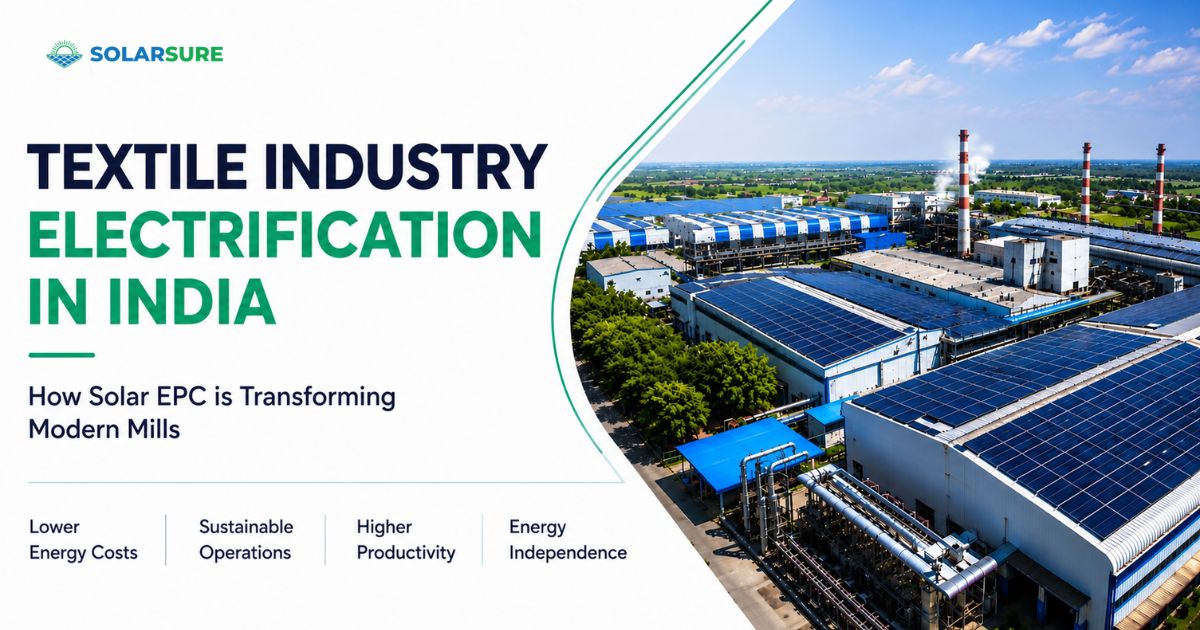
Textile Industry Electrification in India is transforming how manufacturers reduce energy costs, improve operational efficiency, and achieve sustainability goals. As electricity remains one of the largest operating expenses for textile mills, businesses are increasingly adopting Solar EPC solutions to generate clean, reliable, and cost-effective power. This shift is helping manufacturers improve profitability while meeting the growing demand for sustainable production.
Solar Engineering, Procurement, and Construction (Solar EPC) has become an important part of this transformation. Rooftop, ground-mounted, and captive solar installations help textile mills reduce dependence on conventional power sources while gaining greater control over electricity costs. Beyond lowering energy expenses, solar power improves operational stability and reduces carbon emissions. It also helps textile manufacturers meet the sustainability expectations of global brands such as H&M, Zara, and Nike. In addition, evolving regulations like the EU’s Corporate Sustainability Reporting Directive (CSRD) are increasing the focus on supply-chain emissions and renewable energy adoption.
What Is Textile Industry Electrification?
Textile industry electrification means replacing conventional energy sources with electricity-based systems. These systems often use renewable energy such as solar power. Energy can account for 30–40% of a textile mill’s operating costs in India. Electrification helps manufacturers reduce energy expenses, improve efficiency, and support sustainable manufacturing.
| 30-40% | 20-30% | 25+ Years | ₹3.5-5.0/kWh |
| Share of energy costs in textile manufacturing operations | Potential reduction in electricity expenses with solar EPC | Expected operational life of a solar power system | Typical solar power cost compared to grid tariffs |
Industry estimates based on reports from the Ministry of New & Renewable Energy (MNRE)
Source: Industry estimates based on textile sector energy studies and reports from the Bureau of Energy Efficiency(BEE) and Ministry of Textiles Government of India
Why Is Textile Industry in India Need Electrification?
India’s textile industry is a major contributor to the national economy. It is also one of the most energy-intensive manufacturing sectors. Processes such as spinning, weaving, dyeing, and finishing require large amounts of electricity.
Rising energy costs are creating new challenges for textile manufacturers. Energy can account for 30–40% of a textile mill’s operating costs, making electricity a major expense. In textile clusters such as Surat, Tirupur, and Ludhiana, manufacturers are exploring electrification solutions to improve efficiency and lower energy costs.
1. Rising Energy Costs and Operational Challenges
Electricity is one of the largest operating expenses for textile mills. Industrial electricity tariffs vary significantly across states for example, Maharashtra’s HT tariff is around ₹12/unit, while Karnataka’s is approximately ₹6.60/unit. Rising tariffs, fuel price fluctuations, and unreliable power supply increase production costs and affect profitability, making energy cost management a key priority for textile manufacturers.
Electrification offers a practical solution to these challenges. When combined with renewable energy, it can reduce electricity costs. It also improves power reliability and supports better cost control over the long term.
2.Sustainability and Global Market Demands
Global buyers and regulators are increasing sustainability requirements for textile manufacturers. SEBI’s Business Responsibility and Sustainability Reporting (BRSR) framework requires India’s top 1,000 listed companies to disclose Scope 2 emissions, while the EU Corporate Sustainability Reporting Directive (CSRD) increases demand for emissions data across global supply chains. In addition, India’s grid emission factor is approximately 0.71 kg CO₂/kWh (CEA), making solar adoption an effective way to reduce emissions, strengthen ESG performance, and improve competitiveness.
What Is Solar EPC and How Solar EPC Supports Textile Industry Electrification in India?
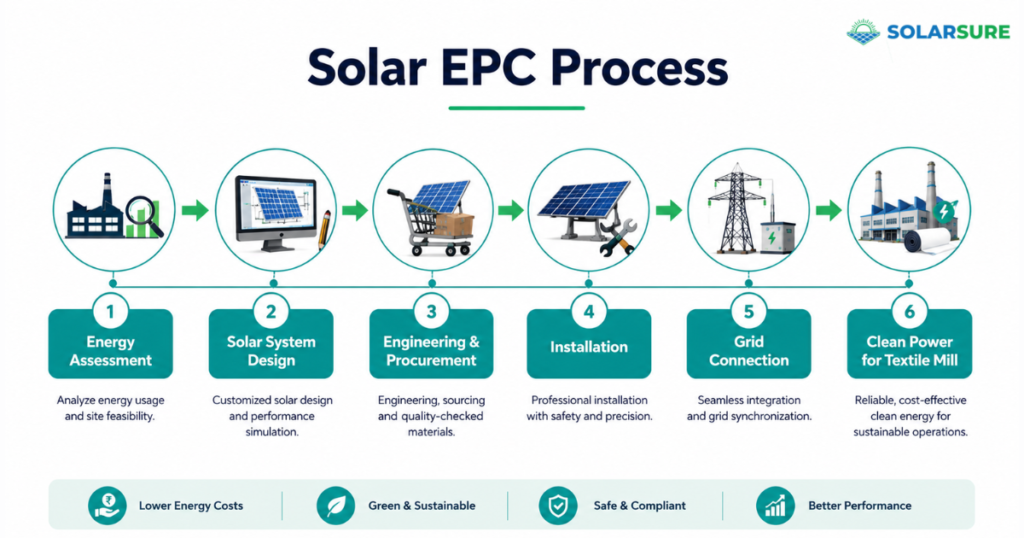
Solar EPC stands for Engineering, Procurement, and Construction. It provides complete solutions for designing, sourcing, installing, and commissioning solar power systems.
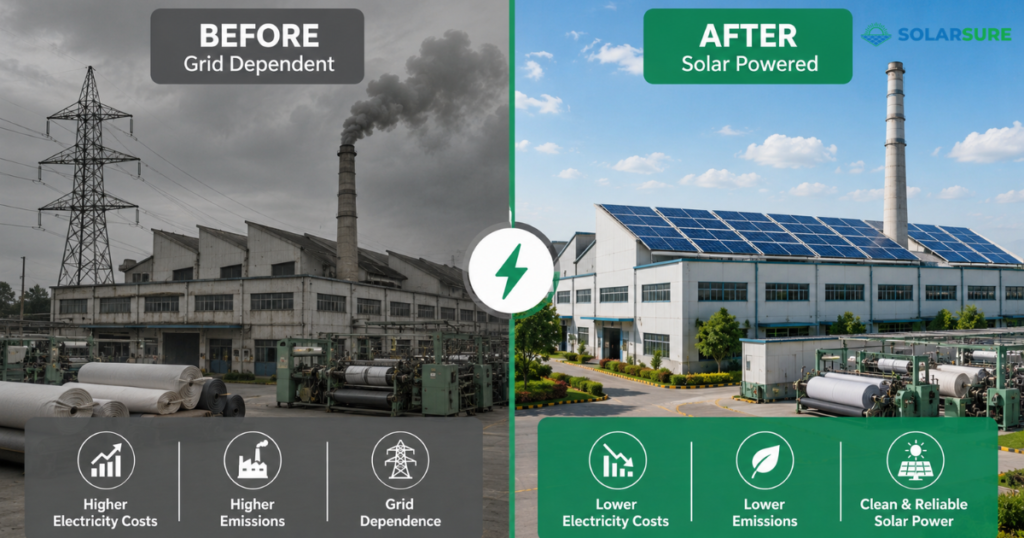
For textile manufacturers, Solar EPC simplifies the transition to clean energy. As a result, it helps mills generate their own electricity and reduce dependence on grid power. Consequently, manufacturers benefit from lower energy costs and improved operational efficiency. Moreover, Solar EPC supports long-term sustainability goals through reliable renewable energy integration.
📖 You can also read: What is Solar EPC and How It Works: Explained Step-by-Step Process
How Much Electricity Do Textile Mills Consume in India?
Textile mills consume large amounts of electricity throughout the production process. For example, a 500-kW spinning mill typically consumes around 3.6 lakh units (kWh) of electricity per month, while a large integrated textile mill can have a connected load exceeding 2 MW. Energy is required for spinning, weaving, knitting, dyeing, printing, and finishing operations.
Electricity demand is especially high in processing units, where heating, cooling, and continuous machine operation are essential. As production often runs 24/7, a reliable and cost-effective power supply is critical for maintaining productivity and profitability. This is one reason why many textile manufacturers are investing in electrification and solar energy solutions.
Why Are Textile Manufacturers Investing in Textile Industry Electrification?
Textile manufacturers are increasingly adopting solar energy to address rising electricity costs and meet sustainability goals. According to Mercom India, India’s solar open access capacity reached approximately 7.8 GW in 2025, reflecting the rapid adoption of renewable energy by commercial and industrial consumers. Solar power offers a cost-effective and reliable source of electricity, helping businesses reduce energy costs while supporting long-term growth. Source: Q4 & Annual 2025 India Solar Open Access Market Report – 7.8 GW Installed In 2025
1.Reducing Energy Costs and Improving Profitability
Electricity is one of the largest operating expenses for textile mills. For example, a mill consuming 10 lakh units per month would pay nearly ₹1.2 crore more annually if electricity tariffs increased by ₹1 per unit. As a result, solar power helps reduce grid dependence, stabilize energy costs, and improve profitability.
2.Achieving Sustainability Goals and Energy Security
Sustainability is a growing priority for textile manufacturers as global brands such as H&M, Zara (Inditex), and Marks & Spencer strengthen supplier requirements. Additionally, frameworks like the High Index and EU CSRD encourage lower carbon emissions. As a result, solar power helps textile mills reduce emissions, improve ESG performance, and strengthen their competitive position.
How Much Can Textile Industry Electrification Save Textile Mills?
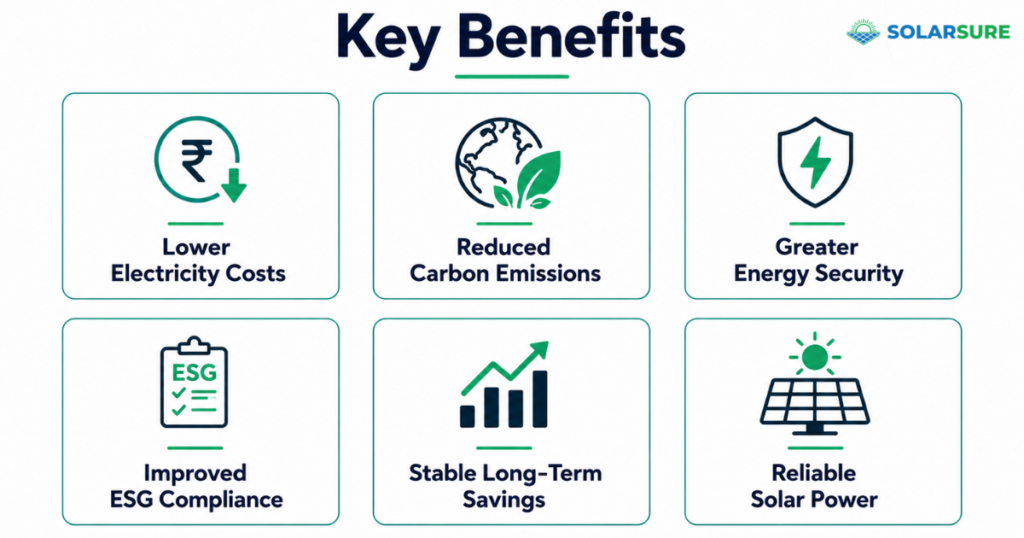
Solar EPC projects help textile mills reduce electricity costs by generating clean energy on-site. For example, a 500-kW group captive solar plant in Gujarat can save approximately ₹65–70 lakh annually, assuming an HT tariff of around ₹9 per unit compared with a landed solar power cost of about ₹3.40 per unit. By reducing dependence on grid electricity, solar energy delivers predictable operating costs, improves profitability, and provides long-term financial benefits.
1.Electricity Bill Savings
Electricity is a major operating expense for textile manufacturers. For example, a 500 kW group captive solar plant generating approximately 7.25 lakh units annually can save around ₹65 lakh per year, assuming an HT tariff of ₹9 per unit. By reducing reliance on expensive grid electricity, solar power helps mills lower energy costs and improve long-term profitability.
2.Payback Period and Return on Investment (ROI)
Most industrial solar projects achieve payback within three to six years. After the payback period, businesses continue to benefit from low-cost electricity for many years.
A well-designed solar system can operate for more than 25 years. This makes Solar EPC a cost-effective investment for textile manufacturers seeking long-term savings and energy security.
 You can also read: How Do Solar EPC Services Help Commercial and Industrial Businesses Save Energy Costs?
What Challenges Do Textile Mills Face During Electrification?
The upfront investment for a 500-kW solar plant is typically ₹1.85–2.20 crore, which can be a concern for textile manufacturers. However, financing options such as SIDBI’s 4E Green Finance Scheme help reduce the financial burden, and in many cases, monthly loan repayments are lower than the savings on electricity bills. Experienced Solar EPC providers also simplify project implementation and integration with existing systems.
Group Captive and Open Access Solar Models for Textile Industry Electrification
Group Captive and Open Access models allow textile mills to use solar energy without installing on-site solar systems. These models provide access to renewable power while reducing upfront investment requirements.
1. Group Captive Solar Model
In a Group Captive model, multiple businesses jointly own a solar power plant. As a result, each participant receives electricity from the project at a lower cost. This model helps textile manufacturers reduce electricity expenses and improve energy cost predictability. Additionally, group captive consumers are exempt from the Cross-Subsidy Surcharge (CSS), saving approximately ₹0.60–₹2.11 per unit, depending on the state.
2. Open Access Solar Model
Open Access allows textile mills to purchase renewable electricity directly from off-site solar projects. The power is delivered through the existing grid network. This model provides access to clean energy while helping businesses reduce electricity costs by up to 62%, with landed solar power costs of around ₹3.40 per unit compared to grid tariffs of approximately ₹9 per unit, while supporting sustainability goals.
Rooftop vs. Ground-Mounted Solar for Textile Industry Electrification in India
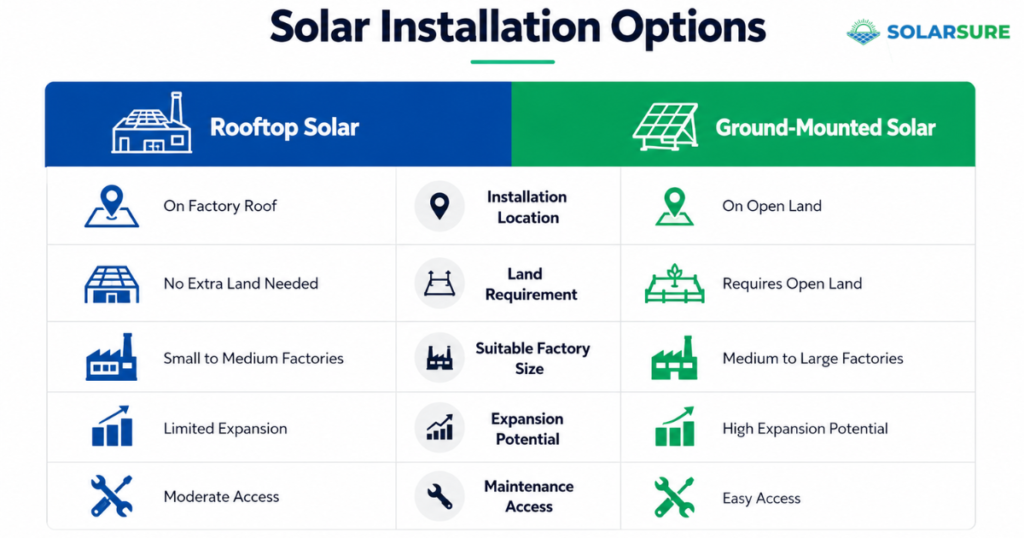
| Feature | Rooftop Solar | Ground-Mounted Solar |
| Installation Location | Factory rooftops | Open land near or away from the mill |
| Land Requirement | No additional land needed | Requires dedicated land |
| System Capacity | Suitable for small to medium capacities | Ideal for large-scale installations |
| Installation Cost | Generally lower (30,000–38,000/kW) | Higher due to land and infrastructure needs (Rs 40,000–50,000/kW) |
| Scalability | Limited by available roof space | Easily expandable |
| Maintenance Access | More challenging on rooftops | Easier access for maintenance |
| Best For | Mills with large unused roof areas | Mills with high energy demand and available land |
| Key Benefit | Maximizes existing space utilization | Delivers higher power generation potential |
Environmental Benefits of Textile Industry Electrification in India
Solar-powered textile manufacturing reduces the environmental impact of industrial operations by replacing fossil fuel-based electricity. Based on the Central Electricity Authority’s grid emission factor of 0.71 kg CO₂/kWh, a 500-kW solar plant generating 7.25 lakh units annually can avoid approximately 515 tonnes of CO₂ emissions each year. This helps textile mills achieve ESG goals while accelerating India’s transition toward clean energy.
Government Policies Driving Textile Industry Electrification in India
Government policies such as Section 32 (Accelerated Depreciation), GST Input Tax Credit, the Green Energy Open Access Rules, 2022, SEBI’s BRSR framework, and Renewable Purchase Obligation (RPO) targets are accelerating industrial solar adoption. As a result, textile manufacturers can improve project economics while advancing their sustainability goals.
| Policy | Official Source |
| Green Energy Open Access Rules, 2022 (100 kW threshold) | Ministry of Power – Green Energy Open Access Rules, 2022 (Press Information Bureau) |
| Section 32 of the Income-tax Act (Depreciation) | Income-tax Act – Section 32 (Etds) |
| SEBI Business Responsibility and Sustainability Reporting (BRSR) | SEBI BRSR Framework |
| Renewable Purchase Obligation (RPO) Trajectory (43.33% by FY2029–30) | Ministry of Power – Renewable Purchase Obligation Trajectory Order |
| GST Input Tax Credit (ITC) | CBIC – GST Portal (Input Tax Credit) |
1.Financial Incentives for Industrial Solar
Textile manufacturers can benefit from Section 32 Accelerated Depreciation, GST Input Tax Credit (ITC), and SIDBI’s 4E Green Finance Scheme, which help reduce upfront costs and improve project returns.
2.Open Access and Captive Power Policies
Open Access and Captive Power policies allow industries to procure renewable energy from off-site solar projects. These models provide access to clean electricity at competitive rates.
As a result, businesses can reduce dependence on conventional power sources and manage energy costs more effectively.
3. Renewable Energy Targets and Green Manufacturing
India has set ambitious renewable energy goals to promote sustainable development. As a result, these targets encourage industries to adopt clean energy solutions and reduce carbon emissions. Consequently, by investing in solar power, textile manufacturers can align with national sustainability objectives and support low-carbon manufacturing practices.
How Are Indian Textile Mills Benefiting from Solar Energy?
Indian textile manufacturers are increasingly adopting rooftop solar to reduce electricity costs and emissions. For example, Arvind Ltd. installed a 16.2 MW rooftop solar plant at its Santej facility in Gujarat, generating approximately 22 million kWh of clean electricity annually and reducing carbon emissions by around 20,000 tonnes each year. The project demonstrates how large-scale solar adoption can lower energy costs while supporting long-term sustainability goals.
Source: Arvind’s 16.2 MW rooftop solar project at Santej, Gujarat.
What Is the Future of Textile Industry Electrification in India?
India’s textile industry is increasingly adopting renewable energy to improve efficiency and reduce costs. Advances in solar technology, energy storage, and smart energy management are accelerating this transition. As energy costs rise, more textile mills will invest in solar, supporting lower carbon emissions and greater competitiveness. India’s target of 500 GW of non-fossil fuel capacity by 2030 further reinforces this shift.
Frequently Asked Questions (FAQs)
What Is the Minimum Load Required for Green Energy Open Access in India?
Under the Green Energy Open Access Rules, 2022, consumers with a contract demand or sanctioned load of 100 kW or more are eligible to procure renewable energy through the Green Energy Open Access framework, subject to applicable state regulations. As a result, eligible textile manufacturers can access lower-cost renewable power through open access arrangements.
What Is Solar EPC in the Textile Industry?
Solar EPC stands for Engineering, Procurement, and Construction. It covers the complete process of designing, sourcing, installing, and commissioning solar power systems. In addition, Solar EPC helps textile manufacturers transition to clean and cost-effective energy solutions.
How Does Solar EPC Reduce Energy Costs for Textile Mills?
Solar EPC enables textile mills to generate electricity on-site. This reduces dependence on grid power and lowers monthly electricity expenses. It also protects businesses from rising energy tariffs and provides long-term cost savings.
Which Textile Manufacturing Processes Consume the Most Electricity?
Spinning, weaving, knitting, dyeing, printing, and finishing are among the most energy-intensive textile processes. As a result, these operations require continuous machine usage and high power consumption, making reliable electricity essential for efficient production. Consequently, many textile manufacturers are investing in renewable energy solutions to improve energy efficiency and reduce operating costs.
What Are the Environmental Benefits of Solar-Powered Textile Manufacturing?
Solar energy helps reduce carbon emissions and decreases reliance on fossil fuels. For example, based on the Central Electricity Authority’s grid emission factor of 0.71 kg CO₂/kWh, a 500 kW solar plant generating 7.25 lakh units annually can avoid approximately 515 tonnes of CO₂ emissions each year. As a result, textile manufacturers can improve their environmental performance and achieve their sustainability and ESG goals.
Which Is Better for Textile Mills: Rooftop or Ground-Mounted Solar?
The best option depends on available space and energy requirements. Rooftop solar systems use existing roof space and require no additional land. Ground-mounted solar systems offer higher capacity and are ideal for mills with large energy demands.
What Is the Typical Payback Period for a Solar EPC Project?
Most industrial solar projects achieve payback within three to six years. The exact period depends on factors such as system size, electricity consumption, local energy tariffs, and project configuration.
What Is the Future of Textile Industry Electrification in India?
The future of textile industry electrification will be driven by renewable energy, energy storage, and smart energy management. India aims to achieve 500 GW of non-fossil fuel power capacity by 2030, while the Renewable Purchase Obligation (RPO) target is set to reach 43.33% by FY2029–30. These initiatives will help textile manufacturers reduce energy costs, improve efficiency, and remain competitive in global markets.
Can Textile Mills Use Solar Power Without Installing On-Site Systems?
Yes. Textile mills can access solar energy through Group Captive and Open Access models. These options allow businesses to purchase renewable electricity from off-site solar projects without installing solar panels at their facilities.
How Much Can Textile Mills Save with Solar Energy?
Textile mills can significantly reduce electricity expenses by switching to solar power. Savings vary by project size and energy consumption. Many businesses achieve lower operating costs and benefit from predictable energy pricing over the long term.
How Does Textile Industry Electrification Help Achieve Sustainability Goals?
Textile industry electrification reduces greenhouse gas emissions, increases the use of renewable energy, improves energy efficiency, and supports compliance with global environmental standards. It also strengthens the sustainability credentials of textile manufacturers serving international markets.
Why Is Textile Industry Electrification Important for Indian Manufacturers?
Textile industry electrification helps manufacturers lower energy costs, reduce carbon emissions, and improve operational efficiency. It also enables textile exporters to comply with global sustainability standards and meet the environmental expectations of international buyers.
Bottom Line
India’s textile industry is moving toward cleaner and more efficient operations. Rising electricity costs are encouraging mills to adopt renewable energy solutions. As a result, Solar EPC helps manufacturers generate clean electricity and reduce operating expenses. Additionally, it improves energy security and supports sustainability goals.
Textile mills can choose from rooftop, ground-mounted, group captive, or open-access solar models. Each option offers long-term cost savings and environmental benefits.
Looking ahead, more textile mills will adopt solar as energy costs rise. To support this transition, Solarsure helps textile manufacturers with end-to-end Solar EPC solutions, from feasibility assessment to commissioning, enabling lower energy costs and long-term savings. Contact Solarsure today to get a site-specific solar assessment.