Rooftop solar panel maintenance protects generation, safety, and long-term investment returns. Dust, debris, loose connections, and hidden faults can reduce performance gradually. However, many building owners notice problems only after generation drops significantly. Therefore, planned maintenance prevents avoidable losses and costly equipment failures.
Solar panels have no moving parts, yet they still need care. Cleaning alone cannot ensure safe and reliable solar plant performance. Moreover, inverters, cables, structures, earthing, and protection devices require inspections. Regular monitoring also detects unusual changes before they cause major failures.
This guide explains maintenance schedules, cleaning methods, safety checks, and monitoring. It also covers common mistakes, costs, challenges, and expert recommendations. In addition, verified examples will show how organizations maintain solar assets. These practices can improve reliability and support longer solar plant lifespans.
What Is Rooftop Solar Panel Maintenance?
Rooftop solar panel maintenance includes cleaning, inspections, monitoring, and timely repairs. It covers panels, inverters, cables, structures, earthing, and protection equipment. Therefore, proper maintenance supports safe and consistent solar plant performance.
Maintenance can be preventive, corrective, or performance-based. Preventive work addresses risks before equipment fails or generation declines. Meanwhile, corrective maintenance repairs faults after teams identify a specific problem. Performance-based maintenance uses monitoring data to find unexpected generation losses.
The U.S. Department of Energy studied 75 federal solar PV installations across 16 agencies. Its analysis compared actual generation against modelled solar plant performance. Moreover, the report highlights maintenance’s role in optimising ageing PV assets. This approach shows why data-based maintenance matters across large solar portfolios.
How Often Should Rooftop Solar Panels Be Maintained?
Rooftop solar maintenance frequency depends on location, weather, and plant size. Dusty industrial areas may require more cleaning than cleaner urban rooftops. Therefore, teams should use performance data instead of fixed cleaning dates.
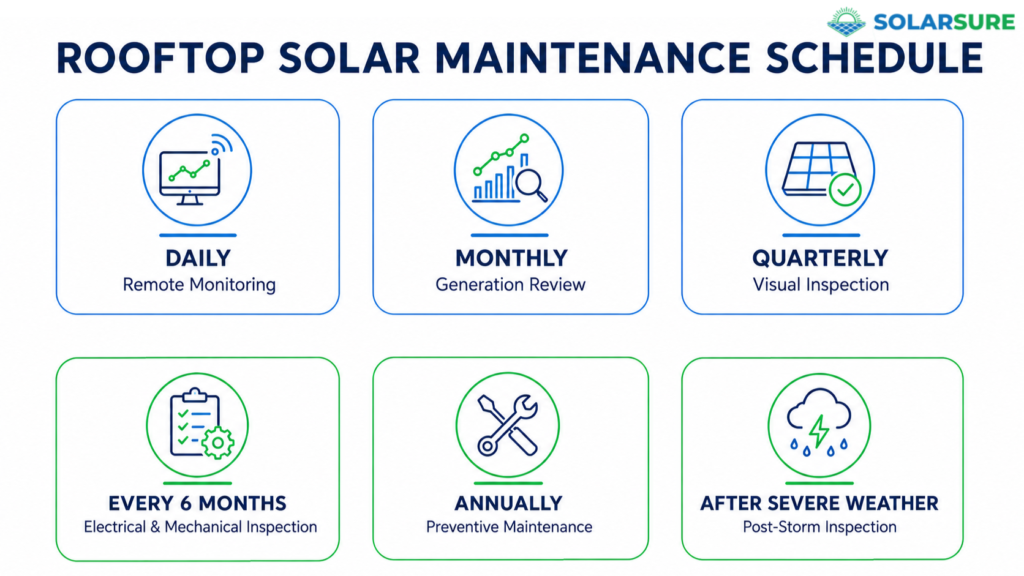
| Maintenance Activity | Suggested Frequency | Purpose |
| Remote Performance Monitoring | Daily or continuous | Detects faults and unusual generation changes |
| Generation Review | Monthly | Compares actual output against expected performance |
| Panel Cleaning | Condition-based | Removes dust, droppings, leaves, and other deposits |
| Visual Site Inspection | Quarterly | Identifies damage, debris, shading, and drainage problems |
| Electrical and Mechanical Inspection | Every six months | Checks cables, connectors, fasteners, and protection devices |
| Comprehensive Preventive Maintenance | Annually | Tests complete solar plant safety and operating performance |
| Post-Storm Inspection | After severe weather | Identifies water, wind, debris, or structural damage |
This schedule provides a practical baseline, not a universal requirement. Manufacturers, EPC partners, and O&M contracts may specify different intervals. Moreover, coastal, dusty, or high-rainfall locations need customised maintenance plans.
Sandia National Laboratories analysed 55,000 maintenance records across 880 PV sites. The study examined common inverter failure patterns across operating solar plants. Consequently, maintenance schedules should reflect actual fault history and equipment behaviour. This data-led approach improves planning across larger rooftop solar portfolios.
How Should Rooftop Solar Panels Be Cleaned Safely?
Solar panels need gentle cleaning methods that protect glass and coatings. Incorrect tools can scratch surfaces, weaken seals, or create electrical hazards. Therefore, trained professionals should manage cleaning across commercial rooftop solar plants.
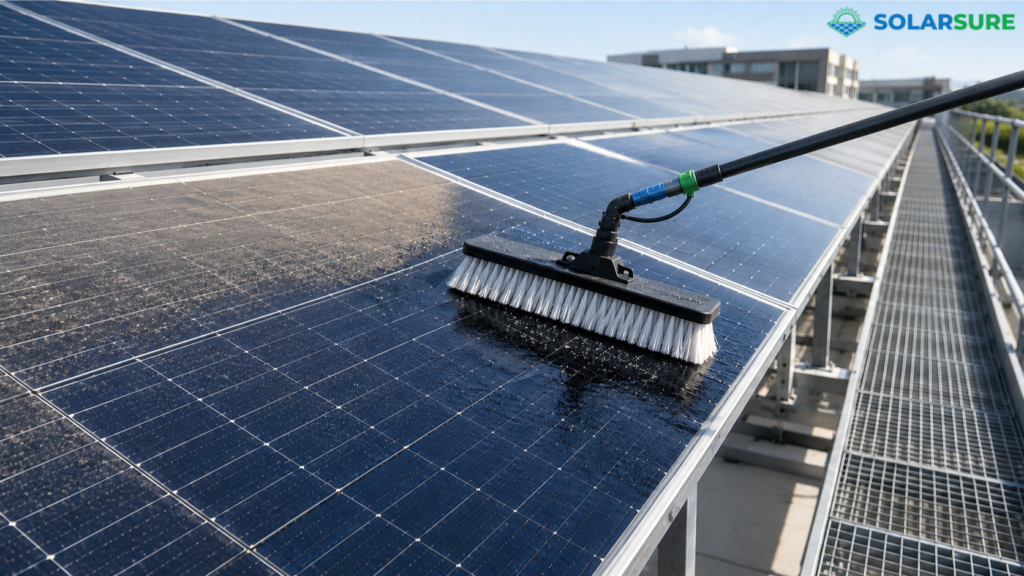
Step-by-Step Solar Panel Cleaning Process
- Review performance before cleaning: Confirm whether soiling affects generation noticeably.
- Inspect rooftop conditions: Check weather, access routes, drainage, and fall hazards.
- Follow shutdown procedures: Isolate equipment according to manufacturer and EPC instructions.
- Use suitable cleaning tools: Choose soft brushes, clean water, and approved equipment.
- Remove loose deposits carefully: Clear leaves and debris without damaging cables.
- Wash panels gently: Avoid heavy pressure near frames, seals, and connectors.
- Inspect cleaned modules: Check glass, frames, clamps, wiring, and visible defects.
- Restart and verify output: Follow procedures and confirm normal solar plant operation.
Cleaning Practices to Avoid
- Walking, sitting, or placing heavy equipment upon solar panels
- Using abrasive brushes, blades, powders, or harsh chemical cleaners
- Spraying high-pressure water directly near seals and electrical connections
- Cleaning hot panels with very cold water during peak sunlight
- Allowing untrained workers near live electrical equipment or rooftop edges
- Cleaning without fall protection, safe access, and proper supervision
A Bhubaneswar rooftop solar study examined seasonal soiling losses at a university building. Researchers found stronger dust-related losses during non-monsoon operating periods. Meanwhile, rainfall reduced accumulated soiling during the monsoon season. This example supports location-specific cleaning instead of rigid universal schedules.
What Should a Complete Rooftop Solar Inspection Cover?
Complete maintenance extends far beyond washing the solar panels. Technicians must inspect electrical, mechanical, structural, and monitoring components. Moreover, rooftop drainage and safe access areas require regular attention.
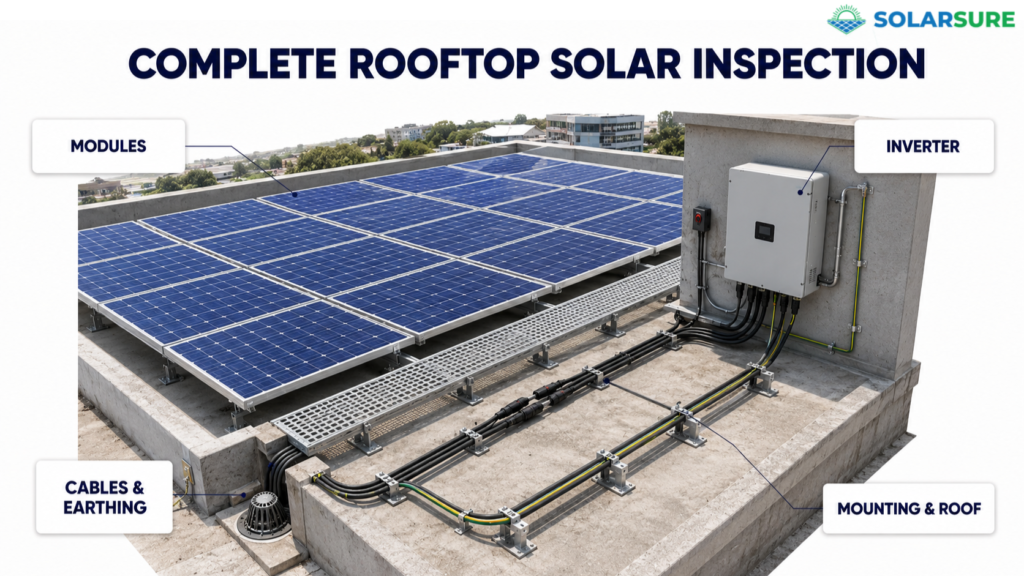
| Component | What Technicians Should Check | Common Warning Signs |
| Solar Modules | Glass, frames, seals, shading, and visible damage | Cracks, discolouration, hotspots, or uneven output |
| Mounting Structure | Clamps, bolts, corrosion, alignment, and roof attachments | Loose panels, rust, movement, or unusual vibration |
| DC Cables | Insulation, routing, supports, connectors, and animal damage | Exposed wires, loose cables, melting, or burn marks |
| Inverter | Alarms, ventilation, filters, temperature, and operating data | Frequent tripping, overheating, noise, or fault codes |
| AC Equipment | Breakers, panels, terminals, and cable connections | Heating, nuisance tripping, odour, or discolouration |
| Earthing System | Continuity, connections, corrosion, and earth resistance | Loose terminals, damaged conductors, or poor readings |
| Protection Devices | Surge protection, isolators, fuses, and lightning protection | Failure indicators, damaged enclosures, or repeated faults |
| Monitoring System | Sensors, meters, communication, and recorded generation | Missing data, inaccurate readings, or communication loss |
| Rooftop Area | Drainage, waterproofing, walkways, and surrounding debris | Waterlogging, leakage, blocked routes, or vegetation growth |
Technicians should record findings with photographs, readings, and corrective actions. Therefore, every inspection creates a useful long-term maintenance history. These records also support warranty claims and future performance investigations.
The German 1000-Roofs Programme recorded several causes of low solar yield. These included inverter failures, partial shading, soiling, and faulty connections. Consequently, panel cleaning alone cannot protect complete solar plant performance. This real-world programme demonstrates the value of comprehensive inspections.
How Does Monitoring Improve Rooftop Solar Maintenance?
Digital monitoring tracks generation, inverter operation, and solar plant availability continuously. It helps teams identify unusual changes before physical inspections occur. Therefore, businesses can respond faster and reduce avoidable generation downtime.
Important Performance Indicators to Monitor
- Daily, monthly, and annual electricity generation
- Actual output compared with expected solar production
- Inverter status, alarms, temperature, and operating hours
- String-level current and voltage, where monitoring supports them
- Solar plant availability and recorded downtime
- Grid interruptions and repeated inverter tripping
- Communication failures across meters, sensors, and dashboards
- Sudden or gradual generation changes across comparable periods
However, weather changes can also influence daily solar generation. Teams should compare output with irradiance, temperature, and historical patterns. Moreover, repeated alarms need root-cause analysis instead of simple inverter restarts.
Enel Green Power uses thermal-imaging drones for photovoltaic inspections. The drones collect panel temperature data across large solar installations. Consequently, technicians can locate abnormal heating and target inspections efficiently. This approach shows how digital tools make solar maintenance more precise.
📊 Related Guide: Understand How an Energy Management System Improves Monitoring
Common Rooftop Solar Faults and Warning Signs
Solar faults often appear through alarms, damage, or declining generation. However, early action can prevent downtime and expensive equipment repairs. Building owners should never open electrical equipment without trained professionals.
-
Unexpected Generation Drop
Dust, shading, damaged modules, or string faults can reduce output. First, compare current generation with weather-adjusted historical performance. Then, arrange testing if low production continues for several days.
-
Inverter Alarms or Frequent Tripping
Grid fluctuations, overheating, or internal faults may trigger inverter shutdowns. Therefore, record every fault code before contacting the maintenance team. Avoid repeatedly restarting equipment without identifying the underlying technical cause.
-
Cracked Panels or Hotspots
Impact, thermal stress, and manufacturing defects can damage solar modules. Warning signs include cracks, burn marks, or unusual discolouration. Consequently, qualified technicians should inspect affected modules using suitable diagnostic equipment.
-
Loose or Damaged Cables
Heat, rodents, weather, and poor routing can damage cable insulation. Moreover, loose connectors may create resistance, heating, or electrical arcing. Keep people away and report exposed wiring immediately.
-
Corroded or Loose Mounting Structures
Moisture and harsh conditions may corrode mounting system components. Loose clamps can also affect panel alignment and rooftop safety. Therefore, technicians should tighten fasteners according to approved torque requirements.
-
Waterlogging or Roof Leakage
Blocked drains may cause standing water around rooftop solar equipment. Meanwhile, damaged waterproofing can create leakage inside the commercial building. Clear drainage routes and inspect roof penetrations during scheduled maintenance.
-
Missing Monitoring Data
Communication failures can hide faults even while equipment remains operational. Check whether meters, sensors, and dashboards show complete information. However, technicians should investigate repeated data gaps and inaccurate readings.
-
New Shading Around Panels
Growing vegetation, nearby construction, or rooftop equipment may create shading. Even partial shade can reduce output from connected solar strings. Therefore, include shading reviews during every major rooftop inspection.
A kWh Analytics study examined nearly 6,000 commercial and utility-scale inverters. It identified inverter failures as a leading source of production losses. Consequently, recurring alarms require diagnosis instead of repeated manual restarts.
Seasonal Rooftop Solar Maintenance Checklist
Weather conditions change maintenance needs throughout the year. Therefore, one fixed routine cannot protect every rooftop solar plant. Businesses should adjust inspections according to local seasonal risks.
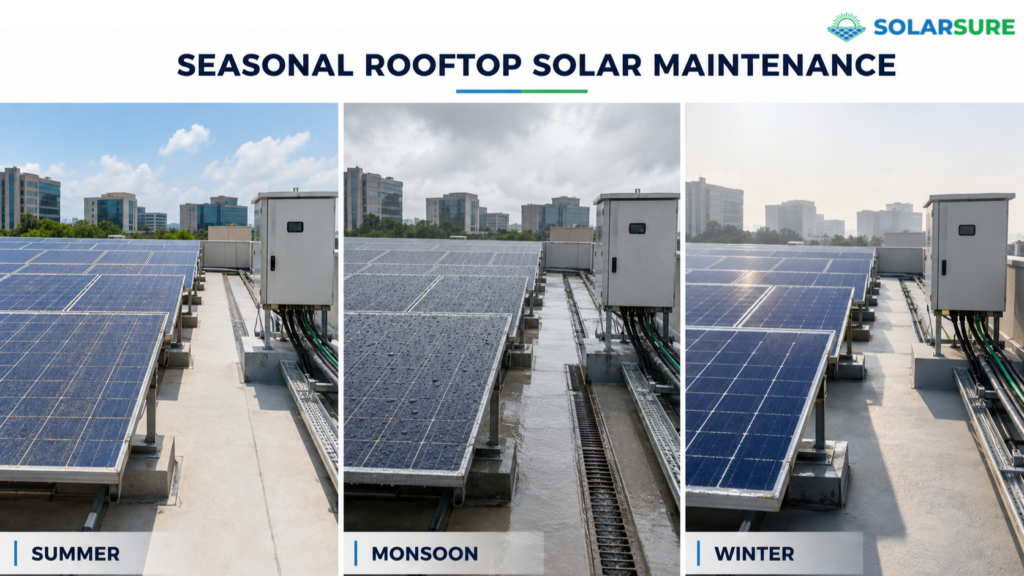
Summer Maintenance
High temperatures can increase stress upon inverters and electrical equipment. Therefore, technicians should clean ventilation openings and inspect inverter temperatures. They should also check cables for heat damage or discolouration.
Summer dust can accumulate quickly across commercial and industrial rooftops. However, cleaning should depend on measured generation losses and site conditions. Teams should avoid cleaning extremely hot panels during peak sunlight.
Monsoon Maintenance
Before monsoon, teams should clear drains, walkways, and nearby debris. Moreover, technicians must inspect cable glands, enclosures, and waterproof roof penetrations. Loose structures and corroded fasteners also require immediate corrective action.
After heavy rainfall, check monitoring data for unusual generation changes. However, workers should avoid wet rooftops until access becomes completely safe. Qualified teams must inspect waterlogging, leakage, and visible electrical damage.
Winter Maintenance
Winter haze, pollution, and dry dust may reduce available sunlight. Therefore, compare actual output against irradiance and seasonal generation estimates. Cleaning may help when data confirms significant and persistent soiling losses.
Technicians should also inspect morning condensation around electrical enclosures. Moreover, growing trees or nearby structures may create new seasonal shading. A shading review can identify problems missed during summer months.
Maintenance After Severe Weather
Storms can loosen panels, damage glass, and disturb electrical connections. Therefore, visually inspect the rooftop from a safe location first. Never restart visibly damaged equipment before qualified electrical testing.
The U.S. General Services Administration rebuilt a 469 kW solar array after Hurricane Maria caused major damage. Engineers studied the failure causes before redesigning the damaged installation. Consequently, the rebuilt array performed better during Hurricane Fiona. This case demonstrates how post-storm findings can improve future resilience.
Common Rooftop Solar Maintenance Mistakes to Avoid
Poor maintenance can damage equipment and create serious safety risks. Therefore, businesses should follow documented procedures and use trained professionals. The following mistakes often reduce rooftop solar plant reliability.
-
Cleaning Panels Without Performance Data
Frequent cleaning wastes water, labour, and maintenance budgets unnecessarily. Meanwhile, delayed cleaning may allow substantial soiling losses to continue. Use generation trends and site inspections before scheduling each cleaning.
-
Treating Maintenance as Panel Cleaning Only
Panels represent only one part of a rooftop solar plant. Inverters, cables, structures, earthing, and protection devices also require attention. Therefore, every maintenance plan should cover the complete installation.
-
Ignoring Small Inverter Alarms
Repeated alarms may indicate overheating, grid problems, or internal defects. Simply restarting the inverter can hide a developing technical issue. Instead, record fault codes and arrange professional diagnosis promptly.
-
Using Untrained Cleaning Workers
Solar modules continue generating electricity whenever they receive sufficient sunlight. Consequently, untrained workers can face electrical and rooftop fall hazards. Maintenance teams need suitable training, supervision, and protective equipment.
-
Using Harsh Chemicals or Abrasive Tools
Strong chemicals may affect glass coatings, seals, and module warranties. Similarly, hard brushes and blades can permanently scratch panel surfaces. Use only manufacturer-approved cleaning methods and suitable water quality.
-
Walking Directly Upon Solar Panels
Solar panels are not designed to support concentrated human weight. Walking upon them may create invisible cell cracks and frame damage. Therefore, workers should use designated walkways and safe access routes.
-
Delaying Minor Repairs
Loose cables, damaged connectors, and corrosion can worsen over time. Moreover, delayed repairs may increase downtime and future replacement costs. Assign deadlines and responsible teams for every corrective action.
-
Keeping Incomplete Maintenance Records
Missing records make recurring faults and warranty claims harder to manage. Each visit should document readings, photographs, repairs, and replaced components. Consequently, businesses can track equipment health throughout its service life.
Queensland’s Electrical Safety Office investigated a fatal incident involving solar panel modification. The investigation showed that extra-low-voltage solar equipment can still present serious hazards. Therefore, businesses should never allow unauthorised modifications or unsafe maintenance work.
How to Create a Preventive Maintenance Plan
A preventive maintenance plan defines tasks, schedules, responsibilities, and response times. Therefore, it replaces irregular maintenance with a consistent operating process. Businesses can follow these steps for better solar plant reliability.
Step 1: Collect Complete Project Documents
Gather drawings, datasheets, warranties, test reports, and commissioning records. Moreover, include inverter settings and protection system details. These documents provide the baseline for every future inspection.
Step 2: Assign Clear Maintenance Responsibilities
Identify responsible teams for monitoring, cleaning, inspections, and repairs. Also, define contacts for emergencies, warranties, and grid-related issues. Clear ownership prevents delays when the solar plant develops faults.
Step 3: Set Performance Benchmarks
Record expected monthly generation using approved project estimates. Then, compare actual output against weather and historical operating data. This process helps identify underperformance before losses become substantial.
Step 4: Prepare an Activity Schedule
Plan routine inspections around local weather and rooftop conditions. However, keep cleaning frequency flexible and dependent on measured soiling. Include additional inspections after storms, construction, or electrical shutdowns.
Step 5: Define Fault Response Times
Not every solar fault requires the same response priority. Therefore, classify issues as critical, urgent, or routine. Electrical hazards and complete shutdowns should receive immediate professional attention.
Step 6: Maintain Essential Spare Parts
Keep compatible fuses, connectors, protection devices, and communication components available. Moreover, confirm storage requirements and replacement approval procedures. Suitable spares can reduce downtime during urgent corrective maintenance.
Step 7: Record Every Maintenance Activity
Document inspection findings, electrical readings, photographs, and completed repairs. Additionally, record replaced components with serial numbers and warranty details. Accurate histories support analysis, audits, and warranty claims.
Step 8: Review the Plan Annually
Equipment age, site conditions, and fault patterns change over time. Therefore, review maintenance schedules using yearly performance and repair records. Update tasks whenever recurring problems or new risks emerge.
The U.S. Department of Energy recommends comprehensive PV operations and maintenance plans. Its guidance includes system documentation, responsible contacts, monitoring, and maintenance records. Consequently, structured planning supports safer operations and longer equipment life.
🔧 Related Guide: Explore Solar EPC Solutions for Commercial and Industrial Projects
What Should a Rooftop Solar Maintenance Contract Include?
A maintenance contract should define services, responsibilities, costs, and exclusions clearly. Otherwise, businesses may discover important gaps only after equipment fails. Therefore, review every technical and commercial clause before signing.
Scope of Preventive Maintenance
The contract should list each component receiving scheduled inspection. This includes panels, inverters, structures, cables, earthing, and protection equipment. Moreover, it should specify inspection methods and service frequencies.
Panel Cleaning Terms
Cleaning frequency, water quality, tools, and labour should remain clearly defined. However, condition-based cleaning may deliver better value than fixed schedules. The agreement should also assign rooftop safety and water arrangements.
Monitoring and Performance Review
The service provider should monitor generation and important inverter alarms. Additionally, reports should compare actual output with expected performance. Clearly define who investigates underperformance and within what timeframe.
Breakdown Response Times
Contracts should state response times for critical and routine faults. Complete shutdowns and safety hazards need faster professional attention. Therefore, include escalation contacts and emergency response procedures.
Spare Parts and Repair Costs
Clarify which spare parts, labour, and transportation costs remain included. Moreover, specify approval procedures for expensive replacements and unplanned repairs. This clarity prevents unexpected expenses during equipment failures.
Warranty Coordination
The maintenance provider should support valid manufacturer warranty claims. Therefore, contracts must explain documentation, inspection, and replacement responsibilities. Businesses should also understand which actions may invalidate equipment warranties.
Reporting and Documentation
Each maintenance report should include photographs, readings, faults, and recommendations. Additionally, it should record completed repairs and outstanding corrective actions. These records create accountability and support long-term performance analysis.
Important Exclusions
Businesses should identify exclusions for specialised tests, equipment, and emergency visits. Roof repairs, scaffolding, water, and replacement parts may cost extra. Consequently, compare contract coverage instead of reviewing annual prices alone.
SolarPower Europe’s O&M Best Practice Guidelines Version 6.0 combines insights from over 30 solar industry experts. The guidance covers maintenance, electrical safety, inspections, and data management. Moreover, Lightsource bp highlighted preventive quality practices during its 2025 Solar Quality Summit. This industry experience supports detailed and preventive maintenance agreements.
Latest Trends in Rooftop Solar Maintenance
Solar maintenance is becoming more digital, automated, and performance-focused. However, new technology should support trained technicians, not replace safety procedures. Businesses should select tools according to plant size and operating needs.
AI-Based Predictive Maintenance
Predictive software studies generation, alarms, weather, and equipment behaviour. It can identify unusual patterns before complete equipment failure occurs. Therefore, teams can inspect high-risk components and plan repairs earlier.
Robotic Panel Cleaning
Cleaning robots can reduce manual work across suitable solar installations. Some models also clean panels without using large water volumes. However, rooftop layout, panel structure, and safety require careful evaluation.
Thermal Imaging Inspections
Thermal cameras detect abnormal heat across modules and electrical connections. Hotspots may indicate damaged cells, loose connectors, or electrical resistance. Consequently, technicians can target repairs without inspecting every component manually.
Digital Twins and Asset Mapping
A digital twin creates an equipment-level map of the solar plant. Teams can connect defects, photographs, and repairs with exact component locations. Moreover, this record improves fault tracking across large commercial rooftops.
Automated Maintenance Workflows
Modern platforms can convert alarms directly into technician work orders. They also track response times, repairs, and unresolved maintenance tasks. Therefore, asset managers gain clearer visibility across multiple rooftop solar plants.
Ecoppia introduced water-free robotic cleaning at Ketura Sun Solar Park in Israel’s Negev Desert. One hundred robots cleaned the dusty installation during nighttime operations. Meanwhile, Raptor Maps analysed digital-twin data covering 22 GW across 27 countries. These examples show how automation and digital records support modern maintenance.
📘 Industry Resource: Explore SolarPower Europe’s Latest O&M Best Practices
Expert Tips to Extend Rooftop Solar Plant Life
Good equipment alone cannot guarantee reliable long-term solar performance. Installation quality, monitoring, and preventive care remain equally important. Therefore, businesses should follow these practices throughout the project lifecycle.
Choose Quality Equipment and Engineering
Select modules, inverters, structures, and protection devices from dependable manufacturers. Moreover, ensure equipment ratings match the site’s environmental and electrical conditions. Poor component selection can increase failures despite regular maintenance.
Protect Rooftop Waterproofing
Use approved mounting and sealing methods around every roof penetration. Additionally, maintain clear drainage paths beneath and around solar arrays. Early waterproofing repairs prevent damage to both equipment and buildings.
Keep Inverters Cool and Ventilated
Dust and blocked airflow can increase inverter operating temperatures. Therefore, maintain ventilation spaces and clean filters according to manufacturer guidance. Never store materials around inverters or electrical panels.
Maintain Safe Cable Routing
Cables need suitable supports, bend radius, protection, and separation. Loose cables may touch sharp surfaces or collect standing water. Moreover, exposed wiring can suffer weather, heat, and animal damage.
Monitor Generation Consistently
Review generation patterns instead of waiting for electricity bills. Consequently, gradual losses and recurring faults become easier to identify. Compare performance against weather conditions and approved generation estimates.
Use Qualified Maintenance Professionals
Electrical and rooftop work requires training, tools, and safety procedures. Therefore, avoid unauthorised repairs and temporary connector replacements. Qualified technicians also protect warranties and maintain accurate testing records.
Act Quickly on Corrective Actions
Assign priorities, deadlines, and responsible people for every reported defect. Small problems can become expensive failures when teams delay repairs. Moreover, verify that every completed action resolves its original problem.
Review Ageing Equipment Regularly
Failure risks can increase as inverters and components become older. Therefore, include replacement planning within long-term maintenance budgets. Planned upgrades reduce emergency downtime and rushed purchasing decisions.
Conduct Independent Performance Reviews
Periodic independent reviews can identify overlooked technical and contractual issues. They also verify maintenance quality and reported solar plant performance. Consequently, businesses gain stronger control over long-term asset value.
Businesses should understand how Solar EPC manages engineering, procurement, and construction before selecting their project partner. Strong engineering decisions can reduce future maintenance requirements and operating risks.
Frequently Asked Questions (FAQs)
Q. Do Rooftop Solar Panels Need Regular Maintenance?
Yes, rooftop solar panels need regular inspections, monitoring, and condition-based cleaning. Although panels have no moving parts, other components can develop faults. Inverters, cables, structures, earthing, and protection devices also need attention. Therefore, complete maintenance supports safety, generation, and longer equipment life.
Q. How Often Should Commercial Solar Panels Be Cleaned?
Commercial solar panels should follow condition-based cleaning instead of fixed schedules. Dust levels, rainfall, pollution, panel tilt, and generation losses affect frequency. Some sites may need frequent cleaning during dry months. However, teams should review performance data before arranging every cleaning visit.
Q. Can Rain Clean Rooftop Solar Panels Completely?
Rain can remove loose dust from tilted solar panels. However, it may not remove bird droppings, oily deposits, or hardened dirt. Rainwater can also leave mineral residue in some locations. Therefore, businesses should inspect panels and verify generation after rainy periods.
Q. Can I Clean Solar Panels Myself?
Commercial rooftop solar panels should be cleaned by trained professionals. Rooftops contain fall hazards and live electrical equipment during daylight. Moreover, incorrect tools can damage panel coatings and seals. Qualified workers follow safe access, isolation, and manufacturer-approved cleaning procedures.
Q. Does Cleaning Solar Panels Increase Electricity Generation?
Cleaning can improve generation when dust or deposits block incoming sunlight. However, improvement depends on soiling levels and local weather conditions. A clean panel may show little change when soiling was minimal. Therefore, compare generation before and after cleaning to measure results.
Q. What Is the Average Lifespan of Rooftop Solar Panels?
Quality solar panels commonly carry long performance warranties, often spanning decades. However, actual service life depends on equipment quality, installation, climate, and maintenance. Inverters and smaller components may require earlier replacement. Regular inspections help identify ageing-related defects before serious failures occur.
Q. How Can I Identify a Faulty Solar Panel?
A faulty panel may show cracks, discolouration, burn marks, or reduced output. However, many internal defects remain invisible during normal visual inspections. Technicians may use thermal imaging, electrical testing, and string comparisons. Never disconnect or test panels without appropriate training.
Q. What Happens If Rooftop Solar Panels Are Not Maintained?
Neglected maintenance can reduce generation and allow minor defects to worsen. Loose connectors, corrosion, blocked ventilation, and waterlogging may create safety concerns. Moreover, missing records can complicate warranty claims. Planned maintenance reduces downtime and supports dependable long-term solar plant performance.
Q. Does Solar Panel Maintenance Affect the Warranty?
Maintenance can affect warranty eligibility when manufacturers specify particular procedures. Harsh chemicals, unauthorised repairs, or incompatible components may invalidate coverage. Therefore, follow manufacturer instructions and retain complete maintenance records. Confirm warranty terms before cleaning, repairing, or replacing any solar equipment.
Q. How Much Does Rooftop Solar Maintenance Cost?
Maintenance costs depend on plant capacity, rooftop access, cleaning frequency, and service scope. Monitoring, specialised testing, spare parts, and emergency visits may cost extra. Therefore, businesses should compare inclusions, exclusions, and response times. The cheapest contract may not provide complete plant coverage.
Bottom Line
Rooftop solar panel maintenance protects generation, safety, and long-term asset value. Cleaning matters, but complete maintenance also covers every electrical component. Therefore, businesses need monitoring, inspections, testing, and timely corrective repairs.
A condition-based plan delivers better results than irregular maintenance visits. Moreover, seasonal checks help address dust, rainfall, heat, and storms. Clear records also support warranties, audits, and recurring fault investigations.
Finally, qualified professionals should manage rooftop and electrical maintenance activities. Strong engineering, preventive planning, and digital monitoring can reduce avoidable downtime. Together, these practices help rooftop solar plants perform reliably for decades.
☀️ Continue Reading: Discover the Key Benefits of Solar Power for Businesses in India