Solar for Textile Mills is becoming a cost-effective solution for Indian manufacturers facing rising electricity costs. Through long-term Power Purchase Agreements (PPAs), textile manufacturers can procure renewable electricity from off-site solar plants instead of relying only on conventional grid power or large rooftop solar systems.
This model helps reduce electricity costs, improve price stability, and lower carbon emissions without significant upfront investment. As electricity tariffs continue to rise, more textile manufacturers are adopting Open Access Solar to reduce operating expenses, strengthen energy security, and meet sustainability goals. These benefits are making it a preferred energy procurement model across India’s textile industry.
To explore the concept in greater detail, refer to our comprehensive guide: What is Open Access Solar? A Complete Guide to Process, Fees, Timeline and Benefits
Why Rising Electricity Costs Are Challenging India’s Textile Industry
India’s textile industry is one of the country’s largest manufacturing sectors. It is also among the most energy-intensive industries. Electricity powers key processes such as spinning, weaving, dyeing, and finishing.
According to the Ministry of Textiles, the sector contributes around 2% of India’s GDP and approximately 12% of the country’s export earnings. Therefore, improving energy efficiency is essential for maintaining global competitiveness. However, rising electricity tariffs and increasing grid charges have made power one of the largest operating expenses for textile mills.
Textile hubs such as Tiruppur (Tamil Nadu), Surat (Gujarat), and Ludhiana (Punjab) are showing growing interest in renewable energy. Manufacturers are adopting cleaner energy solutions to reduce electricity costs and improve operational efficiency. As global competition increases, businesses are also seeking long-term energy solutions. They want solutions that provide both cost savings and price stability.
How Rising Energy Costs Are Impacting Textile Mill Profitability
Electricity directly affects textile production costs, especially during energy-intensive processes such as spinning and dyeing. Industry studies show that energy accounts for 15–30% of manufacturing costs, depending on the production process and product mix. As electricity prices rise, production costs also increase. This reduces profit margins and makes long-term financial planning more difficult for textile manufacturers.
Why Traditional Power Sources Are No Longer Sustainable for Textile Manufacturers
Many textile mills still rely on conventional grid electricity. Electricity tariffs have increased over time due to fuel price volatility, transmission costs, and regulatory charges. Meanwhile, global brands such as H&M, IKEA, and Inditex (Zara) are encouraging suppliers to reduce their carbon footprint. They are also promoting the use of renewable energy across their supply chains. As a result, many manufacturers are exploring solutions such as Open Access Solar for Textile Mills . This helps them reduce electricity costs, strengthen ESG performance, and improve long-term energy security.
What Is Open Access Solar?
Open Access Solar is a renewable energy procurement model for eligible commercial and industrial (C&I) consumers. It allows businesses to purchase electricity directly from an off-site solar power plant instead of relying only on their local distribution company (DISCOM).
The electricity is transmitted through the existing power grid under the Green Energy Open Access (GEOA) Rules, 2022. These rules have made renewable power more accessible for industrial consumers. Since their introduction, India’s C&I Open Access market has grown rapidly. According to an IEEFA and JMK Research report, installed capacity increased by more than 90% between FY2023 and FY2024, reaching 18.7 GW.
For energy-intensive industries such as textiles, Open Access Solar offers a practical solution. It helps businesses reduce electricity costs and improve price predictability. It also supports sustainability goals without requiring large rooftop solar installations.
Understanding Open Access Solar for Textile Mills
Open Access Solar enables industrial consumers with high electricity demand to procure renewable electricity from third-party solar developers. Businesses typically do this through long-term agreements such as Power Purchase Agreements (PPAs).
 You can also read: : Key features of a Power Purchase Agreement
For example, a textile mill with limited rooftop space can source electricity from a large off-site solar power plant. The renewable power is delivered through the existing transmission and distribution network.
This model has been widely adopted across several manufacturing sectors. These include textiles, automotive, cement, pharmaceuticals, and data centers. In these industries, electricity is a major operating expense.
Companies such as Arvind Limited, Welspun Living, and Vardhman Textiles have expanded their use of renewable energy. They have made it part of their sustainability and decarbonization strategies. This trend highlights the growing role of clean energy in India’s textile sector.
How Open Access Solar Differs from Rooftop Solar
Both Open Access Solar and rooftop solar generate clean electricity. However, they differ in how the power is produced and delivered. Rooftop solar systems generate electricity on the consumer’s premises. Their capacity is limited by the available roof space. In contrast, Open Access Solar sources electricity from large off-site solar projects. This makes it ideal for textile mills with high energy demand or limited rooftop space.
The Green Energy Open Access Rules reduced the minimum eligibility threshold from 1 MW to 100 kW. As a result, more medium-sized industrial consumers can access renewable power. Businesses can also procure larger volumes of clean electricity without investing in extensive on-site solar infrastructure. This makes Open Access Solar an increasingly attractive option for textile manufacturers.
How Open Access Solar Works for Textile Mills
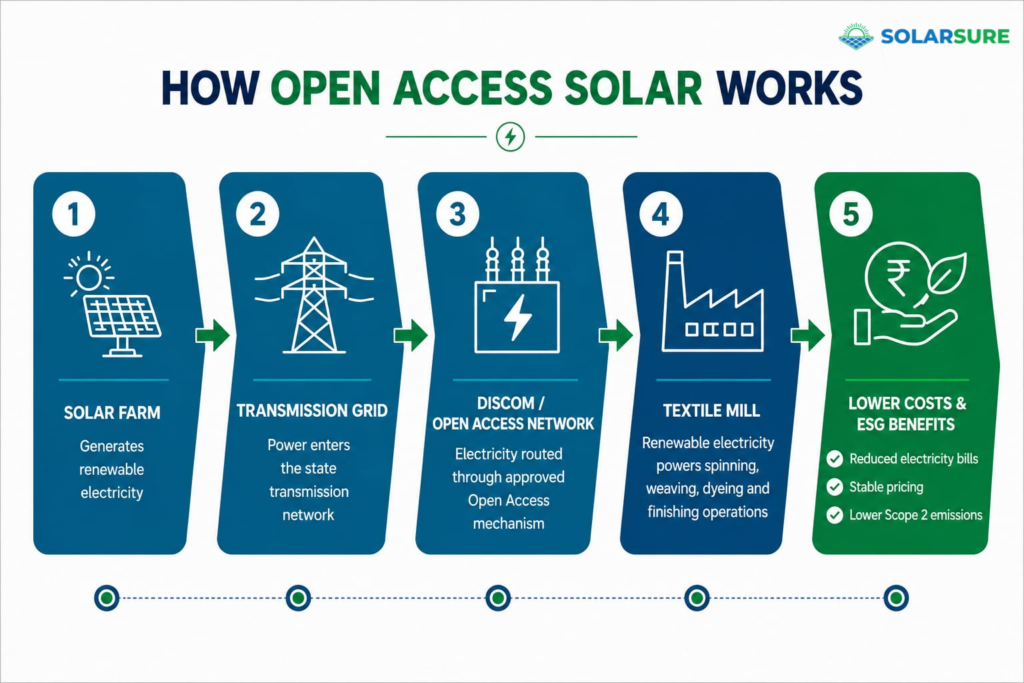
Open Access Solar enables textile mills to purchase renewable electricity from an off-site solar power plant. This reduces their dependence on conventional grid power.
The electricity is delivered through the existing transmission and distribution network. As a result, manufacturers can access clean energy without installing large solar systems on their premises.
India’s Commercial & Industrial (C&I) renewable energy market continues to expand. Consequently, Open Access Solar has become one of the fastest-growing procurement models for large industrial consumers. It offers long-term cost savings and improves energy security.
Step-by-Step Process of Open Access Solar Procurement
The Open Access Solar procurement process typically involves the following steps:
1. Assess Energy Requirements: The textile mill evaluates its electricity consumption. It then determines its eligibility for Open Access based on state regulations.
2. Select a Solar Developer: The business partners with an experienced solar developer. It procures renewable electricity through a long-term agreement, such as a Power Purchase Agreement (PPA).
3. Obtain Regulatory Approvals: The business obtains approvals from the relevant state authorities and the local DISCOM. These approvals ensure compliance with Open Access regulations.
4. Power Delivery: The off-site solar plant generates electricity. The power is transmitted through the existing grid and supplied to the textile mill.
5. Monitor Performance: Smart meters and digital energy management systems continuously track electricity generation, consumption, and savings. This helps optimize operational performance.
For example, leading Indian manufacturers such as Arvind Limited and Welspun Living have expanded their renewable energy portfolios. They have made renewable energy a key part of their sustainability strategies. This demonstrates the growing role of clean energy in industrial operations.
Role of Solar Developers, DISCOMs, and Power Exchanges
Successful Open Access Solar projects involve multiple stakeholders. They work together to ensure a reliable and efficient electricity supply.
- Solar Developers: They design, finance, build, own, and operate solar power plants. They also supply renewable electricity through long-term Power Purchase Agreements (PPAs).
- DISCOMs (Distribution Companies): They transmit and distribute electricity through the existing grid infrastructure. They also ensure compliance with Open Access regulations.
- Power Exchanges: Where applicable, they provide a transparent platform for buying and selling electricity. This helps businesses optimize their energy procurement based on market conditions.
According to JMK Research and IEEFA, commercial and industrial (C&I) consumers accounted for nearly 18% of India’s renewable energy capacity additions in FY2024. This highlights the growing preference for clean energy among businesses. Together, solar developers, DISCOMs, and power exchanges help textile manufacturers access reliable, cost-effective, and sustainable electricity. They also improve long-term business resilience.
You can read more about the research paper here: JMK research paper and IEEFA
Why Textile Mills Are Switching to Open Access Solar
Rising electricity prices are forcing Indian textile manufacturers to rethink their energy procurement strategies. Growing sustainability expectations and increasing pressure from global buyers are also driving this shift.
Open Access Solar provides a cost-effective way to access renewable electricity. It also reduces dependence on conventional grid power.
According to JMK Research and IEEFA, India’s Green Open Access market recorded more than 90% year-on-year growth between FY2023 and FY2024. This growth highlights the rapid adoption of renewable energy by commercial and industrial (C&I) consumers.
Rising Grid Tariffs
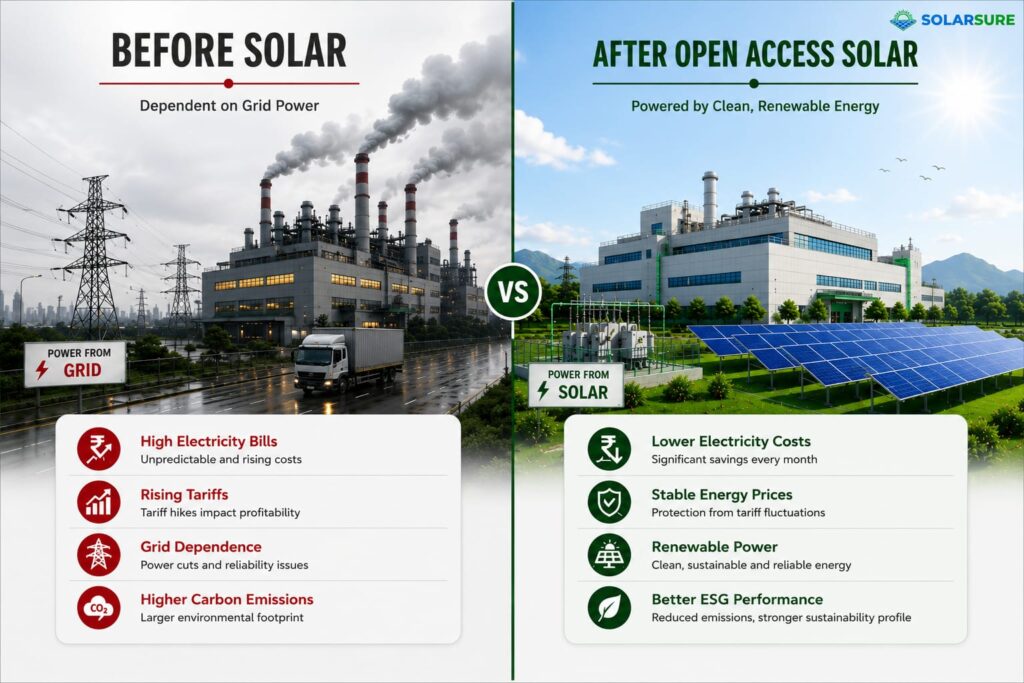
Electricity is one of the largest operating expenses for textile mills. This is especially true for energy-intensive processes such as spinning, weaving, dyeing, and finishing.
Rising grid tariffs, transmission charges, and fuel cost adjustments have increased manufacturing costs in many states.
As a result, manufacturers in states with mature Open Access markets are evaluating Open Access Solar. These states include Gujarat, Karnataka, Maharashtra, and Tamil Nadu. Businesses are adopting this model to secure more predictable electricity prices and improve long-term cost competitiveness.
| State | Approx. HT Industrial Grid Tariff (₹/kWh) | Open Access Solar Viability | Why Textile Manufacturers Choose Open Access |
| Gujarat | 7.5–9.5 | Excellent | Mature Open Access market, strong textile ecosystem, competitive regulations |
| Maharashtra | 10.5–12.5 | Very High | High industrial tariffs make Open Access highly attractive |
| Tamil Nadu | 8.0–10.5 | High | Large textile industry with significant renewable energy adoption |
| Karnataka | 6.5–8.5 | Excellent | Favourable Open Access ecosystem and competitive tariffs |
| Rajasthan | 7.0–8.5 | High | Growing renewable energy capacity and improving Open Access policies |
| Telangana | 7.5–9.0 | High | Increasing C&I renewable energy adoption |
| Andhra Pradesh | 7.0–8.5 | High | Strong solar resource and expanding industrial renewable procurement |
| Odisha | 6.5–8.0 | Medium- High | Emerging Open Access market with competitive industrial tariffs |
Sustainability and ESG Goals
Global brands and retailers are placing greater emphasis on sustainable sourcing and low-carbon manufacturing.
Companies such as Adidas, Puma, Levi Strauss & Co., and Decathlon are working with suppliers to reduce greenhouse gas emissions. They are also encouraging the use of renewable energy across their supply chains.
As a result, many Indian textile manufacturers are investing in renewable energy. This helps strengthen their ESG performance and reduce Scope 2 emissions. It also helps them remain preferred suppliers in international markets.
Long-Term Energy Cost Stability
Unlike conventional grid electricity, Open Access Solar is usually procured through long-term renewable energy supply agreements. These agreements offer pre-determined electricity tariffs.
This gives textile manufacturers greater visibility into future energy costs. It also enables more accurate budgeting and reduces exposure to electricity price increases.
Stable energy pricing improves financial planning. It supports better investment decisions and enhances competitiveness in both domestic and export markets.
Key Benefits of Open Access Solar for Textile Mills
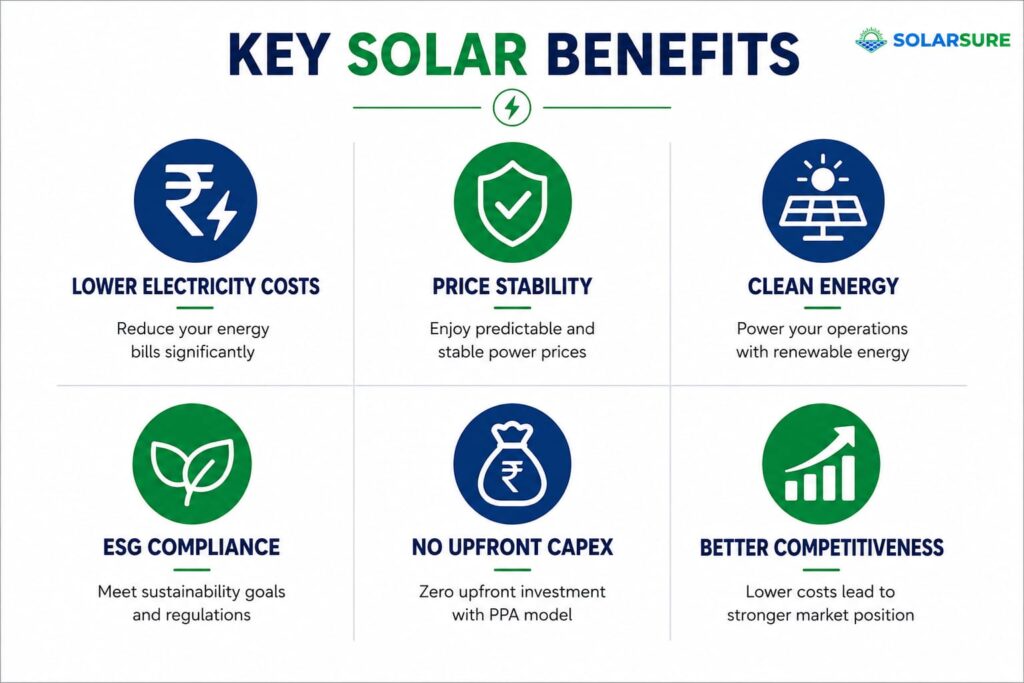
Open Access Solar offers more than lower electricity bills. It helps textile manufacturers improve operational efficiency. It also supports sustainability targets and provides greater control over long-term energy costs.
Renewable energy adoption is growing across India’s commercial and industrial sector. As a result, more manufacturers are choosing Open Access Solar as a strategic energy solution. It helps improve profitability, strengthen energy resilience, and support long-term business growth.
Lower Electricity Costs
One of the biggest advantages of Open Access Solar is access to renewable electricity at competitive rates. Depending on the state, electricity consumption profile, and procurement model, industrial consumers can often reduce their electricity procurement costs compared to conventional grid power.
Large textile manufacturing facilities consume millions of units of electricity each year. Even small reductions in energy costs can result in substantial savings. They also improve operating margins.
Predictable Long-Term Energy Pricing
Open Access Solar enables textile manufacturers to procure renewable electricity through long-term electricity supply agreements. These agreements offer fixed or pre-determined tariffs. This reduces exposure to fluctuating grid electricity prices. It also provides greater certainty over future energy costs.
As a result, businesses can improve budgeting and manage operating expenses more effectively. They can also make long-term investment decisions with greater confidence.
Reduced Carbon Emissions
By replacing conventional grid electricity with renewable power, Open Access Solar helps textile manufacturers reduce Scope 2 greenhouse gas emissions. These emissions are associated with purchased electricity.
This supports ESG goals and helps businesses meet the sustainability expectations of global customers.
Leading textile companies such as Raymond, Trident Group, and Alok Industries are expanding their sustainability initiatives. They are increasing renewable energy adoption and implementing measures to reduce their environmental impact.
Learn how some of India’s leading textile manufacturers are adopting open access solar and why the Power Purchase Agreement (PPA) model is making this transition easier and more affordable. Raymond Corporate, Trident Group and Alok Industries
No Upfront Infrastructure Investment (for PPA Models)
Under the Power Purchase Agreement (PPA) model, the solar developer finances, owns, operates, and maintains the solar power plant. As a result, textile manufacturers can access renewable electricity without making a significant upfront capital investment.
This allows businesses to preserve capital for production expansion, technology upgrades, and other strategic investments. At the same time, they continue to benefit from clean energy.
Improved Business Competitiveness
Lower electricity costs and stronger sustainability performance can improve a textile manufacturer’s competitiveness in domestic and export markets.
International retailers such as Uniqlo, Marks & Spencer, GAP Inc., and C&A are encouraging suppliers to improve energy efficiency. They are also promoting the transition to renewable electricity.
As a result, manufacturers that invest in clean energy are better positioned to meet buyer expectations. They can also strengthen ESG performance and secure long-term business opportunities.
Open Access Solar vs Rooftop Solar vs Conventional Grid Power
Choosing the right energy solution depends on electricity demand, available space, investment capacity, and long-term business goals.
Rooftop solar is suitable for facilities with sufficient roof space. However, Open Access Solar is often a better choice for textile mills with high electricity consumption.
The Green Energy Open Access Rules, 2022 reduced the minimum eligibility threshold from 1 MW to 100 kW. As a result, many more commercial and industrial consumers can access renewable electricity.
Large integrated textile manufacturing facilities often have high electricity demand. They may also have limited rooftop space. In such cases, Open Access Solar provides access to larger volumes of renewable electricity than rooftop systems.
Meanwhile, conventional grid power remains vulnerable to rising tariffs, regulatory charges, and fuel price volatility.
The table below compares Open Access Solar, rooftop solar, and conventional grid electricity. It helps textile manufacturers identify the most suitable energy solution for their operational and financial requirements.
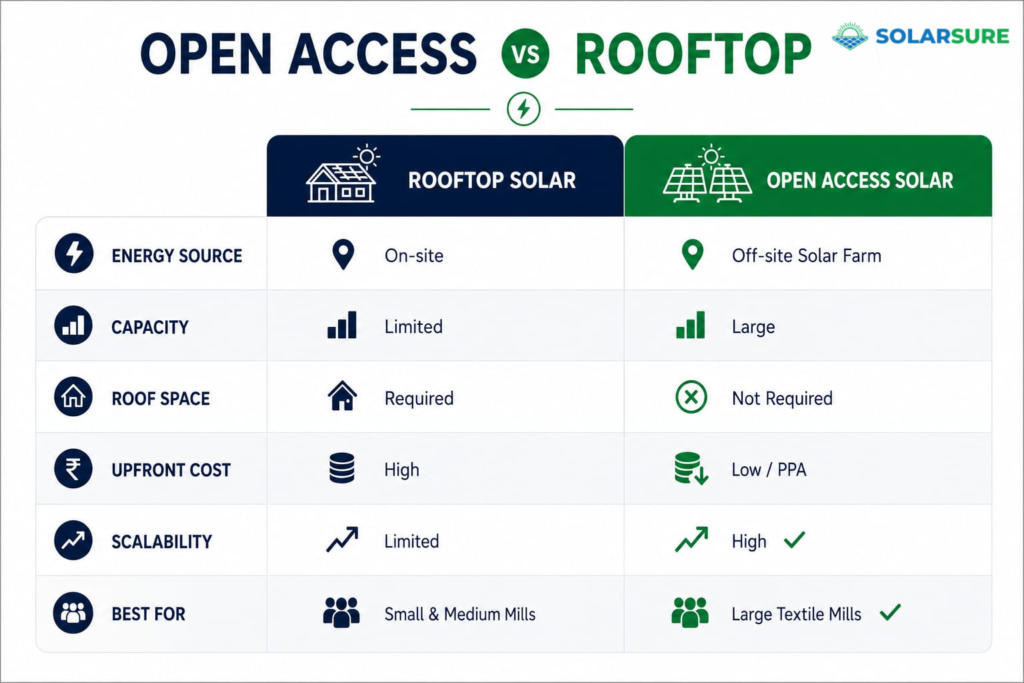
Open Access Solar vs Rooftop Solar vs Conventional Grid Power
| Feature | Open Access Solar | Rooftop Solar | Conventional Grid Power |
| Power Source | Off-site solar power plant | On-site solar panels | State electricity grid |
| Best Suited For | Large energy-intensive textile mills | Facilities with adequate rooftop space | All businesses |
| Upfront Investment | Low or none (PPA model) | High (CAPEX) or low (RESCO model) | None |
| Electricity Cost | Competitive and predictable | Low after installation | Subject to tariff fluctuations |
| Scalability | High | Limited by available roof area | Limited to grid availability |
| Long-Term Cost Stability | High | High | Low |
| Carbon Emissions | Very Low | Very Low | Higher, depending on grid energy mix |
| Maintenance Responsibility | Solar developer (under PPA) | Business owner or service provider | Managed by DISCOM |
| Suitable for ESG Goals | Excellent | Excellent | Limited |
| Business Impact | Significant cost savings with long-term price certainty | Reduces dependence on the grid | Reliable but increasingly expensive |
How Much Can Textile Mills Save with Open Access Solar?
The cost savings from Open Access Solar depend on several factors. These include a textile mill’s electricity consumption, location, state regulations, and procurement model.
Compared to conventional grid electricity, many commercial and industrial (C&I) consumers can achieve 20–40% lower electricity procurement costs. The actual savings depend on Open Access charges, electricity tariffs, and consumption patterns.
For textile manufacturers, electricity is a major operating expense. Therefore, these savings can significantly improve profitability. They also provide greater certainty over long-term energy costs. Several leading textile companies have accelerated their renewable energy transition.
For example, KPR Mill, one of India’s largest integrated textile manufacturers, has invested extensively in wind and solar power. These investments help reduce electricity costs and improve energy security across its manufacturing operations.
Click here to know more about KPR Mills.
Similarly, Raymond has expanded its renewable energy portfolio as part of its sustainability strategy. The company aims to lower carbon emissions and optimize long-term energy expenses. These examples show that renewable energy has become a strategic business investment. It enhances both financial performance and long-term sustainability.
Factors That Influence Cost Savings
Several factors determine how much a textile mill can save with Open Access Solar:
- Electricity Consumption: Mills with higher electricity demand usually achieve greater savings. They can replace a larger share of grid electricity with renewable power.
- State Regulations: Open Access policies, wheeling charges, banking provisions, and other regulatory costs vary across states. These factors directly affect the overall savings potential.
- Contract Structure: The type and duration of the Power Purchase Agreement (PPA) influence electricity pricing. Long-term agreements usually provide greater price certainty. They also help keep operating costs predictable.
- Solar Generation Profile: Savings depend on the solar plant’s generation capacity and seasonal weather conditions. They also depend on how closely energy generation matches the mill’s electricity consumption.
Estimated Savings for Textile Mills with Open Access Solar
| Textile Mill Size | Typical Electricity Demand | Potential Cost Savings | Recommended Model |
| Small | Up to 500 kW | Moderate | Rooftop Solar / Hybrid |
| Medium | 500 kW – 2 MW | High | Open Access Solar (PPA) |
| Large | Above 2 MW | Very High | Open Access Solar with Long-Term PPA |
Government Policies Supporting Open Access Solar in India
The Government of India has introduced several policies to promote renewable energy adoption among commercial and industrial (C&I) consumers. These initiatives support India’s goal of achieving 500 GW of non-fossil fuel capacity by 2030. They also make Open Access Solar an increasingly attractive option for textile manufacturers.
Green Energy Open Access Rules
The Green Energy Open Access Rules, 2022 simplified renewable energy procurement. They reduced the minimum eligibility threshold from 1 MW to 100 kW. As a result, more industrial consumers can procure green power directly.
State-Level Open Access Regulations
Each state has its own Open Access regulations. These rules govern eligibility, banking provisions, and applicable charges. States such as Gujarat, Karnataka, Tamil Nadu, and Maharashtra have become leading adopters of Open Access Solar.
Renewable Purchase Obligations (RPOs)
Renewable Purchase Obligations encourage designated consumers to source part of their electricity from renewable energy. This helps textile manufacturers strengthen their ESG performance and achieve sustainability goals.
Policy Support for Industrial Consumers
India’s renewable energy transition is creating new opportunities for industrial consumers. It helps businesses reduce electricity costs and improve energy security.As of 2025, India has surpassed 230 GW of installed non-fossil fuel power capacity. This milestone reinforces the country’s commitment to expanding clean energy for commercial and industrial users.
As a result, more textile manufacturers are adopting Open Access Solar. It helps improve energy price stability, reduce dependence on conventional grid electricity, and strengthen long-term energy security.
Is Open Access Solar Right for Every Textile Mill?
Open Access Solar offers significant cost and sustainability benefits. However, it may not be the right solution for every textile manufacturer. Its suitability depends on electricity demand, plant location, state regulations, available infrastructure, and business objectives. Industrial consumers with a contracted demand of 100 kW or more are generally eligible for Green Open Access under the Green Energy Open Access Rules, 2022. Manufacturers should evaluate their energy profile and financial viability before making the transition.
Ideal Business Profiles
Open Access Solar is best suited for textile manufacturers that:
- Have high and consistent electricity consumption.
- Operate large manufacturing facilities or multiple production units.
- Have limited rooftop space.
- Want to reduce long-term electricity costs.
- Are working toward ESG or net-zero goals.
For example, leading textile companies such as Raymond, Trident Group, KPR Mill, and Alok Industries have expanded renewable energy adoption. They have also improved energy efficiency across their operations.
Eligibility Criteria
Eligibility depends on state-specific Open Access regulations. Generally, businesses must:
- Meet the minimum contracted demand specified by the state.
- Obtain approvals from the DISCOM and relevant authorities.
- Enter into a long-term Power Purchase Agreement (PPA) with a qualified solar developer.
When Rooftop Solar May Be a Better Choice
Rooftop solar is often better for textile mills with lower electricity demand. It also suits facilities with adequate roof space and the ability to invest in on-site infrastructure. However, manufacturers with high energy requirements may benefit more from Open Access Solar. It offers greater scalability, access to larger volumes of renewable electricity, and better long-term cost predictability.
Challenges Textile Mills Should Consider Before Switching
Here’s the revised version with shorter sentences (mostly under 20 words) while keeping the meaning and SEO keywords intact.
Challenges Textile Mills Should Consider Before Switching
Open Access Solar offers significant cost and sustainability benefits. However, textile manufacturers should evaluate several practical factors before switching. The Green Energy Open Access Rules, 2022 expanded access to renewable electricity. The rules reduced the minimum eligibility threshold to 100 kW. However, successful implementation still depends on state regulations, project economics, and the right implementation partner.
Regulatory Variations Across States
Open Access regulations vary across states. Differences include banking provisions, wheeling charges, transmission charges, cross-subsidy surcharge (CSS), and additional surcharge (AS). States such as Rajasthan, Telangana, Andhra Pradesh, and Odisha are seeing growing Open Access adoption. Their regulatory frameworks continue to evolve. Manufacturers should review the latest state policies before making investment decisions.
Contractual Commitments
Open Access Solar usually involves long-term renewable electricity procurement agreements. Before signing a contract, businesses should review pricing mechanisms and contract tenure. They should also evaluate energy supply commitments and exit provisions. This helps ensure the agreement supports their operational and financial goals.
Grid Connectivity Requirements
Reliable grid connectivity is essential for successful project implementation. Timely regulatory approvals are also important. Textile manufacturers should confirm that their facilities meet local DISCOM requirements. These include metering standards, interconnection requirements, and evacuation capacity. They should verify these requirements before proceeding with an Open Access project.
Choosing the Right Solar Partner
Selecting an experienced renewable energy partner is critical to project success. Businesses should evaluate developers based on their experience with industrial Open Access projects, regulatory expertise, project execution capabilities, and long-term operations and maintenance (O&M) support. A reliable partner can help optimize project performance, ensure regulatory compliance, and maximize long-term cost savings.
Future of Open Access Solar in India’s Textile Industry (2026 and Beyond)
As India’s renewable energy ecosystem continues to evolve, Open Access Solar is expected to play an even greater role in powering the textile industry. Supported by favourable policies and India’s target of achieving 500 GW of non-fossil fuel power capacity by 2030, more manufacturers are investing in clean energy to reduce operating costs, improve energy security, and strengthen sustainability performance.
Increasing Renewable Energy Adoption
The implementation of the Green Energy Open Access Rules, 2022, which reduced the minimum eligibility threshold from 1 MW to 100 kW, has expanded access to renewable electricity for a broader range of commercial and industrial consumers. As electricity prices continue to rise and global buyers prioritize low-carbon supply chains, more textile manufacturers are expected to adopt Open Access Solar as part of their long-term energy strategy.
Integration with Battery Energy Storage Systems (BESS)
Battery Energy Storage Systems (BESS) are expected to complement Open Access Solar by storing excess renewable energy and improving power reliability. As battery costs continue to decline, more textile mills are likely to integrate storage solutions to optimize energy use, reduce peak-demand charges, and improve operational flexibility.
AI-Based Energy Management
AI-powered energy management platforms are helping manufacturers monitor electricity consumption in real time, identify inefficiencies, forecast demand, and optimize energy usage. These technologies can improve operational efficiency while maximizing the value of renewable energy investments.
Net Zero Manufacturing Trends
Many export-oriented textile manufacturers are integrating renewable energy, energy-efficient technologies, and science-based decarbonization strategies to meet the sustainability requirements of global customers. As international buyers increasingly prioritize low-carbon supply chains, Open Access Solar will play a critical role in reducing Scope 2 emissions, supporting net-zero ambitions, and enhancing long-term business competitiveness.
Frequently Asked Questions
Q: What is Open Access Solar for textile mills?
Open Access Solar allows eligible textile mills to purchase renewable electricity from an off-site solar power plant. The electricity is supplied through the existing power grid. Enabled by the Green Energy Open Access Rules, 2022, it helps manufacturers reduce electricity costs. It also supports sustainability and ESG goals.
Q: How much can textile manufacturers save with Open Access Solar?
Savings depend on electricity consumption, state regulations, and the Power Purchase Agreement (PPA). Electricity can account for 15–30% of textile manufacturing costs. Open Access Solar can improve long-term operating margins. It also provides predictable energy pricing.
Q: Is Open Access Solar available in every Indian state?
Open Access Solar is available in many Indian states. However, regulations, eligibility criteria, and applicable charges vary by state. Gujarat, Karnataka, Maharashtra, and Tamil Nadu have well-developed Open Access markets. This makes renewable energy procurement more accessible.
Q: What is the minimum electricity requirement for Open Access Solar?
The minimum electricity requirement depends on state regulations. The Green Energy Open Access Rules, 2022 reduced the eligibility threshold from 1 MW to 100 kW. This change allows more commercial and industrial consumers to adopt Open Access Solar.
Q: How is Open Access Solar different from rooftop solar?
Rooftop solar generates electricity from on-site solar panels. Open Access Solar supplies renewable electricity from an off-site solar plant through the grid. It is generally better suited for textile mills with high electricity demand. It is also ideal for facilities with limited rooftop space.
Q: Can textile mills use Open Access Solar under a Power Purchase Agreement (PPA)?
Yes. Many textile manufacturers adopt Open Access Solar through long-term PPAs. Under this model, the solar developer finances, owns, and operates the solar plant. This allows businesses to access renewable electricity without significant upfront investment.
Q: What government policies support Open Access Solar in India?
The Green Energy Open Access Rules, 2022 support Open Access Solar. State electricity regulatory commissions also issue supporting regulations. Together, these policies promote renewable energy adoption. They also support India’s target of 500 GW of non-fossil fuel capacity by 2030.
Q: Does Open Access Solar help reduce Scope 2 emissions?
Yes. Open Access Solar replaces conventional grid electricity with renewable power. This helps reduce Scope 2 greenhouse gas emissions. It also supports ESG reporting, sustainability initiatives, and customer decarbonization requirements.
Q: How long does it take to implement an Open Access Solar project?
The implementation timeline depends on project size, regulatory approvals, and grid connectivity. An experienced Open Access Solar developer can streamline approvals. They can also help ensure timely project execution.
Q: How do I choose the right Open Access Solar developer?
Choose a developer with experience in commercial and industrial (C&I) renewable energy projects. Look for strong regulatory expertise, transparent pricing, and reliable long-term support. Also, review the company’s project portfolio, client references, and experience in your state.
Bottom Line
Rising electricity costs and growing sustainability expectations are reshaping India’s textile industry. Manufacturers are rethinking how they procure electricity. The sector contributes approximately 2% of India’s GDP and 11% of the country’s merchandise exports. It also employs more than 45 million people. Reliable and cost-effective energy is essential for maintaining global competitiveness.
Open Access Solar is emerging as a practical solution for textile manufacturers. It helps reduce electricity costs and improve energy price predictability. It also supports the transition to renewable energy without requiring large on-site solar infrastructure.
Many leading textile manufacturers, including KPR Mill, Raymond, and Trident Group, have expanded renewable energy adoption. These initiatives support their sustainability and operational efficiency goals. However, the success of an Open Access Solar project depends on several factors. These include electricity consumption patterns, commercial viability, regulatory compliance, and choosing the right implementation partner.
Global buyers continue to prioritize low-carbon supply chains. As a result, manufacturers that invest in clean energy will be better positioned for long-term success. They can improve operational resilience and strengthen ESG performance. They will also be better equipped to manage future energy costs, meet evolving customer expectations, and build a more sustainable and competitive business.