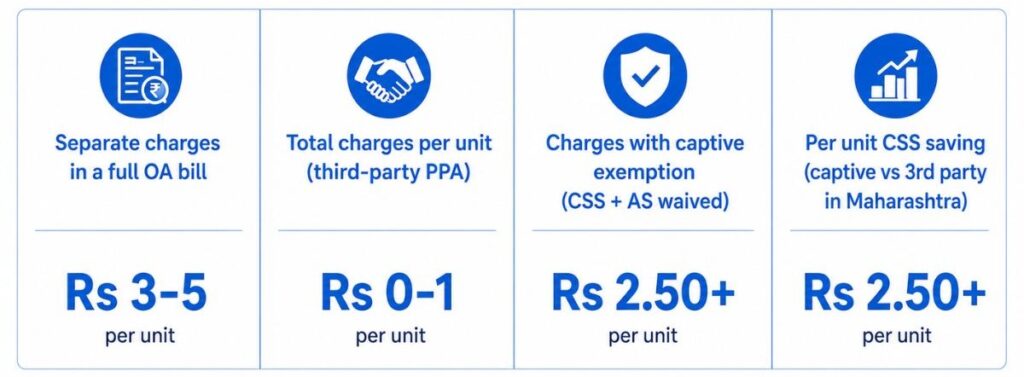
Open access solar charges are the reason most Indian businesses either save 30 to 40 percent on their electricity bill or save almost nothing. The solar tariff is only one part of what you pay. Cross-Subsidy Surcharge, wheeling fees, banking charges, SLDC scheduling fees, transmission losses each adds rupees to your landed cost, and each one behaves differently depending on your state, your procurement model, and whether you own equity in the plant.
Most vendors show you the solar PPA rate: Rs 2.50 per unit. They do not show you what it becomes by the time it reaches your factory meter: Rs 5.50 per unit after all regulated charges. That gap Rs 3 per unit is what this guide exists to close.
This is a charge-by-charge breakdown of every open access solar charge in India in 2026, with state-specific figures, exemption rules, and the exact formula for calculating your true landed cost before you sign any PPA.
What Are Open Access Solar Charges? The Complete List
When you source electricity through open access solar, you are using the DISCOM’s physical grid infrastructure wires, transformers, substations to wheel power from a remote solar plant to your meter. You pay regulated charges for that use, set by your State Electricity Regulatory Commission (SERC) under the framework of the
Electricity Act, 2003 (Section 42) — read Section 42 on indiacode.nic.in — and the MNRE Green Energy Open Access Rules 2022.
These charges fall into two categories: one-time setup costs, and recurring per-unit charges that apply to every unit of solar power delivered to your facility.
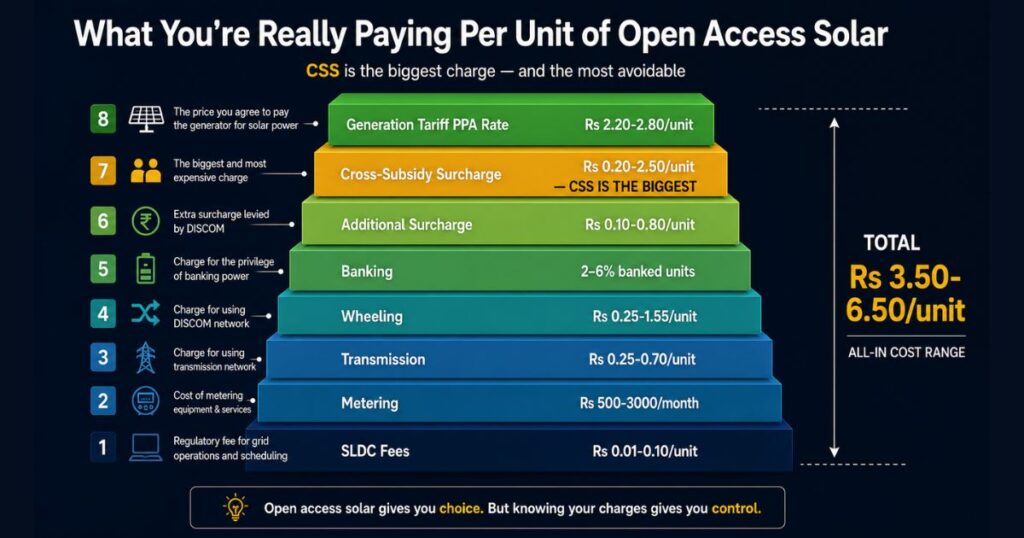
| Recurring (Per Unit — Every Month) | One-Time (At Project Setup) |
| Wheeling Charges (Rs 0.25–1.55/unit) | Connectivity / Grid Access Fee (Rs 1–10 lakh) |
| Transmission Charges (Rs 0.25–0.70/unit) | Meter Installation Cost (Rs 500–3,000/month) |
| Cross-Subsidy Surcharge / CSS (Rs 0.20–2.50/unit) | Application & Approval Fees (Rs 50,000–2 lakh) |
| Additional Surcharge (Rs 0.10–0.80/unit) | Grid Infrastructure Setup (variable by site) |
| Banking Charges (2–6% of banked units) | |
| SLDC Scheduling Fees (Rs 0.01–0.10/unit) |
01 Wheeling Charges Paid to DISCOM for using its distribution network: Rs 0.25–1.55/unit
Wheeling charges are fees you pay the DISCOM for using its physical distribution infrastructure the wires, transformers, and substations that carry your solar power from the injection point to your factory meter. Every unit of electricity travels through this network, and you pay per unit for that use.
State variation is extreme: Karnataka has the lowest wheeling charges in India at Rs 0.29/unit a major reason it is the country’s most active open access market. Maharashtra charges approximately Rs 0.70/unit. Some states in North India range up to Rs 1.55/unit for lower-voltage connections. The voltage level of your connection matters too: HT (High Tension, 33 kV+) consumers typically pay lower wheeling rates than EHT (Extra High Tension) lines.
Wheeling charges are non-negotiable and non-exemptible for any consumer captive, group captive, or third-party. They apply to every unit wheeled, regardless of your procurement structure.
02 Transmission Charges Paid for using the state high-voltage transmission network: Rs 0.25–0.70/unit
Transmission charges apply when your solar power travels through the State Transmission Utility (STU) network the high-voltage backbone grid before entering the DISCOM’s local distribution network. These are distinct from wheeling charges and apply to the high-voltage portion of the journey.
For intra-state open access projects (plant and consumer in the same state), transmission charges are set by the SERC and are typically Rs 0.25 to Rs 0.45 per unit. For inter-state projects (plant in Rajasthan, consumer in Gujarat, for example), ISTS (Inter-State Transmission System) charges apply and are set by CERC.
Note: The ISTS charge waiver previously covering 100% of inter-state transmission for renewable projects — has been phasing out since June 2025 per CERC regulations. Projects commissioned after June 2025 receive 75% waiver in FY26, reducing to 0% by July 2028. This is pushing most buyers toward intra-state procurement.
03 Cross-Subsidy Surcharge (CSS) The most expensive and most avoidable charge: Rs 0.20–2.50/unit
The Cross-Subsidy Surcharge is the single most consequential open access solar charge in India. It is the charge that makes or breaks the economics of third-party open access in high-CSS states and the charge that group captive and captive structures avoid entirely.
CSS exists to compensate DISCOMs for revenue lost when large, high-paying industrial consumers exit the grid for cheaper alternatives. DISCOMs cross-subsidise lower tariff consumers (agriculture, residential) using the higher tariffs they charge industry. When a factory goes open access and pays less, the DISCOM loses that cross-subsidy contribution. CSS is how they partially recover it.
The range is extreme: Karnataka’s CSS is Rs 0.60/unit. Maharashtra’s CSS for HT industrial consumers is Rs 2.11/unit. That Rs 1.51/unit difference means a factory consuming 3 lakh units per month pays Rs 4.53 lakh more per month in CSS in Maharashtra than in Karnataka Rs 54 lakh per year for the same solar procurement decision.
| State | CSS (Third-Party PPA) | CSS (Captive / Group Captive) |
| Karnataka | Rs 0.60/unit | EXEMPT (Rs 0) |
| Madhya Pradesh | Rs 0.30–0.60/unit | EXEMPT (GEOA) |
| Rajasthan | Rs 0.40–0.80/unit | EXEMPT (captive/RE OA) |
| Gujarat | Rs 0.30–0.70/unit | EXEMPT (RE captive) |
| Maharashtra | Rs 1.00–2.11/unit | EXEMPT |
| Tamil Nadu | Rs 0.40–0.80/unit | Partial exemption |
| Uttar Pradesh | Rs 0.50–1.00/unit | Limited waivers |
⚠ The CSS exemption for captive and group captive consumers is established under Section 42(2) of the Electricity Act, 2003, and reinforced by the Supreme Court’s 2021 judgement. Some state DISCOMs have attempted to impose CSS on captive consumers these are legally challengeable. If your EPC or developer cannot confirm the CSS status of your procurement structure in writing, that is a due diligence gap, not a minor detail.
📖 You can also read: Open Access Solar for MSMEs and Factories: A Complete Guide
04 Additional Surcharge (AS) Also exempt for captive and group captive consumers: Rs 0.10
The Additional Surcharge recovers the fixed power purchase costs that DISCOMs incur for capacity they contracted from generators but can no longer fully utilise because consumers have migrated to open access. Like CSS, the Additional Surcharge is waived for captive and group captive consumers under the Electricity Act 2003.
In states with lower open access penetration where DISCOM stranded costs are less the Additional Surcharge is minimal or nil. In Maharashtra, where open access migration has been significant, the surcharge has risen to Rs 0.20 to Rs 0.80 per unit for third-party consumers. Karnataka charges approximately Rs 0.40 per unit from March 2026.
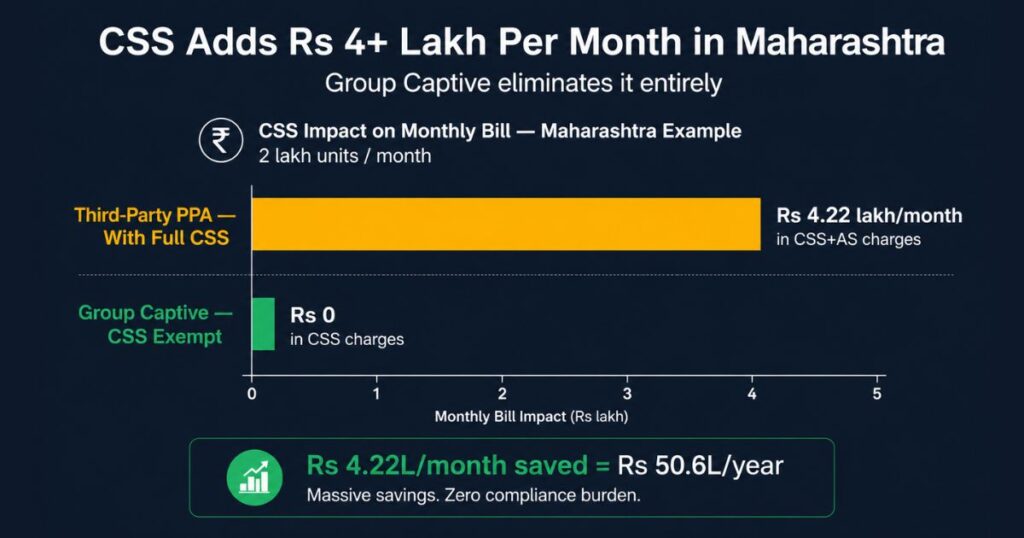
Combined CSS + Additional Surcharge impact: In Maharashtra, a third-party PPA consumer pays Rs 2.11 CSS + Rs 0.50 Additional Surcharge = Rs 2.61 per unit in surcharges alone. A group captive consumer with identical solar procurement pays Rs 0 on both. On 2 lakh units per month, that is Rs 5.22 lakh per month — Rs 62.6 lakh per year — in surcharge savings from choosing the right structure.
05 Banking Charges Paid for storing surplus solar in the grid for later use 2–6% of banked units
Banking is the mechanism that makes open access solar work for factories with mismatched generation and consumption timing. A solar plant generates between 8 AM and 5 PM. A factory may consume more evenly across 16 or 24 hours. Banking allows you to “deposit” surplus solar units into the grid during peak generation hours and “withdraw” them later at night, on weekends, or during monsoon low-generation periods.
Banking charges are a percentage of the units banked. Most states charge 2% of banked units. Uttar Pradesh charges 6% significantly higher and a material project economics factor. Maharashtra’s banking charge was revised upward to 8% in 2025, making banking-dependent project structures materially more expensive in that state.
| State | Banking Charge | Settlement Period |
| Madhya Pradesh | 2% of banked units | Monthly |
| Rajasthan | 2% of banked units | Monthly |
| Karnataka | 2% of banked units | Monthly (flexible) |
| Gujarat | 2% of banked units | Monthly |
| Maharashtra | 8% of banked units | Monthly |
| Uttar Pradesh | 6% of banked units | Monthly |
| Tamil Nadu | 2% of banked units | 15-min block settlement |
💡 Tamil Nadu moved to 15-minute block scheduling settlement in 2025, effectively eliminating traditional banking. Every unit must be scheduled in advance. This requires tighter load forecasting and more sophisticated energy management. Plants sized based on older banking-friendly rules are now over-generating relative to schedulable consumption generating surplus that cannot be efficiently monetised.
06 SLDC Fees + Connectivity + Metering Paid to SLDC for scheduling, and to DISCOM for grid access: Rs 0.01–0.10/unit + One-time Rs 1–10 lakh
SLDC (State Load Dispatch Centre) Fees are small per-unit charges for the scheduling, monitoring, and energy accounting services provided by the SLDC. These range from Rs 0.01 to Rs 0.10 per unit depending on the state and are a minor component of total landed cost but are non-negotiable.
Connectivity charges are a one-time fee paid at project commissioning for grid connection approval and infrastructure setup typically Rs 1 lakh to Rs 10 lakh depending on project size and connection complexity. Metering charges for the special import/export meters required at both the injection point and your consumption point range from Rs 500 to Rs 3,000 per month per meter.
The Landed Cost Formula: Putting All Open Access Solar Charges Together
The landed cost is the number that determines whether open access solar actually makes economic sense for your business. It combines every charge into a single per-unit figure you can compare directly against your current DISCOM tariff.
| Landed Cost = PPA Rate + Wheeling + Transmission + CSS (if applicable) + Additional Surcharge (if applicable) + Banking Charges + SLDC Fees + Transmission Loss % |
The following example is drawn from Solarsure’s own customer economics template 5 lakh units per month, DISCOM tariff Rs 9 per unit, transitioning to open access:
| Cost Element | Before Open Access | After Open Access (Group Captive) |
| Monthly Consumption | 5 lakh units | 5 lakh units |
| Power Cost (PPA/DISCOM Rate) | Rs 9.00/unit | Rs 2.50/unit (PPA) |
| Wheeling + Transmission | — | Rs 0.80/unit |
| Cross-Subsidy Surcharge | — | Rs 0 (EXEMPT) |
| Additional Surcharge | — | Rs 0 (EXEMPT) |
| Banking + SLDC + Other | — | Rs 0.10/unit |
| TOTAL EFFECTIVE COST | Rs 9.00/unit | Rs 3.40/unit |
| Monthly Bill | Rs 45 lakh | Rs 17 lakh |
| Monthly Saving | — | Rs 28 lakh / month |
| Annual Saving | — | Rs 3.36 crore / year |
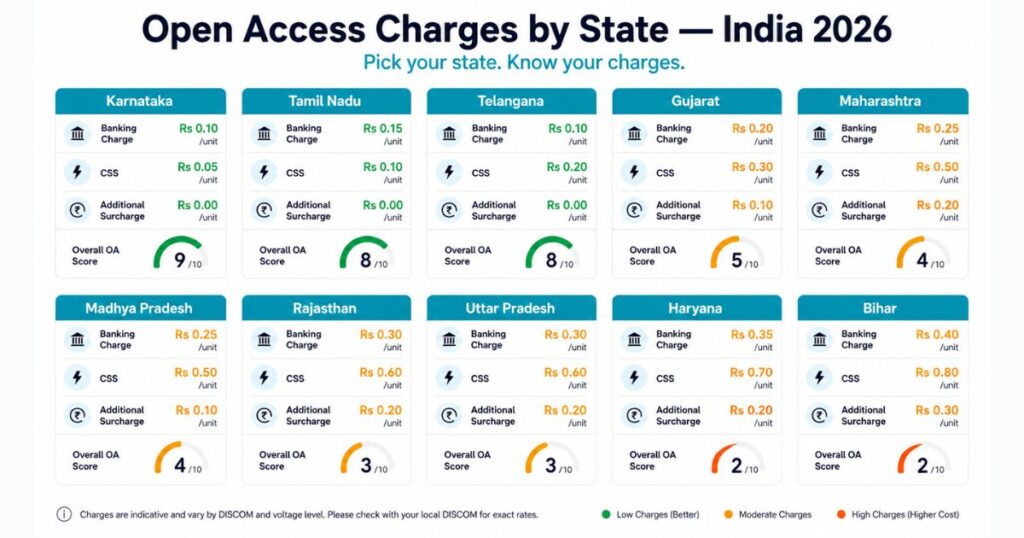
State-Wise Open Access Solar Charges Comparison (2026)
The following table consolidates the per your reference PPT data and current market figures for the 10 major open access states in India. All figures are indicative for FY2025-26; verify current tariff orders with your state SERC or nodal agency before financial modelling.
| State | Banking | CSS (3rd Party) | Additional Surcharge | Min. Load | OA Score |
| Madhya Pradesh | 2% | Rs 0.30–0.60 | Waived (GEOA) | 100 kW (GEOA) | 8 / 10 |
| Rajasthan | 2% | Rs 0.40–0.80 | Waived (captive/RE) | 1 MW | 7 / 10 |
| Karnataka | 2% | Rs 0.40–0.90 | Waived (captive RE) | 1 MW | 8 / 10 |
| Gujarat | 2% | Rs 0.30–0.70 | Waived (RE captive) | 500 kW (RE) | 7 / 10 |
| Haryana | 2% | Rs 0.40–0.90 | Waived (captive RE) | 1 MW | 6 / 10 |
| Tamil Nadu | 2% (15-min blocks) | Rs 0.40–0.80 | Some waivers | 1 MW | 6 / 10 |
| Telangana | 2% | Rs 0.40–0.80 | Waived (captive RE) | 1 MW | 6 / 10 |
| Maharashtra | 8% — HIGH | Rs 1.00–2.11 | Rs 0.20–0.80 | 1 MW | 5 / 10 |
| Uttar Pradesh | 6% — HIGH | Rs 0.50–1.00 | Limited waivers | 1 MW | 5 / 10 |
| Bihar | TBD by BERC | Rs 0.50–1.00 | Applicable | 1 MW | 5 / 10 |
Source: Solarsure project data, Mercom India Q4 2025 Solar Open Access report, state SERC tariff orders FY25-26. OA score is Solarsure’s internal rating across charge levels, banking policy, approval timeline, and regulatory stability.
For the latest state-specific charge notifications, refer to MNRE’s open access policy resources at mnre.gov.in.
📖 You can also read: Solar Payback Period for C&I India 2026 — How Long Before You Break Even?
Frequently Asked Questions
Q: What are the main open access solar charges in India?
A: There are eight open access solar charges. Recurring per-unit charges include: wheeling charges (Rs 0.25–1.55/unit), transmission charges (Rs 0.25–0.70/unit), Cross-Subsidy Surcharge or CSS (Rs 0.20–2.50/unit), Additional Surcharge (Rs 0.10–0.80/unit), banking charges (2–6% of banked units), and SLDC scheduling fees (Rs 0.01–0.10/unit). One-time charges include connectivity fees (Rs 1–10 lakh) and meter installation. Of these, CSS is the largest variable charge and the most avoidable — it is waived entirely for captive and group captive consumers.
Q: What is the Cross-Subsidy Surcharge in open access solar?
A: The Cross-Subsidy Surcharge (CSS) compensates DISCOMs for the revenue they lose when large industrial consumers exit the grid for cheaper solar power. It is set by each State Electricity Regulatory Commission and ranges from Rs 0.20/unit in some states to Rs 2.11/unit in Maharashtra. Under Section 42(2) of the Electricity Act 2003, captive and group captive consumers are fully exempt from CSS and Additional Surcharge — making them significantly cheaper than third-party PPA structures in high-CSS states.
Q: What are banking charges in open access solar?
A: Banking charges are fees for “storing” surplus solar generation in the grid for later use. When your solar plant generates more than you consume during daytime hours, the excess units are credited to a “bank” account. You draw these units at night or on weekends. Most states charge 2% of banked units as banking charges. Maharashtra charges 8% (revised upward in 2025), making banking-heavy project structures significantly more expensive. Tamil Nadu has moved to 15-minute block scheduling, effectively removing traditional banking.
Q: How do I calculate the landed cost of open access solar?
A: Landed cost = PPA generation tariff + wheeling charges + transmission charges + CSS (if applicable) + Additional Surcharge (if applicable) + banking charges + SLDC fees + transmission loss as a percentage deduction. For a group captive consumer in Madhya Pradesh, a typical calculation might be: Rs 2.50 (PPA) + Rs 0.55 (wheeling) + Rs 0.30 (transmission) + Rs 0 (CSS exempt) + Rs 0 (AS exempt) + Rs 0.10 (banking/SLDC) = Rs 3.45/unit all-in — against a DISCOM tariff of Rs 8.80/unit, a saving of Rs 5.35/unit.
Q: Which state has the lowest open access solar charges in India?
A: Karnataka has the lowest wheeling charges (Rs 0.29/unit) and a relatively low CSS (Rs 0.60/unit), making it one of India’s most competitive open access markets for third-party PPA consumers. For captive and group captive consumers — who are CSS-exempt — Madhya Pradesh and Rajasthan offer strong economics due to high industrial tariffs (Rs 8.80–9.50/unit), competitive PPA rates, and favourable banking policies. Solarsure models state-specific landed costs for every client before any procurement decision.
Q: Are open access solar charges the same for captive and third-party PPA consumers?
A: No — this is the most important distinction in open access solar procurement. Captive and group captive consumers are exempt from both CSS and Additional Surcharge under the Electricity Act 2003. These two charges together can add Rs 1.50 to Rs 2.90 per unit to a third-party PPA consumer’s landed cost. All other charges wheeling, transmission, banking, SLDC fees apply equally to all consumer types. This is why group captive is the dominant procurement structure in 2026, particularly in high-CSS states like Maharashtra.
Bottom Line
Open access solar charges are not a footnote in your solar procurement decision. They are the decision. In the wrong state, with the wrong model, open access solar charges can consume 60 to 70 percent of your potential savings leaving you wondering why the economics didn’t work out the way your vendor showed you.
The formula is not complicated. Know whether you qualify for captive or group captive status. Add every charge to your landed cost before you sign a PPA. The difference between a third-party PPA consumer and a group captive consumer in Maharashtra is Rs 62 lakh per year on 2 lakh units per month from the exact same solar tariff.
Solarsure models the full landed cost every charge, every exemption, every state-specific variable as part of every open access feasibility assessment. The number in your proposal is the number that shows up in your monthly invoice.