For many Commercial and Industrial (C&I) businesses in India, electricity is not a minor overhead. It typically accounts for 5–20% of operating expenses, and in power-intensive industries such as textiles, food processing, packaging, and engineering units, it can be even higher.
Whether you’re a small, medium-sized enterprise or a large organisation, navigating the complexities of solar adoption without expert guidance can be difficult. This is where a Solar EPC (Engineering, Procurement, and Construction) partner becomes crucial, who helps you throughout the entire process of building a solar plant.
Solar EPC services offer an end-to-end solution, managing everything from initial site assessments and custom system design to procurement of high-quality components, installation, regulatory approvals, and ongoing operations and maintenance (O&M).
But the point worth considering is that installing solar panels alone does not guarantee savings. The main savings come from correct design, proper approvals, strong structure, and consistent performance over 25 years. This is where a Solar EPC partner’s role becomes crucial. So, let’s understand how a solar EPC company helps commercial and industrial businesses save energy costs.
What is Solar EPC?
Solar EPC is a company that handles the full journey of a solar project. It starts from site study and design to installation and approvals, and extends into long-term maintenance. The purpose of solar EPC is to make the plant generate reliable power for years and reduce the company’s electricity bill.
Below is how EPC services help businesses save money in practical and measurable ways.
How Solar EPC Services Save Energy Costs of Commercial and Industrial Sectors’ Businesses
Choose Better Technology and Correct System Design to Improve Generation and Lower Cost Per Unit
A solar plant saves money only when it generates electricity consistently across its lifetime. Two plants with the same installed capacity can produce very different energy depending on how they are engineered. A professional EPC focuses on energy output rather than simply completing an installation that looks good.
An experienced EPC focuses on energy yield, not just capacity. Below are the important areas a solar EPC focuses on:
Technology Selection
EPC engineers analyse:
- available rooftop or land area
- sanctioned load and consumption profile
- shadow patterns across seasons
- local solar irradiation levels
- plant operating hours
Based on this, they select modules and inverters that maximise lifetime output rather than the lowest upfront price.
High-efficiency modules (540W–600W+) are often used because:
- More electricity is produced from the same area
- Fewer mounting structures and cables are required
- Installation losses are reduced
Bifacial modules are increasingly recommended for ground-mounted and elevated structures. These modules capture sunlight from both front and rear surfaces and typically add 3–8% additional generation depending on site reflectivity.
Engineering Optimisation
Generation losses in solar plants usually occur due to:
- shading from adjacent buildings or equipment
- incorrect tilt angles
- thermal losses
- cable losses
- inverter mismatch
A professional EPC performs simulation studies (such as PV yield modelling) before installation. Proper tilt, spacing, and orientation can increase annual generation significantly. Over 25 years, even a 3–4% improvement in generation can translate into lakhs of rupees in extra savings.
In simple terms, better engineering directly lowers the Levelised Cost of Electricity (LCOE), which means the actual per-unit cost of solar power produced.
Helps in Financial Planning and Tax Advantages
Many businesses view solar as a hefty capital expense, but EPC partners simplify financing to make savings start sooner. There are two primary models: CapEx (Capital Expenditure) and OPEX (Operational Expenditure, or third-party Power Purchase Agreement).
In the CapEx model, the business owns the system outright. EPC companies guide you through incentives like accelerated depreciation under Section 32 of the Income Tax Act, allowing 40% depreciation in the first year (potentially up to 60% if operational for over 180 days).
Also, the experts of Mercom India mentioned, “Savings on power bills are the key motivator for C&I clean energy transition.”
This can reduce taxable income by lakhs that allows businesses to recover 60% of investments in year one through tax savings. Additionally, GST input tax credit on components (at 5-18% rates) and state subsidies further lower effective costs.
The OPEX model requires no upfront investment. The EPC or developer installs and maintains the plant, selling power at a fixed tariff (often ₹2-4/kWh). This delivers immediate 40-80% savings.
Performance Guarantees
In some projects, reputable EPCs also commit to performance ratios (PR) and generation estimates. If the plant underperforms due to engineering or installation issues, corrective action is taken. This reduces financial risk for the business.
Handle Approvals and Reduce Risk Factors
Solar projects involve a maze of permissions, from net-metering applications to grid connectivity and safety inspections. Delays can defer savings by months or increase costs.
A solar plant requires coordination with utilities and authorities, including:
- net metering or gross metering applications
- load feasibility approval
- grid interconnection permission
- electrical inspector approvals
- safety certifications
Incomplete documentation or incorrect designs can delay commissioning by months. Every month of delay means continued high electricity bills.
An EPC contractor acts as a single point of responsibility and manages:
- utility coordination
- technical drawings
- inspection scheduling
- commissioning procedures
Overall, they handle DISCOM (distribution company) approvals, CEIG (Chief Electrical Inspector to Government) certifications, compliance with MNRE (Ministry of New and Renewable Energy) guidelines, etc. In India, where bureaucratic hurdles are common, experienced EPCs like Solarsure ensure projects are commissioned on time, often within 3-6 months for commercial scales.
Ensure Maintenance of Performance Over 25 Years
Solar savings depend on uptime. Even small downtime reduces annual generation and financial return. Even small inefficiencies reduce annual generation:
- 5% downtime = 5% revenue loss
- Dirty modules can reduce output by 8–20% in dusty industrial zones
Professional EPCs provide Operations & Maintenance (O&M) services to ensure smooth performance of the solar plant by focusing on multiple factors, such as:
- module cleaning schedules
- inverter health checks
- earthing and safety inspection
- thermal imaging for hotspot detection
- cable and connector testing
EPC providers also monitor plant performance remotely. If the generation drops, the issue is detected quickly. This keeps generation consistent across the life of the plant and protects the business from unexpected power expenses.
Prepare You for Future Energy Requirements
Energy costs rarely stay stable. EPC partners now help businesses prepare for future power demand as well.
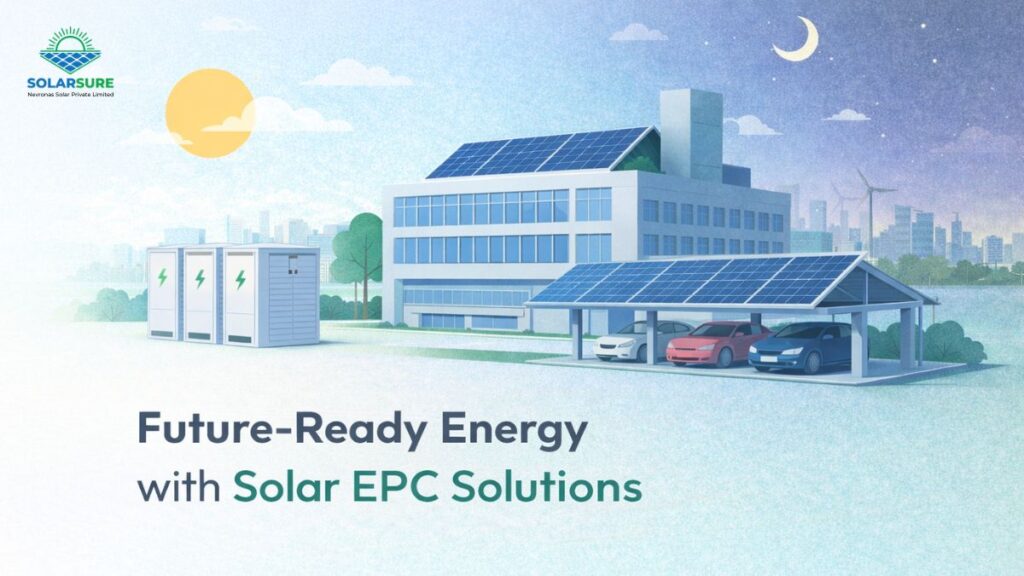
Battery storage can store daytime solar energy and use it during evening peak tariff hours. This reduces expensive grid consumption.
Some facilities also use solar carports. They generate electricity while providing shaded parking and improving environmental reporting for clients and investors.
Reduced Dependence on Diesel Generators
Power outages or unreliable supply often force industries to use diesel generators. Diesel power typically costs ₹18–₹28 per unit, far higher than grid electricity.
Solar power helps businesses by:
- Reducing generator runtime
- Cutting fuel expense
- Lowering maintenance cost
- Improving operational stability
How Solar Helps C&I Businesses?
Solar EPC is not only about installing panels. It is about controlling one of the highest operating costs for the next 20 to 25 years.
A properly designed and maintained plant gives predictable electricity pricing, reduces exposure to tariff hikes, and improves operating margins. Businesses gain cost visibility and energy security at the same time.
A good EPC partner turns solar from a one-time project into a long-term financial asset that keeps working every day the factory or facility operates.
Over To You
If you operate a business in India, steadily rising electricity bills are a reality you deal with every month. Energy costs increase even when production remains the same, and over time, they begin to affect profitability and planning. A Solar EPC partner addresses this by ensuring the system is properly designed, approved, and maintained so it consistently produces electricity at a lower cost than the grid. Over the years, it has served as a working asset, continually generating savings alongside power.
So, if you are planning to adopt solar power or want to know more about solar, book a free consultation with us. Our experts will help you with proper solutions to your queries.