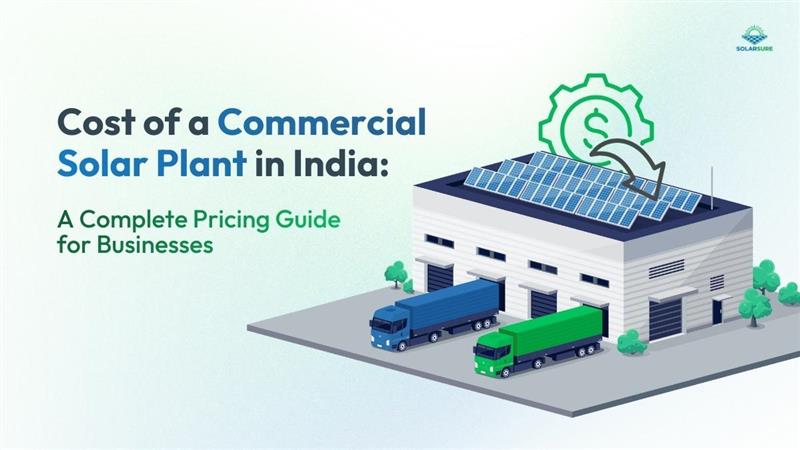
Every month, the electricity bills arrive, and the numbers feels little harder to justify for a business. Nowadays, installing solar is the only option to control expenses. Once decided to install solar, the next step is to understand how this works and the cost of a commercial solar plant.
Whenever you call any vendor or request a quote, you need to understand what a commercial solar plant actually costs and what drives that cost up or down. Because without that knowledge, you cannot tell a fair quote from an inflated one.
This blog will help you provide a detailed breakdown of the cost of installing a commercial-scale solar system. If you are a business owner evaluating commercial solar for the first time or want more clarity on costing, start here.
Average Cost of a Commercial Solar Plant in India
There is no single fixed price for a commercial solar plant because the cost changes with system size and site conditions. However, the price range across India has now become relatively stable due to competition and standardised equipment.
Below is the average price range in India for rooftop and ground-mounted systems.
| System Size | Approx Price per kW | Total Estimated Cost |
| 20 kW | ₹55,000 to ₹65,000 | ₹11 lakh to ₹13 lakh |
| 50 kW | ₹48,000 to ₹58,000 | ₹24 lakh to ₹29 lakh |
| 100 kW | ₹45,000 to ₹52,000 | ₹45 lakh to ₹52 lakh |
| 250 kW | ₹42,000 to ₹48,000 | ₹1.05 crore to ₹1.2 crore |
| 500 kW and above | ₹38,000 to ₹45,000 | Depends on the site and design |
The important point most businesses miss is that the price per kilowatt decreases as the plant size increases. A small system is always more expensive per kilowatt because installation effort, engineering work, and approvals remain almost the same regardless of plant size. When capacity increases, those fixed costs get distributed, which lowers the effective price.
These prices usually include a full EPC installation. That means equipment supply, structure, wiring, protection, installation, testing, and commissioning are part of the project.
Apart from the cost of a commercial solar plant, businesses also face practical challenges during solar installation, such as approvals, technical design, efficiency, and performance. This is why hiring a professional solar EPC company is important, as they manage the entire process from planning to smooth operation. To understand these issues and their solutions in detail, read our guide on solar project challenges and EPC solutions.
Effect of GST on Solar Cost
Government taxation policy has also improved project viability. Solar power generating systems supplied as a complete installation now attract 5% GST. Earlier, different components had higher effective taxation, which increased the cost of a commercial solar plant.
This change alone reduced rooftop solar installation cost by roughly 8-10%. For a medium-sized commercial project, this difference itself can save several lakh rupees and improve return on investment.
CAPEX and OPEX Model: Which Type of Model Suits Your Requirements
The total cost of a commercial solar plant that a business experiences depends more on the ownership model than on the equipment price.
In the CAPEX model, the business invests in the plant and becomes the owner. The company pays the installation amount once and then uses the generated electricity freely. The biggest advantage is long-term savings.
Since the plant life is about 25 years and payback is usually 4-6 years, the company effectively receives very low-cost electricity for almost two decades after recovering the investment. The company can also claim accelerated depreciation, which reduces taxable income in the initial years.
In the OPEX model, a solar developer installs the plant at its own expense on the business premises. The business does not invest any capital. Instead, it purchases electricity from the developer at a fixed rate lower than the grid tariff.
In this model, maintenance responsibility remains with the developer. This model is suitable for companies that prefer savings without investment, although tax benefits and ownership remain with the developer.
Price Structure Breakdown: Major Components of Solar Plant
The cost of a commercial solar plant in India is never a fixed figure. It shifts based on how large the system needs to be, what technology goes into it, where the site is located, and how the market is moving at the time of procurement.
A smaller commercial setup might start at 50 kW, while a large industrial plant can run into several megawatts. Each of these scales comes with its own economics and its own engineering demands, which ultimately vary its own price tag.
As of 2025-2026, most commercial rooftop and industrial solar installations in India are priced somewhere between ₹35,000 and ₹50,000 per kW for on-grid systems. Larger ground-mounted or multi-megawatt projects tend to land closer to ₹32,000 to ₹40,000 per kW, simply because buying and building at scale brings down the cost of nearly every component involved.
This makes the calculations compelling for businesses because of the broader price trajectory of solar in India. Over the past decade, solar PV module costs have fallen by more than 90-95%. Panels that once cost upwards of ₹200 per watt in 2010 now come in at under ₹9 to ₹15 per watt. That shift has been driven by advances in global manufacturing, a massive expansion in production capacity, and consistent policy support.
Understanding where that money goes is important for any business evaluating a solar project. The capital expenditure breaks down into four main categories, and each one plays a specific role in how the system performs and how long it lasts.
Solar PV Modules (50-60% of Total Cost)
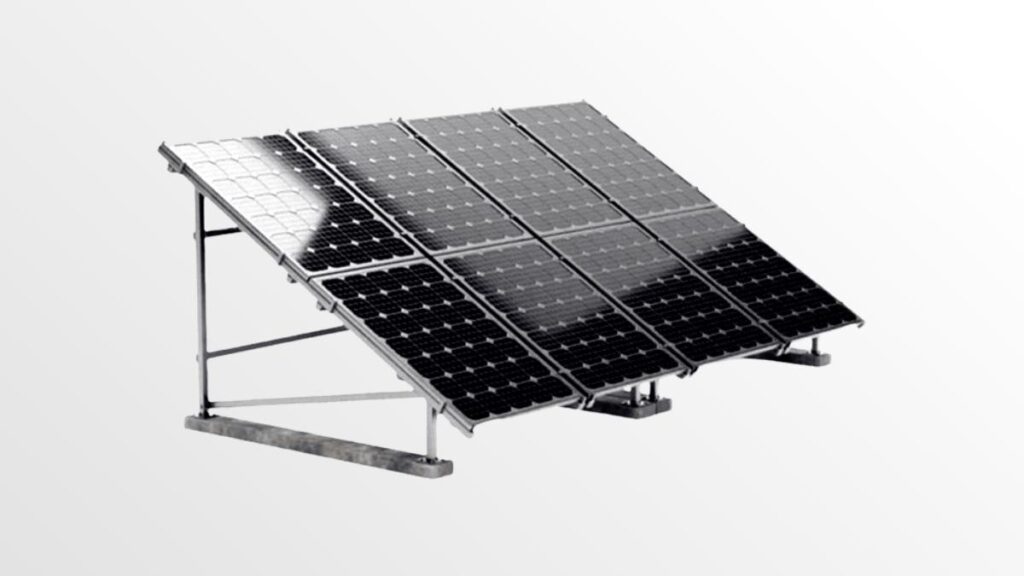
Solar panels represent the single largest share of any commercial installation budget. They are responsible for converting sunlight into electrical energy every single day for the next 25 years or more.
Modern commercial projects in India are increasingly moving toward N-type TOPCon panels (Tunnel Oxide Passivated Contact) and bifacial modules, and the reasons go beyond marketing. N-type TOPCon technology delivers efficiencies of 22-23% and above, which means more electricity is generated from the same roof area.
These panels also handle India’s heat better than older P-type technology, maintaining stronger output during peak summer months when temperatures routinely climb above 40 degrees. Their degradation rate is lower, meaning the drop in power output over time is more gradual, and the system retains more of its generating capacity well into its operational life. They are also resistant to potential induced degradation, which is a common reliability issue in humid and coastal climates.
Bifacial panels add another dimension entirely. By capturing sunlight reflected off surfaces beneath the panels, whether a white-painted rooftop or open ground, they can generate 10-30% more energy compared to conventional single-sided panels. For a business running a large flat roof or a ground-mounted array, this additional yield can meaningfully improve the ROI without requiring additional space.
On the cost side, bulk procurement at a commercial scale helps significantly. For projects in the 1 MW range and above, panel costs typically fall between ₹15,000 and ₹25,000 per kW equivalent, which depends on wattage, panel tier, quality materials, and procurement timing.
Solar Inverters (10-20% of Total Cost)

Inverters do the essential job of converting the direct current generated by the panels into the alternating current that the facility’s electrical infrastructure actually uses. In a commercial setting, inverter selection is a decision that affects not just upfront cost but system uptime and how well the installation can grow or adapt over time.
For medium-scale rooftop installations, three-phase string inverters ranging from 15 kW to 100 kW and beyond are the most common choice. They are cost-effective, straightforward to install, highly efficient, and backed by a mature ecosystem of spare parts and service support across India.
Larger projects lean toward central or high-capacity string inverters that can handle up to 385 kW or more per unit. Many of these now incorporate Synergy technology, which is a modular design approach that allows individual inverter sections to be serviced or replaced without taking the entire unit offline. This is particularly valuable for businesses that cannot afford extended generation downtime.
For a system in the 100 kW to 500 kW range, inverter costs typically range between ₹8,000 and ₹15,000 per kW, depending on the chosen capacity, technology, and whether advanced monitoring or power optimisation features are included.
Mounting Structures (8-15% of Total Cost)

A solar mounting structure might not seem like a glamorous investment, but it is the foundation on which everything else depends. A poorly designed structure can compromise panel orientation, accelerate degradation, or fail under weather stress, potentially damaging both the panels and the building beneath them.
Rooftop mounting systems are engineered to work with the specific characteristics of flat or sloped industrial rooftops. Aluminium and hot-dip galvanised steel are the materials of choice because they minimise additional load on the building while resisting corrosion from rain, humidity, and industrial environments. Many rooftop designs now incorporate elevated racking that allows air to circulate beneath the panels, reducing operating temperatures and improving energy output, an especially relevant factor for bifacial installations where ground reflection also matters.
Ground-mounted systems serve facilities with available open land adjacent to the building. These can be configured with fixed tilt angles optimised for the site’s latitude, or in some cases with single-axis trackers that follow the sun’s path through the day for higher annual yield.
Regardless of the type, all mounting structures in India must be designed to withstand wind speeds of up to 150 km per hour in many regions, along with applicable seismic zone requirements.
In coastal or cyclone-prone areas, the structural engineering demands are even higher and push costs upward accordingly. For projects in the 1 to 2 MW range, mounting structure costs generally fall between ₹30 and ₹90 lakhs in total, or roughly ₹3,000 to ₹5,000 per kW, with custom wind-resistant or elevated configurations sitting toward the higher end.
Balance of System (5-15% of Total Cost)

The Balance of System covers everything that connects, protects, and completes the installation. These are the components that rarely get mentioned in sales conversations but are critical to whether a system operates safely and at its full rated capacity over the long term.
This category includes the DC and AC cabling that carries power from the panels through the inverters and into the building’s distribution network. UV-resistant, double-insulated cables are essential because they run outdoors and must hold up against years of sun exposure, heat cycling, and occasional physical stress. Junction boxes and combiner boxes bring multiple panel strings together safely and provide the first line of protection for the DC side of the system.
Earthing and grounding systems are a non-negotiable part of any properly designed installation. India’s varied weather, including frequent thunderstorm activity across large parts of the country, makes lightning and surge protection equally important. A direct or nearby lightning strike without proper protection can destroy inverters and monitoring equipment in an instant.
Monitoring systems have become a standard inclusion in commercial installations. Real-time data on panel-level or string-level performance allows facility managers to spot underperforming sections quickly, confirm that generation targets are being met, and have accurate records for maintenance decisions and financial reporting.
Other BOS elements include AC distribution boards, disconnect switches, and any civil works required, such as cable trenching, panel foundations, or structural reinforcements to the roof.
Technical Requirements Before Installation
Before installation, a feasibility assessment is necessary. The roof must be structurally capable of supporting the additional load. Engineers usually conduct a structural analysis to confirm this.
The installation area must remain largely shadow-free during the daytime. Even partial shadow from a nearby building, tree, or water tank can reduce overall system generation because solar panels are electrically connected in strings.
Electrical infrastructure is also important. The plant size is generally linked with the sanctioned load approved by the local distribution company. Transformer capacity and safety protections must support power export to the grid.
Regulatory approvals are another requirement. Smaller rooftop systems typically operate under net metering, where extra energy is exported to the grid and adjusted in the electricity bill. Large consumers may use open access arrangements based on state policy.
How a Business Should Plan Its Solar Project?
The first step should always be understanding the electricity usage pattern. Solar generates electricity only during the day, so daytime consumption must be analysed. Many factories operate heavy machinery during working hours, which makes solar highly effective for them.
Correct system sizing is crucial. Installing a plant larger than the allowed load may create approval issues, while installing a very small system reduces potential savings. A professional energy study helps in selecting the right capacity.
Technology selection also affects returns. Limited rooftops benefit from high-efficiency panels, while large campuses can integrate solar as parking sheds or roof replacement structures.
Selecting an experienced installer is extremely important because solar performance depends heavily on engineering design quality, not just panel brand. Good companies provide performance monitoring systems that allow the owner to track generation and detect faults early.
Over to You
Commercial solar is one of those rare business decisions where the longer you wait, the more it costs you. Not because prices are going up, but because every month without a solar plant is another month of paying full grid rates that a solar installation would have eliminated.
The businesses seeing the strongest returns today are not the ones that spent the most. They are the ones who planned carefully, sized their systems correctly, picked the right ownership model for their financial situation, and chose an installer who took long-term performance seriously rather than just closing a sale.
If you want to find out the cost of a commercial solar plant in India for your facility and what your returns would look like, book a free consultation call with our team today. We will assess your site, analyse your consumption, and give you a clear, honest projection with no obligation attached.