Solar energy has become one of the smartest business decisions in India today. Electricity bills are climbing every year, grid reliability remains a concern in many industrial zones, and the pressure to adopt cleaner energy is growing from both regulators and customers. So, it is no surprise that businesses from small textile units in Surat to large auto-component manufacturers in Chennai are actively exploring solar installations and group captive power projects.
And yet, for every business that gets this right, there are several that end up disappointed. The savings are lower than the promised. The project is delayed by months. A regulatory approval falls through. Or worse, a poorly drafted agreement leaves them locked into unfavourable terms for the next two decades.
This blog walks you through the most common solar installation mistakes Indian businesses make while setting up solar plants and participating in group captive projects, so you can avoid them before they cost you time, money, effort, and peace of mind.
Common Solar Installation Mistakes Business Owners Make While Setting Up A Solar Plant
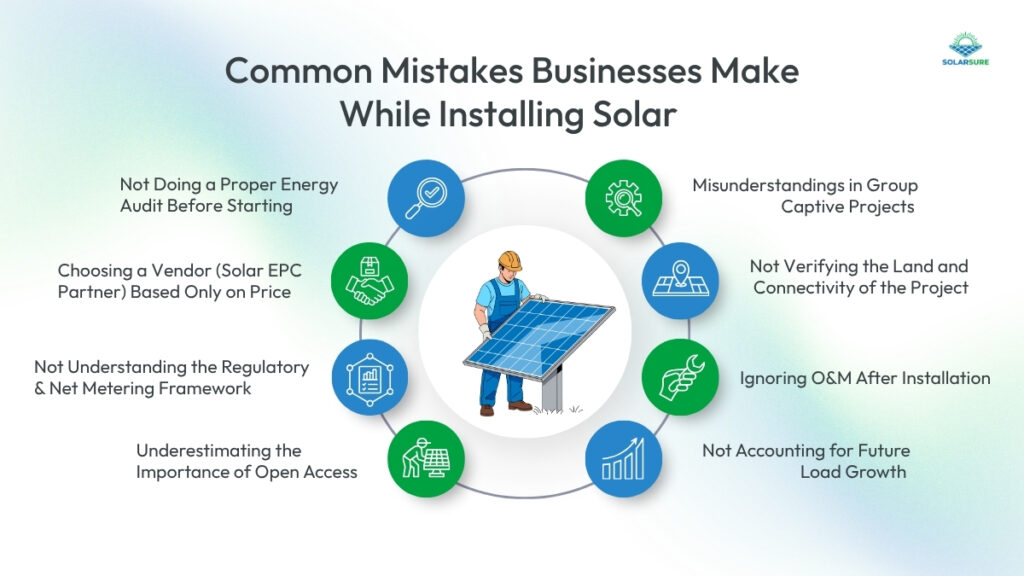
Not Doing a Proper Energy Audit Before Starting
Many businesses jump straight into getting solar quotes without first understanding their actual energy consumption pattern. They do not know their peak demand hours, power factor, generation requirements, or how their load changes across seasons.
When you skip the energy audit assessment, you end up either over-sizing or under-sizing your solar plant. An oversized plant means you paid more than needed. An undersized plant means your savings will be much lower than what was promised to you.
Before signing any agreement, get a detailed energy audit done. Understand your unit consumption month by month and your tariff category. This forms the foundation of a good solar proposal.
Choosing a Vendor (Solar EPC Partner) Based Only on Price
This is perhaps the most common solar installation mistake. A business gets three or four quotes and simply goes with the cheapest one.
In solar, the cheapest quote often uses lower-quality panels, cheaper inverters, and weaker civil and electrical work. The system might work fine for one or two years, but after that, the performance drops significantly. Panels degrade faster, inverters fail more often, and the savings you expected never fully materialise.
Instead, evaluate vendors on the quality of components they use, their past project references, their after-sales service track record, and the monitoring systems they provide. Ask for the make and model of panels and inverters, and check their efficiency ratings and warranty terms. A slightly higher upfront cost with better components and a reliable vendor will save you far more over the 25-year life of the project.
You can also read: What is Solar EPC and How It Works: Explained Step-by-Step Process
Not Understanding the Regulatory and Net Metering Framework
Solar projects in India operate within a framework of state electricity regulations. Every state has its own rules for net metering, gross metering, banking of units, wheeling charges, and cross-subsidy surcharges. These rules change frequently, and many business owners do not take the time to understand them.
For example, in many states, units exported to the grid after a certain threshold are settled at a lower rate than what you consume. If you are not aware of this, your financial projections will be incorrect.
For group captive projects specifically, there are strict regulatory requirements under the Electricity Act and CERC or SERC regulations. The minimum equity ownership by the consuming entity, the minimum self-consumption percentage, and the open access approval process are all critical factors that must be correctly handled.
Before starting any solar project, consult with someone who understands the regulatory landscape in your specific state. To know more about net metering, you can read “Complete Guide to Solar Net Metering System in India for Industrial and Commercial Consumers.”
Underestimating the Importance of Open Access
Open access is the mechanism through which businesses can procure power from a solar plant located outside their premises. While it sounds straightforward, getting and maintaining open access approval is a process that many businesses find unexpectedly difficult.
The mistakes here include not applying for open access well in advance, not accounting for the time it takes for state discoms to process applications, and not understanding that open access approval is not permanent and needs to be renewed periodically.
Some businesses have gone ahead with costly infrastructure investments only to find that their open-access application was rejected or delayed for months. This can completely derail the financial model of a group captive project. So, it is recommended to work with consultants or a reliable solar EPC partner who has hands-on experience in getting open access approvals in your specific state.
You can also read: What is Open Access Solar? A Complete Guide to Process, Fees, Timeline and Benefits
Misunderstandings in Group Captive Projects
Group captive is a popular model in India where multiple businesses come together to jointly own and consume power from a single solar plant. It offers attractive tariffs and helps businesses access renewable energy without setting up a full plant on their own. However, many businesses enter group captive arrangements without fully understanding how they work. The key misunderstandings include:
Mandatory Equity Ownership: Under the captive model, each consuming entity must hold at least 26% equity in the generating company and consume at least 51% of the power generated in proportion to its equity. Businesses often do not understand what this means in terms of actual financial commitment and legal obligations.
Long-term Commitment: Group captive agreements are typically for 15 to 25 years. Many businesses sign these without fully reading the exit clauses, lock-in periods, and penalty structures.
Not Zero Charges: Even in a group captive solar model, you still pay transmission charges, wheeling charges, and sometimes a cross-subsidy surcharge. The net savings depend on your current tariff and the applicable charges. Businesses often compare only the solar tariff with their current tariff without accounting for these additional costs. So, it is suggested to get the full landed cost of power, not just the generation tariff, before comparing it with your current electricity bill.
Not Verifying the Land and Connectivity of the Project
In group captive and third-party sale models, the solar plant is often located far from the business premises. Businesses often do not verify whether the project developer actually owns or has a long-term lease on the land, whether environmental clearances are in place, or whether the grid connectivity of the plant is confirmed.
There have been cases where businesses signed Power Purchase Agreements and paid advance money only to find that the developer’s project was stuck due to land disputes or delayed grid connectivity. So, before signing any agreement, conduct a basic due diligence on the project site, the developer’s financial health, and the status of regulatory approvals.
Ignoring O&M After Installation
The job does not end when the panels are installed. Operation and maintenance are critical to keeping your solar plant running at its best. Many businesses sign a low-cost or even no-cost O&M package and then wonder why their system is producing 15 to 20% less than projected after three years.
Good O&M includes regular panel cleaning, inverter health checks, string monitoring, yield analysis, and timely replacement of underperforming components. Make sure your O&M agreement has clear performance benchmarks and monitoring reports. In dusty industrial areas of India, panel cleaning alone can improve generation by 10 to 15% if done regularly.
Not Accounting for Future Load Growth
Businesses operating today will not operate in the same way after five years. Your energy consumption today might be very different from what it will be five years from now. Many businesses design their solar plant for the current load and realise later that they cannot easily add capacity based on further requirements.
If you expect your operations to expand, keep this factor in mind while designing the plant. Make sure that the structure, inverter capacity, wiring, and grid connection can support future expansion with minimal additional cost.
Bottom Line
Solar energy and group captive projects offer real and significant savings for Indian businesses. The economy is genuinely attractive, and more and more companies are making the switch successfully. But success depends on making informed decisions at every step. From the energy audit to the agreement signing to the daily monitoring of your plant, every stage requires attention.
Avoid rushing into decisions driven by low prices or aggressive sales pitches. Take your time, ask the right questions, and work with people who have a proven track record. If you want further clarity, schedule a free consultation call with us.