Many commercial and industrial businesses today are seriously evaluating solar power. The interest usually begins with a simple objective to reduce electricity costs without affecting operational reliability. However, once companies begin exploring solar, they quickly encounter several practical decisions.
Businesses must determine how large the solar plant should be, which financial model makes sense, and whether rooftop generation alone can meet their energy needs. In some cases, the question is not whether to install solar, but how to structure it so that it actually offsets a meaningful portion of the electricity bill.
These questions matter because solar is a long-term infrastructure decision. A poorly sized system may fail to offset meaningful electricity consumption. An incorrect financial model may reduce the expected return on investment.
This guide explains how industries can choose the right solar investment model, determine the appropriate plant capacity, and evaluate the most suitable solar configuration for their facility.
How to Choose the Right Solar Investment Model for Your Business?
Every industrial solar project begins with a financial decision. Businesses must determine whether they want to own the solar plant or purchase solar electricity from a developer.
These two approaches form the basis of the CAPEX model and the OPEX or RESCO model. The decision depends on several factors, including available capital, long-term business plans, and appetite for infrastructure ownership.
Companies that treat solar as a strategic asset often choose ownership. Others prefer to treat solar as a service and purchase power from developers. Both models remain widely used in the commercial and industrial sectors. Let us understand these models in detail.
The CAPEX Model (Self-Owned Solar Plant)
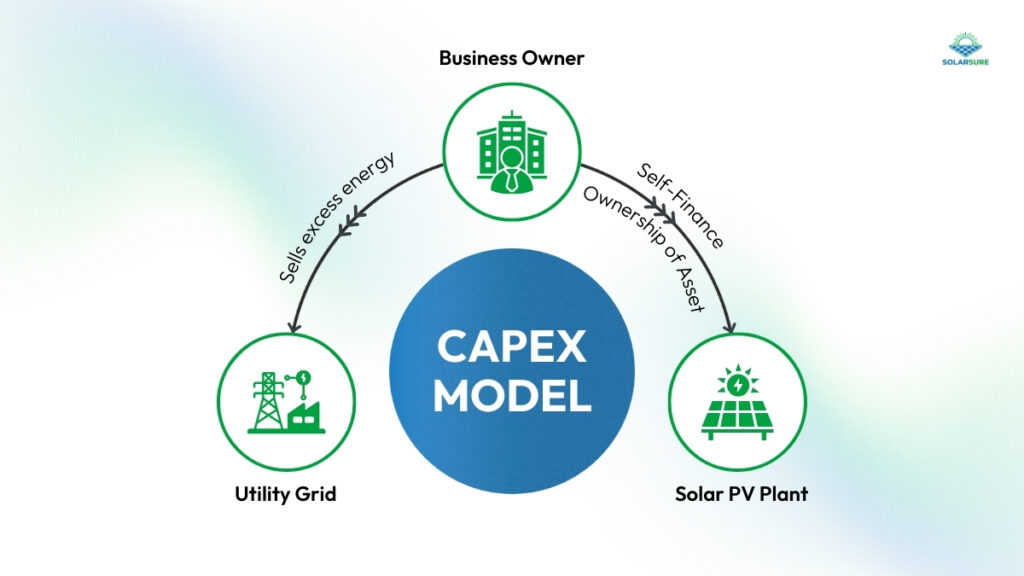
In the CAPEX model, the business invests its own capital to install the solar plant. The company becomes the owner of the system and consumes the electricity it generates.
If the plant produces more electricity than the business requires, the excess energy can often be exported to the grid or supplied to the government under applicable net metering or open access regulations. This model typically delivers the highest long-term financial return. Once the system recovers its installation cost, the electricity produced becomes extremely economical.
Most industrial solar plants achieve payback within four to six years. After this period, the plant continues generating low-cost electricity for nearly two decades. Another advantage of the CAPEX model lies in tax benefits for businesses. Businesses can claim Accelerated Depreciation on solar assets, which reduces taxable income in the early years of the project. This benefit improves overall project economics.
However, the CAPEX model requires upfront capital investment. The company must also ensure that the plant receives proper operation and maintenance throughout its lifetime. Industries with strong financial stability and long-term operational plans usually prefer this model.
When is the CAPEX Model Important for Businesses?
The CAPEX model generally works best for industries that:
- Have available capital for infrastructure investments
- Have high electricity consumption
- Plan to operate the facility for many years
- Want to maximise long-term financial returns
For such businesses, solar becomes not just a sustainability initiative but a high-performing financial asset.
The OPEX / RESCO Model (Third-Party Solar)
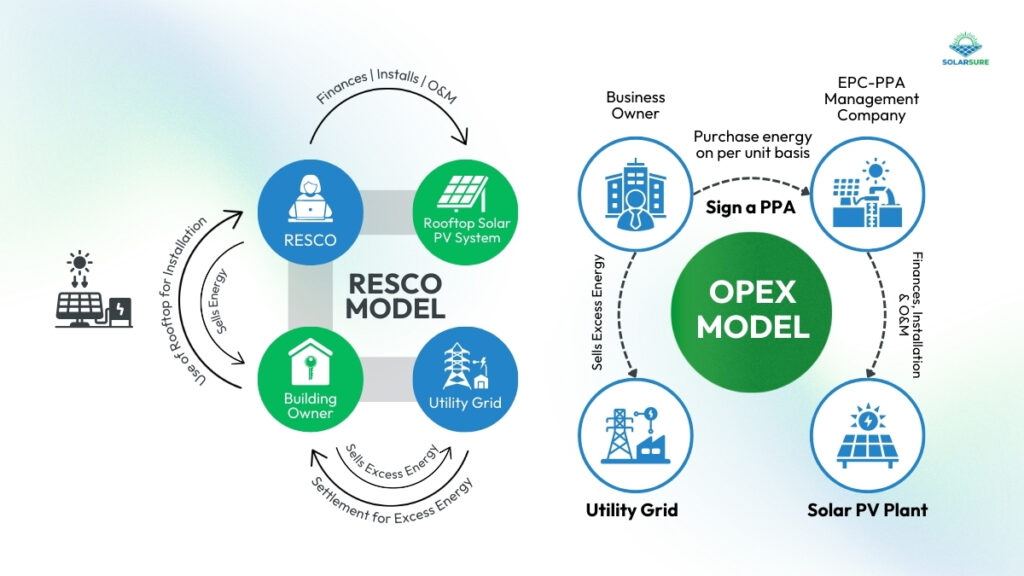
Some companies prefer not to allocate capital to energy infrastructure. Instead, they focus their financial resources on production expansion or core operations. For such businesses, the OPEX model provides an alternative route to solar adoption.
Under this arrangement, a solar developer finances, installs, and owns the solar plant. The industry purchases electricity generated from the system through a long-term Power Purchase Agreement. The electricity tariff agreed in the contract is usually lower than the local grid tariff.
This allows the business to reduce electricity costs immediately without making any upfront investment. The developer manages plant installation, performance monitoring, and maintenance responsibilities. The consumer simply purchases the generated power.
Many industries adopt this model when they want predictable electricity costs but prefer not to own energy infrastructure.
When is the OPEX Model Important for Businesses?
The OPEX model is often preferred by businesses that:
- Want to adopt solar without upfront capital investment
- Prefer predictable electricity costs over long periods
- Want to avoid managing plant maintenance
- Treat solar power as an energy procurement strategy rather than an asset investment
Although the lifetime savings are usually lower compared to owning the plant, the OPEX model allows companies to start benefiting from solar power immediately.
OPEX vs RESCO Model: A Comparative View
Both the OpEx and RESCO models allow businesses to adopt solar without investing upfront capital. Although there is a slight difference between the two models, they differ in how ownership, payment structures, and operational responsibilities are arranged.
These distinctions help procurement teams and decision-makers to evaluate which model aligns better with their financial strategy, risk tolerance, efficiency management, and operational requirements.
The table below provides a side-by-side comparison of the key differences between the OpEx and RESCO solar models.
|
Parameter |
OpEx Model |
RESCO Model |
| Asset Ownership | A third party or developer owns the solar plant | RESCO company owns and operates the solar system |
| Payment Structure | Customer pays through subscription, lease, or PPA fee. Fee may be fixed or variable | Customer pays only for the electricity consumed, usually charged per kWh |
| Scope | Focuses on energy supply. The cost is treated as an operating expense. | Includes energy supply along with operation, maintenance, and performance assurance. |
| Risk bearer | The developer takes responsibility for asset performance and system risks | RESCO provider takes full responsibility for energy generation and output |
| Upfront cost for the customer | Zero or minimal upfront investment | Zero upfront investment with a service-based arrangement |
| Operation and maintenance | Usually handled by the developer or shared with the customer | Fully handled by the RESCO provider |
| Output guarantee | Not always included, depending on the agreement | Energy generation or supply is typically guaranteed |
| Common use cases | Commercial rooftops, SMEs, and general solar procurement | Large industrial users, government projects, defence, and critical infrastructure |
If you want to know more about these models, consult these models in detail with a Solar EPC company. To know how a solar EPC can help you save costs, explore this blog: How Do Solar EPC Services Help Commercial and Industrial Businesses Save Energy Costs?
Decide Whether Your Business Needs Rooftop Solar or Open Access Solar
After selecting the financial model, industries must decide where the solar electricity will be generated. Most projects fall into two broad categories: rooftop solar installations and open access solar procurement.
The choice depends primarily on the facility’s energy demand and available installation space. Facilities with large rooftops often generate solar power on-site. Businesses with higher demand but limited space may procure solar electricity from off-site projects.
Let us understand how this distinction helps industries select the most practical solar configuration.
Rooftop Solar for Industrial Facilities
Rooftop solar systems are installed directly on factory sheds, warehouses, open spaces, and office buildings. Many industrial structures offer large roof surfaces that remain unused throughout the year. These surfaces can support solar installations effectively when they receive adequate sunlight.
A rooftop solar plant generates electricity exactly where it is consumed. This reduces transmission losses and improves overall energy efficiency for the businesses.
Industrial rooftop systems typically range between 50 kW and 5 MW, which depends on roof size. Facilities with multiple buildings may install even larger capacities.
Rooftop solar works best when the building structure can support the mounting system and the roof remains mostly shadow-free during the day. Industries such as textiles, pharmaceuticals, logistics, and automotive manufacturing commonly deploy rooftop solar plants.
Open Access Solar for High Energy Consumers
Some industries consume very large amounts of electricity but lack sufficient rooftop space. In such cases, rooftop solar alone cannot meet their energy needs.
Open access solar allows these companies to procure electricity from off-site solar plants. In open access, the solar project operates at a different location, often where land and solar resources work effectively. The electricity generated is transmitted to the industry through the state transmission network.
Large solar farms benefit from economies of scale and can often produce electricity at lower costs. Industries with high energy demand can use open access solar to access clean power without space limitations.
Captive and Group Captive Structures
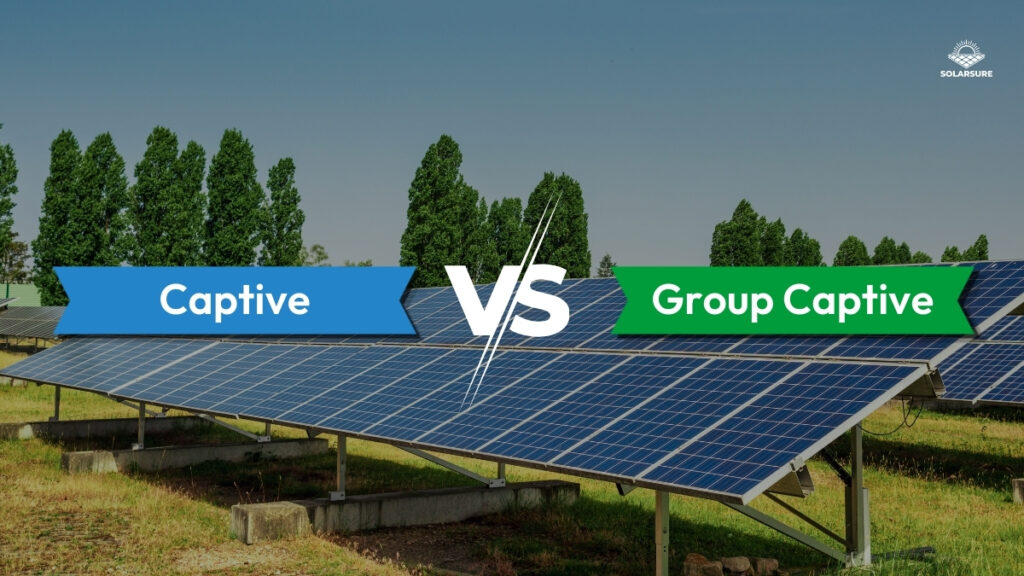 Many open access projects operate under captive or group captive regulations. Under the group captive structure, the consumer must hold at least 26% equity in the generating plant. The consumer must also consume at least 51% of the electricity generated.
Meeting these conditions allows industries to receive exemptions from certain grid surcharges. These exemptions significantly reduce the final landed cost of electricity.
For large industrial consumers, open access solar can reduce electricity costs by 25 to 40% compared with conventional grid tariffs.
When is Open Access Solar Suitable for Businesses?
- Industries with electricity demand above 1 MW
- Businesses with limited rooftop space
- Multi-facility industrial groups
- Large commercial campuses
Determine the Right Solar Capacity Your Industry Needs
One of the most common mistakes in industrial solar planning is selecting the plant size without proper analysis.
Installing a plant that is too small limits potential savings. Installing a plant that is too large may lead to unused generation capacity or regulatory restrictions.
A structured evaluation usually involves three key parameters.
Understand Your Annual Electricity Consumption
The first step in solar sizing involves analysing electricity consumption data.
Industries should review electricity bills from the previous twelve months. This data reveals annual electricity demand and seasonal variations. In India, one kilowatt of solar capacity typically generates around 1,500 to 1,600 units of electricity per year.
Engineers use this estimate to determine how much solar capacity can offset the facility’s electricity consumption. This analysis provides the first benchmark for system sizing.
Evaluate Available Roof Space
Solar panels require adequate shadow-free space for installation. A common design guideline suggests that one kilowatt of solar capacity requires roughly 100 square feet of roof area.
However, the usable space may be smaller because rooftops often contain equipment such as HVAC units, cooling towers, or skylights. A professional site survey helps determine the realistic installation capacity. Engineers also evaluate the structural strength of the roof before installation. This ensures that the building can safely support the solar mounting structures.
Check the Sanctioned Load Limit
Every electricity connection has a sanctioned load approved by the local DISCOM. In many Indian states operating under net metering regulations, the solar plant capacity cannot exceed the sanctioned load.
For example, if a facility has a sanctioned load of 800 kW, the rooftop solar plant is usually limited to that capacity. Ignoring this factor during planning can lead to regulatory complications during project approval.
Net Metering vs Gross Metering
The billing mechanism applied by the distribution company influences the financial performance of a solar installation. Usually, two primary mechanisms operate in many Indian states, net metering and gross metering.
Let us understand these in detail to know how these help industries estimate their potential savings.
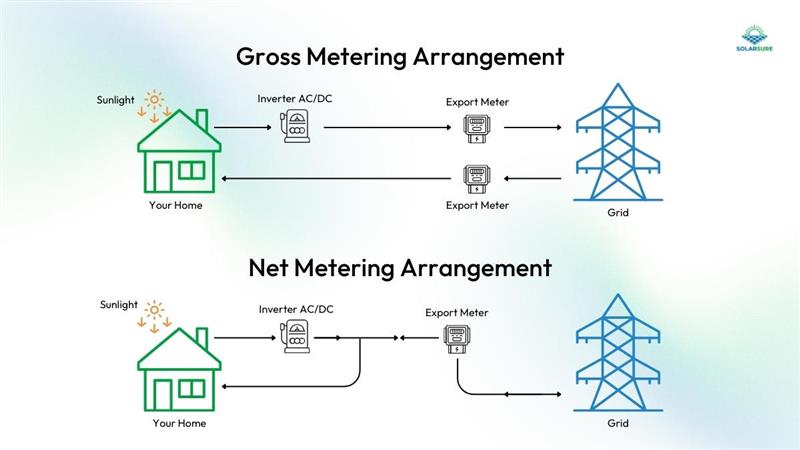
Net Metering
Under net metering, the electricity generated by the solar plant is first used by the facility itself. If the plant generates more electricity than the facility consumes at that moment, the excess power is exported to the grid.
The DISCOM provides credits for this exported electricity, which are adjusted against the monthly electricity bill. Net metering significantly reduces electricity expenses and generally offers the fastest return on investment for industrial rooftop solar projects.
Gross Metering
Under gross metering, the entire electricity generated by the solar plant is exported to the grid. The DISCOM purchases this electricity at a predetermined feed-in tariff.
The facility continues to purchase electricity separately from the grid for its own operations. This arrangement can be useful for buildings that have large rooftops but relatively low daytime electricity consumption. In such cases, the solar plant functions more like a revenue-generating asset.
Select the Right Solar Panel Technology
The choice of solar module technology affects plant efficiency and overall system performance. Several photovoltaic technologies are currently used in commercial and industrial solar installations.
Each technology offers different advantages depending on project requirements. Industries should understand the key characteristics of these technologies before selecting a module type. Here are some major solar panel technologies that businesses prefer for better efficiency.
Polycrystalline Solar Modules
Polycrystalline panels were widely used in earlier solar installations due to their lower manufacturing cost. These modules offer efficiencies between 15 and 17%.
Lower efficiency means they require more installation space to produce the same power output. As solar module prices have declined, many industrial projects now prefer higher-efficiency technologies.
MonoPERC Solar Modules
MonoPERC modules remain one of the most widely deployed technologies in modern solar projects. They provide efficiencies between 19 and 22% and offer a reliable balance between performance and cost.
Many rooftop installations across India use MonoPERC modules because they perform well under varied climatic conditions. Their proven reliability makes them a practical choice for many industrial facilities.
N-Type TOPCon Solar Modules
TOPCon technology represents a newer generation of solar cell design. These modules achieve efficiencies between 22 and 24% and perform well in high-temperature environments.
They also degrade more slowly over time compared with older technologies. Industries with limited rooftop space often prefer TOPCon modules because higher efficiency allows greater energy generation from the same area.
Heterojunction (HJT) Solar Modules
HJT solar panels combine crystalline silicon cells with thin-film layers. This design allows very high efficiency and strong performance under high temperatures.
HJT modules also experience very low degradation rates over time. These advantages make them attractive for projects that prioritise maximum energy output over the long term.
However, their cost remains higher than most other module technologies. So, this one is not a preferred option among commercial and industrial solar.
Bifacial Solar Modules
Bifacial panels generate electricity from both the front and rear surfaces of the module. They capture reflected sunlight from surrounding surfaces such as concrete, sand, or reflective roofing materials.
This design can increase energy generation by 5 to 20%, which depends on installation conditions. Bifacial modules are particularly effective in ground-mounted solar plants and open access projects.
Bottom Line
For commercial and industrial businesses, solar power is no longer just a sustainability initiative. It is a strategic decision that can influence long-term energy costs and operational stability. Since industrial solar plants typically operate for more than two decades, working with an experienced EPC partner becomes important.
A qualified EPC contractor can conduct detailed feasibility studies, manage regulatory approvals, design optimised systems, and ensure reliable plant performance over the life of the project. If you have any doubts or want to know more about solar for your facilities, schedule a free consultation with us.