
ALMM Update 2026 has become one of the most significant developments for India’s solar industry. The latest clarification from the Ministry of New and Renewable Energy (MNRE) removes uncertainty surrounding the implementation of ALMM List-II. However, it also highlights important deadlines that businesses cannot ignore. Consequently, developers, EPC companies, and commercial and industrial (C&I) consumers should review their project timelines without delay.
The notification confirms that no blanket extension applies to ALMM List-II requirements. Instead, eligible Open Access and Net Metering projects receive a limited exemption until 31 December 2026. Therefore, businesses planning new solar projects must align their procurement and commissioning strategies with the revised compliance timeline.
This update is more than a regulatory clarification. It directly affects project execution, equipment sourcing, investment planning, and supply chain decisions. Understanding this policy today can prevent costly decisions tomorrow. Therefore, let’s explore what the ALMM Update 2026 means, who it affects, and how businesses can prepare confidently for the transition.
What Is ALMM?
ALMM (Approved List of Models and Manufacturers) is a quality assurance framework introduced by the Ministry of New and Renewable Energy (MNRE). It identifies approved manufacturers whose solar modules and cells can be used in eligible solar projects. Consequently, the framework promotes quality, strengthens domestic manufacturing, and supports India’s long-term renewable energy goals.
Initially, ALMM covered only solar modules under List-I. Later, the government introduced List-II to include solar cells. Therefore, eligible projects must now comply with both lists based on the latest regulatory requirements.
The government introduced ALMM to encourage domestic manufacturing and reduce import dependence. Moreover, the framework improves supply chain resilience and supports India’s clean energy transition. As a result, businesses can procure reliable solar equipment while complying with government regulations.
Why Was ALMM Introduced?
MNRE introduced ALMM to strengthen India’s solar manufacturing ecosystem and ensure product quality. The framework also supports national initiatives like Atmanirbhar Bharat by encouraging the use of domestically manufactured solar components.
Its primary objectives include:
- Ensuring quality standards for solar modules and cells.
- Promoting domestic solar manufacturing.
- Reducing dependence on imported solar equipment.
- Building a resilient renewable energy supply chain.
- Supporting India’s long-term energy security goals.
ALMM List-I vs ALMM List-II
| Feature | ALMM List-I | ALMM List-II |
| Covers | Solar Modules | Solar Cells |
| Purpose | Approves eligible module manufacturers | Approves eligible cell manufacturers |
| Objective | Ensure module quality and compliance | Strengthen domestic cell manufacturing |
| Current Status | Applicable as per MNRE guidelines | Mandatory as per the latest implementation timeline |
| Primary Impact | Module procurement | Cell procurement |
What Does the Latest ALMM Update 2026 Say?

The Ministry of New and Renewable Energy (MNRE) issued a new clarification on 18 July 2026. The notification addresses the implementation of ALMM List-II for solar cells. More importantly, it removes confusion created by previous circulars and industry discussions.
The latest clarification confirms that no blanket extension applies to ALMM List-II requirements. Therefore, businesses should not assume that all solar projects remain exempt from compliance. Instead, the exemption applies only to specific project categories that meet the prescribed conditions.
MNRE has provided a limited exemption for eligible Open Access and Net Metering projects. However, these projects must be commissioned on or before 31 December 2026 to benefit from this relaxation. After this deadline, projects must comply with the applicable ALMM requirements.
This clarification gives businesses greater certainty for project planning and procurement. Consequently, developers and EPC companies can make informed decisions without relying on speculation about future policy extensions.
Key Highlights of the Notification
- No blanket extension has been granted for ALMM List-II.
- A limited exemption applies to eligible Open Access projects.
- Eligible Net Metering projects also receive temporary relief.
- The exemption remains valid until 31 December 2026.
- Projects commissioned after the deadline must follow applicable ALMM requirements.
- The notification clarifies and updates earlier MNRE Office Memorandums.
Previous Understanding vs Latest Clarification
| Previous Understanding | Latest MNRE Clarification |
| Many stakeholders expected a blanket extension. | No blanket extension has been granted. |
| Confusion existed around ALMM List-II implementation. | MNRE has clarified the applicable conditions. |
| Several temporary relaxations created uncertainty. | Only eligible projects receive limited exemption. |
| Businesses expected additional policy relaxations. | Compliance becomes mandatory after the prescribed deadline. |
Which Projects Can Benefit from the Temporary Exemption?
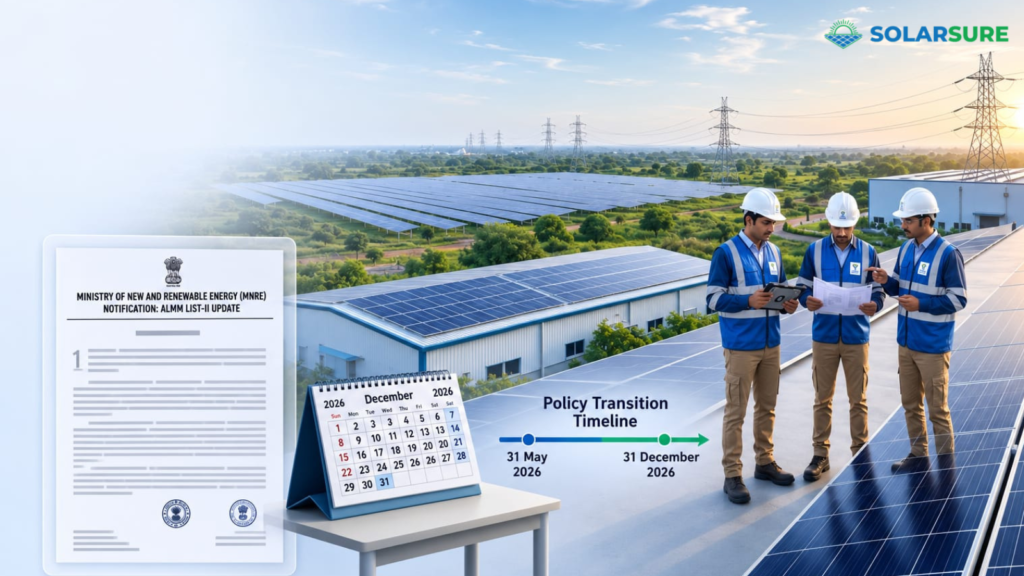
The latest MNRE clarification provides a temporary exemption for selected solar projects. However, the exemption does not apply to every installation. Therefore, businesses should carefully verify their project’s eligibility before planning procurement or commissioning activities.
Open Access Projects
Eligible Open Access projects can benefit from the temporary exemption until 31 December 2026. However, project developers must complete commissioning before the prescribed deadline. Missing this timeline may require compliance with the applicable ALMM requirements.
Example: A manufacturing company signs an Open Access Power Purchase Agreement (PPA) in September 2026. If the project achieves commissioning before 31 December 2026, it can benefit from the temporary exemption, subject to the notification’s conditions.
Net Metering Projects
The clarification also covers eligible Net Metering projects under the temporary relaxation. However, businesses should avoid assuming that every rooftop installation automatically qualifies. Project eligibility depends on meeting the conditions specified by MNRE.
Example: A commercial office installs a rooftop solar system under the Net Metering framework. Completing the project before the deadline helps the business remain eligible for the temporary exemption.
Why Does This Matter?
The temporary exemption provides businesses with additional planning flexibility. Consequently, developers can optimise procurement schedules while reducing uncertainty around ongoing projects. However, companies should treat this period as a transition rather than a long-term policy relaxation.
Waiting for another extension could increase compliance risks and delay project execution. Therefore, businesses should finalise procurement and commissioning plans as early as possible.
| Project Type | Temporary Exemption Available | Key Requirement |
| Open Access Projects | Yes | Commission before 31 December 2026 |
| Net Metering Projects | Yes | Meet MNRE conditions and commissioning timeline |
| Projects after 31 December 2026 | No | Comply with applicable ALMM requirements |
How Does the ALMM Update 2026 Impact Different Stakeholders?

The latest ALMM clarification affects every stakeholder differently. Therefore, each group should review its procurement strategy and project timeline carefully. Early planning can reduce compliance risks and prevent unnecessary project delays.
Commercial and Industrial (C&I) Businesses
Commercial and industrial businesses should reassess their upcoming solar investment plans. The revised timeline directly influences procurement decisions and project commissioning schedules. Consequently, delaying key decisions could increase compliance requirements after the exemption period ends.
Example: A textile manufacturer planning an Open Access solar project should confirm procurement timelines early. This approach helps avoid last-minute sourcing challenges and project execution delays.
Open Access Developers
Open Access developers must align project execution with the revised compliance timeline. Moreover, they should coordinate closely with EPC partners and equipment suppliers. Strong project planning can help developers complete eligible projects before the exemption expires.
Example: A renewable energy developer managing multiple industrial projects should prioritise sites nearing completion. This strategy can improve commissioning efficiency before the regulatory deadline.
EPC Companies
EPC companies should review their procurement strategy and supplier commitments immediately. Equipment availability and delivery schedules may influence project completion dates. Therefore, proactive coordination with manufacturers becomes increasingly important.
Example: An EPC contractor handling several rooftop solar installations should verify equipment availability before confirming commissioning schedules. Early procurement reduces the risk of unexpected project delays.
Solar Manufacturers
The notification reinforces India’s long-term focus on domestic solar manufacturing. Therefore, approved manufacturers may experience stronger demand as mandatory compliance approaches. This transition also supports investments in local manufacturing capacity and supply chain development.
Example: A domestic solar cell manufacturer may expand production capacity to meet rising market demand. Such investments can strengthen India’s renewable energy manufacturing ecosystem over time.
Why Did MNRE Introduce This Clarification?
The latest clarification reflects India’s long-term vision for a stronger domestic solar ecosystem. Instead of extending broad relaxations, the government has chosen a structured transition toward mandatory ALMM compliance. Consequently, businesses now have greater clarity while preparing future solar investments.
Strengthening Domestic Manufacturing
India aims to reduce its dependence on imported solar cells and modules. Therefore, ALMM encourages developers to source equipment from approved domestic manufacturers. This approach supports local production while creating new opportunities across the renewable energy value chain.
Example: Several Indian manufacturers have announced capacity expansions to meet growing domestic demand. These investments strengthen local supply chains and reduce dependence on overseas imports.
Improving Supply Chain Resilience
Global supply chain disruptions highlighted the risks of relying heavily on imported components. Therefore, the government continues encouraging local manufacturing to improve supply security. A stronger domestic ecosystem can also reduce procurement uncertainties during large-scale project execution.
Example: During the pandemic, delayed shipments affected solar project timelines across several countries. Many developers later diversified their sourcing strategies to improve supply chain resilience.
Supporting India’s Renewable Energy Goals
India has set ambitious renewable energy and clean energy capacity targets. Achieving these goals requires a reliable manufacturing ecosystem alongside rapid project development. Consequently, ALMM supports both quality assurance and long-term industry growth.
Example: Large utility-scale and commercial solar projects increasingly prefer reliable supply partners. Consistent equipment availability helps projects maintain planned commissioning schedules.
What Should Businesses Do Next?

The temporary exemption offers businesses valuable planning flexibility. However, companies should avoid treating it as a long-term solution. Instead, they should use this period to prepare for mandatory ALMM compliance and reduce future project risks.
-
Review Your Project Timeline
Evaluate your project’s development and commissioning schedule without delay. Consequently, you can identify potential risks before they affect project completion. Early planning also provides greater flexibility during procurement and execution.
-
Verify Equipment Compliance
Confirm whether your selected solar modules and cells meet applicable ALMM requirements. Moreover, discuss compliance with your EPC partner before placing procurement orders. This step can prevent unexpected changes during project execution.
-
Strengthen Procurement Planning
Develop a procurement strategy based on realistic delivery timelines and supplier commitments. Relying on last-minute equipment availability can increase both costs and project uncertainty. Therefore, secure critical components as early as possible.
-
Work Closely with Your EPC Partner
Maintain regular communication with your EPC contractor throughout the project lifecycle. Collaborative planning helps identify challenges before they become costly delays. It also improves coordination between procurement, installation, and commissioning activities.
-
Plan Beyond the Exemption Period
Businesses should prepare for mandatory ALMM compliance after the temporary exemption ends. Consequently, long-term procurement strategies should align with India’s evolving solar policy framework. Early preparation will reduce compliance risks and improve project certainty.
Expert Tip
Businesses should not base investment decisions on the possibility of another policy extension. Instead, planning according to the current regulatory timeline creates greater certainty and reduces execution risks. A proactive approach almost always delivers better project outcomes than a reactive one.
Common Mistakes Businesses Should Avoid
Many businesses focus only on policy announcements and overlook execution planning. However, successful solar projects depend on timely decisions and effective coordination. Avoiding these common mistakes can reduce compliance risks and improve project outcomes.
Assuming Another Extension Will Be Announced
Some businesses may postpone decisions while expecting another policy extension. However, investment decisions should always follow the current regulatory framework. For instance, a manufacturing company delaying procurement while anticipating another extension may later face costly design changes to meet updated compliance requirements.
Delaying Procurement Decisions
Waiting until the final months can increase procurement pressure and delivery risks. Moreover, rising demand may affect equipment availability and project schedules. Consider an EPC contractor managing multiple projects simultaneously. Placing equipment orders close to the deadline could delay deliveries and push project commissioning beyond the exemption period.
Ignoring Supplier Compliance
Selecting equipment without verifying ALMM compliance can create unnecessary project risks. Therefore, businesses should confirm supplier approvals before finalising procurement contracts. A practical example is a developer discovering late that selected solar cells do not meet applicable ALMM requirements. Replacing non-compliant equipment can increase both costs and project timelines.
Treating Compliance as a Final-Step Activity
Many businesses review compliance only after procurement decisions are complete. However, compliance planning should begin during the project’s early stages. Imagine a commercial facility evaluating ALMM requirements before selecting equipment and suppliers. This proactive approach helps prevent last-minute changes and keeps project execution on schedule.
Frequently Asked Questions (FAQs)
Q. What is the ALMM Update 2026?
The ALMM Update 2026 is the latest clarification issued by the Ministry of New and Renewable Energy (MNRE). It confirms that no blanket extension applies to ALMM List-II requirements. However, eligible Open Access and Net Metering projects can benefit from a temporary exemption until 31 December 2026, subject to the prescribed conditions.
Q. What is ALMM List-II in the solar industry?
ALMM List-II is the Approved List of Models and Manufacturers for solar cells. It identifies approved manufacturers whose solar cells can be used in applicable projects. The framework supports domestic manufacturing, improves equipment quality, and strengthens India’s renewable energy supply chain.
Q. Has MNRE extended the ALMM List-II deadline for all solar projects?
No, MNRE has not granted a blanket extension for all solar projects. Instead, the latest clarification provides a temporary exemption only for eligible Open Access and Net Metering projects. Businesses should review the notification carefully before making procurement or commissioning decisions.
Q. Which projects are eligible for the temporary ALMM exemption?
The temporary exemption applies to eligible Open Access and Net Metering projects meeting the conditions specified by MNRE. These projects must also be commissioned before 31 December 2026 to benefit from the temporary relaxation. Projects commissioned later must comply with the applicable ALMM requirements.
Q. What happens after 31 December 2026 under the latest ALMM update?
After 31 December 2026, eligible projects must comply with the applicable ALMM requirements under the prevailing government guidelines. Therefore, businesses should complete planning, procurement, and commissioning activities well before the exemption period expires to minimise compliance risks.
Q. How does the ALMM Update 2026 affect Open Access solar projects?
The clarification provides temporary flexibility for eligible Open Access projects until the specified deadline. However, developers should not delay project execution or procurement planning. Early commissioning can help businesses benefit from the temporary exemption while maintaining regulatory compliance.
Q. How does the latest ALMM clarification impact commercial and industrial (C&I) businesses?
Commercial and industrial businesses should review their solar investment timelines carefully. The clarification influences procurement planning, equipment sourcing, and project commissioning schedules. Consequently, early planning can reduce execution risks and help businesses meet the applicable compliance requirements.
Q. What should businesses do to comply with ALMM requirements?
Businesses should review project timelines, verify equipment compliance, and coordinate closely with EPC partners. They should also confirm supplier approvals before placing procurement orders. Taking these steps early can reduce project delays and improve overall execution efficiency.
Q. Why did the Government of India introduce ALMM for solar projects?
The Government introduced ALMM to strengthen domestic solar manufacturing and improve equipment quality. The framework also reduces dependence on imported components while supporting India’s long-term renewable energy goals. Consequently, it helps build a more resilient and reliable solar ecosystem.
Q. Where can businesses find the latest official ALMM notifications and guidelines?
Businesses should always refer to official notifications issued by the Ministry of New and Renewable Energy (MNRE) for the latest ALMM updates. They can also consult government circulars and policy documents to verify compliance requirements before planning new solar projects.
Bottom Line
The ALMM Update 2026 provides much-needed clarity for India’s solar industry. While eligible Open Access and Net Metering projects receive temporary relief, the notification confirms that no blanket extension applies to ALMM List-II requirements. Therefore, businesses should review the latest compliance timeline before making critical project decisions.
The clarification also signals India’s continued focus on strengthening domestic solar manufacturing and building a resilient renewable energy supply chain. Consequently, developers, EPC companies, and commercial and industrial (C&I) consumers should align their procurement and commissioning strategies with the evolving regulatory framework.
Most importantly, businesses should view the temporary exemption as an opportunity to prepare rather than postpone. Early planning, compliant equipment sourcing, and proactive project execution can reduce compliance risks while ensuring smoother project delivery. Organizations that act today will be better positioned for India’s next phase of solar growth.