
On-site vs off-site PPA these two terms define the most fundamental choice in corporate solar procurement in India. Get this decision right, and your savings start on Day 1. Get it wrong, and you pay for the mistake for 25 years.
The difference is simple at the surface. On-site means the solar plant sits on your roof or premises. Off-site means it sits somewhere else and power travels to you through the grid. However, that physical difference creates a cascade of financial, regulatory, and operational consequences.
CSS exemption, capital requirements, load size fit, roof availability, accelerated depreciation every one of these factors plays out differently depending on which structure you choose. This guide covers both models in full. It also gives you a practical framework to decide which is right for your specific business in 2026.
| Rs 2.20
Typical on-site PPA rate per unit |
Rs 3.40
Typical off-site group captive landed cost |
CSS 0
Both captive structures CSS fully exempt |
25 yrs
Standard PPA tenure for both models |
What Is On-Site vs Off-Site Solar PPA? A Clear Definition
In an on-site solar PPA, the developer builds a solar plant directly on your premises. This includes your rooftop, carport, or adjacent land. Power flows from the panels straight to your electrical panel. No grid transmission is involved. You consume what you generate, in real time.
In an off-site solar PPA, the developer builds a ground-mounted plant at a remote location. This is typically in a high-irradiance zone Rajasthan, MP, or Gujarat. Power travels through the state grid to your facility. You pay the developer a PPA rate plus regulated grid charges for that journey.
Both structures fall under the broader category of the on-site vs off-site PPA spectrum. Both give you solar power. However, the financial architecture, CSS treatment, and suitability differ substantially. Understanding the distinction is the starting point of any good solar procurement decision.
For a full introduction to PPA structures in India, read: Renewable Power Purchase Agreement for Net-Zero Solarsure.
Key Differences Between On-Site and Off-Site Solar PPA in India
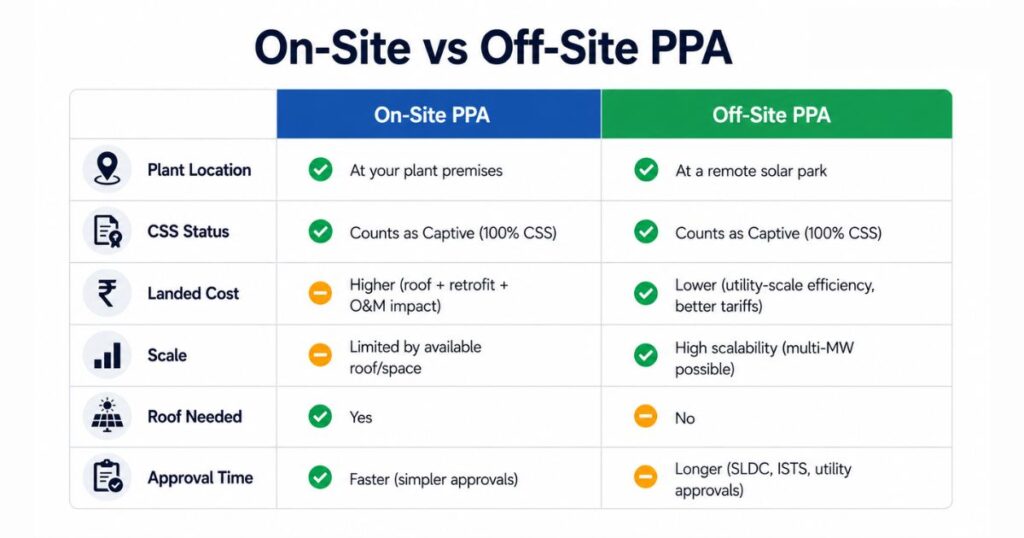
The table below summarises the core distinctions. Study each row carefully. Each one represents a financial or regulatory variable that affects your total savings.
| Factor | On-Site Solar PPA | Off-Site Solar PPA |
| Plant Location | Your roof, premises, or adjacent land | Remote site wheeled to you via grid |
| Capital Required | Zero (developer-owned PPA) | Zero (3rd party) or 26% equity (group captive) |
| CSS Status | Exempt captive consumer by default | Exempt (group captive) or Applicable (3rd party) |
| Wheeling/Transmission | None direct consumption | Applies Rs 0.55–1.50/unit by state |
| Typical Landed Cost | Rs 2.20–2.60/unit | Rs 3.40–5.50/unit (model + state dependent) |
| Accelerated Depreciation | 40%/60% if you own the plant | 40%/60% on equity portion (group captive) |
| Scale Range | 100 kW to ~2 MW | 500 kW to 100 MW+ |
| Roof/Land Required | Yes structural clearance needed | No developer arranges remote land |
| Grid Dependency | None for direct on-site generation | Yes SLDC scheduling, metering required |
| BRSR / REC Documentation | Full on-site generation RECs | Full generation + transfer RECs |
| Approval Complexity | Low DISCOM net metering, CEIG | High SLDC, STU connectivity, GEOA |
How an On-Site Solar PPA Works and When It Makes Sense
In an on-site PPA, the developer installs solar panels on your building. They own and maintain the system throughout the PPA tenure. You pay a fixed per-unit rate for electricity generated. The rate starts at Rs 2.20 to Rs 2.60 per unit.
Power flows directly from panels to your electrical board. No grid transmission occurs. Therefore, you pay no wheeling charges, no transmission fees, and no CSS. Additionally, because you consume power at the same point as generation, you qualify as a captive consumer under the Electricity Act 2003. This captive status makes CSS and Additional Surcharge fully exempt.
The savings are immediate. From Day 1 of commissioning, your DISCOM bill drops. For a business paying Rs 9 per unit, every unit from the on-site system saves Rs 6.40 to Rs 6.80 per unit. That saving goes straight to operating margin.
Capital, Ownership, and Tax Status On-Site PPA
In a standard on-site PPA, the developer owns the plant. Therefore, no capital expenditure is required from your side. The developer recovers investment through the PPA rate over 15 to 25 years.
If you choose to own the plant instead a captive CAPEX model you claim 40% accelerated depreciation under Section 32. Manufacturing businesses claim 60%. This produces a Rs 20 to Rs 30 lakh tax saving in Year 1 on a Rs 2 crore plant. As a result, effective payback drops to 2.0 to 2.8 years for most businesses.
The Section 32 depreciation rules are documented at incometaxindia.gov.in.
Who Should Choose an On-Site Solar PPA
On-site is right for you if your building has adequate rooftop or open land area. It suits daytime-heavy operations retail complexes, IT parks, hotels, food processing factories, and commercial offices.
However, on-site generation typically covers 40 to 75 percent of total consumption. It cannot replace all grid power. For businesses with large loads above 2 MW, the roof simply runs out of space. In those cases, on-site handles the baseline load and off-site handles the remainder.
How an Off-Site Solar PPA Works and When It Makes Sense
In an off-site PPA, a solar plant is built at a remote location. Power is injected into the state grid. The SLDC schedules delivery to your factory in 15-minute blocks. You draw that power from your existing DISCOM connection.
The landed cost includes the developer’s PPA rate plus regulated charges. These charges cover wheeling, transmission, SLDC fees, and for third-party consumers CSS and Additional Surcharge. For group captive consumers, CSS and Additional Surcharge are exempt. This makes group captive the dominant off-site structure in high-CSS states.
Off-site structures work for any load size above 500 kW. There is no roof requirement. The developer selects land with optimal irradiance. This is a major advantage for factories in dense industrial zones with limited roof area.
Open Access Charges and the CSS Variable Off-Site PPA
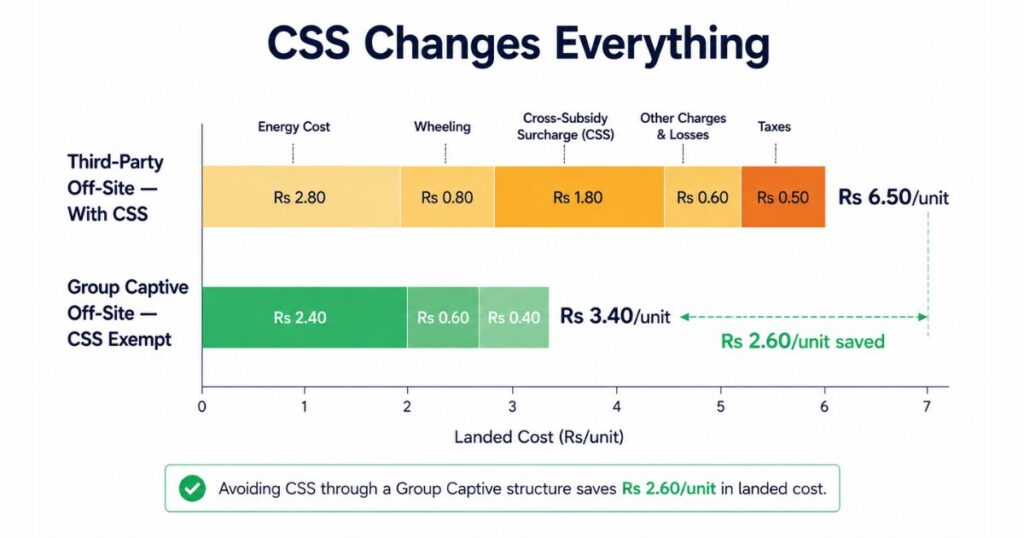
CSS is the critical charge in any off-site calculation. In Maharashtra, third-party CSS runs to Rs 2.11 per unit. That turns a Rs 2.50 PPA rate into a Rs 6.00+ landed cost. The saving over the DISCOM shrinks sharply.
However, group captive eliminates CSS entirely. A 26% equity stake in the plant grants captive status. Therefore, off-site group captive delivers Rs 3.40 to Rs 4.20 per unit landed competitive with on-site in most states.
For a full charge breakdown by state, read: Open Access Solar Charges Explained India 2026. On-site vs off-site PPA selection for MSMEs: Open Access Solar for MSMEs and Factories.
Who Should Choose an Off-Site Solar PPA
Off-site is right for factories with loads above 500 kW to 1 MW. It suits businesses with no adequate roof. It works for operations in multiple locations one shared plant serves several consumption points.
Additionally, off-site is the only viable route for businesses wanting to source 100% of their electricity from solar. A 5 MW off-site plant delivers 5 to 6 times more generation than a 1 MW rooftop. Consequently, off-site is the model for companies with aggressive net-zero electricity targets.
The CSS Exemption The Biggest Financial Difference in Any PPA Decision
CSS – Cross-Subsidy Surcharge is not a minor charge. In high-CSS states, it determines whether off-site solar is economic at all.
Under Section 42(2) of the Electricity Act 2003, captive and group captive consumers are fully exempt from CSS and Additional Surcharge. Third-party consumers pay both in full. The Electricity Act 2003 Section 42 is documented at indiacode.nic.in.
| State | Third-Party CSS | Group Captive CSS | Annual Saving on 2L units/month |
| Maharashtra | Rs 2.11/unit | Rs 0 EXEMPT | Rs 50.6 lakh/year |
| Karnataka | Rs 0.60–0.90/unit | Rs 0 EXEMPT | Rs 14.4–21.6 lakh/year |
| Tamil Nadu | Rs 0.40–0.80/unit | Rs 0 EXEMPT | Rs 9.6–19.2 lakh/year |
| Madhya Pradesh | Rs 0.30–0.60/unit | Rs 0 EXEMPT (GEOA) | Rs 7.2–14.4 lakh/year |
| Rajasthan | Rs 0.40–0.80/unit | Rs 0 EXEMPT | Rs 9.6–19.2 lakh/year |
The CSS exemption is established under the Electricity Act 2003 and confirmed by Supreme Court judgment. Any EPC company that cannot explain your CSS status in writing is not equipped to structure your PPA correctly.
On-Site vs Off-Site PPA Cost Comparison for India 2026
The table below shows indicative all-in landed costs for both models across different load sizes and states. All figures assume commissioning before October 3 to capture full accelerated depreciation where applicable.
| Model | PPA Rate | All Charges | Landed Cost | vs Grid (Rs 9/unit) |
| On-Site Captive PPA (CAPEX owned) | Rs 2.20–2.60 | Nil | Rs 2.20–2.60/unit | 71–75% saving |
| On-Site Developer PPA (zero CAPEX) | Rs 2.40–2.80 | Nil | Rs 2.40–2.80/unit | 69–73% saving |
| Off-Site Group Captive (MP / Rajasthan) | Rs 2.40–2.70 | Rs 1.00–1.30 | Rs 3.40–4.00/unit | 55–62% saving |
| Off-Site Group Captive (Maharashtra) | Rs 2.40–2.70 | Rs 0.80–1.10 | Rs 3.20–3.80/unit | 58–64% saving |
| Off-Site Third-Party (Karnataka) | Rs 2.40–2.70 | Rs 1.50–2.00 | Rs 3.90–4.70/unit | 48–57% saving |
| Off-Site Third-Party (Maharashtra) | Rs 2.40–2.70 | Rs 3.50–4.00 | Rs 5.90–6.70/unit | 26–34% saving only |
All figures assume Bifacial TOPCon modules, standard DC/AC ratio 1.2, and commissioning in FY2025-26.
What Should Drive Your Decision A Practical Framework
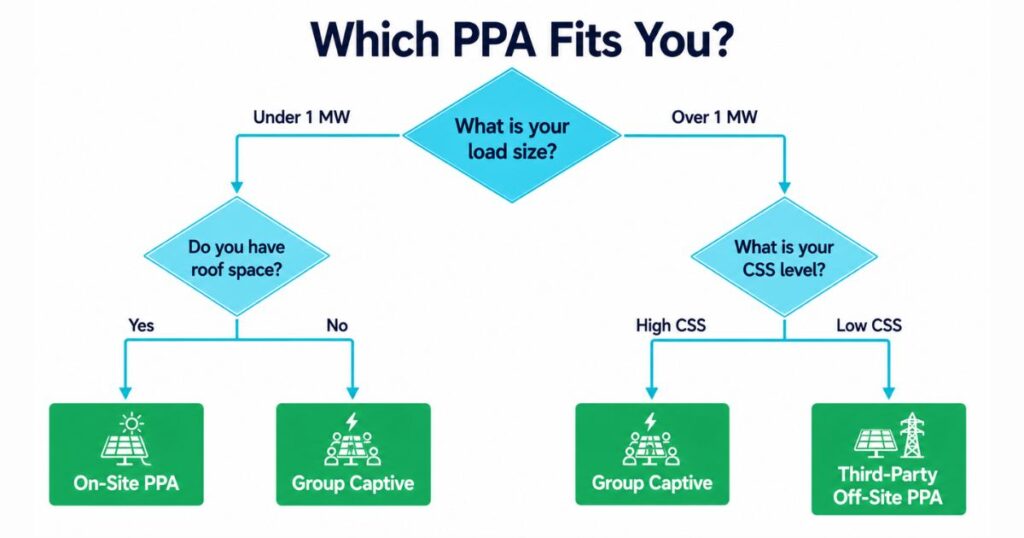
Choosing between on-site vs off-site PPA is not about preference. It is about matching the right model to your specific business conditions. Four checks determine the answer.
Check 1 Roof or Land Availability
On-site solar requires suitable roof space or adjacent open land. A 1 MW rooftop system needs approximately 5,000 to 6,000 square metres of shadow-free, structurally sound roof area. If your building cannot provide this, on-site solar is limited. Off-site removes this constraint entirely. The developer identifies and leases land in a high-irradiance zone. Additionally, rooftop structures must pass a structural load assessment before installation.
Check 2 Your Load Size and Daytime Pattern
On-site solar is size-limited by available roof. Most industrial rooftops support 100 kW to 2 MW. If your total load is 5 MW, on-site covers only a fraction. Furthermore, on-site generation aligns with solar hours 8 AM to 5 PM. Factories with heavy night-shift or 24×7 operations cannot absorb full on-site generation in real time. Off-site with banking allows more flexible consumption matching.
Check 3 Your State and CSS Level
In low-CSS states like Karnataka and Rajasthan, third-party off-site PPAs are economically competitive. In Maharashtra, CSS of Rs 2.11 per unit makes third-party unviable. Group captive is the right off-site choice there. On-site avoids CSS entirely regardless of state. Therefore, check your state SERC order before any off-site procurement decision.
Check 4 Capital Position
On-site PPA structures require zero capital. The developer owns the plant. However, if you own the plant a CAPEX model you capture the full accelerated depreciation benefit. This typically returns Rs 20 to Rs 30 lakh in Year 1 on a Rs 2 crore plant. Off-site group captive requires 26% equity investment. This is typically Rs 25 to Rs 60 lakh per 500 kW share. If capital is tight, a zero-capex on-site or third-party off-site PPA serves better. Solarsure models both scenarios with 25-year projections before any recommendation.
Can You Use Both? The Hybrid On-Site and Off-Site PPA Strategy
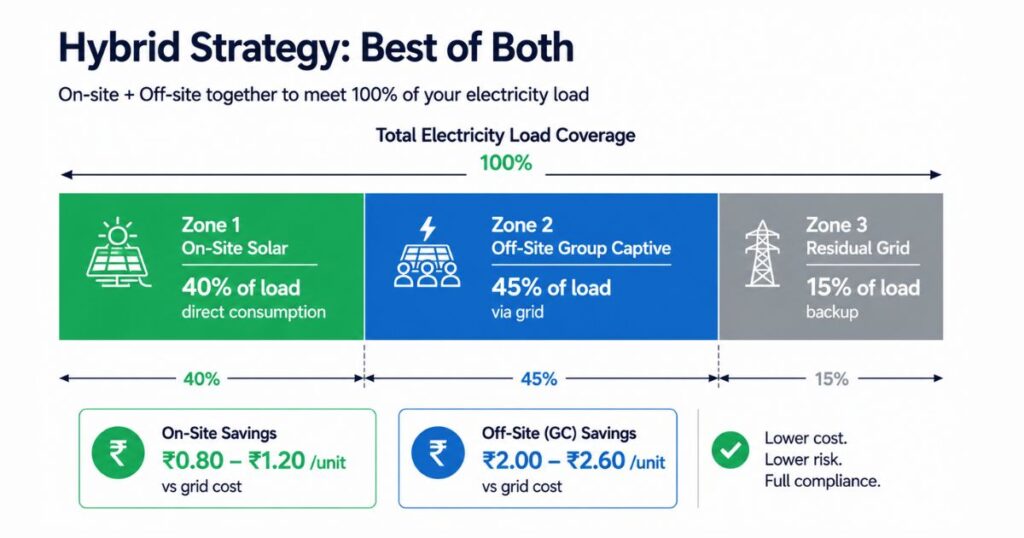
Many Indian corporates in 2026 run both on-site and off-site solar simultaneously. This is not unusual. It is often the most economically rational strategy for medium-to-large industrial consumers.
Here is how it works. The on-site plant covers 30 to 60 percent of daytime load directly. This reduces grid draw during peak solar hours. The off-site plant handles the remaining load including nights, weekends, and monsoon periods through banking. Together, the two systems can cover 80 to 100 percent of annual electricity consumption from solar.
Furthermore, the hybrid approach optimises the on-site vs off-site PPA decision by matching each model to its strength. On-site is cheaper per unit and needs no grid charges. Off-site scales beyond what any roof can deliver. Additionally, a hybrid structure produces more verifiable REC documentation for BRSR and RE100 reporting.
UltraTech Cement uses exactly this structure. It combines on-site captive rooftop plants at its manufacturing facilities with large off-site group captive agreements like its 30 MW Odisha plant. As a result, it achieves clean energy coverage across its full operational footprint not just at headquarters.
For a full financial model comparison, read: Solar Payback Period for C&I India 2026.
For MNRE open access policy guidelines: mnre.gov.in.CERC open access regulations: cercind.gov.in. CEA grid emission factor: cea.nic.in.
Frequently Asked Questions On-Site vs Off-Site Solar PPA India
Q: What is the main difference between on-site and off-site solar PPA in India?
A: On-site means the solar plant sits on your premises roof or land. Power flows directly to your meter without using the grid. Off-site means the plant is at a remote location. Power travels through the state grid to your facility via open access. Therefore, on-site avoids all grid charges. Off-site incurs wheeling, transmission, and CSS charges. However, CSS is fully exempt for captive and group captive consumers under the Electricity Act 2003. As a result, group captive off-site can match on-site economics in most states.
Q: Which is cheaper on-site or off-site solar PPA?
A: On-site solar is generally cheaper per unit. Typical landed cost is Rs 2.20 to Rs 2.60 per unit. No wheeling or CSS applies. Off-site group captive costs Rs 3.40 to Rs 4.20 per unit all-in after state charges. However, on-site is limited by roof area. For loads above 2 MW, off-site is the only way to scale. Additionally, the CSS exemption in group captive reduces the gap significantly. In low-CSS states like Rajasthan and MP, the difference between the two models is only Rs 0.80 to Rs 1.20 per unit.
Q: Does an on-site solar PPA qualify as captive under the Electricity Act?
A: Yes. When a developer builds a solar plant on your premises and you consume the output, you qualify as a captive consumer under the Electricity Act 2003. This grants full exemption from CSS and Additional Surcharge. Furthermore, if you own the plant a captive CAPEX model you claim 40 to 60 percent accelerated depreciation under Section 32. This makes owned on-site solar one of the highest-IRR investments available to Indian businesses in 2026.
Q: What is group captive and how does it relate to off-site PPA?
A: Group captive is a legal structure where multiple consumers collectively own at least 26% equity in a shared solar plant and consume at least 51% of its output. The plant is typically off-site ground-mounted at a remote location. CSS and Additional Surcharge are fully exempt for group captive consumers. This makes off-site group captive the most cost-effective large-scale solar procurement route in high-CSS states. The 26% equity investment typically ranges from Rs 25 to Rs 60 lakh per 500 kW share.
Q: Can a business use both on-site and off-site solar PPA simultaneously?
A: Yes, and many large Indian corporates do. On-site covers daytime load at low cost with no grid charges. Off-site group captive scales beyond what any roof can deliver. Together, the two systems can cover 80 to 100 percent of annual electricity consumption from solar. Furthermore, a hybrid strategy produces comprehensive REC documentation for BRSR Scope 2 reporting and RE100 compliance.
Q: How do I choose between on-site and off-site PPA for my factory in India?
A: Four checks determine the answer. First, check roof availability on-site needs 5,000 to 6,000 sq m for 1 MW. Second, check load size on-site suits up to 2 MW; off-site suits anything larger. Third, check your state CSS Maharashtra’s Rs 2.11 per unit CSS makes group captive essential for off-site. Fourth, check capital position zero-capex options exist for both structures, but CAPEX ownership captures accelerated depreciation. Solarsure runs this analysis for every client before any recommendation is made.
Bottom Line
The on-site vs off-site PPA decision is not about ideology. It is about matching a financial structure to your building, your load, your state’s CSS level, and your capital position. Both produce verifiable REC documentation for BRSR compliance.
On-site wins on per-unit cost and simplicity. Off-site wins on scale and flexibility. Group captive off-site wins on economics in high-CSS states. The hybrid of both wins on coverage.
Solarsure builds a site-specific model for each client covering both structures. The model shows you exact landed costs, 25-year savings projections, and tax benefit calculations before you commit to anything. The right decision is the one that fits your numbers not the one that sounds best in a sales pitch.