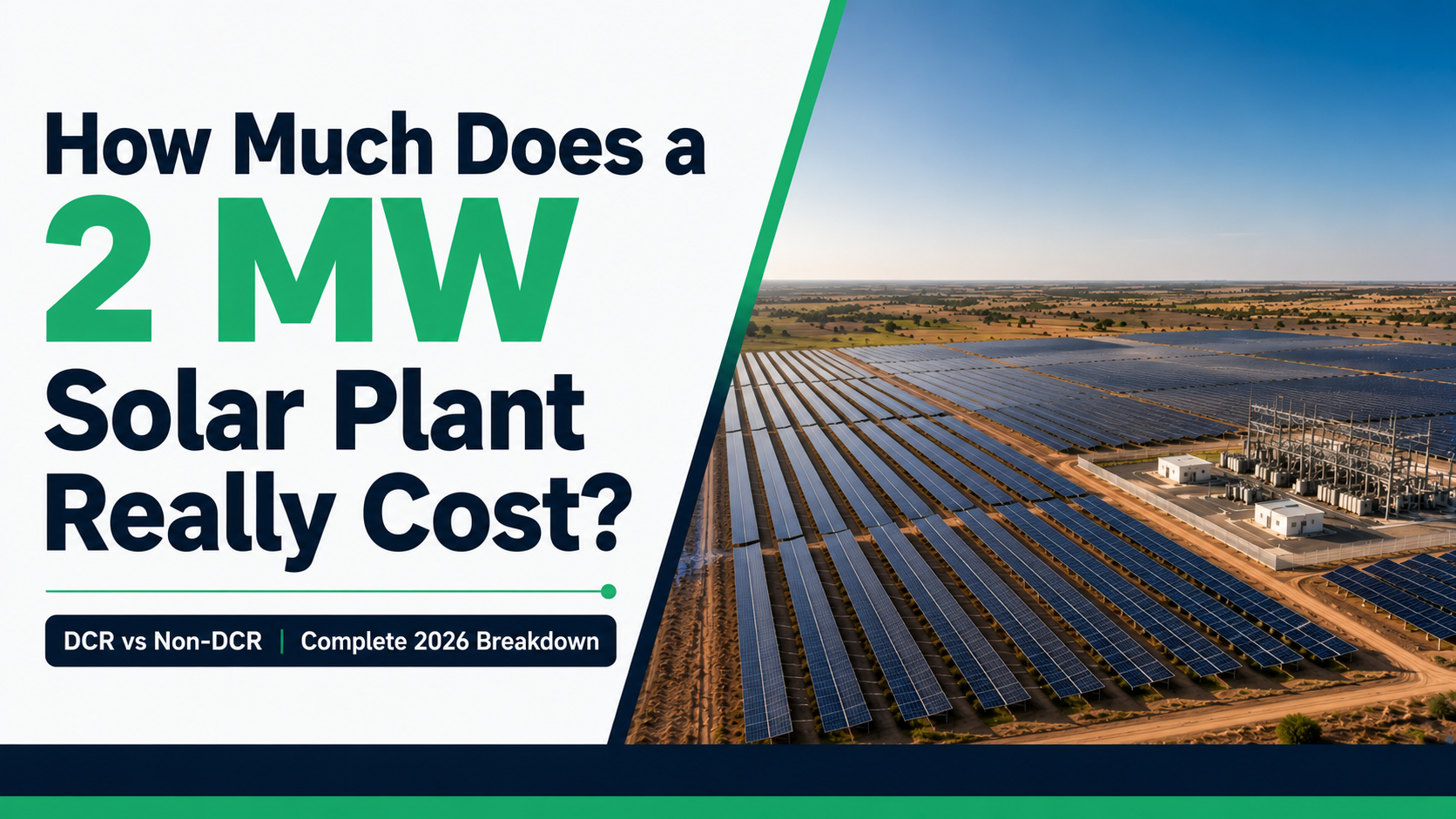
Cost of a 2MW solar plant in India isn’t a single fixed number anyone who gives you one exact price upfront is either guessing or trying to sell you something. Solar module prices move every quarter. Civil costs depend on your site. Grid connection charges vary by DISCOM. And the single biggest pricing variable, whether your project requires DCR (Domestic Content Requirement) panels or can use Non-DCR modules can shift your total budget by Rs 50 lakh to Rs 1 crore on a 2 MW plant.
The honest answer: a 2 MW AC plant (which requires 2.4 MW DC of installed panel capacity) costs between Rs 6 crore and Rs 7.5 crore in India in 2026, depending on your module specification, site conditions, grid connection complexity, and whether your project falls under a government scheme that mandates DCR compliance.
This guide gives you the component-wise breakdown for both Non-DCR and DCR configurations, explains what drives the cost range, and tells you which choice is right for your project type before you invite a single EPC quotation.
Rs 6 – 7.5 Cr Total Cost of a 2 MW AC Solar Plant in India (2026) 2 MW AC = 2.4 MW DC installed capacity | Indicative range actual cost depends on 8 key variables
First – Understand the AC vs DC Difference. This Changes Your Panel Count.
When someone says “2 MW solar plant,” you must immediately ask: 2 MW AC or 2 MW DC? These numbers aren’t the same, and the difference will affect your total cost.
| Term | What It Means |
| 2 MW AC | The plant’s grid export capacity the output your inverter(s) deliver to the grid. This is the contracted capacity in PPAs, open-access agreements, and net metering sanctions. |
| 2.4 MW DC (2400 kWp) | The total installed panel capacity needed to produce 2 MW AC. A standard DC/AC ratio of 1.2 is used in India to account for system losses, temperature derating, and inverter clipping. |
| DC/AC Ratio: 1.2 | Industry-standard oversize ratio for Indian conditions. Accounts for high ambient temperatures, panel degradation, wiring losses, and irradiance variability. Some designers use 1.25 for sites with high peak irradiance. |
💡 All costs in this guide are based on 2.4 MW DC (2400 kWp) of installed panel capacity the actual quantity of hardware you are procuring. When evaluating competitor quotes, always confirm whether their per-kW price is on AC or DC capacity. A quote of Rs 30,000/kW on AC capacity is equivalent to Rs 25,000/kW on DC capacity for a 1.2 ratio plant.
DCR vs Non-DCR -What It Means and Why It Changes Your Cost of a Solar Plant
What Is a DCR Solar Panel?
DCR stands for Domestic Content Requirement. A DCR-compliant solar panel uses solar cells manufactured in India, assembled into modules in India. Both the cell and the module must come from manufacturers listed on the MNRE’s Approved List of Models and Manufacturers (ALMM) specifically ALMM List I (modules) and ALMM List II (cells).
India’s domestic solar cell manufacturing capacity currently stands at approximately 30 GW per year, against module manufacturing capacity of around 120 GW per year. This mismatch more module capacity than cell capacity is what drives the DCR price premium. Manufacturers competing for scarce domestic cells must pay more for them, and that cost passes through to the project.
As of 2026, DCR Bifacial TOPCon modules from Indian manufacturers (Waaree, Adani Solar, Vikram Solar, Premier Energies) are priced significantly higher than their equivalent Non-DCR counterparts. This is the primary driver of the cost gap between DCR and Non-DCR plants.
What Is a Non-DCR Solar Panel?
Non-DCR panels use imported solar cells primarily from China, Taiwan, Vietnam, or Malaysia assembled into modules either abroad or in India. They are not eligible for government schemes that require DCR compliance, but they carry no such restriction for private-sector projects.
Non-DCR Bifacial TOPCon panels from global Tier 1 manufacturers (JinkoSolar, LONGi, Trina Solar, Canadian Solar, JA Solar) offer high efficiency, strong performance warranties, and competitive pricing because they are sourced from the global supply chain without domestic procurement constraints.
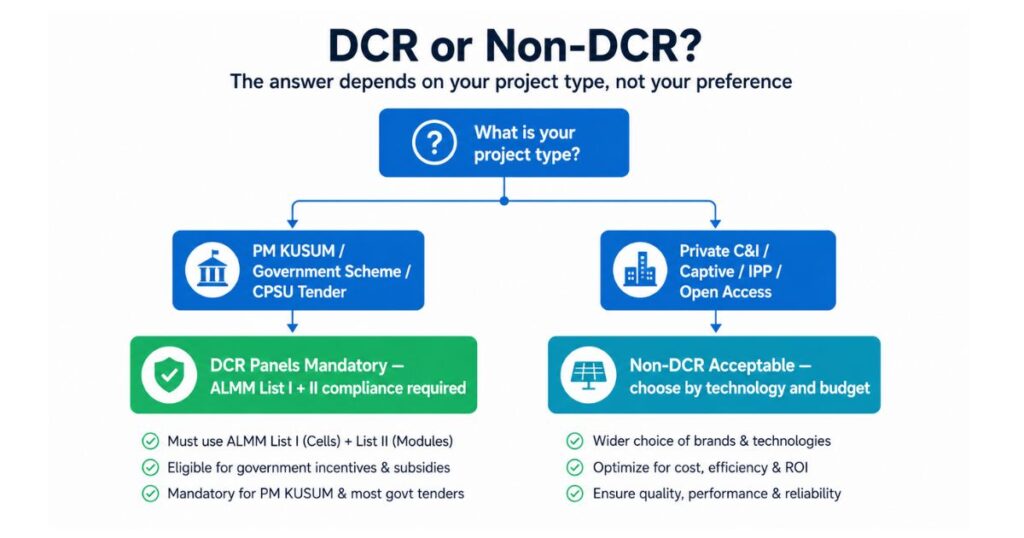
Which Projects Require DCR?
| DCR Mandatory | Non-DCR Acceptable |
| PM KUSUM Component A farmers’ solar plants under PPA | Private C&I rooftop and ground-mounted (captive) |
| CPSU Scheme (Central Public Sector Undertakings) | Independent Power Producer (IPP) projects |
| SECI / NTPC government tenders | Open Access solar projects (3rd party PPA) |
| PM Surya Ghar (residential rooftop subsidy) | Group Captive solar projects |
| State DISCOM procurement tenders | RESCO / PPA projects for private buyers |
⚠ From June 1, 2026, MNRE has mandated ALMM List-II cell compliance for all government-scheme projects. Verify with your DISCOM or nodal agency whether your specific project falls under this mandate before finalising module procurement.
📖 You can also read: Solar Panel Technologies Explained: TOPCon vs Mono PERC vs HJT
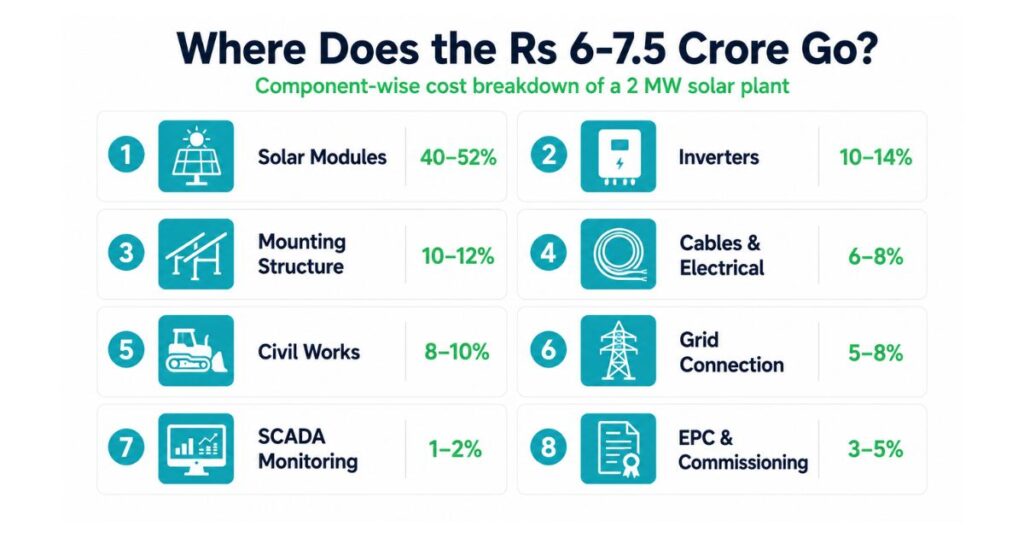
Cost of a Solar Plant Breakdown: 2 MW AC (2.4 MW DC) Plant
The table below provides an indicative component-wise cost breakdown for both Non-DCR and DCR configurations of a standard ground-mounted 2 MW AC / 2.4 MW DC plant in India in 2026
| Component | % of Cost | Non-DCR (Rs) | DCR (Rs) |
| 1. Solar PV Modules | 40–52% | Rs 2.40 – 2.93 Cr | Rs 3.60 – 4.20 Cr |
| Bifacial TOPCon, 580–610 Wp modules | Non-DCR: JinkoSolar, LONGi, Trina | Rs 13–16/Wp | DCR: Waaree, Adani, Vikram, Premier | Rs 22–28/Wp | |
| 2. Solar Inverters (String or Central) | 10–14% | Rs 60 – 85 Lakh | Rs 60 – 85 Lakh |
| String inverters preferred for 2 MW scale | Sungrow, Growatt, ABB, SMA (80–100 kW units) | Same — inverters not subject to DCR mandate | |
| 3. Module Mounting Structure (MMS) | 10–12% | Rs 60 – 78 Lakh | Rs 60 – 78 Lakh |
| GI / hot-dip galvanised, fixed-tilt ground mount | Fixed tilt standard; single-axis tracker adds Rs 40–60L | Same — structural components not DCR-dependent | |
| 4. DC + AC Cables & Electrical BOS | 6–8% | Rs 36 – 52 Lakh | Rs 36 – 52 Lakh |
| DC strings, AC feeder, earthing, lightning arr. | Polycab, Havells, KEI — no import duty impact | Same cost as Non-DCR | |
| 5. Civil & Structural Works | 8–10% | Rs 48 – 65 Lakh | Rs 48 – 65 Lakh |
| Land levelling, fencing, access road, drainage | Cost varies significantly with site conditions | Same — civil work not affected by DCR | |
| 6. Grid Connection Package | 5–8% | Rs 30 – 52 Lakh | Rs 30 – 52 Lakh |
| Transformer, HT panel, metering, DISCOM charges | Varies by DISCOM, connection distance, voltage level | Same — grid connection independent of module type | |
| 7. SCADA + Remote Monitoring System | 1–2% | Rs 6 – 13 Lakh | Rs 6 – 13 Lakh |
| Plant-level monitoring, string-level data, alerts | Cloud-based platform; Rs 5–7/kWp typically | Same cost as Non-DCR | |
| 8. EPC Charges, Insurance & Commissioning | 3–5% | Rs 18 – 32 Lakh | Rs 20 – 36 Lakh |
| Engineering, procurement management, testing | Includes performance testing, DPR, As-Built drawings | Slightly higher due to ALMM documentation compliance | |
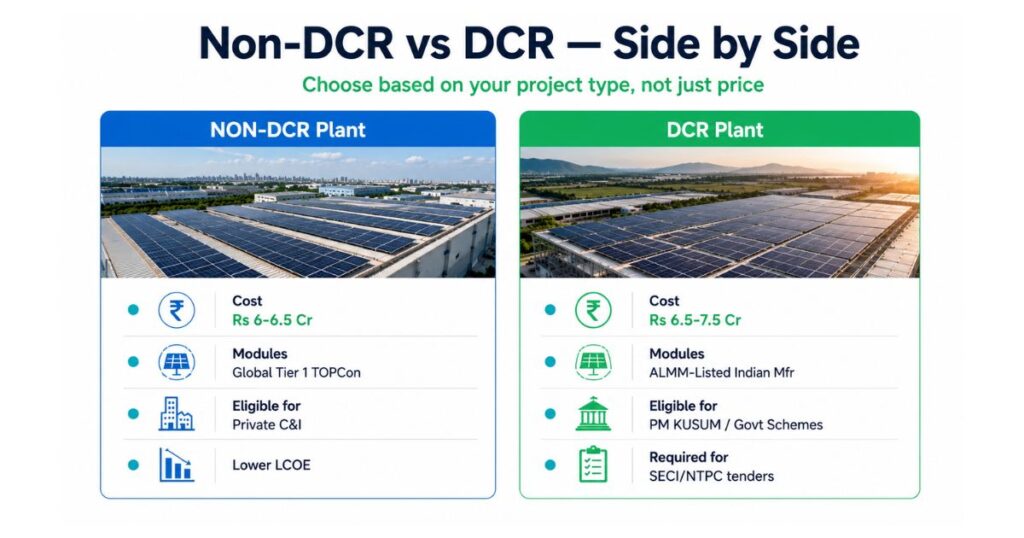
| TOTAL INDICATIVE COST | 100% | Rs 6.00 – 6.50 Crore | Rs 6.50 – 7.50 Crore |
| Per kW (DC basis, 2400 kWp) | — | Rs 25,000 – 27,000 per kW | Rs 27,000 – 31,000 per kW |
📌 These are indicative market rates as of May 2026. Module prices are the most volatile component and can shift 10–20% in a single quarter based on global polysilicon pricing, import duty reviews, and INR/USD exchange rates. Always obtain a fresh quotation before financial close on your project.
Why Does the Cost of a Solar Plant Range from Rs 6 Crore to Rs 7.5 Crore? The 8 Variables
Two identically rated 2 MW AC plants can have costs separated by Rs 1.5 crore. Here are the eight variables that drive the range and what you can control.
| # | Variable | Lower Cost End | Higher Cost End |
| 1 | Module Specification | Non-DCR Bifacial TOPCon — Rs 13-16/Wp | DCR Bifacial TOPCon — Rs 22-28/Wp | adds Rs 60-80 Lakh at 2.4 MWp scale |
| 2 | Site Conditions | Flat agricultural land, good access road | Rocky terrain, sloped site, remote location — higher earthwork and transport cost |
| 3 | Grid Connection Distance | Substation within 500 m of plant | HT line extension over 1-2 km — adds Rs 15-35 Lakh |
| 4 | MMS Type — Fixed vs Tracker | Fixed-tilt GI structure | Single-Axis Tracker (SAT) — adds Rs 40-60 Lakh; increases generation 12-18% |
| 5 | Inverter Technology | String inverters, Tier 2 brand | String inverters, Tier 1 brand (SMA, ABB) — 8-12% price premium |
| 6 | Module Market Timing | Low demand period; polysilicon prices soft | Peak demand; polysilicon tight; INR weaker — modules can move 15-20% in one quarter |
| 7 | State-Level DISCOM Charges | MP / Rajasthan — relatively streamlined grid charges | Maharashtra / TN — transformer upgrades, additional surcharges possible |
| 8 | EPC Partner Margin | Competitive EPC with efficient supply chain | Premium EPC — justified by execution quality, guarantees, O&M commitment |
The Number That Actually Matters Cost Per Unit Over 25 Years
The sticker price of Rs 6 crore vs Rs 7 crore is not the right comparison frame. What matters is the Levelised Cost of Energy (LCOE) how much each unit of electricity your plant generates costs you over its 25-year operational life.
This is where Non-DCR and DCR converge and in some scenarios, DCR comes out ahead.
| Parameter | Non-DCR (Bifacial TOPCon) | DCR (Bifacial TOPCon, India) |
| Total Plant Cost | Rs 6.00 – 6.50 Crore | Rs 6.50 – 7.50 Crore |
| Module Efficiency | 21.5 – 23% | 21% – 22.5% |
| Annual Degradation Rate | 0.40 – 0.45%/yr | 0.40 – 0.50%/yr |
| 25-yr Generation (MP site, 5.2 PSH) | ~340 – 345 Lakh units | ~335 – 342 Lakh units |
| Effective LCOE (after 40% AD tax benefit) | Rs 2.50 – 3.00/unit | Rs 2.80 – 3.40/unit |
| PM KUSUM Eligibility | ❌ Not eligible | ✅ Fully eligible |
For a PM KUSUM farmer receiving a PPA of Rs 3.20 to Rs 3.50 per unit from the DISCOM, DCR compliance is non-negotiable the project’s revenue model only works under the scheme. For a private C&I or captive project, Non-DCR delivers a lower LCOE and a faster payback, making it the financially superior choice where policy permits.
📖 You can also read: What Is the Real Payback Period for C&I Solar Under 2026 Policies?
Which Configuration Is Right for Your Project?
The choice between DCR and Non-DCR is determined by your project type, not by your budget preference. Here is the decision framework:
| Project Type | Module Requirement | Solarsure Recommendation |
| PM KUSUM Component A (farmer PPA) | DCR Mandatory — ALMM I + II | DCR Bifacial TOPCon — Waaree / Adani / Vikram |
| Private C&I Rooftop Captive | Non-DCR Acceptable | Non-DCR Bifacial TOPCon — JinkoSolar / Trina / LONGi |
| Ground-Mounted Captive (industrial) | Non-DCR Acceptable | Non-DCR for faster ROI; confirm open access policy first |
| SECI / NTPC Tender (bid project) | DCR Mandatory per tender spec | DCR — verify ALMM List-II cell compliance for June 2026 deadline |
| Open Access 3rd Party PPA (private developer) | Non-DCR Acceptable | Non-DCR preferred — lower LCOE strengthens tariff competitiveness |
Solarsure’s standard specification for all PM KUSUM and government-scheme projects: DCR Bifacial TOPCon, ALMM List I + II compliant, minimum 580 Wp, minimum 21% module efficiency, maximum 0.45% annual degradation, 25-year linear power output guarantee. Specified in writing in every contract before procurement.
⚠ Module prices are the most volatile element of a solar plant BOQ. A price locked in a quotation in March may be 12-15% different from market rate in June. Solarsure locks module brand, model, and wattage in the contract not just a price ensuring what was quoted is what gets installed.
Frequently Asked Questions
Q: What is the total cost of a 2 MW solar plant in India in 2026?
A: Cost of a 2MW AC Solar Plant (which requires 2.4 MW DC of installed capacity at a 1.2 DC/AC ratio) between Rs 6 crore and Rs 7.5 crore in India in 2026. Non-DCR configurations (using imported Bifacial TOPCon panels from global Tier 1 manufacturers) sit at Rs 6.00 to Rs 6.50 crore — approximately Rs 25,000 to Rs 27,000 per kW DC. DCR configurations (using ALMM-listed Indian-manufactured cells and modules) range from Rs 6.50 to Rs 7.50 crore — approximately Rs 27,000 to Rs 31,000 per kW DC. These are indicative ranges; actual cost depends on site conditions, grid connection complexity, module market pricing at procurement time, and EPC partner.
Q: What is the difference between a DCR and Non-DCR solar plant?
A: DCR (Domestic Content Requirement) panels use solar cells manufactured in India, listed on MNRE’s ALMM List II. They are mandatory for government-scheme projects including PM KUSUM Component A, CPSU scheme, SECI tenders, and residential subsidy programmes. Non-DCR panels use imported cells from global manufacturers and offer lower cost and wider technology choice. They are fully compliant for private C&I, captive, open access, and IPP projects. The cost difference in a 2 MW plant is Rs 60 lakh to Rs 1 crore, almost entirely driven by the module cost premium.
Q: Why does the cost range between Rs 6 crore and Rs 7.5 crore? What causes the variation?
A: Eight variables drive the range: (1) module specification DCR vs Non-DCR is the single biggest driver; (2) site conditions flat accessible land vs rocky or remote terrain; (3) grid connection distance and DISCOM charges; (4) mounting structure type fixed tilt vs single-axis tracker (tracker adds Rs 40-60 lakh); (5) inverter brand Tier 1 vs Tier 2; (6) module market timing prices can shift 10-20% in a quarter based on polysilicon costs and INR/USD exchange; (7) state-level grid charges; and (8) EPC partner margin. Solarsure provides a detailed BOQ with fixed component specifications before contract signing so the price in your proposal is the price you pay.
Q: How much electricity does a 2 MW solar plant generate in India?
A: A 2 MW AC (2.4 MW DC) Bifacial TOPCon plant in Madhya Pradesh with 5.2 peak sun hours daily generates approximately 30 to 34 lakh units (kWh) per year in Year 1. Over 25 years, accounting for 0.40-0.45% annual panel degradation, total lifetime generation is approximately 340 to 345 lakh units. In higher-irradiance states like Rajasthan (5.5 PSH) or Gujarat, annual generation can reach 36 to 38 lakh units. In lower-irradiance states or sites with more cloud cover, it will be lower.
Q: What is the payback period for a 2 MW solar plant in India?
A: For a Non-DCR CAPEX plant in Madhya Pradesh with an HT industrial tariff of Rs 8.80 per unit, effective payback — after 40% accelerated depreciation under Section 32 and GST ITC recovery is approximately 3.0 to 3.5 years. For a PM KUSUM DCR plant earning a DISCOM PPA rate of Rs 3.20 to Rs 3.50 per unit, payback is typically 6 to 8 years from PPA revenue alone, but the farmer’s net cost is lower due to central and state scheme subsidies or cost-sharing mechanisms.
Q: Does Solarsure build 2 MW solar plants, and what does the process look like?
A: Yes. Solarsure is a full-service Solar EPC company that handles site survey, Detailed Project Report, permits, procurement, installation, grid connection, and commissioning for 2 MW and larger plants. Every project begins with a site-specific irradiance study and financial model before procurement is committed. Module brand, model number, efficiency, and degradation specifications are locked in the contract. For PM KUSUM projects, Solarsure manages the full DISCOM coordination and PPA process. For private C&I and captive projects, we model the optimal DC/AC ratio, panel technology, and procurement timing to maximise 25-year ROI. Contact us at solarsure.in for a project assessment.
Bottom Line
The cost of a 2MW Solar Plant is around Rs 6 to Rs 7.5 crore. That range is real, not a hedge and every rupee of that variation comes from a specific, identifiable decision: module type, site conditions, grid connection, and whether your project requires DCR compliance.
The most important thing to know before you receive your first quotation: confirm whether your project type requires DCR or permits Non-DCR. That single decision shifts your module cost by Rs 60 lakh to Rs 1 crore. Everything else is negotiable and manageable.
The second most important thing: a price in a quotation is only worth something if the component specifications are locked alongside it. Solarsure specifies module brand, model number, wattage, efficiency, and degradation guarantee before procurement and verifies delivery against that specification on arrival at site.
Get a site-specific BOQ and 25-year financial model for your 2 MW project at solarsure.in
Trust that Powers Bharat