India’s solar sector enters a new era where the source of every cell inside a panel now determines whether your project gets funded, commissioned, or penalised.
India’s solar ambition has always been about more than megawatts. It is about building an industrial backbone, which means a self-reliant supply chain that doesn’t leave the country exposed to geopolitical shocks or import dependencies. The Approved List of Models and Manufacturers (ALMM), introduced by the Ministry of New and Renewable Energy (MNRE), has been the cornerstone of this vision. But with the arrival of ALMM List-II, the policy has moved from governing finished products to governing the very atoms that power them: the solar cell.
For developers, EPC contractors, and investors navigating India’s complex renewables landscape, this is not an incremental policy tweak. It is a structural realignment of how domestic content requirements (DCR) are enforced, monitored, and penalised. Understanding the precise mechanics of ALMM-II isn’t optional, but it is the difference between timely commissioning and a project mired in regulatory gridlock.
What is the ALMM-II Mandate?
The ALMM-II mandate is a regulatory directive issued by India’s Ministry of New and Renewable Energy (MNRE) that requires solar modules used in government-backed projects to be manufactured using domestically produced solar cells. Starting June 1, 2026, any ALMM-listed solar module procured for a non-exempt project must contain cells sourced exclusively from manufacturers approved under ALMM List-II.
ALMM stands for Approved List of Models and Manufacturers. While ALMM List-I has governed solar modules since its introduction, List-II goes one level deeper by regulating the solar PV cells inside those modules. The goal is to build a fully integrated domestic solar manufacturing ecosystem in India, not just an assembly industry that depends on imported cell components.
For developers, EPC contractors, and investors, this means an entirely new layer of procurement compliance, supply chain planning, and financial modelling is now required for every government-backed or subsidised solar project.
Why Did the MNRE Introduce ALMM List-II?
The MNRE introduced ALMM List-II to close a critical gap in India’s domestic content framework. Before List-II, modules could qualify as “domestically manufactured” under ALMM List-I even when the solar cells inside them were imported. India had built substantial module assembly capacity, but its upstream cell manufacturing base remained far smaller and less developed.
ALMM List-II directly addresses this by making domestic cell sourcing a mandatory compliance requirement. The policy is part of India’s broader industrial strategy to reduce import dependence in the solar sector and build a self-reliant, end-to-end manufacturing supply chain that can support the country’s long-term renewable energy targets.
Key Dates and Deadlines Every Stakeholder Must Know
What is the ALMM List-II compliance deadline?
The ALMM List-II compliance deadline is June 1, 2026. Starting on this date, any solar modules used in government-backed or subsidised projects must be built using solar cells from manufacturers approved under ALMM List-II. If a module manufacturer fails to meet this domestic cell requirement by the deadline, their products risk being delisted from the main List-I, making them ineligible for most major Indian solar installations.
What is the ALMM-II grandfathering cut-off date?
The grandfathering cut-off date is August 31, 2025. Projects whose last date of bid submission was on or before August 31, 2025, are exempt from the ALMM List-II cell requirement, regardless of when they are ultimately commissioned. These projects must still use ALMM List-I approved modules, but the cells inside those modules do not need to be domestically sourced.
What is ALMM List-I(a)?
ALMM List-I(a) is a new sub-list that the MNRE will maintain after May 31, 2026, for solar modules that meet ALMM quality standards but do not use List-II approved cells. This list exists specifically to serve exempt projects. Non-exempt projects that procure modules from List-I(a) will be considered non-compliant.
Which Projects Are Exempt from ALMM List-II?
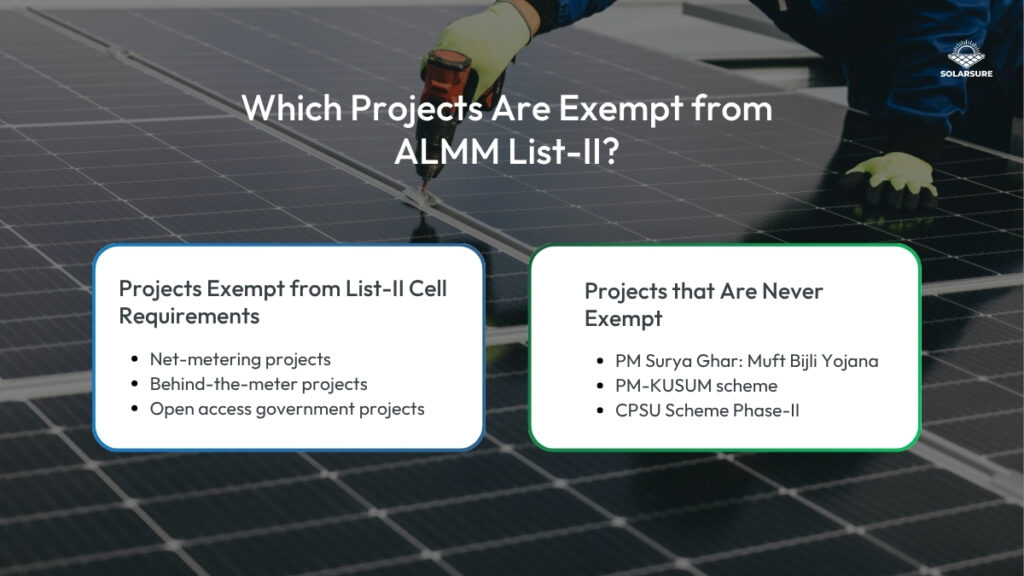
Projects Exempt from List-II Cell Requirements
The following project types are exempt from the ALMM List-II solar cell requirement, as long as their last date of bid submission was on or before August 31, 2025.
- Net-metering projects
- Behind-the-meter projects
- Open access government projects
These projects must continue using ALMM List-I approved modules. Only the cell sourcing requirement is waived under the exemption.
Projects that Are Never Exempt
Certain government schemes operate under strict DCR mandates and are not eligible for any exemption, regardless of bid submission date. These include:
- PM Surya Ghar: Muft Bijli Yojana
- PM-KUSUM scheme
- CPSU Scheme Phase-II
Developers working under any of these schemes must ensure full compliance with both module and cell domestic content requirements at all times.
The Thin-film Technology Exemption
Thin-film technology-based modules manufactured in integrated facilities that are already listed under ALMM List-I are deemed automatically compliant with ALMM List-II. Developers using thin-film technology should confirm their supplier’s integrated facility status directly through the MNRE portal before assuming automatic compliance.
What Is the Current State of India’s Solar Cell Manufacturing Capacity?
India’s module assembly capacity under ALMM List-I stands between 91 GWp and 108 GWp as of mid-2025. Domestic solar cell manufacturing capacity lags at approximately 27-28 GWp. This means domestic cell production covers only about one quarter of the module capacity it is now expected to supply under the new mandate.
This capacity gap is the single most significant operational risk created by the ALMM-II framework. It creates real supply shortages, price volatility, and procurement uncertainty for any developer who has not secured forward supply commitments from ALMM List-II approved cell manufacturers.
The TOPCon Cell Shortage
High-efficiency Tunnel Oxide Passivated Contact (TOPCon) cells are the preferred cell technology for Commercial and Industrial (C&I) solar projects because their superior efficiency requires less land area to generate equivalent output. This makes them particularly valuable for constrained sites in urban and semi-urban environments.
Domestic ALMM-II approved capacity for TOPCon cells is especially limited relative to demand. C&I developers are already reporting severe supply and demand mismatches, and the situation is expected to worsen as the June 2026 deadline approaches without proportional domestic capacity coming online.
Certification and Testing Bottlenecks
Except for the raw supply, the path to ALMM-II compliance involves formal testing and certification, and that pipeline is becoming congested. Industry experts project that testing and certification agencies will face significant capacity constraints due to the surge in compliance applications. Certification delays of six to nine months are being forecast, which can stall project commissioning even where adequate cell supply exists.
How Does ALMM-II Affect Project Economics and Tariffs?
What is the Cost Premium for DCR Modules?
DCR modules currently carry a premium of 4 to 5 cents per Wp, equivalent to approximately Rs 8 to Rs 10 per watt, over non-DCR modules. This is the baseline additional cost for any project required to use ALMM List-II compliant cells.
How Much Does List-II Compliance Increase Total Project Cost?
Shifting to ALMM List-II compliant cells is estimated to increase total project costs by 3% to 5%, translating to a tariff increase of Rs 0.10 to Rs 0.20 per kWh. In the short term, some developers warn that supply-driven cost spikes could push increases as high as 40% until new ALMM-II approved suppliers stabilise the market.
What is the Tariff Impact if a Project Switches away from DCR Modules?
If a project switches from DCR modules (which use local parts) to cheaper non-DCR alternatives, it can save about Rs 0.45 crore for every megawatt of capacity. These savings can lower electricity prices by Rs 0.30 to Rs 0.40 per unit. This is an important option for exempt projects looking to cut costs before the August 31, 2025, deadline.
What Are the Penalties for ALMM-II Non-Compliance?
Non-compliance with the ALMM-II framework carries severe consequences across financial, contractual, developmental, and criminal dimensions.
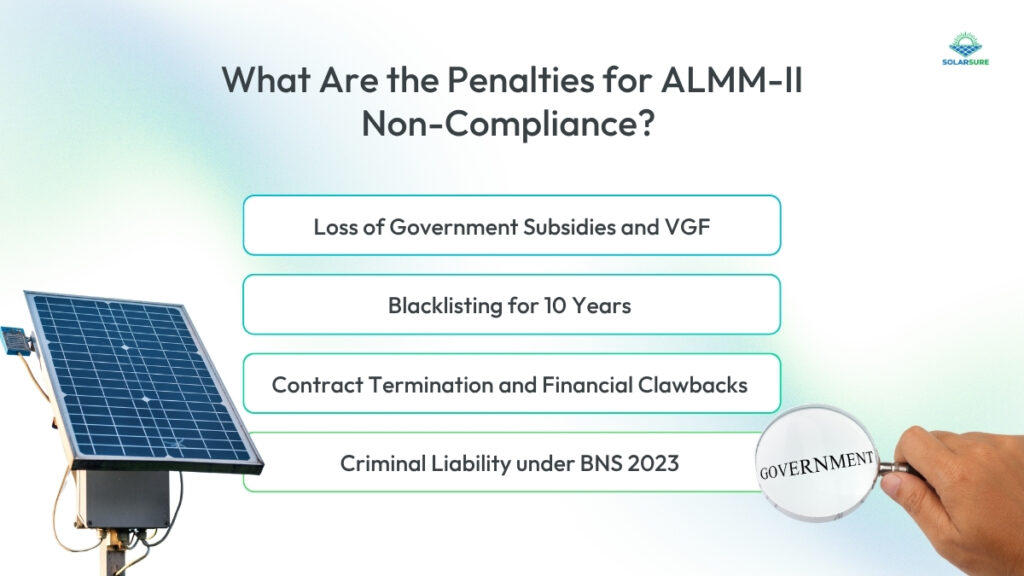
Loss of Government Subsidies and VGF
Government subsidies and financial support (VGF) are only paid out if a project is officially verified as ALMM compliant through the MNRE portal. If a project fails to meet these rules, the government will not release any money. There is no grace period or appeals process if a project misses these requirements.
Blacklisting for 10 Years
If a developer breaks the domestic sourcing rules (DCR), they can be blacklisted for 10 years. This means they cannot bid on any government solar projects in India for a decade. For most companies, being blocked from these major contracts for such a long time is a massive blow that could threaten their entire business.
Contract Termination and Financial Clawbacks
If you don’t follow the rules, your project contract can be cancelled, and the government can take your bank guarantees. You may also be forced to pay back any subsidy money you have already received. This means the financial risk covers both the money you are waiting for and the money you have already spent.
Criminal Liability under BNS 2023
Lying about where solar cells are made to get government subsidies is a serious crime under Section 316 of the Bharatiya Nyaya Sanhita, 2023. This is a criminal case, not just a simple fine, and company directors can be held personally responsible. Because of this, all records showing exactly where your parts came from must be accurate and complete.
What Should Developers and EPC Contractors Do Right Now?
If Your Project’s Bid was Submitted On or Before August 31, 2025
First, confirm that your project does not fall under PM Surya Ghar, PM-KUSUM, or CPSU Phase-II. If it does, List-II compliance is mandatory regardless of bid date.
Second, verify that your module supplier holds current ALMM List-I approval and will remain on that list after May 2026. Some suppliers may migrate to List-I(a), which is valid only for exempt projects.
Third, document your bid submission date thoroughly and retain all related records. This is your primary evidence of exemption status in any future MNRE audit or dispute.
Fourth, revisit your tariff model. If you bid at DCR-inclusive tariffs, your financial projections may be more conservative than necessary and could be revised in your favour.
If Your Project’s Bid was Submitted After August 31, 2025
First, sign contracts with approved ALMM List-II cell manufacturers right away. In the current market, ensuring you actually have the parts is much more important than trying to save a little money.
Second, add six to nine months of “buffer time” to your schedule. Delays in testing and getting official certifications are common, so do not plan a timeline that assumes everything will go perfectly.
Third, update your financial model to reflect the Rs 8 to Rs 10 per watt DCR premium. Run a “stress test” on your profits to see if the project can still survive if costs suddenly jump by as much as 40%.
Fourth, establish end-to-end traceability documentation covering the entire chain from cell manufacturer to module to installation site. The MNRE’s online verification portal requires verifiable chain-of-custody data at each stage.
Fifth, retain legal counsel with expertise in BNS 2023 Section 316 exposure. Particularly, if documentation and compliance practices are not yet fully developed across your procurement pipeline.
Bottom Line
The ALMM-II mandate is not just a compliance requirement. It is a structural shift in how India builds its solar industry. Developers, EPC contractors, and investors who act early will turn regulatory pressure into a competitive advantage. Those who wait will face tighter supply, higher costs, and severe penalties. If you need help in checking your project’s exemption status or building an ALMM-II-compliant procurement plan, you can book a free consultation with us.