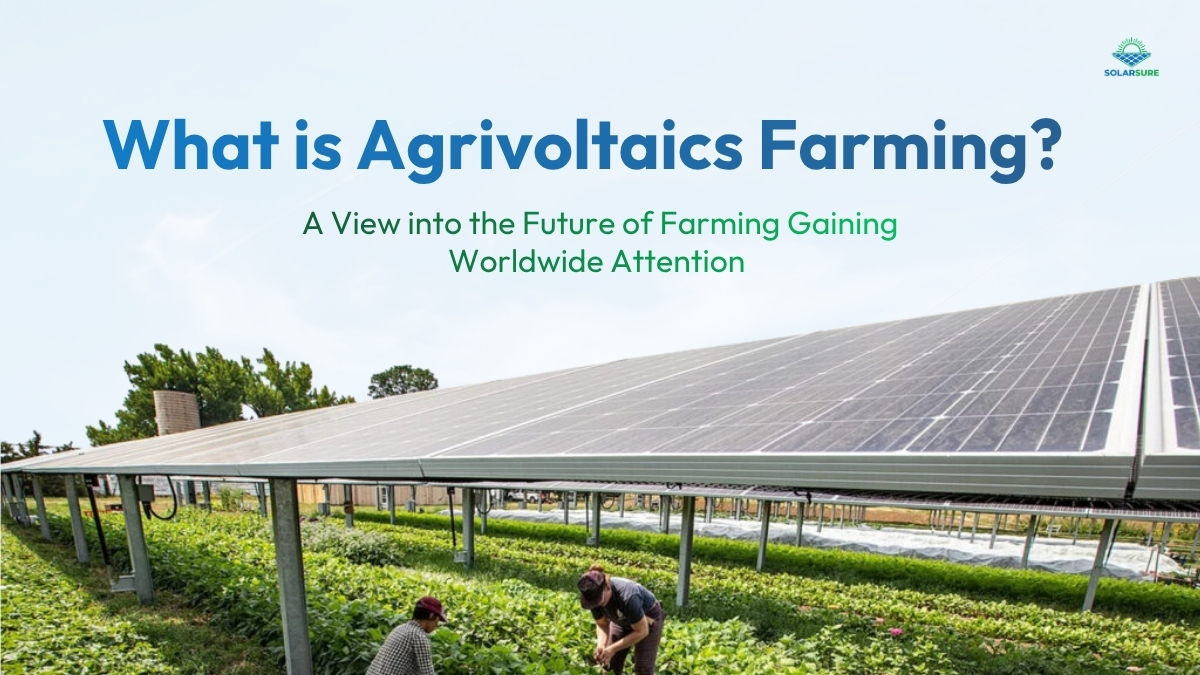
What is Agrivoltaic Farming: A View into the Future of Farming Gaining Worldwide Attention

What is Agrivoltaics Farming?
India has approx 140 million farming households. Most of them face two existential pressures at once, such as reducing agricultural margins and rising energy costs. The cost of crops has not increased over the last five years, and inflation is at its peak. Agrivoltaics is the practice of co-locating solar panels and crop cultivation on the same land and is a rare solution that addresses both with a single infrastructure investment.
Agrivoltaics allows farmers to increase their income potential and doubles their earnings by adopting agriPV plants. AgriPV systems are already operational across India, Europe, East Asia, the United States, and across the world. Pilot projects have demonstrated income increases of over 168%, water savings of up to 30%, and land productivity ratios more than 60% higher than running solar and farming separately. So, let us discuss agrivoltaics in detail and understand how it is changing the future of farming. 

What is Agrivoltaics Farming?

Agrivoltaics is a dual-use system where solar panels are installed in a way that allows farming activities to continue underneath or alongside them. The panels are either elevated at a sufficient height or spaced strategically to ensure that sunlight, machinery movement, and crop growth are not significantly restricted. This system introduces solar power as a third crop for farmers, alongside traditional agriculture. This means farmers generate income from crops year-round and also earn from electricity generation. Overall, their income will increase significantly. 

What are the Advantages of Agrivoltaic Farming?

Agrivoltaics does not just give farmers a little extra money, but it changes how a farm works from the ground up. Here are the six biggest advantages of argivoltaics farming: What are the Advantages of Agrivoltaic Farming?
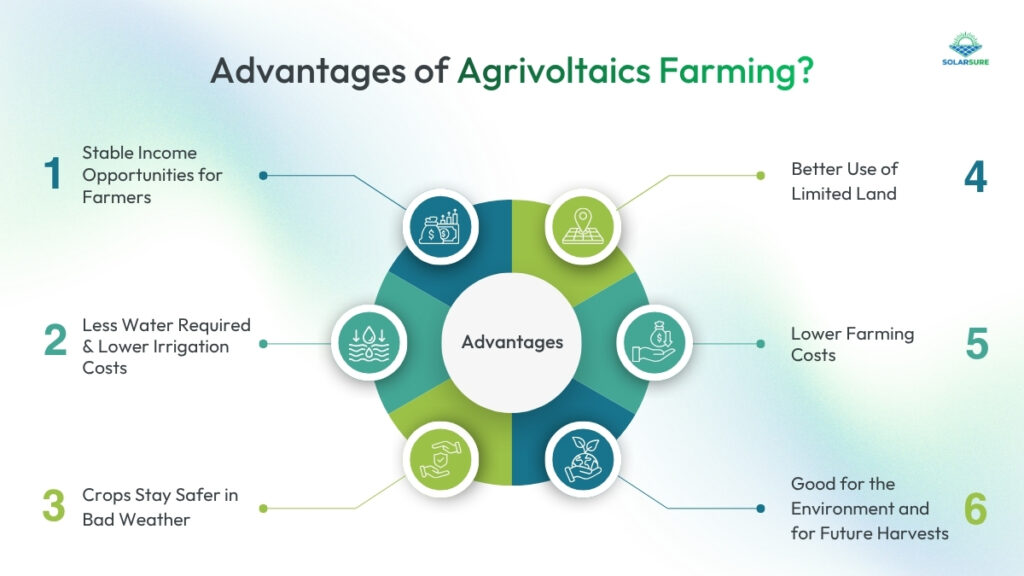
Stable Income Opportunities for Farmers

Agrivoltaics farming enables two sources of income for the farmers. First, what they sell from the field, and second, the electricity their solar panels produce. Usually, crop income can go up and down with the weather, but solar power keeps generating money every single day, irrespective of rain or shine.  This two-income setup gives farmers a financial safety net they never had before. In many cases, total income per acre can go up sharply compared to farming alone.

Less Water Required & Lower Irrigation Costs

The agrivoltaics solar panels create shade on the soil below. This shade means less water evaporates from the ground and less moisture is lost from plants. This makes the soil stay wet for a long time, and farmers do not need to water their crops so often. In dry areas, this alone can improve water efficiency by up to 30%. For farmers who have limited water, it is very effective, and it also requires less money spent on irrigation every season.

Crops Stay Safer in Bad Weather

Solar panels above the crops act as a protective roof. This physical cover reduces crop damage from too much heat, which can dry out and burn young plants. It also protects from heavy rain that flattens crops and washes away nutrients from the soil. Apart from these, panels work as a protective shield from hailstorms that can destroy an entire crop in minutes.  Weather-related losses are a major concern for farmers these days. Extreme weather conditions can wipe out the entire crop and the farmer’s whole income.  So, fewer whether specific losses mean fewer seasons where the farmer walks away with nothing.

Better Use of Limited Land

In India, we have limited land available, and we cannot compromise farming for solar. Most farmers do not have the option to dedicate acres to solar alone. In agrivoltaics, the same land does both jobs simultaneously. The land can feed a family and generate electricity at the same time. 

Lower Farming Costs

Running diesel pumps for irrigation is one of the highest recurring costs for Indian farmers. When solar panels on the farm power the pumps directly, that diesel bill disappears. Farmers who switch to solar-powered irrigation save ₹5,000 to ₹6,500 per acre every year for the next 25 years. 

Good for the Environment and for Future Harvests

Agrivoltaics supports healthier farming for the long term, such as solar energy replacing diesel, and cutting down harmful carbon emissions. Its shade and moisture retention help keep the soil healthy and alive for the long term, and the panel covers stop soil from being washed or blown away over time.

How Does Agrivoltaic Farming Work?

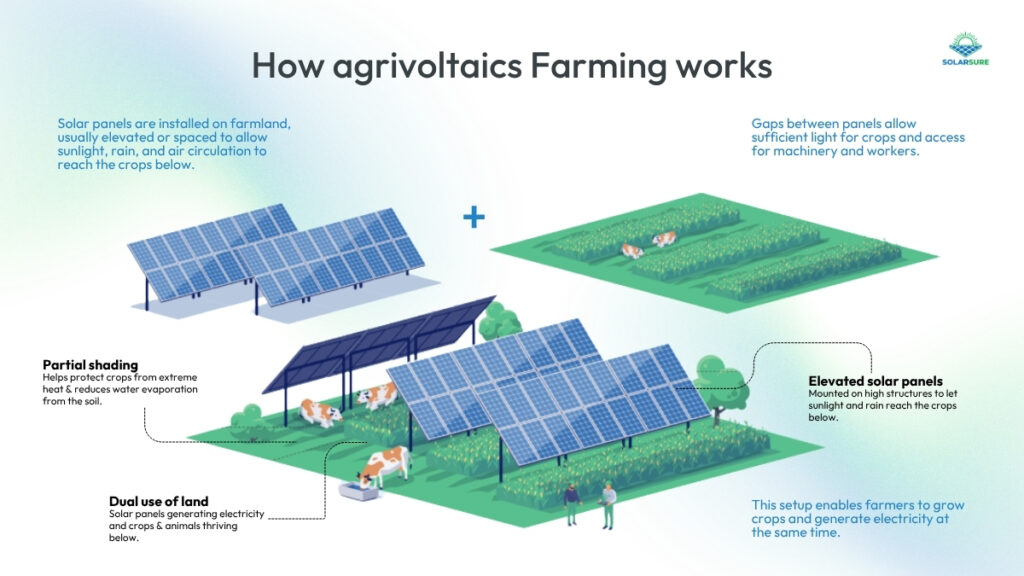
Agrivoltaics works through a combination of engineering design and agricultural planning. It is not simply about installing solar panels on farmland. How Does Agrivoltaic Farming Work?
Structural Design and Layout Planning

The system begins with careful structural design, where solar panels are either elevated above the ground or installed between crop rows. This ensures that essential farming activities such as ploughing, sowing, irrigation, and harvesting can continue without disruption.  The height of the panels, their spacing, and orientation are all planned to maintain accessibility while optimising solar energy generation. In some cases, tracking systems are used to adjust panel angles throughout the day, which helps manage both energy output and the distribution of shade across the field.

Light Management and Microclimate Creation

Instead of blocking sunlight completely, agrivoltaic systems create a filtered light environment. This partial shading reduces the intensity of direct solar radiation, which helps crops avoid heat stress during peak daytime temperatures.  At the same time, the shaded ground retains moisture for longer periods to reduce evaporation and improve water efficiency. These conditions create a more stable microclimate where temperature and humidity fluctuations are moderated to support healthier and more consistent crop growth.

Crop Selection and Compatibility

Crop selection is aligned with the light conditions created by the solar setup. Shade-tolerant crops such as leafy greens, herbs, and certain vegetables often perform well under partial shading, which benefits from reduced heat stress and improved moisture retention.  Crops that require higher sunlight exposure can still be cultivated by adjusting the spacing between panel rows or modifying the system layout. This adaptability allows farmers to plan cropping patterns based on seasonal variations and local climatic conditions.

Integration of Energy into Farm Operations

The electricity generated within an agrivoltaic system is not limited to grid supply but is actively used within the farm itself. Solar energy can power irrigation systems, reducing reliance on diesel and ensuring consistent water availability. It can also support cold storage and processing units, helping minimise post-harvest losses and improving overall efficiency.  Agrivoltaic farming works as a unified model where engineering design and agricultural planning come together to enhance both energy production and crop performance on the same land.

Uses of Agrivoltaic Farming

Agrivoltaics is not a one-size-fits-all system. It is being used across many different types of farming, each in its own way. Here are the six main ways farmers and developers are putting it to work today. Uses of Agrivoltaic Farming
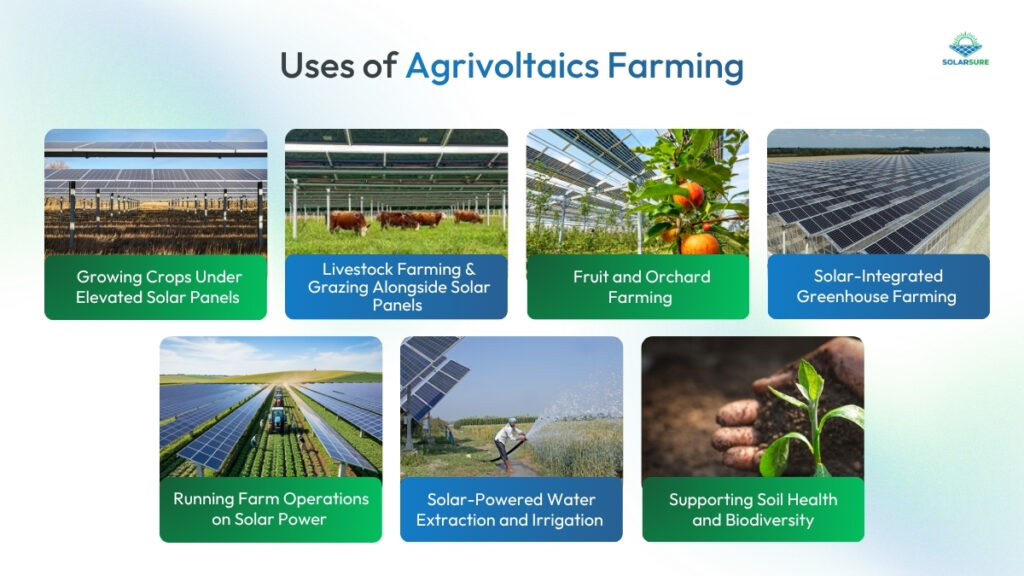
Growing Crops Under Elevated Solar Panels

This is how most agrivoltaic farms are set up. Panels are fixed on frames well above the field, and food crops grow in the space below. The shade that the panels provide suits a wide range of crops, such as turmeric and ginger in Madhya Pradesh, ragi and brinjal in Karnataka, and onions and tomatoes across Maharashtra. Moreover, the sunlight-dependent crops like wheat are planted in the open corridors between panel rows, where full sunlight still reaches the ground.

Livestock Farming and Grazing Alongside Solar Panels

Cattle, goats, and sheep can graze on land that also has solar panels installed above. The animals benefit directly from the shade, which lowers heat stress during hot months and keeps them calmer and healthier.  Fodder grasses and pasture crops grow steadily in the partial shade below the panels. Meanwhile, animals grazing between the panels naturally control weed growth, which reduces unnecessary maintenance work for the farmer. This combination of animal welfare, feed production, stable income, and solar generation from the same land is gaining interest across dry and semi-arid farming regions.

Fruit and Orchard Farming

Fruit trees like guava and lemon are a natural fit for elevated agrivoltaic panels. These trees grow well under partial shade and do not require the same machinery access that annual crops demand. Once established, an agrivoltaic orchard requires low maintenance, the trees grow steadily under the panels, the panels produce power consistently, and the farmer’s involvement focuses mainly on harvest and routine upkeep.

Solar-Integrated Greenhouse Farming

In agrivoltaics farming, solar panels form part of the greenhouse structure, either as the roof or as side panels. The greenhouse continues to function as a protected growing environment for the crops inside, while the panels generate electricity from the sunlight they capture.  This works particularly well for high-value crops like flowers, herbs, vegetables, and certain other crops that already require a controlled environment. The farmer benefits from both the crop inside and the electricity sold outside.

Running Farm Operations on Solar Power

The electricity produced by agrivoltaic panels does not just go to the grid. The farm itself can consume most of the electricity. Irrigation pumps, cold storage units, food processing equipment, and chaff cutters can all run on this power. This reduces dependence on diesel and cuts monthly electricity bills significantly. 

Solar-Powered Water Extraction and Irrigation

In many parts of India, the cost and availability of water are the single biggest concern for farming. Agrivoltaic farming addresses this from two sides at once. Solar panels power the pumps that lift water from bore wells or canals to eliminate diesel costs. At the same time, the shade from the panels reduces how quickly water evaporates from the soil, which means less water is needed overall. Together, these two effects can make a meaningful difference to a farmer’s water bill, especially in drought-prone districts.

Supporting Soil Health and Biodiversity

Agrivoltaic farms can be designed to actively improve the surrounding farm environment. Wildflower strips between panel rows attract bees and pollinators, which improve crop yields across the farm. Panel rows oriented against the prevailing wind direction act as windbreaks that protect topsoil from erosion. Over several growing seasons, these effects accumulate, and the land becomes progressively more productive.

Where is Agrivoltaics Going in India Over the Next 10 Years?

Agrivoltaics in India is at an early but clearly accelerating stage. Understanding where it is headed helps a farmer decide whether to move now or wait.

Indian Engineering is Catching Up to Indian Conditions

The first AgriPV systems deployed in India were largely adapted from European designs, which were built for different soil types, different wind patterns, and different rainfall.  Over the past few years, IIT-led engineering teams have been developing India-specific structural standards that account for monsoon wind loads, expansive clay soils in central India, seismic zones in the west and south, and the specific corrosion conditions of coastal regions. This means the systems being installed today are better suited to Indian farms than those installed five years ago, and the systems being installed five years from now will be better still.

The Range of Crops and Farm Types is Expanding

Early Indian pilots focused primarily on a handful of shade-tolerant crops. As more data comes in from working farms, the list of compatible varieties and farming systems is growing. Floriculture farms, fish ponds with floating solar, dairy farms with solar-powered cooling, and spice cultivation operations are all now being explored as agrivoltaic applications. Cold chain infrastructure powered by on-farm solar, which directly addresses India’s massive post-harvest loss problem, is emerging as one of the most impactful near-term applications.

Policy is Moving from Awareness to Active Support

Three years ago, agrivoltaics was barely mentioned in Indian agricultural policy documents. Today, it has a dedicated 10 GW target in the upcoming PM-KUSUM 2.0, a national alliance coordinating standards and research, and active policy discussions around the land classification reforms needed to protect farmers’ legal status when they install solar.  State governments in Maharashtra, Gujarat, Karnataka, and others have launched schemes that build the financial and grid infrastructure that agrivoltaic farms need. The direction is clear, even if the pace is uneven.

The Economics Will Improve as The Scale Increases

One of the biggest barriers today is the high upfront cost of elevated AgriPV structures, which is 20 to 40% more than conventional ground-mounted solar. As more installations happen, manufacturing volumes for the specialised components increase, supply chains mature, and installation teams gain experience. Costs will come down.  Farmers who participate in early government-subsidised pilot programmes today will be ahead of the curve when agrivoltaics becomes mainstream, and better positioned to advise others, access follow-on support, and benefit from improved designs as they arrive.

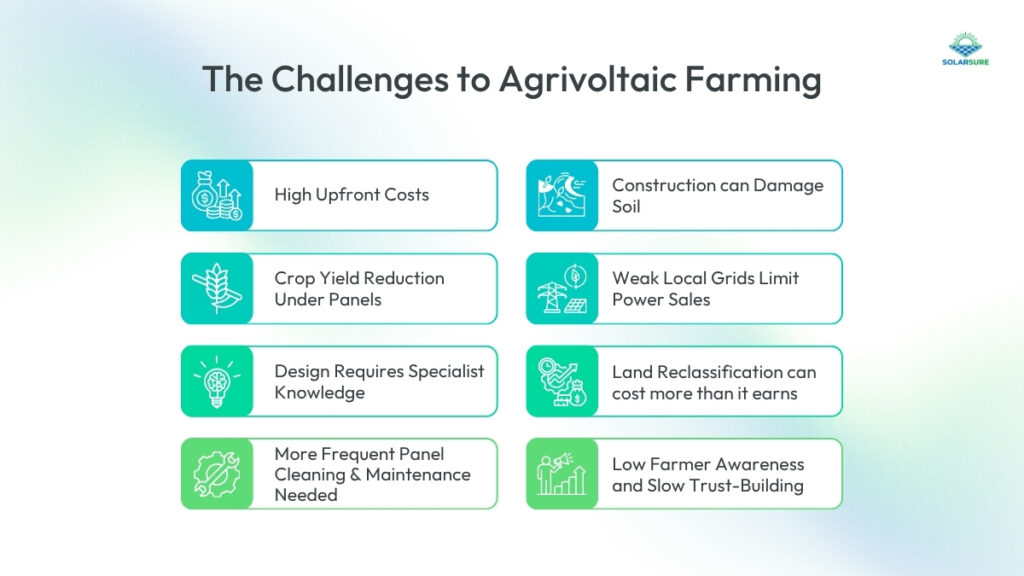
The Challenges to Agrivoltaic Farming

The Challenges to Agrivoltaic Farming

High Upfront Costs

An elevated AgriPV system costs between ₹5 lakh and ₹25 lakh per acre, which is 20 to 40% more than standard ground-mounted solar, because frames must be taller and stronger.  Most smallholder farmers cannot finance this independently. The realistic paths are government subsidies, loans through Farmer-Producer Organisations, or a lease or joint-venture arrangement with a private developer. Each option has its own terms and trade-offs that need careful review before signing anything.

Crop Yield Reduction Under Panels

Some crops yield 15 to 20% less when grown directly under panels compared to open fields. For shade-tolerant crops, this gap is smaller or negligible. The solar income usually more than compensates, but only if crop selection was planned with this trade-off in mind from the start. Discovering a yield reduction mid-season, without financial buffers in place, is avoidable with proper planning.

Design Requires Specialist Knowledge

A solar company without agricultural knowledge will get the design wrong. An agronomy advisor without solar expertise will also get it wrong. Panel height, row spacing, tilt angle, and crop placement must be co-designed by people who understand solar and possess hands-on experience.  Before committing, farmers should ask any developer to show completed working AgriPV installations, not just rooftop or ground-mounted solar projects, and visit those sites in person. You can also read: What is Solar EPC and How It Works: Explained Step-by-Step Process

More Frequent Panel Cleaning and Maintenance Needed

Ploughing, harvesting, and fertiliser spraying generate dust and particles that settle on panel surfaces. This reduces power output and cuts what the farmer earns from electricity. AgriPV panels need to be cleaned more often than standard solar installations. These costs and schedule must be built into the maintenance plan and financial projections from day one to avoid a surprise expense.

Construction can Damage Soil

Heavy machinery used during installation can compact agricultural soil, making it harder for roots to penetrate and for rainwater to drain properly. Responsible developers designate specific access tracks for heavy machines, restrict construction vehicles to those tracks, and restore soil immediately after installation. Farmers should make this a specific written condition of any installation contract before work begins.

Weak Local Grids Limit Power Sales

In many rural areas, the grid cannot absorb large amounts of power from distributed farm-based sources. Surplus electricity that the grid cannot accept is simply wasted, and the farmer earns nothing from it. Understanding the grid connection situation in your area before installing is essential. Net metering availability and battery storage options should be explored as part of the planning process.

Land Reclassification can cost more than it earns

Most Indian states currently require agricultural land to be reclassified as non-agricultural before solar panels can be installed. This reclassification removes agricultural status from the land, and the farmer loses access to Kisan Credit Cards, crop insurance, agricultural subsidies, and state support programmes.  In some cases, the financial loss from these removed benefits can exceed the income gained from solar. Always consult a lawyer familiar with your state’s land laws before proceeding, and work with schemes or developers who can help preserve your agricultural status.

Low Farmer Awareness and Slow Trust-Building

Agrivoltaics requires farmers to allow significant physical changes to the land they have managed for years or decades. Most farmers across India have never seen a working agrivoltaic installation. Building genuine trust requires presenting real results from nearby farms in familiar crops, providing full written clarity on costs and expected returns, and walking farmers through every stage of the process well before any construction begins.

Which Crops Grow Better Under Agrivoltaics Solar Panels?

This is the most practical question any farmer asks before considering agrivoltaics. The answer depends on how much shade the panels create in your specific setup, but there are proven patterns from Indian pilot data that any farmer can use as a starting point. The key factor is shade tolerance, which means how well a crop grows when it does not receive full, direct sunlight throughout the day. Crops that naturally grow under tree canopies, in valleys, or in partially shaded fields tend to do very well under solar panels. Crops that evolved in open plains and need maximum sun exposure throughout the day are less suitable directly under panels, though they can still be grown in the open spaces between panel rows.

Spices and Medicinal Crops

These are among the best-performing crops in agrivoltaic setups across India. Turmeric, ginger, cardamom, black pepper, and various medicinal herbs naturally grow in forested and partially shaded environments. Under solar panels, they not only grow well, but they often produce better quality rhizomes and leaves because the moderated temperature and retained soil moisture reduce stress on the plant. For farmers in central and southern India, these crops offer a strong combination of good yield, high market value, and excellent compatibility with solar shade.

Leafy Vegetables

Spinach, fenugreek (methi), coriander, mint, amaranth, and curry leaves are well suited to partial shade. These crops are also fast-growing, and many can be harvested in 30 to 45 days, which means a farmer can run multiple harvest cycles in a single season under the panels.  Leafy vegetables are particularly practical for small farmers who want quick cash flow from the crop side of the operation while the solar income builds up.

Root Vegetables and Bulbs

Onion, garlic, radish, and beetroot can all be grown under solar panels with good results, particularly in states like Madhya Pradesh and Maharashtra, where these are already common crops. Onions and garlic do especially well because the partial shade reduces the risk of the bulbs drying out prematurely in hot, dry conditions, which is a common problem in open-field cultivation during summer months.

Fodder Crops for Livestock

Fodder grasses, berseem (Egyptian clover), and lucerne grow well under panels and provide a reliable feed supply for cattle and goats on the same farm. For farmers who keep livestock alongside field crops, growing fodder under the solar canopy is a practical way to use the shaded space productively without adding complexity to the crop rotation.

Flowers and Horticulture Crops

Marigold, chrysanthemum, and certain orchid varieties grow well under the moderated light conditions that solar panels create. Floriculture is a high-value option for farmers near urban markets, wedding suppliers, or flower mandis. The income per acre from flowers is typically higher than that from most food crops, and the combination of solar income and flower income can significantly improve overall farm earnings.

Schemes and Initiatives Available for Agrivoltaics Farming in India

The good news is that agrivoltaics does not have to be self-financed. Several central and state government schemes exist that either directly support AgriPV installation or build the infrastructure around it. Here is what is available and what each one actually means for a working farmer:

PM-KUSUM 2.0

The second phase of Pradhan Mantri Kisan Urja Suraksha Evam Utthan Mahabhiyan (PM-KUSUM 2.0) is being designed with agrivoltaics at its centre. It will include a dedicated 10 GW component specifically for dual-use solar-farming installations. It is the first time a national scheme has set an explicit AgriPV target.  Under this scheme, the viability gap funding will be available to close the gap between what an AgriPV system costs to build and what a farmer can actually pay. Equally important, PM-KUSUM 2.0 is expected to formally recognise dual-use land configurations so that a farmer who installs solar panels does not lose agricultural status, agricultural subsidies, or access to farming credit. For any farmer thinking about agrivoltaics, this scheme will be the most relevant entry point when it launches.

PM-KUSUM (Current Scheme) 

The existing PM-KUSUM scheme provides a combined 60% subsidy (30% from the central government and 30% from the state) for solarising irrigation pumps and setting up small grid-connected solar plants on agricultural land.  Under Component C of the scheme, farmers can already access support for installing solar capacity on their farms. Agrivoltaic pilots are being actively integrated into this component. Farmers who engage with PM-KUSUM now gain hands-on experience with solar infrastructure, grid connections, and payment systems, all of which will directly prepare them for a full agrivoltaic setup under PM-KUSUM 2.0.

India Agrivoltaics Alliance

The India Agrivoltaics Alliance brings together research institutions, solar developers, and government agencies to establish how AgriPV systems should be designed, built, monitored, and certified. For farmers, the most important work the IAA does is pushing for policy reforms, particularly the creation of a dual-use land classification that lets farmers install solar while keeping full agricultural status.  The IAA also publishes performance data from working pilots, which gives farmers and developers a clearer picture of what realistic returns look like across different crops and regions.

Region-wise Crop Recommendations for Indian Farmers Using Agrivoltaics Farming

India’s farming regions are very different from each other, such as in soil type, rainfall, temperature, and what crops local markets actually buy. The best agrivoltaic crop choices for a farmer in Madhya Pradesh are not the same as for a farmer in Karnataka or Gujarat. Here is a region-wise guide based on current pilot data and local agricultural conditions.

Madhya Pradesh and Chhattisgarh

This region’s black cotton soil and moderate rainfall suit a strong mix of agrivoltaic crops. Turmeric, garlic, onion, tomato, and coriander perform well under panels here. Soybean, while a full-sun crop, can be grown in inter-row open corridors. Farmers in this region have seen some of the strongest early pilot results in India, particularly at Krishi Vigyan Kendra pilots, where net returns improved by over 168% compared to open cultivation.

Karnataka and Telangana

Ragi (finger millet), brinjal, grapes, and tomatoes are well-suited to agrivoltaic setups in this region. Ragi is particularly interesting because it is already one of Karnataka’s most important crops, and it shows good compatibility with partial shade systems.  Farmers in the Deccan plateau regions also report success with ginger and turmeric in agrivoltaic farming setups, with the shade helping manage the high summer temperatures that can otherwise damage these crops.

Maharashtra

Maharashtra’s varied geography, from the Vidarbha cotton belt to the Konkan coast to the Western Ghats, means different crops suit different parts of the state. Onion and tomato work well in Nashik and the surrounding areas under agrivoltaic panels. In the Konkan belt, banana, ginger, and betel leaf are promising options. For farmers near Pune and Mumbai, floriculture like marigold, chrysanthemum, and roses offers high returns under the moderated light that panels create.

Rajasthan and Gujarat

These are the states where water conservation from agrivoltaics matters most. The shade and retained soil moisture that panels create are especially valuable in dry conditions. Cumin, isabgol (psyllium husk), ajwain, coriander, and fennel are all suitable agrivoltaic crops for these regions.  In Gujarat, farmers near Saurashtra are already exploring groundnut cultivation in open inter-row corridors alongside shade crops directly under panels by using both zones of the agrivoltaic layout productively.

Punjab, Haryana, and Uttar Pradesh

These are India’s major wheat and paddy growing states, which means most existing crop patterns are not directly compatible with solar shade. However, agrivoltaics still makes sense here if the approach is adjusted. Wheat and paddy can be grown in the open inter-row corridors. Under the panels, vegetables like spinach, methi, peas, and radish can be introduced as secondary crops. It provides additional income on land that previously only produced one crop per cycle.

Kerala and Tamil Nadu

The humid climate and existing crop patterns in these states make black pepper, cardamom, coffee, and banana natural candidates for agrivoltaic farming integration. Black pepper in particular grows as a vine and is already used to climb structures, such as panel mounting frames, which can double as trellises. Tamil Nadu farmers in drip-irrigated regions are exploring combinations of banana under panels with solar-powered drip systems, which reduces both water use and electricity costs simultaneously.

Bottom Line

For farmers, the real value of agrivoltaics lies in making the land work more consistently over time. It is not about changing what you do, but strengthening it with an additional layer of stability for an additional source of income. With the right system design and crop planning, you can continue farming while creating a reliable income stream that is less affected by seasonal risks. The decision ultimately comes down to whether you want to keep operating within the limits of traditional farming or move towards a model that is better aligned with how agriculture and energy are evolving together. If you have any doubts, you can book a free consultation call with us.

Table of Contents

Have a Query ?

Contact Us

Scroll to Top