India’s commercial and industrial electricity bills are a silent profit killer. For most businesses, power costs rank among the top three operational expenses, and they rise every year. But there is a proven, policy-backed mechanism that allows your facility to dramatically slash those costs, not someday in the future, but starting from the month your solar system goes live. It is called a solar net metering system.
Solar net metering is not a new concept, but it is one that is still widely misunderstood, or underutilised, by commercial and industrial (C&I) consumers in India. Many business owners assume it is primarily a residential benefit. In reality, the financial case for net metering is far stronger for factories, offices, warehouses, retail chains, and industrial units than it is for any household. So, let us understand this in detail.
What is a Solar Net Metering System?
Net metering is a billing arrangement in which your DISCOM (Distribution Company) measures the difference between the electricity you import from the grid and the electricity you export to it, and bills you only for that net difference.
For example, your solar panels generate 800 units this month, and your facility uses 1,000 units. You import only 200 units from the grid. So your DISCOM bills you only for those 200 units. Similarly, if your solar panels generate 1,200 units, and your facility uses 1,000 units. You export 200 surplus units to the grid. Those 200 units become energy credits (in kWh) that carry forward and offset your next bill.
This means your facility is billed only for the net electricity consumed, not total consumption. For industrial and commercial consumers, this directly translates into lower operational costs and improved profitability. This way, your electricity costs drop dramatically, your dependence on the grid reduces, and your solar investment starts paying back faster than almost any other capital expenditure in your business.
How Solar Net Metering Works (Step-by-step Explanation)
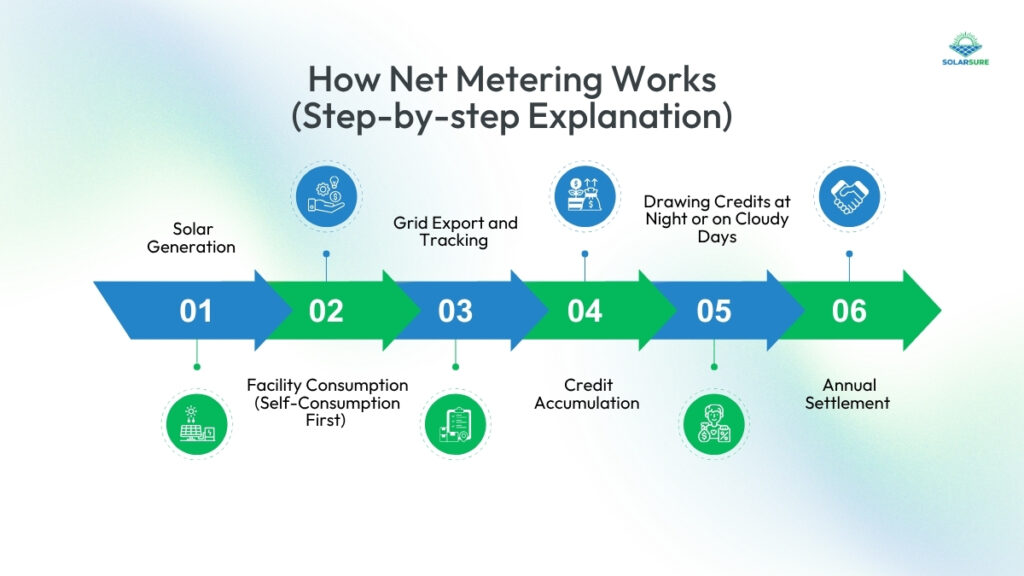
The entire system runs through a single piece of equipment, which is a bi-directional meter, also called a net meter, installed by your DISCOM. Unlike a standard meter that only tracks what you consume, this meter records energy flowing in both directions, from the grid to you, and from you to the grid.
Here is a detailed breakdown of how energy moves through your system and how this system works:
Step 1: Solar Generation
Your solar panels absorb sunlight and generate Direct Current (DC) electricity. This raw DC power cannot directly power your facility’s equipment, so it passes through an inverter, which converts it into Alternating Current (AC), the same type of electricity that is supplied from the grid.
Step 2: Facility Consumption (Self-Consumption First)
Once the power is converted into alternating current, your facility can consume it directly. Your machines, lighting, HVAC, computers, and everything else can be ready to operate from the power your solar panel generates. Solar power you generate and consume yourself is the most valuable unit of energy in the entire system because it directly replaces grid power, which is provided to you at the full retail tariff rate.
Step 3: Grid Export and Tracking
When your solar system produces more power than your facility is consuming at that instant, the surplus electricity does not go to waste. It flows outward through your bi-directional net meter onto the utility grid (DISCOM). The meter records the exact number of kilowatt-hours (kWh) exported with precision.
Step 4: Credit Accumulation
For every unit (kWh) you export, you receive one kWh of energy credit on your account. This is the 1-to-1 credit ratio that makes net metering so effective for businesses. The credits are stored in your account for long-term use based on your needs in future or at any time.
Step 5: Drawing Credits at Night or on Cloudy Days
When your solar system is not generating electricity at night, or during monsoon overcast, or on cloudy winter mornings, you can draw electricity from the grid as usual. But instead of paying the full tariff for every unit, your accumulated credits are first applied to offset those imports. You only pay cash for units drawn beyond your credit balance.
Step 6: Annual Settlement
At the end of your billing cycle, most states either roll unused credits forward to the next month or conduct an annual settlement. Depending on your state DISCOM’s policy, any remaining credits may be carried over indefinitely, settled at a predetermined rate, or lapse at year-end. This is why understanding your state’s specific rules (covered below) is critical before sizing your system.
Solar Net Metering Example: How it Helps Businesses
Let us say your factory consumes 10,000 units of electricity in a month, and your rooftop solar system generates 8,000 units during the same period.
Under net metering, your DISCOM only bills you for the difference, that is, 2,000 units instead of the full 10,000 units.
At a commercial tariff of ₹9 per unit:
Without solar: 10,000 × ₹9 = ₹90,000
With net metering: 2000 × ₹9 = ₹18,000
Monthly savings: ₹72,000
Annual saving: ₹8,64,000
That is an 80% reduction in your electricity bill, simply by generating power on your own rooftop and letting the grid handle the difference.
Why Solar Net Metering is Highly Beneficial for Industrial and Commercial Consumers
Residential solar is valuable, but commercial and industrial solar with net metering is transformative. Here is why the two are not even in the same league financially.
Your Operating Hours Match Solar Generation Hours Perfectly
This is the biggest advantage C&I businesses have over residential consumers, and it is often underappreciated. Solar panels generate peak power between 9 AM and 4 PM. Most commercial offices, factories, retail establishments, and industrial units operate between 10 AM and 6 PM, sometimes 24/7.
This reflects that the bulk of your solar generation happens precisely when your facility is consuming the most electricity. The result is high self-consumption, minimal export dependence, effective control over energy, and maximum direct savings.
A residential household, by contrast, consumes most electricity in the evening when solar panels generate nothing. Homeowners depend much more heavily on the export-credit cycle. Businesses, especially manufacturing units, can often self-consume 70–90% of what they generate, which delivers the highest possible return on every solar rupee spent.
Commercial Electricity Tariffs are Significantly Higher
In India, commercial and industrial consumers pay substantially higher electricity tariffs than residential consumers. Depending on the state and consumption slab, C&I tariffs typically range from ₹7 to ₹12+ per kWh (and higher in peak demand categories), compared to residential rates that may start at ₹3–5 per kWh.
Every unit of solar power you self-consume displaces grid electricity at your full commercial tariff. This means your effective “value” of each solar unit is higher than it would be for a homeowner.
Faster Return on Investment (ROI)
Because of higher tariffs and better load matching, a well-designed commercial solar system with net metering can achieve payback in 3 to 5 years, compared to 6 to 8 years for a typical residential system. Over a 25-year panel lifespan, a business can get electricity for over 20+ years with near-zero cost and get credits for excess power transferred to the grid.
Overall, in a rough calculation, for a business spending ₹5–10 lakh per month on electricity, even a 50% reduction represents crores of rupees in savings over a decade. So, we cannot deny the fact that investing in solar energy is a strategic decision for businesses.
Protection Against Rising Tariffs
Electricity tariffs in India have risen consistently at 4–8% annually over the past decade. Once your solar system is installed, the cost of the energy it generates is essentially fixed (under the capex model). Net metering lets you lock in savings that grow in value every year as grid tariffs increase.
Supports ESG and Sustainability Goals
For businesses with corporate sustainability commitments, export targets, or ESG (Environmental, Social, and Governance) reporting obligations, net-metered solar provides measurable, verifiable renewable energy production data. This strengthens your sustainability narrative with investors, clients, stakeholders, and regulators.
Net Metering vs. Net Billing vs. Gross Metering: What Is the Difference?
Many business owners confuse these three models. The distinction matters enormously for your financial projections. Here is a clear side-by-side comparison:
| Feature | Net Metering | Net Billing | Gross Metering |
| How It Works | Single bi-directional meter tracks imports and exports. You pay only the net difference. | Separate meters (or accounts) track imports and exports independently. | All solar generation is sold to the utility. All consumption is bought from the grid. |
| Metering Setup | One bi-directional net meter. | Two separate meters or dual-register accounting. | Two separate meters (generation + consumption). |
| Credit Type | Energy credits in kWh (not cash). | Monetary credits in ₹. | Cash payment for all units generated. |
| Export Value | Full retail tariff rate (1-to-1 kWh offset). | Lower feed-in tariff, typically wholesale or APPC rate. | Fixed feed-in tariff set by the utility. |
| Import Rate | Standard retail tariffs. | Standard retail tariffs. | Standard retail tariffs. |
| Who Benefits Most | C&I consumers with high daytime self-consumption. | Systems with unavoidable export but priority on self-consumption. | Utility-scale power plants and large developers. |
| Key Advantage | Maximum value per exported unit. Very simple to manage. | Predictable cash credits. Works well with separate generation accounting. | Clean separation of generation revenue and consumption cost. |
| Key Limitation | Credits may lapse annually, which depends on state policy. | An export value lower than the import cost can erode ROI on oversized systems. | Rarely financially optimal for rooftop commercial setups. |
For most commercial and industrial businesses in India, net metering is the most financially favourable model because it values your exported power at the full retail tariff rate rather than a lower wholesale rate.
State-Specific Solar Net Metering Guidelines in India
Net metering in India is not governed by a single national rule. Each state’s DISCOM sets its own regulations on capacity limits, technical requirements, approval processes, and credit settlement policies. Here is what C&I businesses need to know in three major states:
Maharashtra (MSEDCL)
Maharashtra Electricity Distribution Company Limited (MSEDCL) is one of the more progressive DISCOMs for commercial solar adoption.
Capacity Limit: Rooftop solar systems up to 1 MW are eligible for net metering in Maharashtra. It is a generous ceiling that accommodates large industrial setups.
Technical Requirements: MSEDCL enforces strict rules around load matching (your solar capacity cannot exceed your sanctioned load) and requires specific inverter certifications compliant with IS/IEC standards.
Approval Process: The application process is fully digitised. The applicants can submit and track through MSEDCL’s official online portal.
Key Tip: Make sure your inverter carries the required IS 16169 or IEC 62116 certification before applying, because the non-compliant equipment is the most common cause of application delays.
Madhya Pradesh (MPDISCOMs)
In Madhya Pradesh, rooftop solar net metering is governed by the Madhya Pradesh Electricity Regulatory Commission (MPERC). The state has been steadily promoting rooftop solar adoption across residential, commercial, and industrial segments.
Capacity Limit: Rooftop solar systems are generally allowed up to 1 MW capacity under net metering. However, the installed solar capacity must not exceed 100% of the sanctioned load/contract demand of the consumer.
Technical Requirements: MPDISCOMs require systems to comply with MNRE and BIS standards, including certified inverters (IS/IEC compliant) and proper grid synchronisation mechanisms. A bi-directional (net) meter is mandatory, along with protections such as anti-islanding to ensure grid safety.
Approval Process: The application process is largely online via the state DISCOM portals. Consumers must submit technical details, system capacity, and contractor information.
Tamil Nadu (TNEB)
Tamil Nadu Electricity Board (TNEB) has been strongly supportive of commercial solar installations to make it one of the better states for C&I net metering adoption.
Capacity Limit: Commercial and industrial consumers can apply for net metering up to their sanctioned load capacity. The TNEB supports larger C&I rooftop installations.
Technical Requirements: Inverters must meet BIS/IEC certification standards. The system design must comply with TNEB’s grid interconnection norms.
Approval Process: You can apply through TNEB’s official online portal with a structured, trackable approval workflow.
Key Tip: Invest time in preparing complete, accurate technical documentation upfront. Incomplete submissions are the leading cause of TNEB application rejections and delays.
Uttar Pradesh (UPNEDA)
UP’s net metering landscape requires careful verification, as policies have been actively evolving.
Capacity Limit: Residential systems under 5 kW have clear net metering eligibility. For commercial and industrial setups, capacity limits must be verified directly with UPNEDA or the local DISCOM at the time of application.
Technical Requirements: Systems must comply with Central Electricity Authority (CEA) technical standards for grid connectivity and inverter certifications per IS/IEC norms.
Approval Process: Applications are processed through the local DISCOM or UPNEDA. The process is less centralised than in Maharashtra or Tamil Nadu and may vary by distribution circle.
Key Tip: Do not rely on secondhand policy information. Contact your local DISCOM or UPNEDA directly to confirm current net metering eligibility, capacity limits, and tariff structures before committing to a system design.
For businesses in other states: States like Rajasthan, Gujarat, Karnataka, Andhra Pradesh, and Telangana all have their own net metering frameworks. Always consult your state DISCOM or a qualified EPC partner familiar with local regulations before finalising your solar project design.
Step-by-Step Application Process: How to Get Net Metering Approved for Your Business?
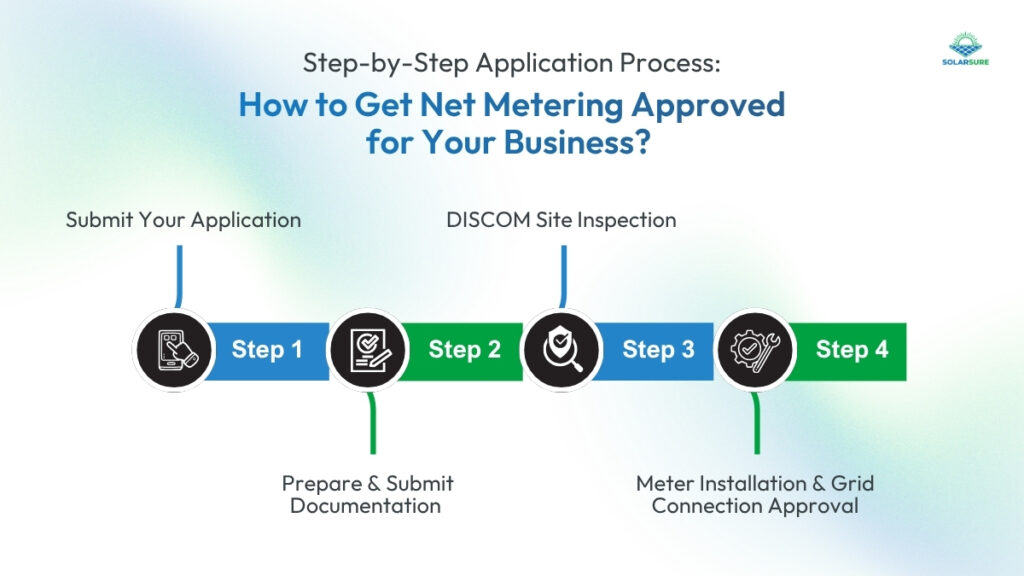
The net metering connection process for commercial installations typically takes 15 to 45 days from application to meter installation, which also depends on your DISCOM’s workload and the completeness of your documentation.
Here is the step-by-step process:
Step 1: Submit Your Application
You can apply directly through your DISCOM’s online portal or through an EPC (Engineering, Procurement, and Construction) partner, a solar installation company that handles the entire process on your behalf.
For C&I businesses new to solar, working with an experienced EPC partner is strongly recommended, as they navigate DISCOM requirements daily and know how to avoid common pitfalls. Before choosing them, you must understand what solar EPC is and how they work.
Step 2: Prepare and Submit Documentation
This is where most applications either succeed quickly or get stuck. Here is the information about the document requirements for a business:
| Document | Details |
| Latest Electricity Bill | Typically, the last 3–6 months of bills establish your consumption baseline. |
| Company KYC / Identity Proofs | GST certificate, company registration, PAN, and authorised signatory ID. |
| Proof of Ownership or Tenancy | Property documents or a lease agreement for the premises. |
| Inverter Capacity Certificates | Manufacturer certifications that confirm compliance with IS/IEC standards. |
| Meter Specifications | Technical datasheet of the proposed bi-directional net meter. |
| Single Line Diagram (SLD) | Professionally drawn electrical schematic showing the complete system layout, including panels, inverter, meter placement, and grid connection point. |
Pro tip: The Single Line Diagram is the document most commonly flagged for errors or omissions. Have it prepared by a qualified electrical engineer, not just a salesperson. A poorly drawn SLD will delay your approval by weeks. A solar EPC partner can have a team of professional experts who help C&I with the challenges businesses face in solar projects.
Step 3: DISCOM Site Inspection
After reviewing your application, the DISCOM assigns a technical team to inspect your facility. They verify:
- Physical installation quality and safety standards
- Compliance between the actual setup and the submitted SLD
- That the inverter and meter match the certified specifications
- That the system capacity does not exceed your sanctioned load
It is recommended to be present during the inspection and ensure your installation team has addressed all technical requirements before this visit. Re-inspection requests are a common cause of timeline overruns and delays.
Step 4: Meter Installation and Grid Connection Approval
Once the DISCOM approves your application and inspection, they install the bi-directional net meter at your facility. From this point, your system is officially grid-connected and begins accumulating export credits. You will receive formal documentation from the DISCOM confirming your net metering arrangement, tariff category, and credit policy.
How Much Does a Solar Net Meter Cost?
The solar net meter itself is a relatively minor cost component of your overall solar investment, but it is worth budgeting accurately. For a commercial or industrial facility, you will require a three-phase net meter (since most C&I connections are three-phase). Here is the typical cost breakdown:
| Cost Component | Typical Range |
| Three-phase net meter (equipment) | ₹4,000 – ₹6,000 |
| DISCOM meter installation charges | ₹1,000 – ₹2,000 |
| Total net meter cost | ₹5,000 – ₹8,000 |
This is a one-time cost. In the context of a commercial solar installation that may cost ₹30–80 lakh or more based on the electricity requirements, the solar net meter expense is negligible, which is less than 0.1% of the total project cost in most cases. The dominant costs remain the solar panels (modules), inverter, mounting structure, DC and AC cabling, and installation labour.
Bottom Line
Net metering is one of the most financially sound policy mechanisms available to commercial and industrial businesses in India today. It transforms solar from a simple “green initiative” into a hard-nosed financial strategy, one that reduces operational costs, provides multi-year protection against tariff hikes, and delivers measurable ROI within a predictable timeframe. If you want to know more about net metering, book a free consultation with us. We, at SolarSure, work exclusively with commercial and industrial clients across India. We handle the end-to-end process, such as system design, DISCOM liaison, documentation, installation, net meter commissioning, and post-installation support.