Businesses across India are increasingly switching to solar power to reduce their electricity costs. But when it comes to open access solar, the journey does not end at just deciding to go solar. The first real step begins with getting your open access solar approval, and understanding this process is what separates a smooth project from one that gets stuck for months.
Unlike rooftop solar, where you install panels and start saving, open access works differently. Here, your solar plant is located at a separate location, and the power travels to your facility through the shared public electricity grid. Because public infrastructure is involved, multiple government bodies and utilities need to verify and approve your project before a single unit of solar power reaches you.
In this blog, we have mentioned all the required open-access solar approvals that a business needs. So, let us discuss all the approvals in detail.
What is Open Access Approval?
Open access solar approval is not a single permission issued by one authority. It is a layered process where multiple stakeholders validate different aspects of your project. Each approval ensures that your project integrates smoothly into the existing electricity ecosystem.
Some approvals focus on technical feasibility, such as whether the grid can handle your power requirement or whether your location is under the shadow of any nearby facilities. Other approvals focus on safety to ensure that your electrical infrastructure meets the required standards. There are also financial and regulatory approvals that protect utilities and maintain system balance.
For every business, it is necessary to satisfy the three major conditions, such as proper technical feasibility, legal compliance, and financial structure. If any of these elements are not fulfilled, the project may be delayed or fail to deliver the expected results.
Below are the major approvals required to start the open-access solar projects. Let us understand these in detail.
Types of Open Access Solar Approvals Required for Businesses
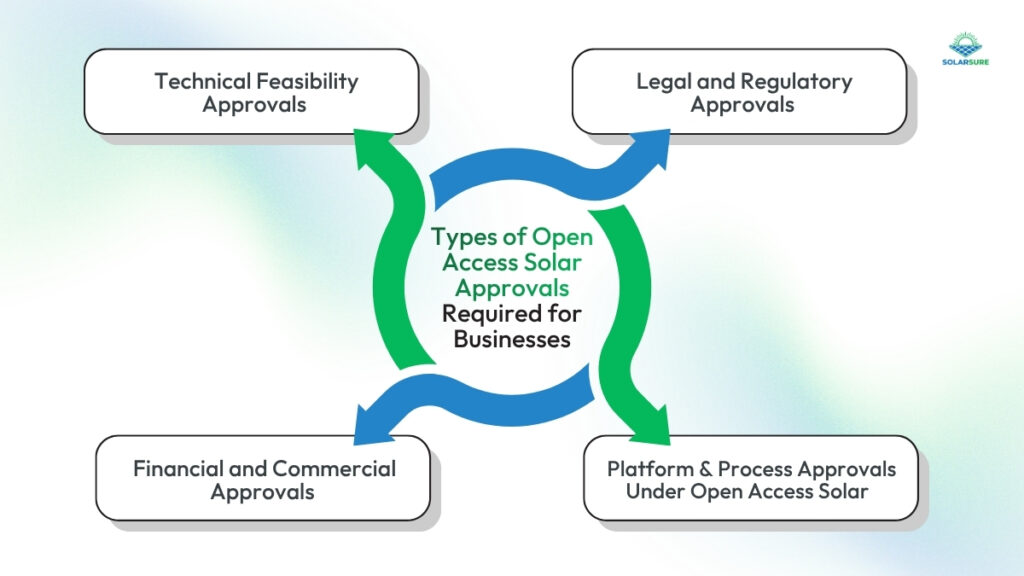
Technical Feasibility Approvals
Technical feasibility approvals ensure that your open access project can physically operate within the electricity grid without causing disruptions. These approvals evaluate whether the infrastructure can support power generation, transmission, and consumption under real operating conditions. They are critical because even a financially strong project cannot proceed if it fails to provide technical validation.
Grid Connectivity Approval
Grid connectivity approval is the formal permission that allows your solar project to connect to the electricity network. This approval ensures that your project can inject or draw power without affecting grid stability, safety, or reliability. Without this approval, your open access project cannot move forward, regardless of financial viability.
In India, the approval process depends on where your project is connected. If your project spans multiple states, it falls under the Inter-State Transmission System, managed by central authorities. If it connects within a state, it is handled by State Transmission Utilities or local DISCOMs, which makes the process more location-specific and dependent on state policies.
There are also important technical and financial requirements that businesses must understand. Projects above certain capacities, such as 5 MW, usually require higher-voltage connectivity, such as 33 kV or higher. Developers may also need to submit a connectivity bank guarantee to secure their position in the approval queue and demonstrate commitment to execution.
Additionally, detailed generator data must be submitted for grid studies, including fault analysis and system simulations. This data helps utilities assess how your project will behave under different operating conditions. For businesses, this ensures that the project will perform reliably without causing disruptions.
Overall, grid connectivity approval is the stage where your project is technically validated for execution. If this step is handled correctly, the rest of the open access process becomes significantly smoother and more predictable.
Net Metering Requirements
Open access works on energy accounting instead of physical power transfer. This means your electricity consumption and solar generation must be measured accurately. Without proper metering, billing disputes and incorrect savings calculations can occur.
To enable this, businesses must install ABT meters or Special Energy Meters. These meters record electricity usage in 15-minute intervals. This allows precise matching of consumption and generation.
For a business owner, this means the timing of electricity usage becomes important. If your consumption aligns with solar generation, your savings will increase. If not, your effective cost may change.
SLDC Approval: The Most Important Technical Clearance
The State Load Dispatch Centre (SLDC) is responsible for checking whether the project requirements impact grid stability or not. SLDC checks whether your project can operate without disturbing the grid. It analyses load patterns, transmission capacity, and scheduling feasibility.
It plays a central role in open access solar approvals by evaluating your project’s technical impact. After all the mentioned evaluations, the SLDC approval clearance will be issued.
For businesses, this is the most critical technical approval. It confirms that your project is viable within the grid system. Without this clearance, the project cannot move forward.
Legal and Regulatory Approvals
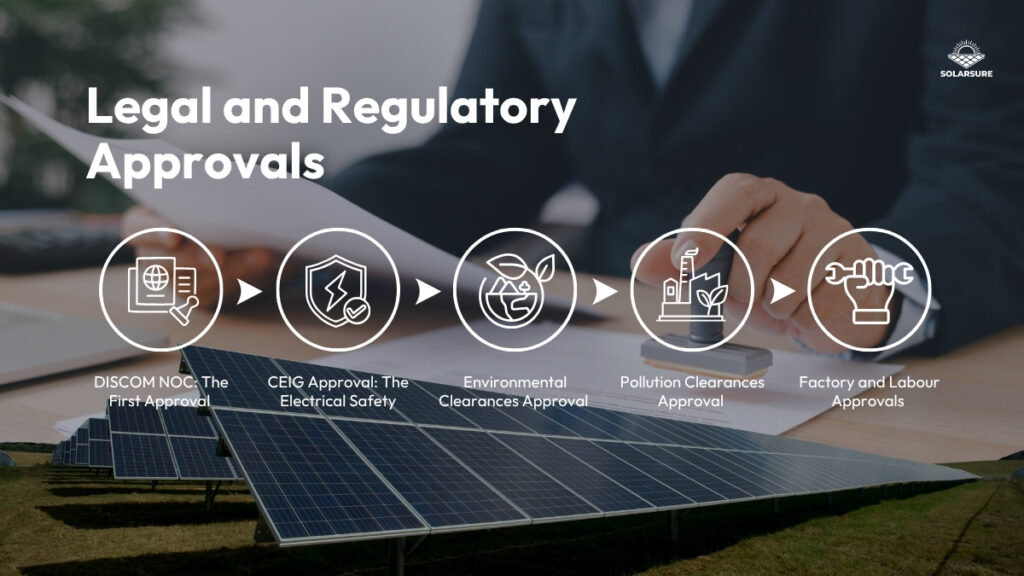
Legal and regulatory approvals ensure that your open access project follows all safety, environmental, and operational laws in India. These approvals protect your business from legal risks while ensuring that the project integrates safely with existing infrastructure. In wheeling electricity solar open access in India, these permissions are essential to maintain compliance, avoid penalties, and enable smooth long-term operations. Some of these approvals are given below:
DISCOM NOC: The First Approval
The No Objection Certificate (NOC) from the DISCOM is the starting point of any open access project. DISCOM is responsible for managing the electricity distribution network in your area. So, it is a must to take NOC from the DISCOM to ensure the project proceeds further.
The NOC by DISCOM ensures that your project will not disrupt the existing power supply or overload the grid. It also confirms that your request for open access is acceptable from a distribution perspective. This is important because in wheeling electricity solar open access in India, the grid must support both supply and transfer simultaneously.
CEIG Approval: The Electrical Safety
The Chief Electrical Inspector to Government (CEIG) approval is required for projects that involve high-voltage electrical systems. This includes solar plants above 100 kWp, installations above 650 volts, and large industrial or commercial setups.
Under the Electricity Act 2003, this approval is mandatory to ensure that your electrical infrastructure is safe to operate. It verifies that all components, such as wiring, transformers, electric lines, and protection systems, meet the required safety standards.
The purpose of this approval is to prevent electrical accidents, system failures, supply barriers, and fire risks. High-voltage systems can cause serious damage if not installed correctly, which is why CEIG approval is mandatory before commissioning.
Environmental Clearances Approval
Environmental and pollution clearances ensure that your project does not harm the surrounding ecosystem or violate regulatory norms. These approvals are governed by the Ministry of Environment, Forest and Climate Change, and State Pollution Control Boards. In recent years, the process has been streamlined for renewable energy projects to reduce delays and support clean energy adoption.
Environmental Clearance (EC) is required under the EIA Notification, 2006, before starting any major project work. Projects are classified into Category A and Category B based on their size and impact, where large projects require central approval and smaller ones are handled at the state level, with further classification into B1 and B2 depending on whether an environmental study is needed.
However, most solar projects below 25 MW are now exempt from separate EC requirements. This simplification supports faster deployment of renewable energy under wheeling electricity solar open access in India.
Pollution Clearances Approval
Pollution clearances are issued as Consent to Establish (CTE) and Consent to Operate (CTO) by State Pollution Control Boards. CTE ensures that your project design includes proper pollution control measures before construction begins, while CTO verifies that these systems are functioning correctly before operations start.
In many cases, if environmental clearance is already obtained, a separate CTE is not required, as both processes are now integrated to reduce duplication and improve ease of doing business.
Factory and Labour Approvals
Factory approvals are governed under the Factories Act, 1948, and apply when the project meets specific thresholds related to workforce and power usage. Before construction begins, the project layout must be approved by the Department of Factories and Boilers to ensure structural safety and compliance with labour norms.
In addition, a factory license is required to start operations, along with a stability certificate that confirms that the mounting structures, control rooms, and other installations are safe for long-term industrial use.
Labour approvals focus on the welfare and legal engagement of workers involved in the project. If contract workers are employed, a contract of labour license is required, along with compliance with worker insurance and compensation under applicable laws.
Businesses must also register with the labour department and ensure that solar modules used in the project comply with the Approved List of Models and Manufacturers (ALMM), which has become mandatory for many open access projects from June 2026 to ensure quality standards and eligibility under government policies.
Financial and Commercial Approvals
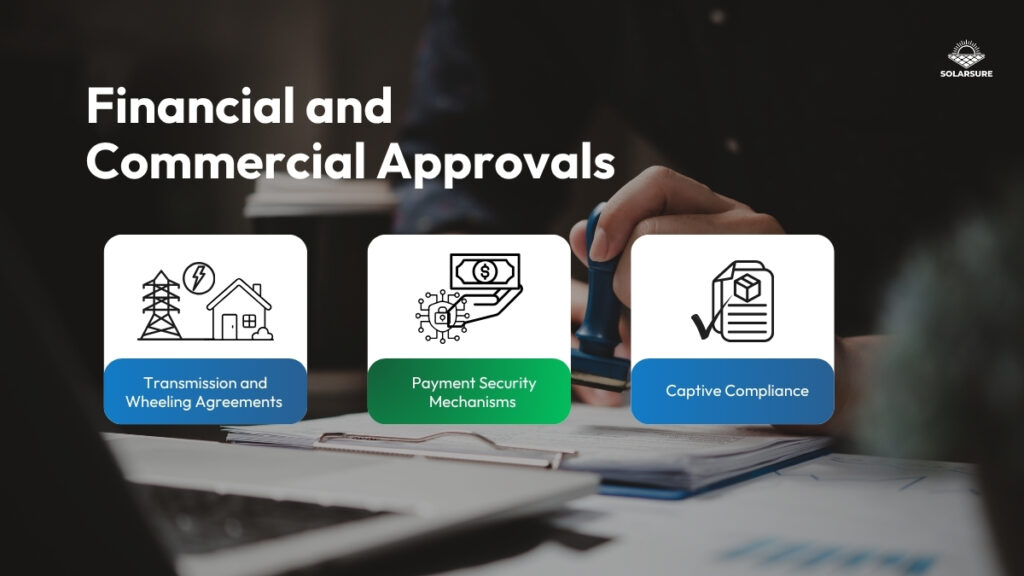
Financial and commercial approvals define how your open access project will function in practical business terms. These approvals determine how electricity is priced, how it is delivered through the grid, how payments are secured between all parties, etc. Without proper financial structuring, even a technically approved project may fail to generate expected savings or face disputes during operations.
Transmission and Wheeling Agreements
Transmission and wheeling agreements define how solar power is transported from the generation site to your facility through the grid. These agreements clearly outline the charges, responsibilities, efficiency, and operational conditions for using the transmission and distribution network.
For businesses, this is the backbone of wheeling electricity solar open access in India, where energy is generated at one location and consumed at another. These agreements include key elements such as grid usage terms, wheeling charges, exemptions, and loss adjustments during transmission.
In many states, wheeling charges are shared among DISCOMs to compensate for infrastructure usage and maintenance costs. Some policies also provide incentives or exemptions on transmission charges, especially for projects commissioned before specific deadlines, which directly improve the financial viability of the project.
Payment Security Mechanisms
Payment Security Mechanisms ensure that developers and utilities receive payments on time for the electricity supplied. These mechanisms typically involve financial instruments such as bank guarantees or letters of credit provided by the consumer. For businesses, this creates a structured system where financial obligations are clearly defined and secured.
These mechanisms also include provisions for late payment surcharges, which are often linked to benchmark rates such as SBI MCLR plus an additional margin. This ensures that payment delays are discouraged and compensated appropriately. In some government-backed models, centralised funds or escrow systems are also used to manage payment risks, which improves trust and stability in long-term open access contracts.
Captive Compliance
Captive compliance ensures that your project qualifies for financial benefits such as exemption from cross-subsidy surcharge. To meet this requirement, businesses must hold at least 26% equity in the solar project and consume at least 51% of the generated electricity annually. These conditions are designed to ensure that the project is genuinely used for self-consumption.
The captive compliance is verified on a financial-year basis, which means businesses must consistently maintain both ownership and consumption levels. Recent regulatory updates have introduced flexibility for group companies, which allows subsidiaries and holding entities to collectively meet these conditions.
Platform and Process Approvals Under Open Access Solar
Platform and process approvals define how you apply and track open access solar approvals in India. These are not technical or financial approvals, but systems that ensure the process is time-bound and transparent. They reduce dependency on manual follow-ups and bring consistency across states under a unified framework.
GOAR Portal
The Green Open Access Registry (GOAR) portal is the central platform for submitting and managing open access applications. It acts as a single-window system where businesses can apply for short-term, medium-term, and long-term open access solar approvals. This eliminates the need to interact with multiple authorities separately and simplifies the overall process.
The portal is operated by the Grid Controller of India and integrates both inter-state and intra-state approvals. It provides real-time updates on application status, including approvals, rejections, and modifications.
Recent updates have added payment gateway integration and enhanced security features, which are making the process faster and more reliable for businesses.
Deemed Approval
The deemed approval mechanism ensures that applications are not delayed unnecessarily by authorities. Under current rules, nodal agencies must process applications within 15 days from submission. If no response is received within this period, the application is automatically considered approved, subject to technical compliance.
This rule was introduced to remove bureaucratic delays and improve the ease of doing business. It also ensures that applications cannot be rejected without a valid written reason and an opportunity for the applicant to respond.
Standard Processing Timelines
Even though the final approval timeline is capped at 15 days, the internal processing follows structured timelines. New registrations are typically processed within 5 to 7 working days, which depends on whether it is intra-state or inter-state. This ensures that applications move forward in a systematic manner without unnecessary waiting periods.
If any discrepancy is found in the application, businesses are required to respond within 2 working days. If they fail to respond within this timeline, it may lead to rejection of the application. In some cases, especially for short-term open access, approvals such as standing clearance are automatically granted within a few working days if not processed manually.
Timeline and Challenges in Open Access Solar
The entire open access approval process typically takes three to nine months. The timeline depends on grid availability, documentation of readiness, approval timings, and state-specific policies. While digital systems have improved efficiency, practical delays may still occur.
DISCOM resistance is one of the most common challenges. Utilities may delay approvals because they lose high-paying consumers. Policy changes and infrastructure limitations can also impact timelines. So, there are several challenges businesses face in adopting solar and proper knowledge helps them navigate the challenges more effectively.
Bottom Line
Open access solar is not just an energy solution. It is a strategic decision that affects your cost structure and sustainability goals. Businesses that understand the approval process are better positioned to benefit from it.
The key is preparation and clarity. When approvals are planned properly, the project moves faster and performs better. This reduces risks and ensures long-term savings.
If you are considering open access solar, start by understanding approvals before everything. For more information, book a free consultation with our experts. We will help you explain everything in detail and with practical insights.