Electricity is one of the most significant operational expenses for commercial and industrial businesses. All the major operations depend on electricity, whether it’s running the machinery or keeping the office lights on. The problem is that electricity prices keep going up, and it is hard to plan your budget when costs change all the time.
You might have thought about rooftop solar to save money. It is a great start, but many big companies find that their roof is just too small. Sometimes the building is not strong enough to hold all the panels needed to power a large factory or office.
Here, open access solar changes the equation entirely. It is a simple solution that lets you get clean and cost-effective solar power from a large plant located somewhere else. You get all the benefits of solar energy without needing any additional space on your own roof.
In this guide, we will explain everything about open access solar and how your businesses can get an advantage with it.
What is Open Access Solar?
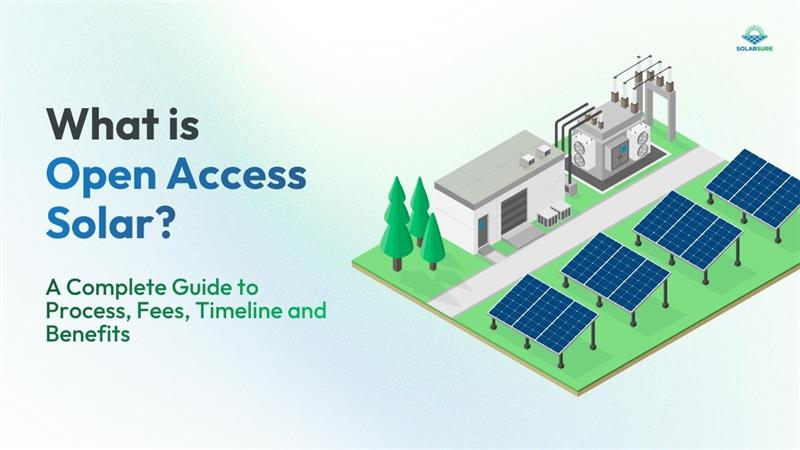
Open Access is a regulatory mechanism that allows eligible consumers to purchase electricity directly from power producers instead of relying completely on local distribution companies.
In a solar Open Access model, a developer installs a large solar plant at a separate location. The electricity generated at this plant is fed into the grid, while the consumer draws power from the grid at their own facility.
This process works through energy accounting rather than physical delivery. Electricity consumption and generation are matched using 15-minute interval data recorded by Special Energy Meters. This ensures that the energy supplied by the solar plant is adjusted against the consumer’s usage accurately.
Types of Open Access Based on Geography
When we talked about geography, the open access solar is classified based on whether the power is sourced from within the same state or from another state. This classification impacts regulations, charges, and project feasibility. So, there are two models works under open access solar based on geography, which are described below:
Intra-State Open Access
In this model, both the solar plant and the consumer are located within the same state. The State Electricity Regulatory Commission governs these projects. Intra-state Open Access is generally easier to implement for businesses. Under this model, the approval process is simpler, and the charges are more predictable.
Interstate Open Access
In this model, the solar plant is located in a different state, and Central authorities regulate these transactions. Interstate Open Access may offer better solar generation potential and competitive tariffs. However, it may involve additional transmission considerations and regulatory approvals.
Types of Open Access Based on Contract Duration
Open Access solar contracts are usually structured based on duration. The contract period directly affects pricing stability and flexibility for the consumer. There are mainly three types of open access solar based on contract duration.
Short-Term Open Access (STOA)
Short-term contracts are usually made for usually one month to three-month period. These are used when businesses need temporary power for peak demand or unexpected shortages. In some jurisdictions, the contract timeline is extended up to 1 year.
While STOA provides flexibility, it does not offer long-term cost savings. It is generally not suitable for businesses looking to reduce electricity costs permanently.
Medium-Term Open Access (MTOA)
The medium-term contracts are made for three months to a three-year period. They are helpful for businesses that need electricity for a specific period to speed up their operations without any disturbance.
This option offers a balance between flexibility and cost savings. Businesses can secure better tariffs than short-term contracts without committing to very long durations.
Long-Term Open Access (LTOA)
Long-term contracts look more like a permanent solution for any facility. These contracts are made for a period of three to ten years. This is helpful for businesses that require consistent and reliable power for a long period.
Long-term Open Access solar allows companies to lock in electricity tariffs for extended periods. This helps them to predict their future expenditures based on the agreed tariff. In case the tariff increases, the contract of open access remains the same without any additional tariff for businesses.
Who Can Apply for Open Access Solar?
Initially, open access solar is limited to consumers who require a large amount of electricity. It started with a purpose to fulfil the energy needs of the large consumers. Later, the policymakers made it available for all businesses.
The Green Energy Open Access Rules 2022 reduced the minimum eligibility requirement to 100 kW. This allows small and medium enterprises to participate in Open Access. Also, some states have further relaxed the criteria, which allows even smaller consumers to get the advantage of this policy.
Technical Requirements for Open Access Solar
There are some technical conditions or criteria that a business must meet before applying for open access solar. These requirements are helpful to ensure accurate energy tracking, the use of quality materials, and other relevant things that are required to monitor.
Advanced Metering
In an Open Access setup, electricity is not physically delivered from the solar plant to your facility. Instead, your usage is adjusted against the energy generated elsewhere.
This is only possible when your consumption is tracked very precisely. That is why Special Energy Meters (SEM) or smart meters are required.
Smart meters record accurate electricity usage, which is recorded at every 15-minute interval. This level of detail is important because solar generation changes throughout the day. Your consumption must be matched with generation in the same time blocks.
Minimum Consumption Requirement
When you sign an Open Access agreement, you commit to consuming a certain amount of electricity from the solar plant. This is known as your contracted demand.
To ensure that the system remains viable, you are required to consume a minimum percentage of this committed energy. In most cases, this is around at least 70% of your contracted demand.
This condition exists because the solar plant is designed based on your expected consumption. If your usage drops significantly, the generated energy may go unused or be sold at a lower value.
ALMM Compliance
The solar plant supplying your power must use modules approved under the government’s Approved List of Models and Manufacturers (ALMM). It is a mandatory criterion to follow when setting up a solar plant.
At first glance, this may seem like a policy requirement only for developers. However, it directly impacts you as a consumer.
The quality of solar modules determines how much electricity the plant will generate over time. Poor-quality modules can degrade faster and produce less power than expected. If the plant underperforms, your expected savings may be reduced.
So, ALMM compliance ensures that only tested and reliable modules are used. This protects your long-term energy generation and financial outcomes.
How to Choose the Right Business Model for Open Access Solar?
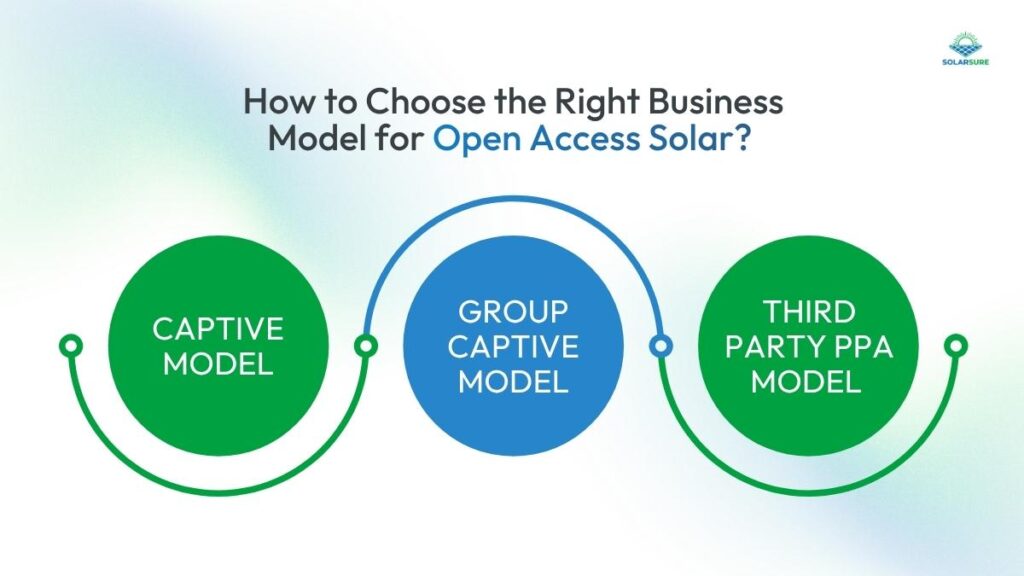
Selecting the right business model is one of the most important decisions in Open Access solar. It determines multiple factors, such as your investment, savings, operational involvement, etc.
Captive and Group Captive Model
In the captive and group captive model, the consumer owns a share in the solar plant. In general, the consumer must hold at least 26% equity of the solar plant and consume at least 51% of the generated power.
The biggest advantage of this model is the exemption from the Cross-Subsidy Surcharge. This significantly reduces the overall cost of electricity. However, this model requires capital investment and long-term commitment. It is best suited for companies that want maximum savings and are willing to invest in energy assets.
Third-Party PPA Model
In the Third-Party PPA model, the developer owns and operates the solar plant. The consumer signs a Power Purchase Agreement to buy electricity at a fixed rate.
There is no upfront investment required from the consumer. The developer takes care of installation, maintenance, efficiency, and operations.
This model is ideal for businesses that want cost savings without investment or operational complexity. It allows companies to adopt solar energy in a simple and hassle-free manner.
Open Access Solar Cost Breakdown and Key Charges You Should Know
When evaluating Open Access, businesses must consider the total landed cost instead of just the base solar tariff. The landed cost includes several regulatory charges that affect final savings.
Transmission and Wheeling Charges
These charges are paid for using the grid infrastructure to transport electricity from the solar plant to your facility. They vary depending on the state, distance, energy requirements, and project configuration.
Cross-Subsidy Surcharge (CSS)
This surcharge compensates DISCOMs for potential revenue loss when businesses procure power from third-party sources. In many cases, this charge is waived under captive models, which significantly improves cost savings for businesses.
Banking Charges
Banking charges apply when excess solar energy is injected into the grid and drawn later. The cost and conditions depend on state-specific policies and allowed banking periods.
SLDC Charges
State Load Dispatch Centre (SLDC) charges are administrative fees for grid coordination, scheduling, management, and monitoring. These ensure stability and efficient electricity distribution.
Even after including all these charges, Open Access solar typically offers 20 to 40% lower electricity costs compared to grid tariffs. Adopting solar is always a win-win situation for businesses required large amount of electricity.
How to Adopt Open Access Solar: Step-by-Step Implementation Process
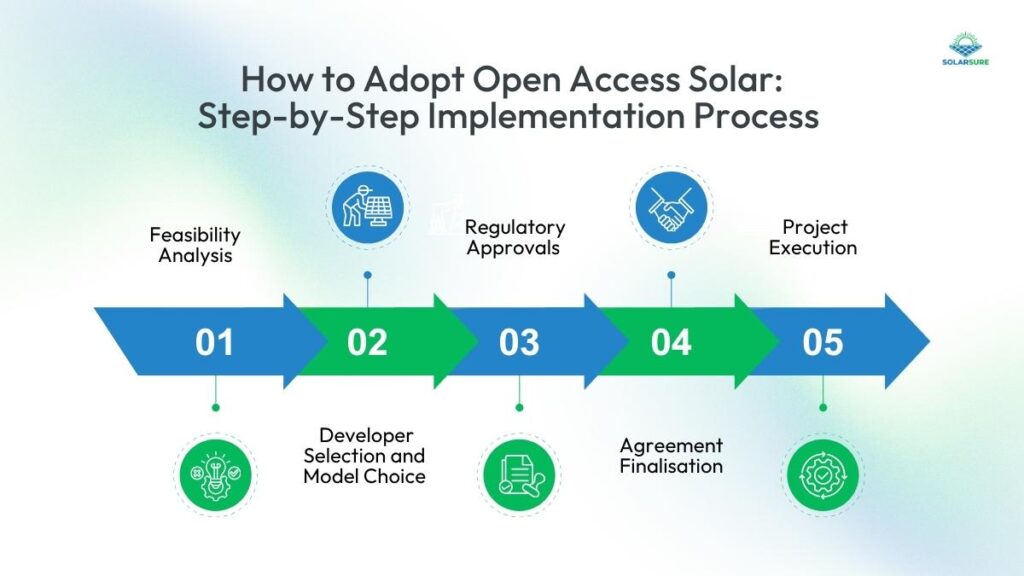
Implementing Open Access requires proper planning and execution. Each step plays a critical role in ensuring project success.
Step 1: Feasibility Analysis
The first step is to analyse your electricity consumption over the past 12 months. This helps determine whether your demand meets the eligibility criteria. It also helps in sizing the project correctly and estimating potential savings.
Step 2: Developer Selection and Model Choice
The next step is to select a reliable solar developer. At this stage, you also need to decide between captive and third-party models. This decision affects your investment, risk, and long-term financial returns.
Step 3: Regulatory Approvals
The developer applies for Open Access approval through the State Load Dispatch Centre. With the introduction of national portals, approvals are expected within defined timelines. However, timelines may vary depending on state regulations and local conditions.
Step 4: Agreement Finalisation
The power purchase agreement is signed only after obtaining all the required approvals. For captive projects, it is necessary to execute a shareholder agreement. These agreements define the terms of electricity supply, pricing, and responsibilities.
Step 5: Project Execution
A solar EPC company assist to smoothen your implementation process. After all the approvals, they ensure to construct the plant within the given timeline and connect it to the grid. They also help in commissioning, energy supply to the facility procedure, and billing adjustments.
Overall, a Solar EPC company handles all of your plant construction work. They are experts in establishing solar plants and also ensure consistent performance for the next 25 years. If you want to learn more about a solar EPC company, check out this blog: What is Solar EPC and How It Works: Explained Step-by-Step Process.
Timeline and Common Challenges of Open Access Solar
A typical Open Access project takes between three and nine months to become operational. The timeline depends on approvals, land availability, and grid connectivity.
However, businesses should be aware of potential challenges. Sometimes DISCOMs delay approvals because they lose high-paying consumers.
Policy changes are another factor that also impacts project economics. Sudden revisions in charges or regulations may affect long-term savings.
Grid infrastructure issues, such as outages or tripping, can also impact energy delivery. Choosing an experienced developer helps mitigate these risks.
Apart from the above challenges, there are multiple procedures that must be followed. You can check out the blog about the challenges businesses face in solar projects and get detailed information to resolve them.
Key Benefits of Adopting Open Access Solar
Lower Electricity Costs and Price Stability
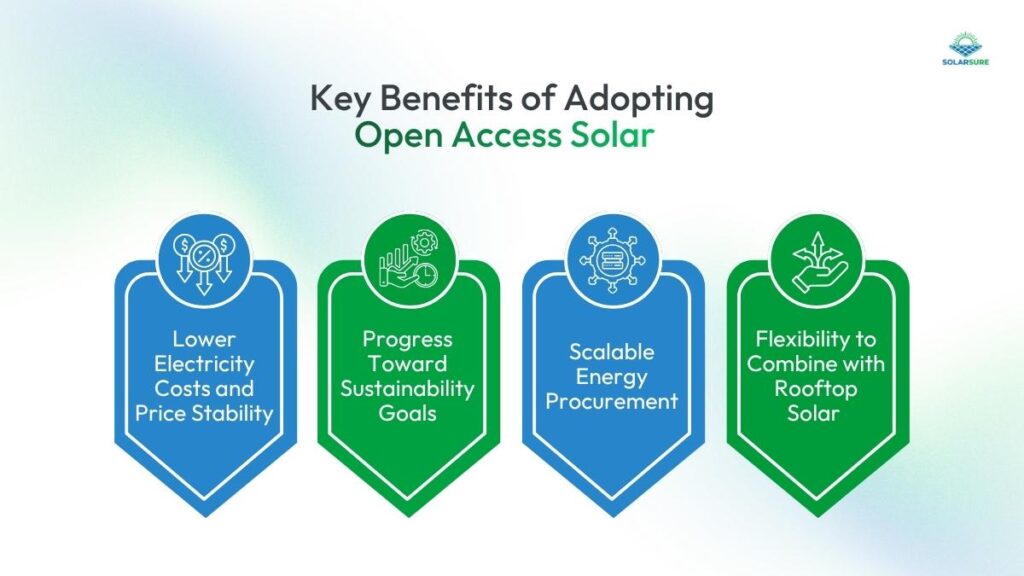
One of the most significant advantages is the reduction in electricity costs. Businesses can secure predictable tariffs and protect themselves from frequent grid price hikes. They can turn the cost into a strategic investment to enable better long-term financial planning.
Progress Toward Sustainability Goals
Big organisations must achieve the sustainable goals to fulfil their corporate social responsibilities. Open Access allows companies to actively reduce their carbon footprint. It supports ESG commitments and helps organisations transition toward cleaner energy without major infrastructure changes on-site.
Scalable Energy Procurement
The space available for businesses in rooftop solar is very limited, but open-access solar is not limited by space. Businesses can procure solar power based on their total energy consumption to make it suitable for large-scale operations.
Flexibility to Combine with Rooftop Solar
Businesses can integrate the Open Access solar with existing rooftop solar systems. This hybrid approach enables businesses to maximise renewable energy generation and usage while optimising overall energy costs and reliability.
Conclusion
Open Access Solar is changing how businesses approach energy procurement in India. It provides a scalable and cost-effective solution for companies with high electricity demand. For businesses looking to reduce costs and adopt clean energy, Open Access is the best available solution. So, if you still have any doubts or want to know more about open access, book a free consultation. Our experts will help you provide detailed information.