If you run a business in India and are considering solar, there is one important thing to understand first. Commercial solar does not receive government subsidies. Instead, they can get tax benefits on commercial solar.
Subsidies are meant for residential rooftop users. Businesses instead receive financial support in a different form. The government allows companies to recover a large portion of the solar investment through tax savings.
These savings come from two mechanisms:
- Accelerated Depreciation under the Income Tax Act
- GST Input Tax Credit under GST regulations
For many companies, these two mechanisms together reduce the effective project cost by about 25% to 35% and significantly shorten payback.
Key Tax Benefits on Commercial Solar in India
A residential household does not pay income tax on electricity consumption, so the government offers a direct subsidy.
Commercial solar is not structured as a subsidy program. It is structured as a tax-saving asset, which benefits businesses in the long term. In addition to tax advantages, companies can also significantly reduce operational expenses, as explained in Commercial Solar Savings: How Much Electricity Bill Can Businesses Save?
Commercial solar is not structured as a subsidy program. It is structured as a tax-saving asset that benefits businesses in the long term. Here are the tax benefits of commercial solar that businesses can get.
Benefit 1: Accelerated Depreciation(AD)
What Depreciation Means
When a business purchases a machine, vehicle, or piece of equipment, accounting assumes the asset loses value each year. That reduction in value is called depreciation, and it is allowed as a tax deduction. A solar plant is also treated as a business asset.
Under Section 32 of the Income Tax Act, solar systems qualify for accelerated depreciation, meaning the business can claim a large deduction early instead of spreading it slowly over many years.
Applicable Depreciation Rates for Commercial Solar
- Standard first-year depreciation: 40%
- Additional depreciation for manufacturers or power generators: 20%
- Possible total first year deduction: up to 60%
Understand the 180 Day Rule
To claim the full first-year benefit, the plant must operate for more than 180 days in that financial year. If commissioned late in the year, only half of the depreciation is allowed in the first year, with the remaining benefit carried over to the next year.
How Accelerated Depreciation Saves Tax: Understand with A Simple Example
Consider this with a typical example. Suppose your:
Solar system size: 100 kW
Project cost: ₹50 lakh
After removing GST, the depreciable asset value becomes roughly ₹44.64 lakh. So, assume the company has:
- Annual turnover: ₹8 crore
- Net profit margin: 10%
- Net profit: ₹80 lakh
- Corporate tax rate: 30%
Without Solar Tax Calculation
Taxable income = ₹80 lakh
Tax payable = ₹24 lakh(30% of ₹80 lakh)
With Solar Tax Calculation (Year 1)
Depreciation = 40% of ₹44.64 lakh ≈ ₹17.86 lakh
New taxable income: ₹80 lakh − ₹17.86 lakh = ₹62.14 lakh
Tax payable ≈ ₹18.64 lakh (30% of ₹62.14 lakh)
Year 1 tax saving = ₹5.36 lakh
Year 2
Remaining asset value = ₹26.78 lakh
40% depreciation = ₹10.71 lakh
Additional tax saving = ₹3.2 lakh (₹10,71,360 × 30%)
Over multiple years, total depreciation-related savings in this example exceed ₹13 lakh.
The business did not receive money from the government. It simply paid significantly less tax.
Benefit 2: GST Input Tax Credit (ITC)
GST-registered businesses can claim 100% Input Tax Credit on the GST paid for solar installations used for commercial or industrial purposes.
What Does GST Input Tax Credit Mean?
If your company is GST registered, the GST paid on the solar installation is not treated as an expense.
You can claim 100% Input Tax Credit and adjust it against the GST you already pay on your products or services.
Example:
Project cost: ₹50 lakh
GST at 5%: ₹2.5 lakh
That ₹2.5 lakh can be offset against your output GST liability. The effective cost of the solar plant becomes only the base price.
In simple terms, businesses do not actually bear GST on a solar project.
Combined Benefit of Solar for Businesses
For a ₹50 lakh, 100 kW commercial solar installation:
| Benefit | Approximate Value |
| GST Input Tax Credit | ₹5.57 lakh (at 12%) or lower at 5% |
| Tax savings via Accelerated Depreciation (10 years) | ₹13+ lakh |
| Total Tax Benefit | ₹18–19 lakh |
For context, a residential user installing the same 100 kW system would receive a subsidy of roughly ₹9,000/kW, totalling approximately ₹9 lakh. The commercial tax route delivers roughly double the benefit.
Additional Incentives Worth Knowing for Businesses
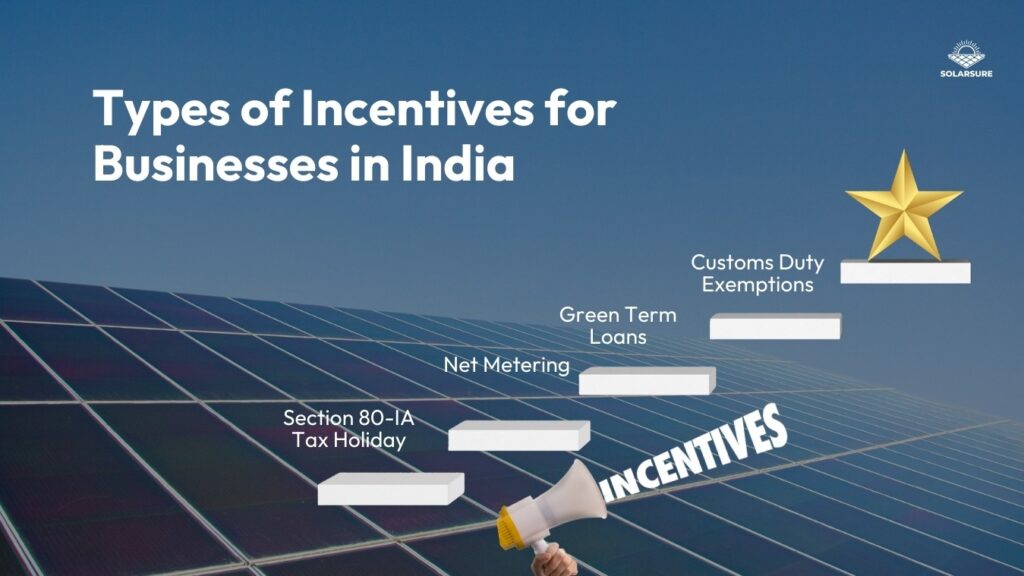
Apart from the primary tax advantages, a commercial solar installation also fits into several other policy benefits that further improve project economics.
Section 80-IA Tax Holiday
If the solar plant is treated as a power generation asset in the company’s books, the profit attributed to the electricity produced can qualify for a tax holiday. Businesses can claim 100% exemption on this power generation income for any 10 consecutive years within the first 15 years of operation.
This does not apply to the entire company’s profit. It applies only to the value of electricity generated, consumed or supplied. In accounting terms, the company recognises the electricity produced as an internal revenue equivalent to the grid tariff it would otherwise pay.
Net Metering
Solar systems generate maximum electricity during daytime working hours. On some days, production exceeds real-time consumption.
Under net metering arrangements, this excess electricity is exported to the local distribution grid. The utility records these exported units and adjusts them against units consumed later, usually during evenings, night shifts, weekends, or lower generation months.
Instead of wasting surplus generation, the business effectively uses the grid as a temporary storage system. This directly reduces the monthly electricity bill and improves the utilisation of the plant capacity.
Green Term Loans
Many banks and financial institutions now classify solar projects as priority or sustainable lending. Because of this, they offer dedicated renewable energy loans at relatively lower interest rates and longer repayment tenures.
In several cases, the monthly loan instalment closely matches the electricity expense being replaced. This allows a company to install solar without significant upfront capital outflow, while still benefiting from reduced operating costs from the beginning of the project.
Customs Duty Exemptions
Government policy also encourages domestic renewable energy deployment through duty structures on specific capital equipment used in solar manufacturing and battery storage. For businesses investing in advanced systems or storage-integrated projects, certain components may qualify for duty-related reliefs.
While this benefit is indirect and depends on project configuration, it can reduce procurement costs in specialised installations and improve long-term project viability.
The Bottom Line
For most companies, power cost keeps increasing but offers no long-term return. A rooftop plant changes that equation. A part of the amount that would have gone into monthly bills begins to build an asset that works for the business every day.
In the early years, statutory deductions and tax adjustments ease the financial burden of the investment, while the purchase of grid power immediately reduces it. Because both effects happen together, recovery typically takes only a few years. After that, the system continues to support operations for decades with limited upkeep.
If you want to review what this would look like for your facility and consumption pattern, you can schedule a free consultation.