If you have been following the news lately, you have probably come across the term “carbon credits” more than once. World leaders talk about them at climate summits. Big companies announce that they are buying them. Environmental groups debate whether they work.
But what exactly is a carbon credit, and why has it become such a central part of the conversation around climate change?
Carbon credits are often explained using complicated environmental terms. In reality, the idea is simple. A carbon credit is proof that pollution has been reduced somewhere. That proof can be sold to a company that still produces emissions. This system allows industries to continue operating while encouraging investment in clean energy.
This guide explains carbon credits in detail. It answers common questions that business owners, decision makers, and property owners usually have. It also explains why solar power is directly connected to carbon credit income.
What are Carbon Credits?
A carbon credit is a permit that represents one metric ton of carbon dioxide, or an equivalent amount of another greenhouse gas that has either been removed from the atmosphere or prevented from entering it in the first place.
Carbon dioxide is released when coal, diesel, petrol, or natural gas is burned to produce energy. Power plants, factories, transportation systems, and heavy industries all release this gas. Scientists have confirmed that high levels of carbon dioxide trap heat in the atmosphere and increase global temperature.
Governments and international climate agreements want total emissions to decrease. But they also understand that industries cannot stop immediately. So a balancing system was created.
If one project reduces pollution, another company can support that reduction financially. The company that reduces pollution can earn carbon credits. The company that still produces emissions purchases those credits and shows it has compensated for part of its environmental impact.
Where Did the Idea of Carbon Credits Come From?
The concept grew out of a broader system called cap & trade, which was developed in the late 20th century as a market-based solution to pollution. The basic idea is that governments or international bodies set a limit, or a cap, on how much pollution industries are allowed to produce.
Companies that pollute less than their allowed amount have leftover allowances, which they can sell to companies that are struggling to stay under their limit. This creates a financial reward for reducing pollution and a financial penalty for producing too much of it.
An international agreement, the Kyoto Protocol, signed in 1997, was one of the first major efforts to apply this thinking to greenhouse gases on a global scale. It was created as the Clean Development Mechanism, which allowed wealthy countries to fund emission-reducing projects in developing countries and receive carbon credits in return. This was the beginning of what we now call the carbon credit market.
What is Carbon Offsetting and Why Do We Need Carbon Credits?
Many industries do not have an immediate alternative to fossil fuels. A steel plant requires extremely high heat. A cement plant depends on chemical processes that release carbon dioxide. Airlines cannot operate without fuel.
Instead of shutting these sectors, the world created a flexible system. Companies that reduce emissions are rewarded. Companies that cannot reduce their emissions immediately can offset their emissions by funding clean projects.
This concept is known as carbon offsetting. It ensures that overall global emissions go down even if individual industries reduce emissions at different speeds.
Carbon credits serve two purposes. They encourage investment in clean energy, and they help companies meet environmental commitments.
How Do Carbon Credits Work?
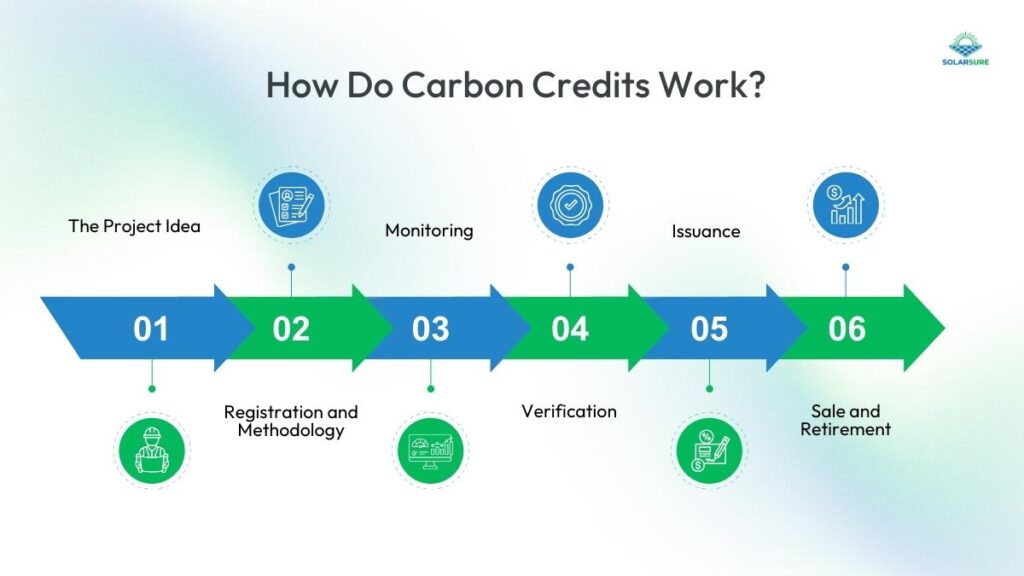
The process starts with a project, or we can say a solar project, that either reduces emissions or removes carbon from the atmosphere. Here are the steps that help you understand how it works:
Step 1: The Project Idea
This could be something as straightforward as installing solar panels in a region that otherwise relies heavily on coal-powered electricity. The goal is to produce clean energy and avoid the carbon dioxide that would have been released by burning fossil fuels. That avoided pollution is what eventually becomes a carbon credit.
Step 2: Registration and Methodology
Once the idea is in place, the project goes through a formal registration process. The project owner chooses an approved methodology from a recognised certification body like Verra or the Gold Standard.
These methodologies are essentially rulebooks that explain exactly how emission reductions should be calculated, tracked, and proven. Using an approved methodology is not optional. It is the foundation that makes the whole process credible.
Step 3: Monitoring
After registration, the project moves into the monitoring phase. This includes monitoring the data collected on an ongoing basis.
For a solar energy project, that means tracking exactly how much electricity is being generated using meters and sensors. For a forest project, it means regularly measuring how much carbon the trees are storing.
The monitoring phase can last for years, and the data collected during this time is what gets reviewed in the next step.
Step 4: Verification
Verification is the part of the process that provides outside accountability. An independent auditing organisation, one that has no financial stake in the project, comes in and checks all the data.
They review the plant details and generation records, and mainly check three things.
First is additionality. The project should depend on carbon credit support and should not be something that would have happened anyway. Second is permanence. The emission reduction must continue for many years. A project that stops working soon cannot claim long term climate benefit. Third is leakage. The project should actually reduce total emissions and not just shift the pollution to another place. Only after this review is completed are carbon credits officially approved.
Step 5: Issuance
Once the auditors are satisfied, credits are officially issued. Each credit represents exactly one metric ton of CO2 equivalent, written as tCO2e. This standardised unit makes it possible to compare very different types of projects on the same scale. The issued credits are then recorded on a public registry to make sure the same credit cannot be sold to two different buyers.
Step 6: Sale and Retirement
The final step is the sale and retirement of the credit. A company purchases the credit and then formally retires it, which means removing it from circulation permanently.
Once a credit is retired, it cannot be resold or reused. The retirement allows the buyer to legitimately claim that they have offset that particular ton of emissions. Without this step, the whole system would break down quickly.
What Kinds of Projects Generate Carbon Credits?
The variety of projects that can generate carbon credits is quite wide. Some of the most common types include renewable energy projects, where the credits come from building solar installations, wind farms, or thermal power plants, and hydroelectric plants that replace power generation from fossil fuels. The difference in emissions between the clean energy produced and what a coal or gas plant would have produced earns the credits.
Forest conservation and reforestation projects are among the most talked-about sources of credits. This includes protecting existing forests from being cut down, which is called REDD+, as well as planting new forests.
Since trees absorb carbon as they grow, both approaches can generate meaningful amounts of credits, though forest projects come with their own set of challenges around permanence and leakage.
Methane capture projects are another important category. Methane is a greenhouse gas that is many times more potent than carbon dioxide in terms of its warming effect, and it is released from sources like landfills, coal mines, and livestock farms. Capturing that methane before it escapes into the atmosphere and often converting it into energy in the process can generate significant carbon credits.
More recently, a category called carbon removal has been growing in importance. This includes direct air capture technology, where machines literally pull carbon dioxide out of the air and store it underground. These projects tend to be more expensive to run, so the credits they generate cost more, but they are seen as high-quality because the removal is direct and measurable.
How Solar Power Generates Carbon Credits?
Solar energy is one of the most common ways businesses earn carbon credits. The reason is simple. Solar panels generate electricity using sunlight, and sunlight does not create pollution.
In India, a large share of grid electricity still comes from thermal power plants that burn coal. When a commercial or industrial building installs a solar power system, it reduces demand from those plants.
| Dr Sayuri Shirai (Advisor, ADBI & Professor, Keio University) argues that because the atmosphere is a “global commons,” the location of emission reductions is less important than the credibility of the project itself. She projects the voluntary carbon market (VCM) could grow from under USD 5 billion in 2024 to USD 24 billion by 2030, driven by corporate net-zero commitments and international aviation frameworks like CORSIA. |
Even though the factory is not directly burning coal, its decision prevents coal from being burned somewhere else in the electricity network. That avoided burning prevents carbon dioxide from entering the atmosphere.
Because the reduction can be calculated accurately, solar projects qualify for carbon credits after verification.
How to Calculate Carbon Credit: Step-by-Step Explanation
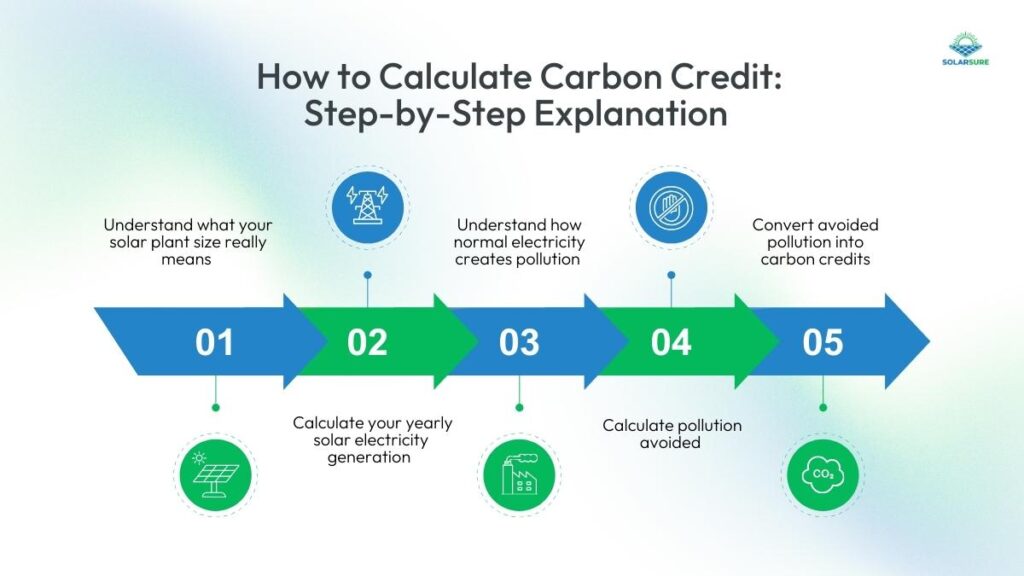
Many business owners hear that a solar plant can also generate carbon credits, but the concept feels unclear because nobody explains the numbers properly. You actually can estimate it yourself. The calculation is logical and based only on electricity generation and avoided pollution.
Below is a practical method you can understand and even apply to your own factory, warehouse, hospital, or commercial building.
Step 1: Understand what your solar plant size really means
If your system size is 100 kilowatt, it does not produce 100 units all the time. Solar panels only produce full power during strong sunlight hours. Morning, evening, and cloudy days produce less electricity. So instead of hourly output, we calculate yearly electricity production.
In India, on average, 1 kilowatt solar system produces about 1,500 to 1,700 units per year. To keep the calculation simple, use 1,600 units.
Step 2. Calculate your yearly solar electricity generation
Now multiply your plant size by yearly production. Example for a 100-kilowatt plant:
100 × 1,600 units = 160,000 units per year
This means your solar plant generates about 1.6 lakh units of electricity annually. This number is important because carbon credits depend completely on how many units of electricity your solar system produces.
Step 3. Understand how normal electricity creates pollution
Grid electricity in India mostly comes from coal power plants. When coal burns, carbon dioxide gas is released into the atmosphere. Energy studies show that 1 unit of coal electricity releases about 0.9 kilograms of carbon dioxide
So every solar unit you generate prevents that much pollution because the coal plant does not need to produce that electricity.
Step 4: Calculate pollution avoided
Now multiply your yearly solar units by emissions per unit.
160,000 units × 0.9 kg = 144,000 kg carbon dioxide avoided
Convert kilograms to tons because carbon credits are issued in tons.
144,000 ÷ 1,000 = 144 tons of carbon dioxide avoided every year.
Step 5: Convert avoided pollution into carbon credits
The rule is direct. 1 ton of carbon dioxide avoided equals 1 carbon credit. So,
144 tons avoided = 144 carbon credits per year.
That is the approximate carbon credit generation for a verified 100-kilowatt solar plant. You can use this process to calculate how many carbon credits you can earn using your plant.
Who Buys Carbon Credits and Why?
Anyone who wants or needs to reduce their carbon footprint can buy carbon credits. In general, the buyers who want to buy carbon credits mainly fall into two main groups.
The first group consists of companies that are legally required to keep their emissions below a certain level. In many countries and regions, governments have set up mandatory carbon markets where heavy industries like power plants, steel manufacturers, and airlines must either cut their emissions or purchase credits to cover the excess. The European Union Emissions Trading System is one of the largest examples of this kind of mandatory market.
The second group consists of businesses and organisations that voluntarily choose to offset their emissions, even when they are not legally required to do so. This often happens because companies want to meet sustainability goals they have set for themselves, respond to pressure from customers and investors who care about climate issues, or work toward becoming carbon neutral, which means their net contribution of carbon to the atmosphere is zero.
Can Individuals Buy Carbon Credits Too?
Yes, individuals can participate in carbon markets, though it looks a bit different from what corporations do. Many organisations offer personal carbon offsetting programs where you can calculate your own carbon footprint, from flying and driving to home energy use, and then purchase offsets to compensate for it.
| Did You Know
Some airlines, such as American Airlines, Delta Air Lines, United Airlines, Southwest Airlines, British Airways, Air France, Lufthansa, and easyJetnow, offer passengers the option to add an offset to their ticket purchase. |
If you are thinking about purchasing personal carbon offsets, it is worth doing a bit of research to make sure you are buying from reputable providers whose projects are independently verified. Look for projects certified under established standards and be cautious of anything that seems too cheap or too good to be true. As with everything in this space, quality varies widely.
Can Carbon Credit Benefit Small and Medium-Sized Businesses?
Carbon credits are not limited to very large corporations. Many medium-sized businesses qualify to earn carbon credits.
Factories, cold storage facilities, hospitals, educational campuses, hotels, warehouses, and commercial complexes often install solar systems of sufficient size or more than their required size. When proper documentation and metering are maintained, these projects can be registered under carbon credit certification programs.
For many medium-sized businesses, this becomes an additional income source along with electricity savings.
Why Businesses are Preferring Carbon Neutral: What it is and How it Works?
You have probably seen companies advertise that they are carbon neutral or that a certain product is carbon neutral. What this usually means is that the company has calculated how much carbon dioxide it produces through its operations, from running its offices and factories to shipping its products, and has purchased enough carbon credits to theoretically cancel out that amount.
The idea is that even if a company cannot eliminate all of its emissions immediately, it can fund projects elsewhere that compensate for what it does emit. Critics point out that this does not actually remove the pollution from the air, it just funds reductions elsewhere. Supporters argue it is a practical bridge that funds important climate work while companies work on reducing their own emissions over time.
How Businesses Earn Money From Carbon Credits?
Carbon credits are traded in voluntary international markets. The price varies depending on demand, project type, and certification quality.
A solar plant that generates more than one hundred credits per year can earn a noticeable yearly payment. This income comes in addition to reduced electricity bills. It is also separate from the tax benefits available for solar investments.
This means a solar project provides three financial advantages. It reduces power expenses, improves tax efficiency, and creates carbon credit revenue.
What is Required for Registration to Claim Carbon Credits?
To claim carbon credits, accurate data is essential. The solar system must have proper energy meters that record generation regularly. The project details are submitted to a recognised carbon certification body.
Environmental specialists calculate emission reductions using approved scientific methods. Independent auditors verify the data. After approval, the credits are issued and recorded in an international registry.
Most businesses work with solar energy providers or carbon consultants who manage the documentation, verification, and sale of credits.
Are All Carbon Credits Considered Equal?
This is one of the most important questions in the entire carbon credit conversation, and the honest answer is no, they are not all equal.
The quality of a carbon credit depends heavily on the project behind it and the standards used to verify it. A high-quality carbon credit comes from a project where the emission reductions are noticeable, meaning they actually happened and can be measured accurately.
They should also be additional, meaning they would not have occurred without the carbon credit financing. They need to be permanent, especially important for projects like forests that could theoretically burn down or be cut down in the future. And they should not lead to leakage, which is when protecting one area of forest just shifts logging activity to another area nearby.
Several well-known standards and organisations certify carbon credits, such as the Gold Standard, Verra’s Verified Carbon Standard, and the American Carbon Registry. Each has its own rules about what projects qualify and how reductions should be measured. Projects certified under these standards are generally considered more trustworthy than uncertified ones.
Why Carbon Credits are Becoming Important for Businesses?
Environmental regulations are becoming stricter across the world. Export-oriented industries, especially those supplying international markets, must now report emissions linked to their products.
Companies with lower emissions will face fewer trade barriers and may gain a competitive advantage. Investors and lenders are also evaluating environmental performance before funding projects.
Because of this, solar power is no longer only a way to reduce electricity bills. It is becoming part of business strategy and compliance planning.
Bottom Line
Carbon credits convert environmental improvement into measurable financial value. When a business installs solar power, it reduces dependence on coal based electricity. This reduces emissions and creates verified environmental benefits.
That benefit can be recorded, certified, and sold to organisations that need to offset emissions. As a result, the business not only saves money on electricity but also creates an additional income stream. So, if you want to know more about carbon credits or earn these credits, book a free consultation with us.