How Solar EPC Works: India’s renewable energy landscape is undergoing a massive transformation. As the country races toward its ambitious target of 500 GW of non-fossil fuel capacity by 2030, solar power has emerged as the cornerstone of this energy revolution. But behind every successful solar power plant, whether it’s a sprawling utility-scale plant in Rajasthan or a rooftop installation on a large commercial building in Mumbai, stands a critical player that most people never hear about, the Solar EPC company.
In this blog, we will discuss more about solar EPC and how they work to build efficient and reliable solar plants. So, let’s dive in.
What is Solar EPC?
Solar EPC stands for Engineering, Procurement, and Construction.
In simple terms, a solar EPC company takes full responsibility for designing, supplying, building, and commissioning a solar power project. The project owner or investor does not need to coordinate with multiple vendors because the EPC contractor manages the entire process from start to finish.
The scope of Solar EPC includes:
- Detailed engineering and system design
- Procurement of high-quality modules, inverters, cables, and other essential parts of plant equipment
- On-site construction and installation
- Testing, commissioning, and grid synchronisation
- Performance warranties and, in many cases, ongoing O&M support
EPC contractors are responsible for delivering the full plant to the asset owner, often including performance warranties that last for several years after the project goes live. The role of EPC becomes significant for project developers and investors. Their single-point responsibility significantly reduces execution risk and improves project bankability.
Why Do People Need A Solar EPC Company?
Solar EPC company is a team of experts who know how to build a solar plant that works effectively for the next 25-30 years. People want them because accountability remains with one party. If the plant does not perform as per expectations, the EPC contractor is responsible for correcting the issue. Most EPC contracts also include performance guarantees, ensuring that the plant generates the expected amount of electricity for several years after commissioning.
Why Solar EPC is Important in India’s Renewable Push
India’s solar projects are exposed to challenges that are very specific to the country. Land acquisition issues, uneven terrain, extreme temperatures, dust, monsoons, and grid limitations all directly affect plant performance. Solar EPC companies design projects while keeping these local realities in mind.
As of early 2026, the solar industry is moving beyond basic installation and focusing more on grid stability and predictability. Recently, the memorandum signed between NISE and GRID-INDIA in February 2026 to improve solar forecasting shows how EPC execution is now linked to advanced planning and grid management. Accurate forecasting helps EPC teams design better evacuation systems and reduce power curtailment.
How Solar EPC Works: Complete Step-by-Step Process
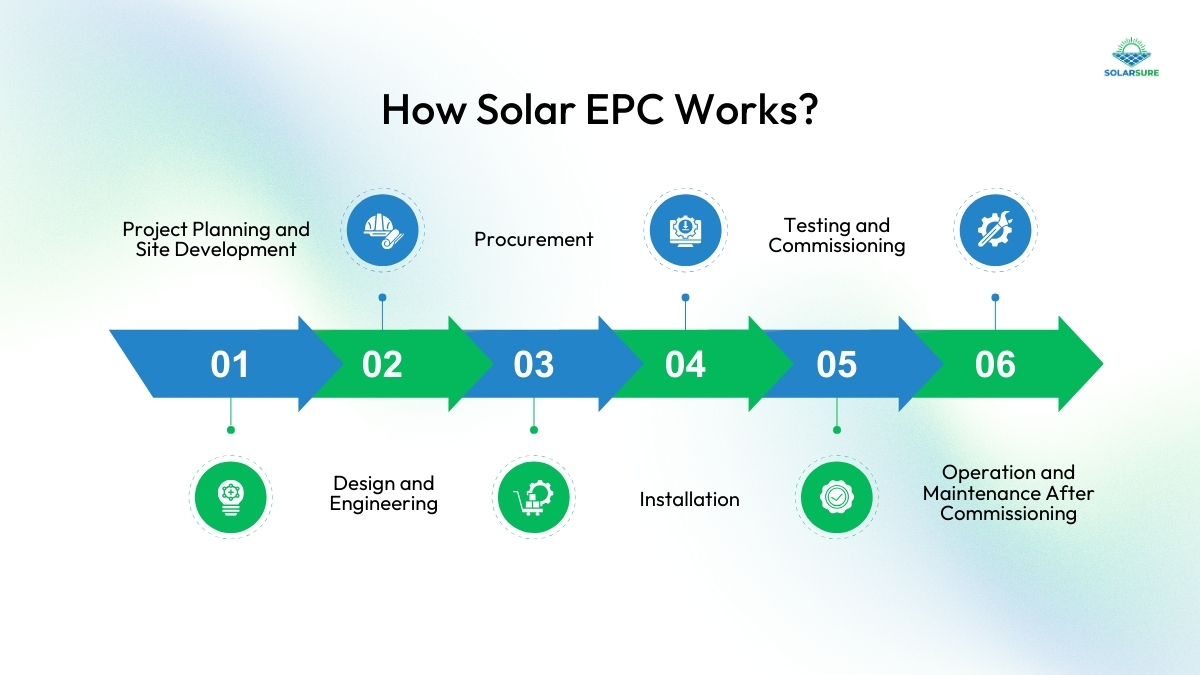
A solar EPC project follows a logical flow where each stage prepares the ground for the next. Skipping or rushing any step usually leads to performance loss or financial risk later.
The workflow of a solar EPC project is a multifaceted process that ensures a plant operates at peak efficiency for its expected 25-30 year lifespan.
Project Planning and Site Development
The EPC process starts well before construction with detailed project planning and site assessment. The first step is a comprehensive land survey to evaluate slope, contours, boundaries, and documentation to make sure the site is technically and legally suitable for a solar plant. Even minor inaccuracies at this stage can lead to layout errors, reduced capacity, ineffective plant, and long-term generation losses.
After a site survey, the solar EPC company perform solar irradiance and shadow analysis to assess how much sunlight the site receives and how shadows move across the land throughout the year. These studies help determine optimal panel orientation, tilt angles such as fixed or seasonal, shadow movement, and row spacing to maximise energy generation and avoid shadow-related losses.
In India, this is a high-stakes phase because land acquisition remains the single largest hurdle, with land disputes and bureaucratic delays causing 30–40% of all project setbacks.
EPC teams usually require around 3-3.5 acres of land per megawatt for utility-scale projects to maintain proper row spacing, avoid shading, ensure water availability for module cleaning, distance to grid substations, and allow movement for maintenance vehicles.
Design and Engineering
Once the site is finalised, detailed engineering works begin. This stage defines how efficiently the plant will operate for the next 25 to 30 years.
Electrical engineers decide the types of modules, how many modules will be connected in each string, how many strings will feed into an inverter, and how power will be evacuated to the grid. It is a very crucial part of the plant because poor design at this stage can lead to high losses, frequent inverter trips, overheating of cables, and overall inefficiency.
Structural and civil engineers design foundations based on soil conditions and wind load. In regions with high wind speeds or loose soil, deeper pile foundations or heavier structures are required. India’s diverse geography makes this step extremely important.
Technology selection also happens during engineering. The industry is currently shifting toward N-type TOPCon modules because they offer higher efficiency and lower long-term degradation. In large projects, EPC companies are also using bifacial modules with single-axis trackers, which allow the panels to follow the sun and capture reflected light from the ground, which results in significantly higher energy output.
Procurement
This stage involves the acquisition of all critical equipment required for the project, including PV modules, inverters, transformers, cables, mounting structures, and other balance-of-plant components.
Beyond sourcing, the EPC contractor is also responsible to make sure the quality and reliability of all procured materials. This includes vendor evaluation, technical compliance checks, factory inspections (where required), and verification against approved specifications.
Maintaining quality at the procurement stage is essential to ensure long-term plant efficiency, reduce failure risks, increase the plant’s lifespan, and safeguard warranties and insurance coverage.
Emkay Research emphasised the importance of self-reliance, noting that for leaders in the field, the “integration of cell and wafer-ingots… should support first movers… driving their competitiveness” by insulating them from global supply shocks.
Construction and Installation on Site
The construction process starts with site levelling, then internal roads are built to allow the movement of material and machinery. Later, mounting structures will be installed with precise alignment to ensure correct tilt and orientation.
After fixing the structure, the next step is to mount the solar modules and lay DC cables. Inverters and transformers are installed at designated locations, followed by AC cabling up to the pooling substation.
In India, EPC must also manage extreme weather conditions, such as heatwaves and monsoons, which can slow construction. Similarly, it applies to other geographies to make sure the plant stands strong in adverse situations.
Testing and Commissioning
Once installation is complete, the plant is not immediately switched on. Each electrical system is tested to double-check that it meets safety and performance standards. A reputable Solar EPC conducts string-level testing to detect faults and test the inverters under different load conditions.
Grid synchronisation is carried out only after receiving approvals from the relevant authorities and the local utility. Typically, the required permissions and clearances include:
- Electrical Inspector approval
- Fire Safety clearance (where applicable)
- DISCOM grid connectivity approval
- CEIG / Chief Electrical Inspector clearance (for high-capacity plants)
- Statutory safety and commissioning approvals as per state regulations
After all approvals are obtained, the DISCOM issues and installs the required energy meters. Only then is the plant synchronised with the grid and declared commercially operational.
Operation and Maintenance After Commissioning
A solar plant’s actual test begins after commissioning. Over 25 to 30 years, dust accumulation, equipment ageing, and grid fluctuations can reduce output if not managed properly.
Modern EPC companies either provide O&M services themselves. Performance monitoring through SCADA systems allows operators to detect faults early.
Conclusion:How Solar EPC Works
Solar EPC market is at a turning point, with massive potential in utility-scale, rooftop, agricultural lands, and floating solar technologies. Despite challenges like supply chain risks and skilled labour shortages, the industry remains a “growing sector” in India’s energy transition. Success for EPC professionals now depends on supply chain management, effective technology optimisation, and financial innovation.
If you have any queries or want to adopt solar for your facilities, book a free consultation with us.